← Year 7 Space

Year 7 Space: recap

For after the lessons: one card per lesson, to check what you remember. Answer each question in your head or on paper first, then check it. Nothing here is marked.

Looking back over the whole year? See the Year 7 recap.

Classifying shapes

1. Classifying triangles

Try firstA triangle has angles 30°, 30° and 120°. Name it by its sides and its angles.

Check your answer

Isosceles (two equal angles, so two equal sides) and obtuse (120°).

Name a triangle by its sides: scalene (none equal), isosceles (two equal), equilateral (all three equal). And by its biggest angle: acute (all under 90°), right-angled (one is 90°), obtuse (one over 90°).

Equal sides sit opposite equal angles. So an equilateral triangle has three 60° angles, and can never be right-angled or obtuse.
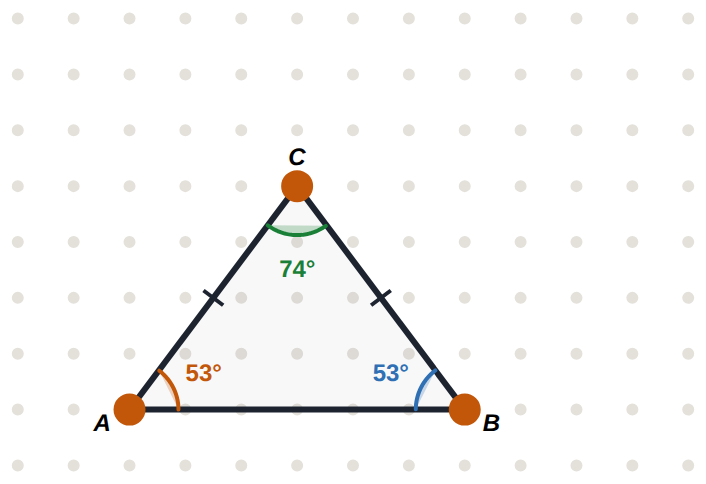
Two sides are marked with a tick: they are equal, so the triangle is isosceles. Every angle is less than 90°, so it is also acute.
Two names for a triangle · Sound on for the voiceover
Open the lesson →

2. The quadrilateral family

Try firstA shape has two pairs of parallel sides and four equal sides but no right angles. Give all its names.

Check your answer

Rhombus, parallelogram and kite.

A quadrilateral's name comes from its properties: a trapezium has at least one pair of parallel sides; a parallelogram two; a rhombus four equal sides; a rectangle four right angles; a square four equal sides and four right angles; a kite two pairs of equal sides next to each other.

A shape with all of another name's properties belongs to that family too: every square is a rectangle and a rhombus, every rhombus and rectangle is a parallelogram, and every parallelogram is a trapezium.

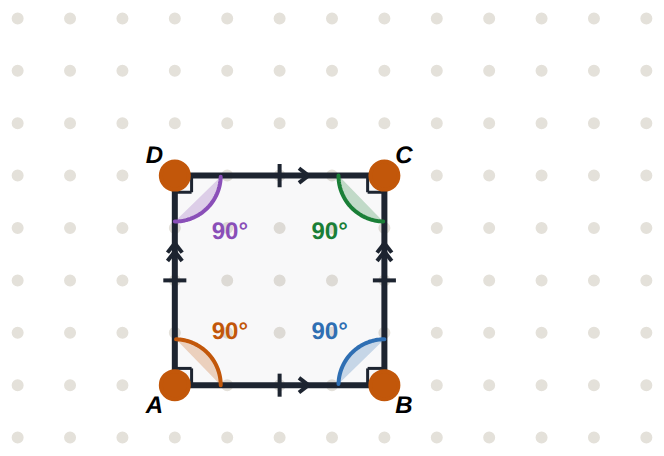
A square: four equal sides (ticks), two pairs of parallel sides (arrows) and four right angles. So it is also a rectangle, a rhombus, a parallelogram, a trapezium and a kite.
Named by properties · Sound on for the voiceover
Open the lesson →

3. Polygons

Try firstA pentagon has angles 100°, 110°, 110°, 100° and 120°. Is it regular? Convex or concave?

Check your answer

Irregular (its angles are not equal), convex (every angle under 180°).

A polygon is named by its number of sides: pentagon 5, hexagon 6, heptagon 7, octagon 8, nonagon 9, decagon 10.

It is regular when all its sides and all its angles are equal (a rhombus has equal sides but is not regular). It is concave when a corner points in (an angle over 180°), and convex when every corner points out.

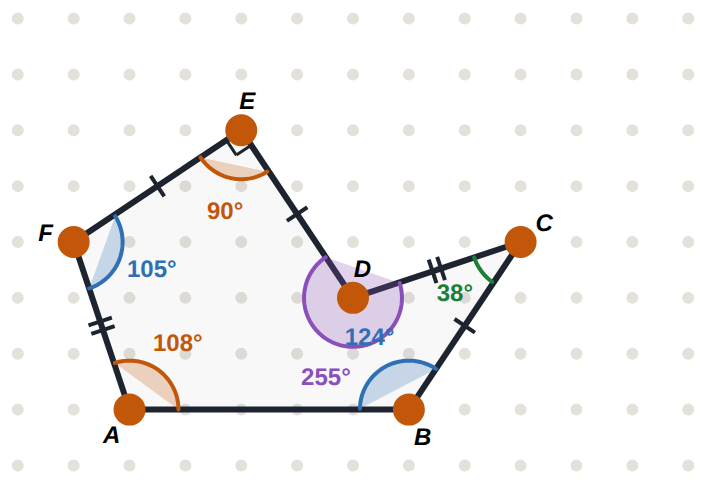
A hexagon with one corner pointing in: concave. Its sides are not all equal, so it is irregular too.
Regular, or not · Sound on for the voiceover
Open the lesson →

Solids

4. Nets

Try firstA net of six squares has four in a row, one above and one below. Does it fold into a cube? How can you tell?

Check your answer

Yes. The row of four wraps round the sides, and the extra two squares are the top and the bottom, so every face is covered once.

A net is a solid unfolded flat. A cube's net is six squares that fold to cover all six faces once; six squares alone is not enough, so test by folding.

A triangular prism's net is two triangles (the ends) and three rectangles (one for each side of the triangle). Its area is the surface area.

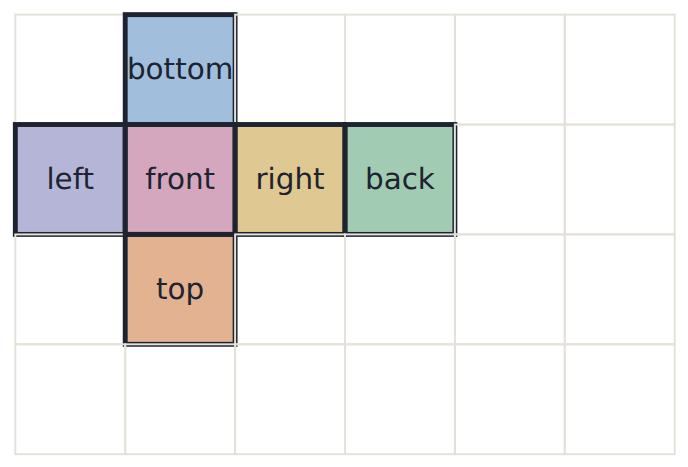
A cross of six squares folds into a cube: each square lands on a different face.
From a row to a net · Sound on for the voiceover
Open the lesson →

5. Views of a solid

Try firstA front view shows 3 squares. Does the pile have 3 cubes? Why or why not?

Check your answer

Not necessarily. The front view shows only the tallest pile in each column; there could be more cubes behind.

A view is what you see from one side. The top view (plan) looks down; the front and side views (elevations) look across. They show the tallest pile in each column, and hide cubes behind or beneath.

A top view with a number on each pile shows every cube. A net shows every face at its true size, but not what the solid looks like when built.

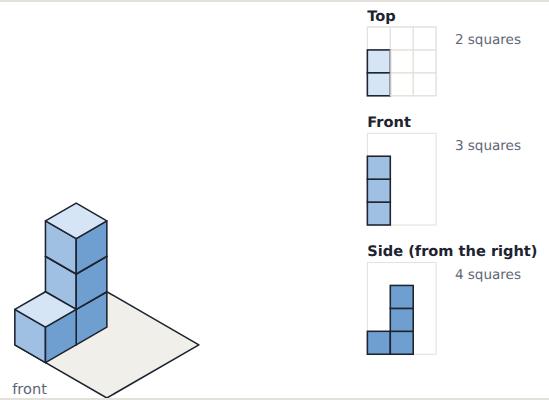
Three drawings of the same cubes: top, front and side. The tall pile hides the one behind it.
Build, then look · Sound on for the voiceover
Open the lesson →

Transformations

6. Translations

Try firstA (2, 5) is translated 4 left and 3 down. Where is A′?

Check your answer

(−2, 2): x is 2 − 4 = −2 and y is 5 − 3 = 2.

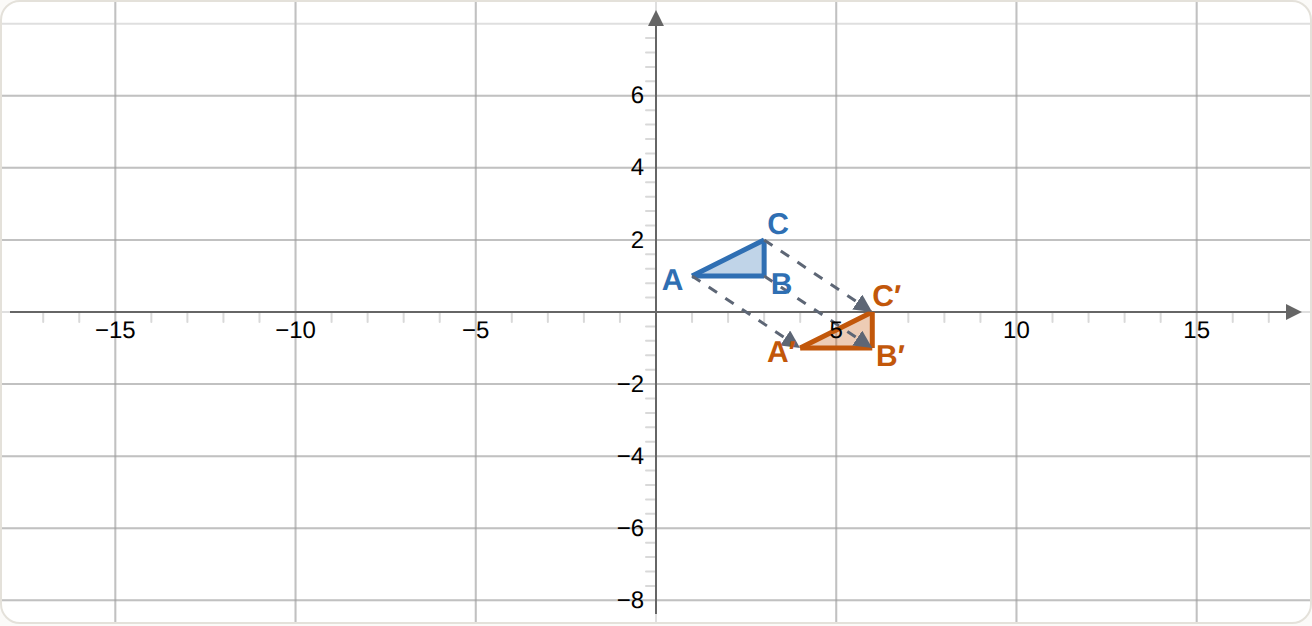
A translation slides every point of a shape the same distance in the same direction. The object becomes the image, and A becomes A′.

Right and up add; left and down take away. A translation of 3 right and 2 down changes (x,y)(x, y) to (x+3,y−2)(x + 3, y - 2).

The triangle moves 3 right and 2 down: every corner changes by (+3, -2).
The triangle moves 3 right and 2 down: every corner changes by (+3,−2)(+3, -2).
Slide, and read the change · Sound on for the voiceover
Open the lesson →

7. Reflections

Try firstThe point (5, −2) is reflected in the x-axis. Where is the image?

Check your answer

(5, 2): y changes sign.

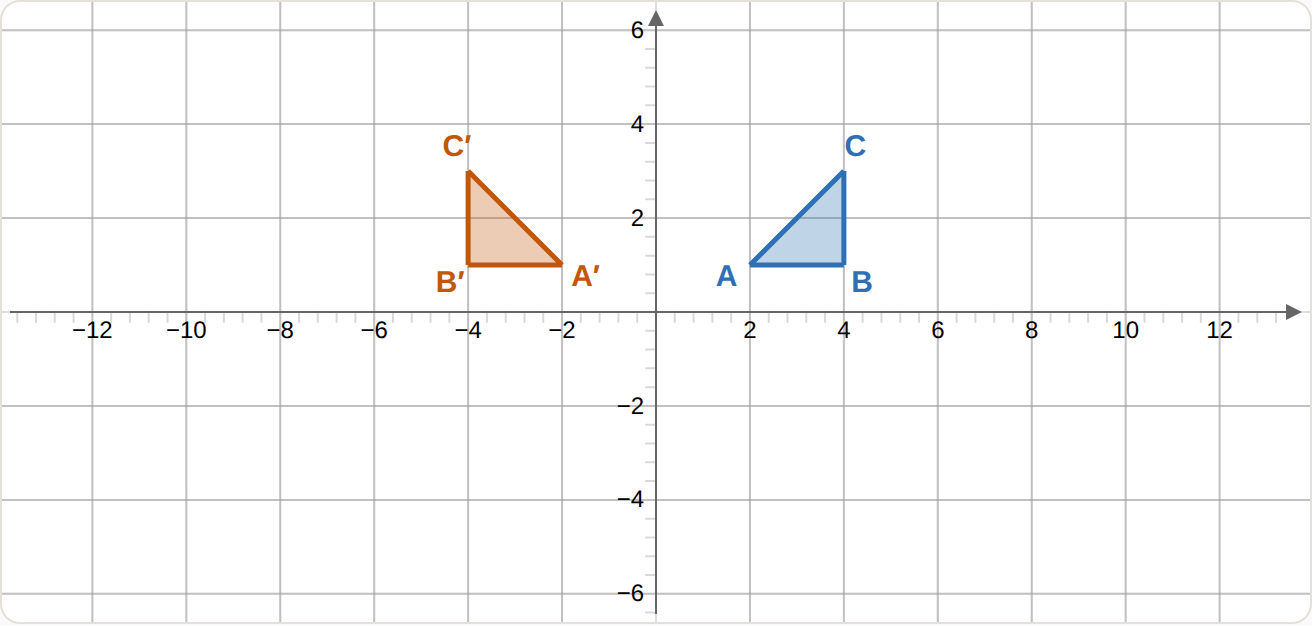
A reflection flips a shape over a mirror line; each point and its image are the same distance from the mirror, on opposite sides.

In the x-axis, (x,y)→(x,−y)(x, y) \to (x, -y). In the y-axis, (x,y)→(−x,y)(x, y) \to (-x, y).

The triangle reflected in the y-axis: (2, 1) becomes (-2, 1). The y-axis is halfway between each point and its image.
The triangle reflected in the y-axis: (2,1)(2, 1) becomes (−2,1)(-2, 1). The y-axis is halfway between each point and its image.
Two mirrors · Sound on for the voiceover
Open the lesson →

8. Rotations

Try firstThe point (2, 3) turns 180° about the origin. Where is the image?

Check your answer

(−2, −3): both signs change.

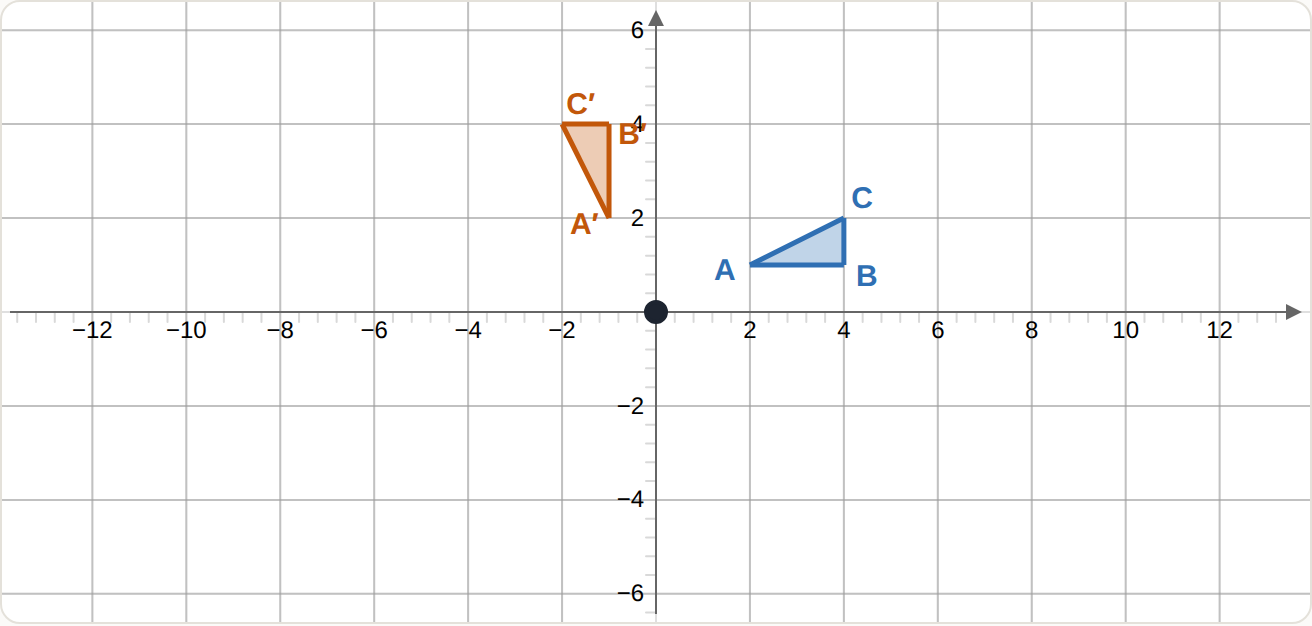
A rotation turns a shape about a centre by an angle in a direction (clockwise or anticlockwise). The shape keeps its size.

About the origin, anticlockwise: 90° changes (x,y)(x, y) to (−y,x)(-y, x); 180° changes it to (−x,−y)(-x, -y); 270° changes it to (y,−x)(y, -x).

A quarter turn anticlockwise about the origin: (2, 1) becomes (-1, 2).
A quarter turn anticlockwise about the origin: (2,1)(2, 1) becomes (−1,2)(-1, 2).
Turning about the origin · Sound on for the voiceover
Open the lesson →

Algorithms

9. Algorithms for classifying shapes

Try firstWhy must a classifier ask 'are all three sides equal?' before 'are two sides equal?'

Check your answer

An equilateral triangle has two equal sides too, so the wider question would give it the wrong name.

An algorithm is a precise series of steps and decisions. A classification algorithm asks yes/no questions about attributes and ends in one name for each shape.

Put the most specific question first, make sure every branch ends in a name, and test it on one shape of every class. A flowchart, a decision tree and numbered steps show the same algorithm.

Following an algorithm · Sound on for the voiceover
Open the lesson →