← Year 7 Space

Maths reference: Year 7 Space

The words and methods from Year 7 Space, each with an example and, where it helps, a picture of the board.

Print a cheat sheet (the whole course or one unit, with board pictures)

Shapes

scalene, isosceles, equilateral    acute, right-angled, obtuse\text{scalene, isosceles, equilateral} \;\; \text{acute, right-angled, obtuse}
triangles by sides and angles

Give two names: one for the sides (how many are equal) and one for the biggest angle. Equal sides sit opposite equal angles.
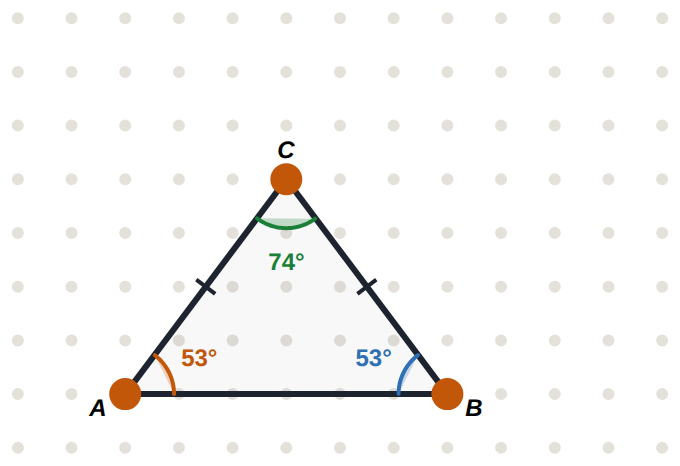
An isosceles acute triangle, its equal sides ticked
every square is a rectangle; every rectangle is a parallelogram\text{every square is a rectangle; every rectangle is a parallelogram}
quadrilateral family

Trapezium: at least one pair of parallel sides. Parallelogram: two. Rhombus: four equal sides. Rectangle: four right angles. Square: both. Kite: two pairs of equal neighbouring sides. A square is also a rectangle and a rhombus.
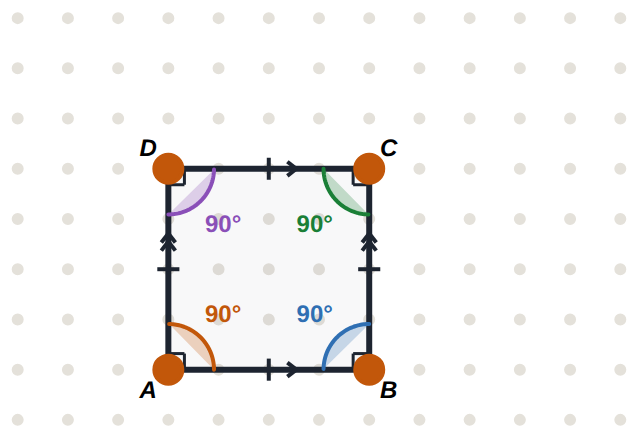
A square with equal sides, parallel sides and right angles marked
equal sides  and  equal angles\text{equal sides} \;\text{and}\; \text{equal angles}
regular polygon

Both are needed: a rhombus has equal sides but is not regular. Names: pentagon 5, hexagon 6, heptagon 7, octagon 8, nonagon 9, decagon 10.

concave: an angle>180∘\text{concave: an angle} > 180^\circ
convex and concave

Convex: every corner points out. Concave: at least one corner points in.
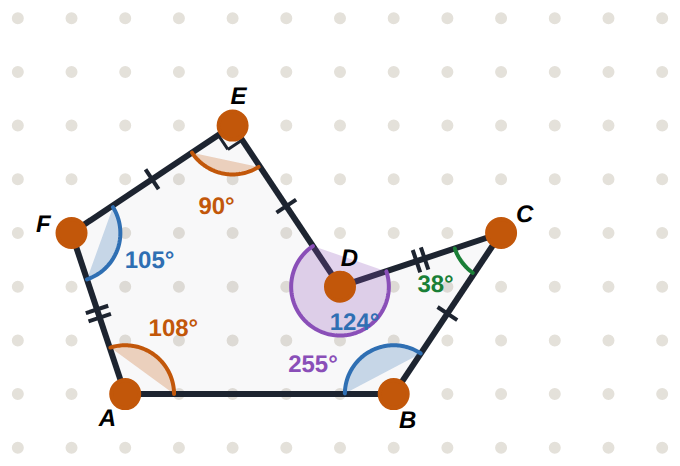
A concave hexagon with one corner pointing in

Solids, transformations and algorithms

cube: 6 squares on 6 different faces\text{cube: 6 squares on 6 different faces}
net

A net is a solid unfolded flat. Fold it, or roll a cube over it, to check that every face is covered once. Six squares is not enough.
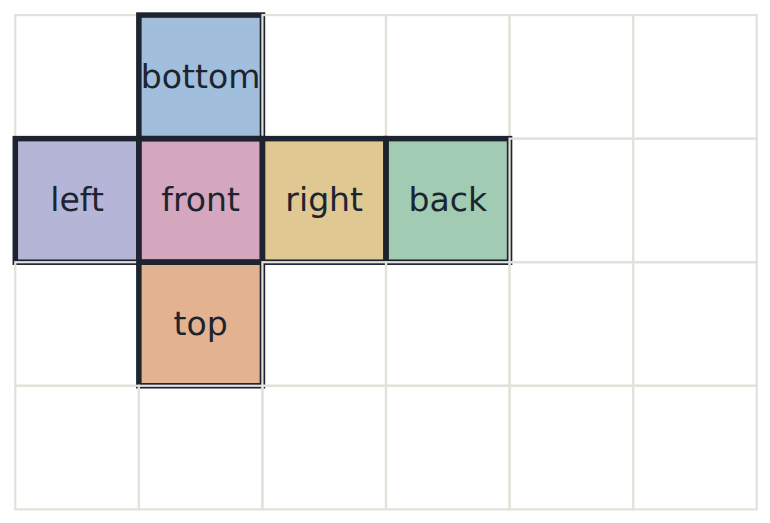
A cross of six squares that folds into a cube
A=2×triangle+length×(a+b+c)A = 2 \times \text{triangle} + \text{length} \times (a + b + c)
prism net area

A triangular prism has two triangles and three rectangles. The net's area is the surface area.

front=tallest pile in each column\text{front} = \text{tallest pile in each column}
top, front and side views

A view shows what you can see from one side; hidden cubes do not show. The top view with heights shows every cube.
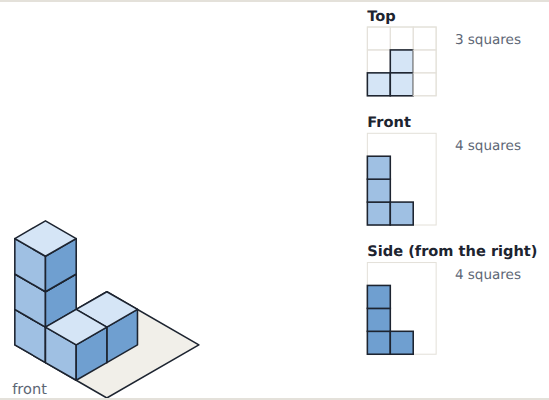
Three drawings of the same cubes
(x,y)→(x+a, y+b)(x, y) \to (x + a, \, y + b)
translation

Every point slides the same way. Right and up add; left and down take away.
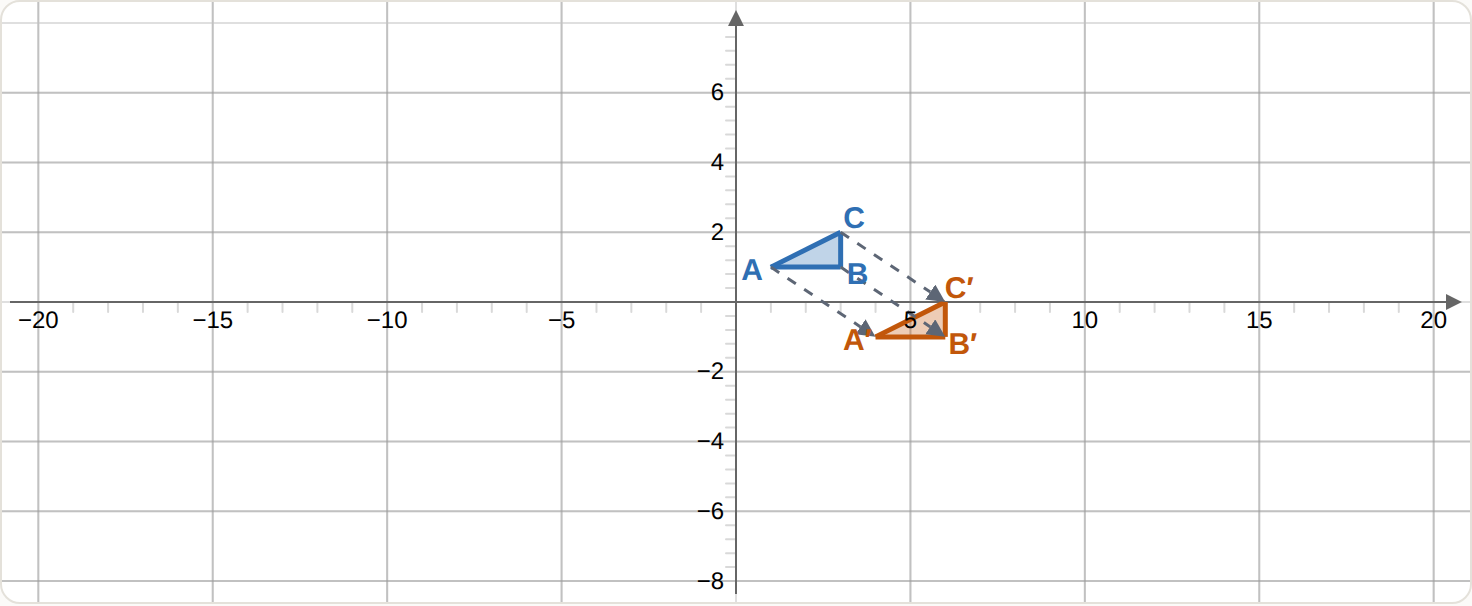
A triangle moved 3 right and 2 down
x-axis: (x,y)→(x,−y)y-axis: (x,y)→(−x,y)x\text{-axis: } (x, y) \to (x, -y) \qquad y\text{-axis: } (x, y) \to (-x, y)
reflection

Each point and its image are the same distance from the mirror, on opposite sides.
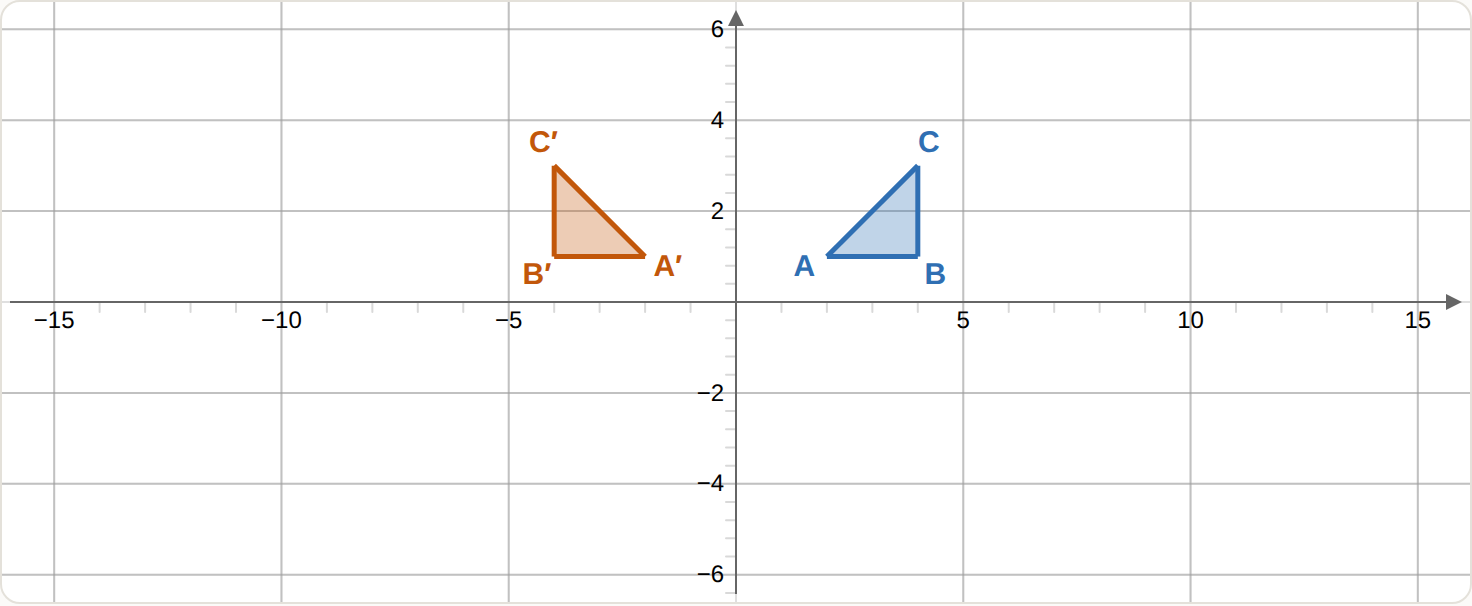
A triangle reflected in the y-axis
90∘ anticlockwise: (x,y)→(−y,x)90^\circ \text{ anticlockwise: } (x, y) \to (-y, x)
rotation

Give the centre, the angle and the direction. A half turn: (x, y) to (−x, −y). 90° clockwise is 270° anticlockwise.
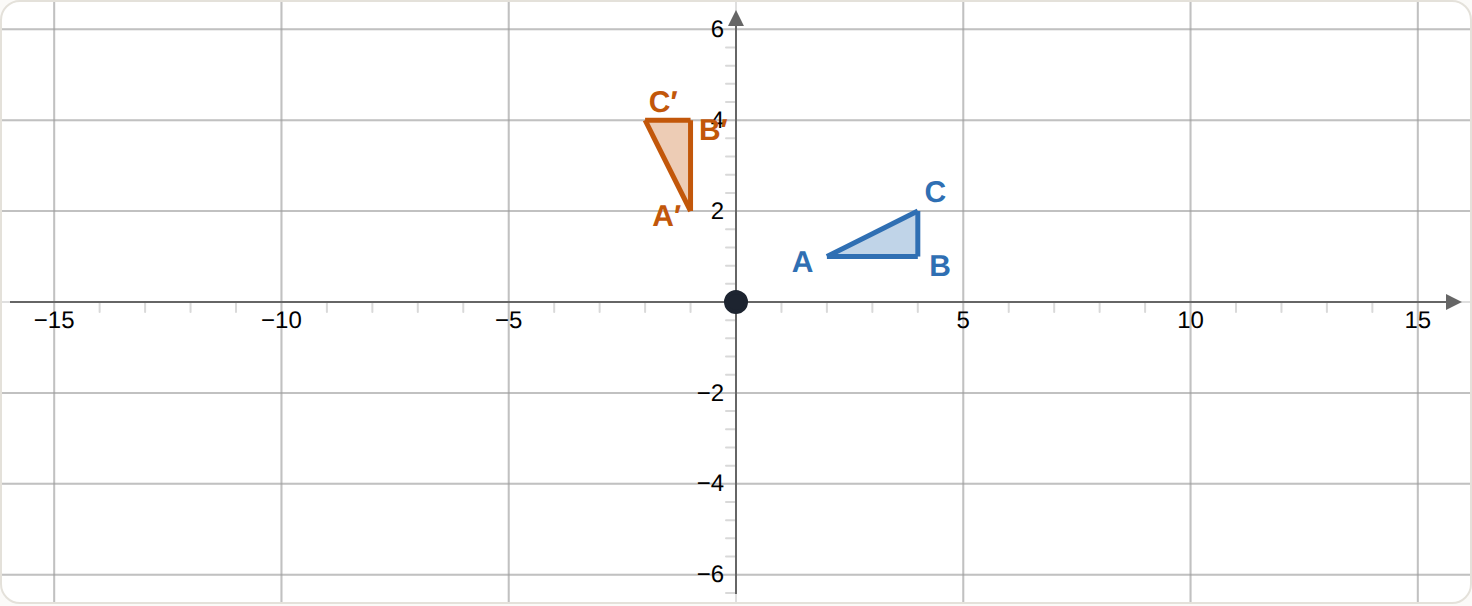
A triangle turned a quarter turn about the origin
ask the most specific question first\text{ask the most specific question first}
algorithm

A set of steps and decisions that gives the right result every time. Test it on one shape of every class.