← Maths

Year 7 maths: recap

Every idea from Year 7 maths in one place, for after you've done the year (or part of it). Answer each question in your head or on paper first, then check it. Nothing here is marked. If one is shaky, open the lesson and go over it again.

Getting ready for Year 7? Start with the Before Year 7 recap.

Year 7 Number

Comparing integers

Try firstPut in order from least to greatest: 4, −6, 0, −1, −10.

Check your answer

−10, −6, −1, 0, 4.

On a number line, the number further left is less. That is true below zero too.

−7-7 is further left than −2-2, so −7<−2-7 < -2 ("−7-7 is less than −2-2"), even though 7 is more than 2. Think of temperatures: −7-7 °C is colder than −2-2 °C.

To put integers in order, place each on the line and read from left to right. Zero is greater than every negative number.

-7 is further left than -2, so -7 < -2.
−7-7 is further left than −2-2, so −7<−2-7 < -2.
Further left is less · Sound on for the voiceover
Open the lesson →

Adding and subtracting integers

Try firstWork out −3 + 7, 2 − 9 and 4 − (−5).

Check your answer

4, −7 and 9.

To add or subtract integers, start at the first number and move along the number line.

  • Adding a positive moves right: −3+5=2-3 + 5 = 2.
  • Adding a negative moves left: 4+(−6)=−24 + (-6) = -2.
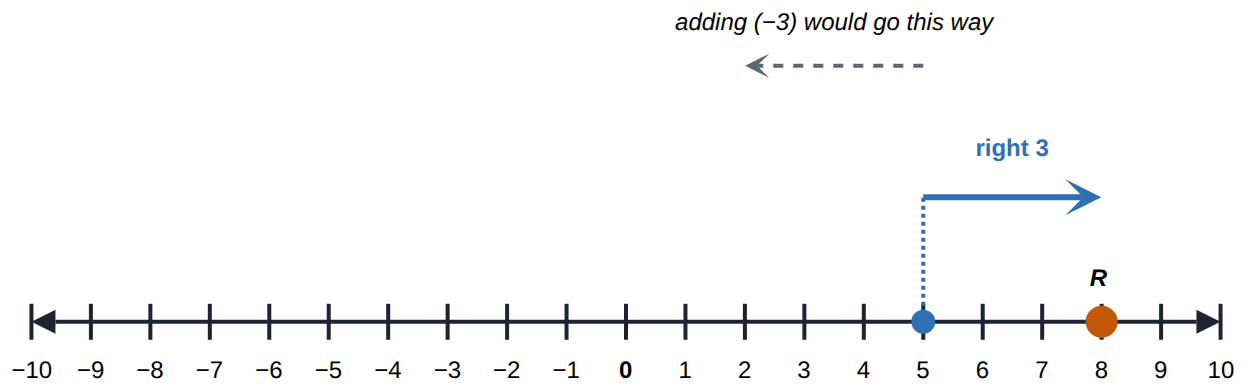
  • Subtracting moves the opposite way to adding. Adding −3-3 would move left 3, so subtracting −3-3 moves right 3: 5−(−3)=85 - (-3) = 8.

So subtracting a negative gives the same answer as adding the positive.

5 - (-3): adding -3 would go left 3, so subtracting goes right 3, to 8.
5−(−3)5 - (-3): adding −3-3 would go left 3, so subtracting goes right 3, to 8.
Adding and subtracting are moves along the line · Sound on for the voiceover
Open the lesson →

Squares and square roots

Try firstA square has area 81 cm². Find its side and its perimeter.

Check your answer

Side √81 = 9 cm; perimeter 4 × 9 = 36 cm.

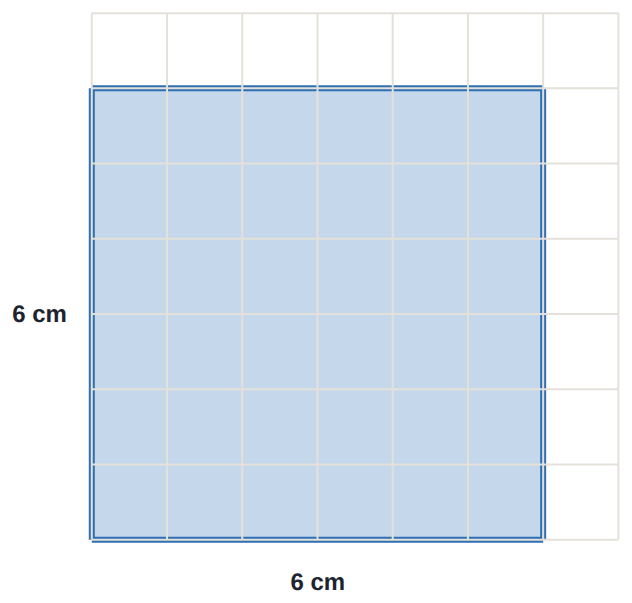
A square number is a number times itself: 62=6×6=366^2 = 6 \times 6 = 36. It is the area of a square with side 6. The perfect squares to 144 are 1, 4, 9, 16, 25, 36, 49, 64, 81, 100, 121 and 144.

The square root undoes squaring: 36=6\sqrt{36} = 6 because 6×6=366 \times 6 = 36. It is the side of a square with area 36. (Squared is not doubled: 52=255^2 = 25, not 10.)

A square of side 6 cm covers 6 \times 6 = 36 unit squares: 6^2 = 36, so \sqrt{36} = 6.
A square of side 6 cm covers 6×6=366 \times 6 = 36 unit squares: 62=366^2 = 36, so 36=6\sqrt{36} = 6.
Side and area · Sound on for the voiceover
Open the lesson →

Between the squares

Try firstBetween which two whole numbers is √55? Give a reason.

Check your answer

7 and 8, because 7² = 49 and 8² = 64, and 55 is between them.

For a number that is not a perfect square, find the perfect squares either side: 36<43<4936 < 43 < 49. Their roots give the whole numbers either side: 6<43<76 < \sqrt{43} < 7.

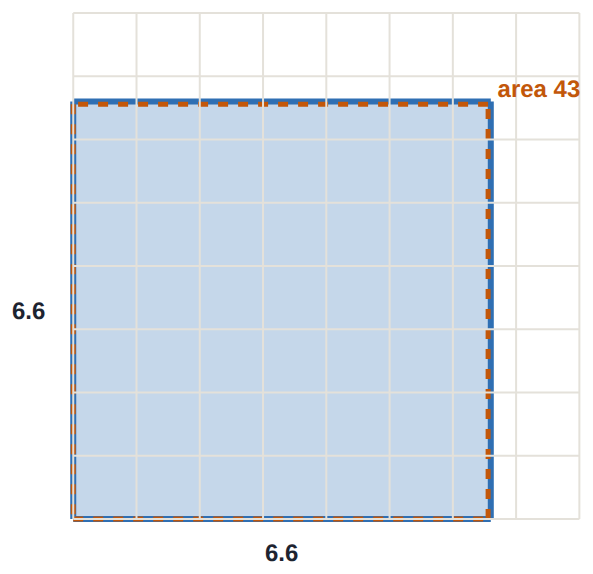
To get closer, square decimals: 6.52=42.256.5^2 = 42.25 and 6.62=43.566.6^2 = 43.56. The closer one wins: 43≈6.6\sqrt{43} \approx 6.6. (A square root is not a half: 50\sqrt{50} is about 7, not 25.)

6.6^2 = 43.56: just over 43. 6^2 = 36 and 7^2 = 49, so \sqrt{43} is between 6 and 7, about 6.6.
6.62=43.566.6^2 = 43.56: just over 43. 62=366^2 = 36 and 72=497^2 = 49, so 43\sqrt{43} is between 6 and 7, about 6.6.
Between two squares · Sound on for the voiceover
Open the lesson →

Powers

Try firstWork out 3³ and write 5 × 5 × 5 × 5 as a power.

Check your answer

3³ = 27; 5⁴.

Exponent notation is short for repeated multiplication: 2×2×2×2=242 \times 2 \times 2 \times 2 = 2^4. The base (2) is multiplied; the exponent (4) counts how many times. So 24=162^4 = 16, not 2×4=82 \times 4 = 8.

Squares are powers with exponent 2 (52=255^2 = 25) and cubes exponent 3 (23=82^3 = 8). Powers of 10 count zeros: 103=100010^3 = 1000.

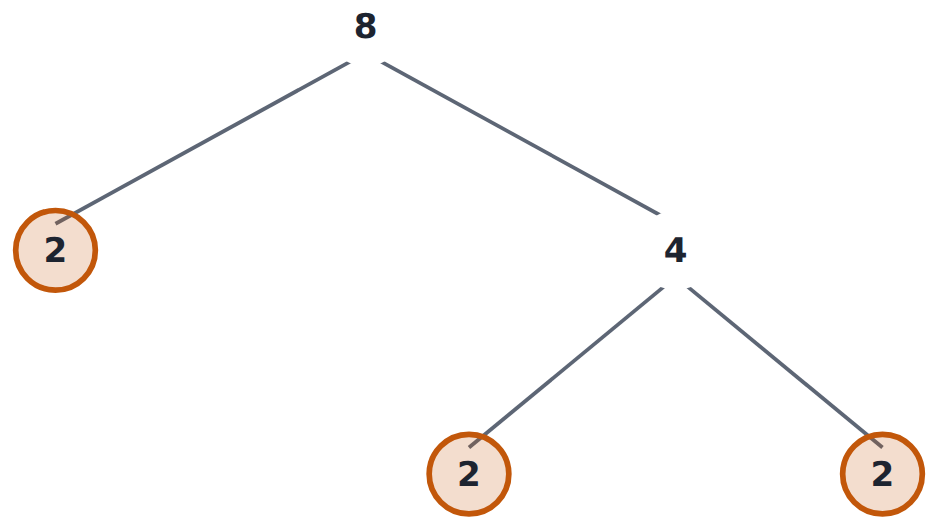
A factor tree for 8: split it until every branch is a prime. Three 2s: 8 = 2 \times 2 \times 2 = 2^3.
A factor tree for 8: split it until every branch is a prime. Three 2s: 8=2×2×2=238 = 2 \times 2 \times 2 = 2^3.
Three 2s · Sound on for the voiceover
Open the lesson →

Prime factors

Try firstWrite 84 as a product of prime factors, with exponents.

Check your answer

84 = 2² × 3 × 7.

A prime has exactly two factors: 1 and itself (1 is not prime). A factor tree splits a number into a factor pair, then splits every branch that is not prime, until all the branches are primes.

The prime factorisation collects them with exponents: 36=2×2×3×3=22×3236 = 2 \times 2 \times 3 \times 3 = 2^2 \times 3^2. Every tree for 36 ends with these primes. Check by expanding: 4×9=364 \times 9 = 36.

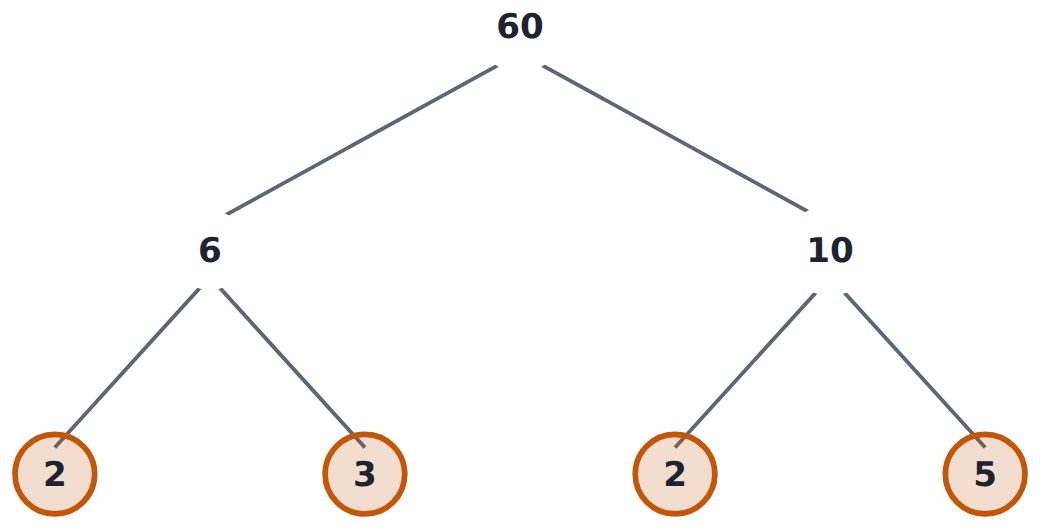
A factor tree for 60 starts with a factor pair and splits until every branch ends in a circled prime: 60 = 2^2 \times 3 \times 5.
A factor tree for 60 starts with a factor pair and splits until every branch ends in a circled prime: 60=22×3×560 = 2^2 \times 3 \times 5.
Down to the primes · Sound on for the voiceover
Open the lesson →

HCF and LCM

Try firstFind the HCF and LCM of 20 and 30.

Check your answer

20 = 2² × 5 and 30 = 2 × 3 × 5. HCF = 2 × 5 = 10; LCM = 2² × 3 × 5 = 60.

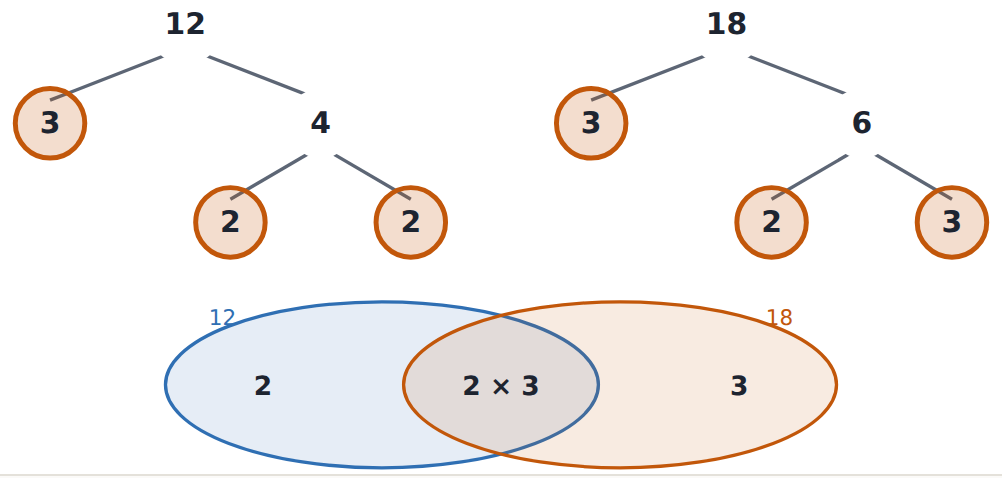
Write both numbers as products of primes: 12=22×312 = 2^2 \times 3 and 18=2×3218 = 2 \times 3^2.

The HCF is the product of the primes they share (each to its lower power): 2×3=62 \times 3 = 6. The LCM is the product of all the primes, each shared one counted once (each to its higher power): 22×32=362^2 \times 3^2 = 36. Multiplying the two numbers (12×18=21612 \times 18 = 216) counts the shared primes twice, so it is a common multiple but not usually the lowest.

12 = 2^2 \times 3 and 18 = 2 \times 3^2. Shared: 2 \times 3, so the HCF is 6. All the primes: 2 \times 2 \times 3 \times 3, so the LCM is 36.
12=22×312 = 2^2 \times 3 and 18=2×3218 = 2 \times 3^2. Shared: 2×32 \times 3, so the HCF is 6. All the primes: 2×2×3×32 \times 2 \times 3 \times 3, so the LCM is 36.
Shared primes · Sound on for the voiceover
Open the lesson →

Place value and powers of 10

Try firstWrite 7 304 in expanded notation using powers of 10.

Check your answer

7 × 10³ + 3 × 10² + 4 × 10⁰. (The 0 in the tens column is left out.)

Every place value column is ten times the one on its right, so each is a power of 10: ones 100=110^0 = 1, tens 10110^1, hundreds 10210^2, thousands 10310^3. The exponent counts the zeros in the value, and it counts from 0 at the ones column.

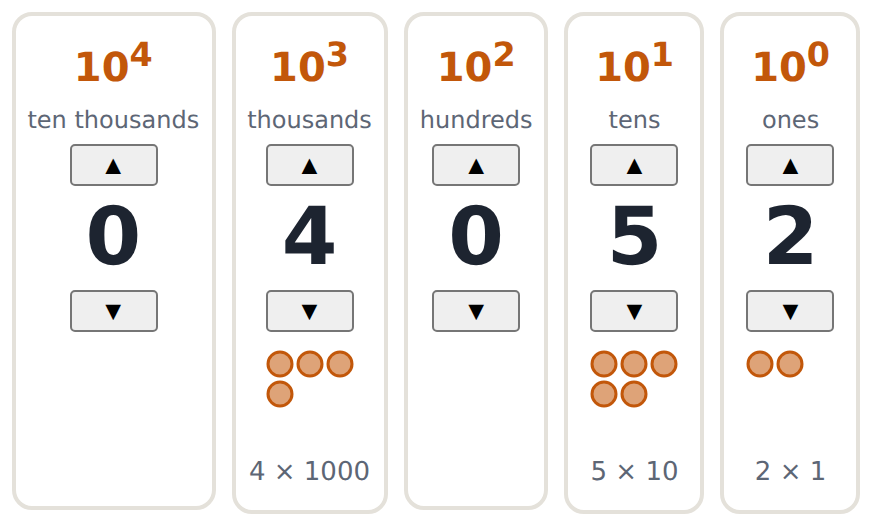
A number in expanded notation is the sum of each digit times its power of 10: 4052=4×10³+5×101+2×1004052 = 4 \times 10^3 + 5 \times 10^1 + 2 \times 10^0. A column holding 0 adds nothing, so it is left out.

4052 on the columns: 4 × 10³ + 0 × 10² + 5 × 10¹ + 2 × 10⁰. The 0 is a column with nothing in it.
Digits and powers of 10 · Sound on for the voiceover
Open the lesson →

Rounding decimals

Try firstA stick is measured as 83.46 cm with a ruler marked in millimetres. Round it sensibly, and say why.

Check your answer

83.5 cm: the ruler shows millimetres, which is 1 decimal place of a centimetre.

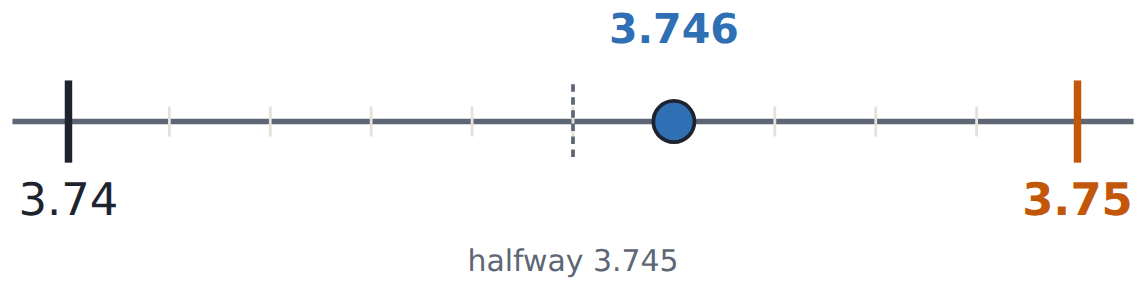
To round to a number of decimal places, find the two numbers with that many places that your number sits between, and take the nearer. Look at the one digit straight after the place: 5 or more rounds up, 4 or less leaves the digit as it is. Halfway rounds up. So 3.746 to 2 places is 3.75.

How much to round depends on the job: money to the cent, a ruler measurement to what the ruler can show, tins of paint up so there is enough. More digits than the instrument measures only gives a false sense of accuracy.

3.746 sits between 3.74 and 3.75. It is past the halfway mark 3.745, so it rounds up to 3.75.
Rounding on a number line · Sound on for the voiceover
Open the lesson →

Estimating to check

Try firstEstimate 4.8 × 31. The calculator shows 148.8. Is it reasonable?

Check your answer

5 × 30 = 150, so yes.

An estimate is a quick, close answer from rounding. Round each number to its first digit and keep its size: 38×52≈40×50=200038 \times 52 \approx 40 \times 50 = 2000. If the exact answer is near the estimate it is reasonable; if it is out by a factor of ten, check the decimal point.

Rounding can go up or down, so an estimate can be above or below the exact answer. What matters is that it is close and quick.

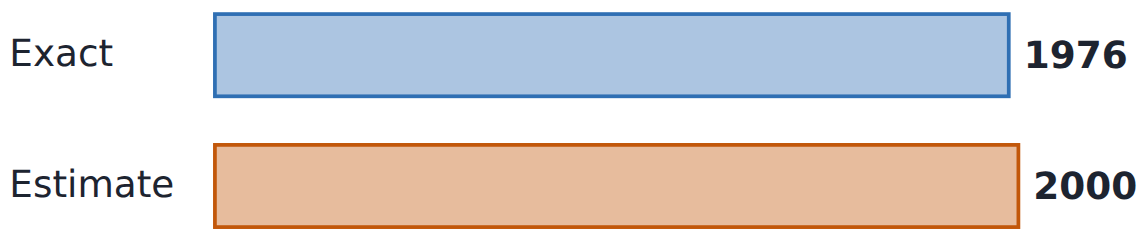
38 × 52 ≈ 40 × 50 = 2000. The exact answer 1976 is close, so it is reasonable.
An estimate and the exact answer · Sound on for the voiceover
Open the lesson →

Equivalent fractions

Try firstWrite 20/32 in its simplest form, and give one other fraction equal to it.

Check your answer

5/8 (÷ 4). For example 10/16 or 15/24.

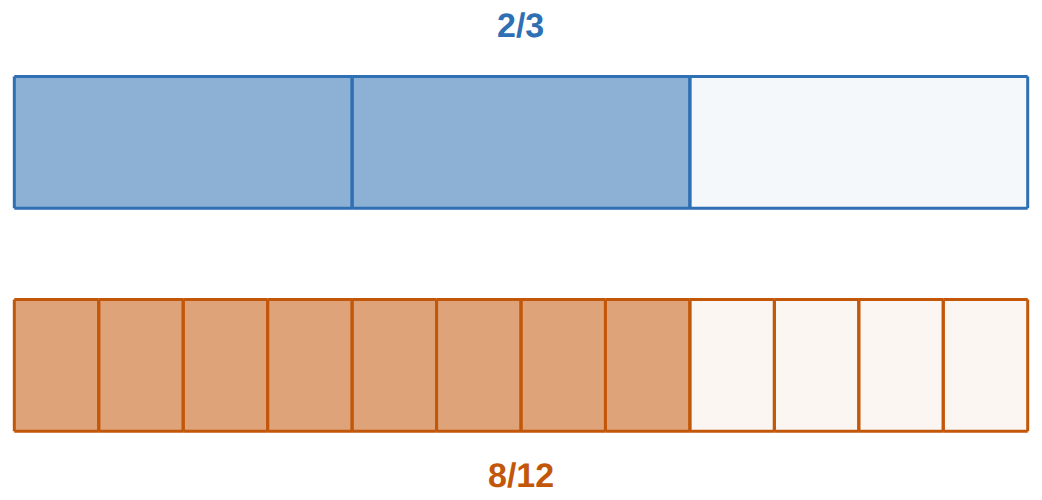
Fractions are equivalent when they name the same amount. Multiply or divide the top and the bottom (the numerator and the denominator) by the same number: 23=2×43×4=812\tfrac{2}{3} = \tfrac{2 \times 4}{3 \times 4} = \tfrac{8}{12}. (Adding the same number to both changes the amount.)

A fraction is in simplest form when the top and the bottom share no factor but 1. Divide both by their highest common factor: 1218=23\tfrac{12}{18} = \tfrac{2}{3} (÷ 6).

\tfrac{2}{3} = \tfrac{8}{12}: each third is split into 4, so the top and the bottom are both multiplied by 4.
23=812\tfrac{2}{3} = \tfrac{8}{12}: each third is split into 4, so the top and the bottom are both multiplied by 4.
The same amount, more parts · Sound on for the voiceover
Open the lesson →

Fractions, decimals and percentages

Try firstWrite 3/5 as a decimal and as a percentage, and 0.08 as a percentage.

Check your answer

0.6 and 60%; 0.08 = 8%.

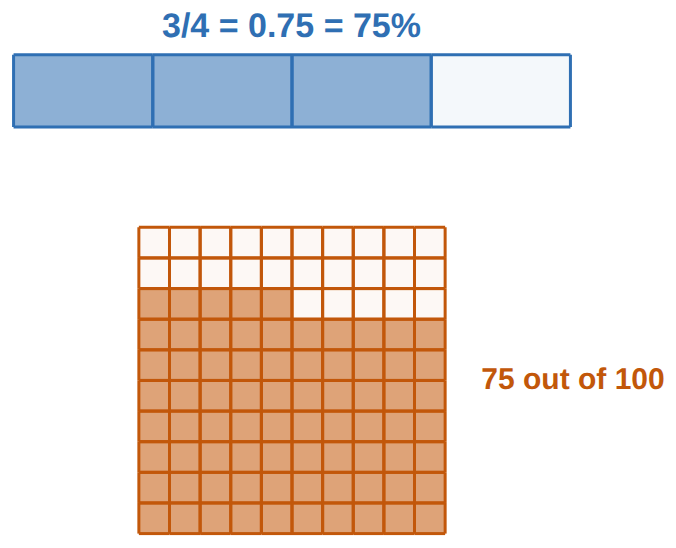
Percent means out of 100, so a percentage is a fraction over 100: 75%=75100=3475\% = \tfrac{75}{100} = \tfrac{3}{4}. A decimal counts tenths and hundredths: 0.750.75 is 75 hundredths.

  • Fraction to decimal: divide the top by the bottom (38=0.375\tfrac{3}{8} = 0.375).
  • Decimal to percentage: × 100 (0.5=50%0.5 = 50\%, not 5%).
  • Percentage to fraction: over 100, then simplify (16%=42516\% = \tfrac{4}{25}).

Some decimals never end: 13=0.333…\tfrac{1}{3} = 0.333\ldots

\tfrac{3}{4} of the bar and 75 of the 100 squares: \tfrac{3}{4} = \tfrac{75}{100} = 0.75 = 75\%.
34\tfrac{3}{4} of the bar and 75 of the 100 squares: 34=75100=0.75=75%\tfrac{3}{4} = \tfrac{75}{100} = 0.75 = 75\%.
One amount, three names · Sound on for the voiceover
Open the lesson →

Fractions and decimals on the line

Try firstPut in order from least to greatest: 0.4, −1 1/4, −0.8, −1/2.

Check your answer

−1 1/4, −0.8, −1/2, 0.4.

To place a fraction or decimal, split each unit into equal parts and count from zero. Quarters: split each unit into 4. Tenths: into 10.

A negative number counts to the left of zero. −34-\tfrac{3}{4} is three quarters left of 0. A negative mixed numeral or decimal is further left still: −1.5-1.5 is one unit left, then half a unit further left, halfway between −2-2 and −1-1.

Once they are on the line, read from left to right to put them in order.

Quarters: -1\tfrac{1}{4} (A), -\tfrac{3}{4} (B) and \tfrac{1}{2} (C).
Quarters: −114-1\tfrac{1}{4} (A), −34-\tfrac{3}{4} (B) and 12\tfrac{1}{2} (C).
Split each unit, then count from zero · Sound on for the voiceover
Open the lesson →

Adding and subtracting fractions

Try firstWork out 2/3 + 1/5 and 1 1/4 − 2/3.

Check your answer

10/15 + 3/15 = 13/15. 15/12 − 8/12 = 7/12.

Fractions can be added only when the parts are the same size. Cut both into the same parts with equivalent fractions, using a common denominator (the LCM of the bottoms is the lowest):

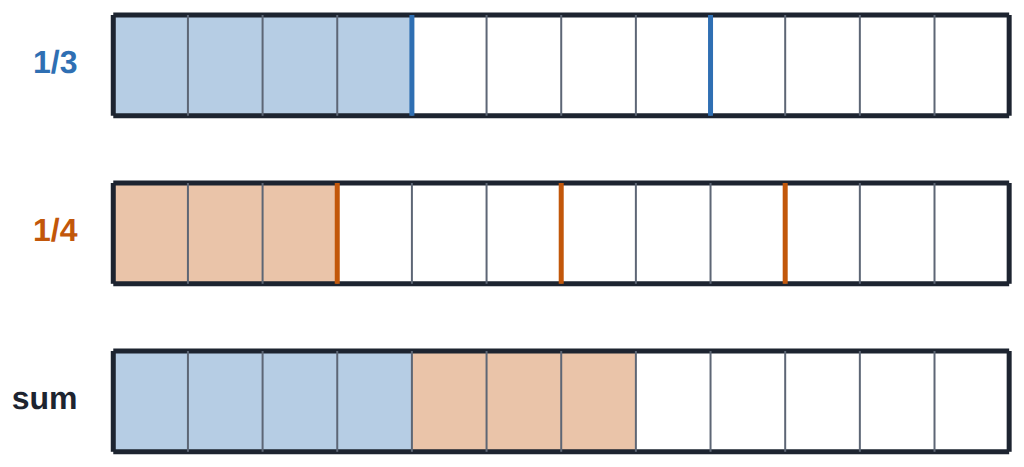
13+14=412+312=712\tfrac{1}{3} + \tfrac{1}{4} = \tfrac{4}{12} + \tfrac{3}{12} = \tfrac{7}{12}. Then add the tops and keep the bottom. (Adding across gives 27\tfrac{2}{7}, which is less than 13\tfrac{1}{3} alone.)

For mixed numerals, change them to improper fractions first. For decimals, line up the points so tenths go with tenths.

Cut into twelfths, \tfrac{1}{3} = \tfrac{4}{12} and \tfrac{1}{4} = \tfrac{3}{12}: together 7 twelfths.
Cut into twelfths, 13=412\tfrac{1}{3} = \tfrac{4}{12} and 14=312\tfrac{1}{4} = \tfrac{3}{12}: together 7 twelfths.
The same size parts · Sound on for the voiceover
Open the lesson →

Multiplying and dividing fractions

Try firstWork out 3/5 × 10/12, and 2 ÷ 1/3.

Check your answer

30/60 = 1/2. 2 ÷ 1/3 = 6 (six thirds in 2).

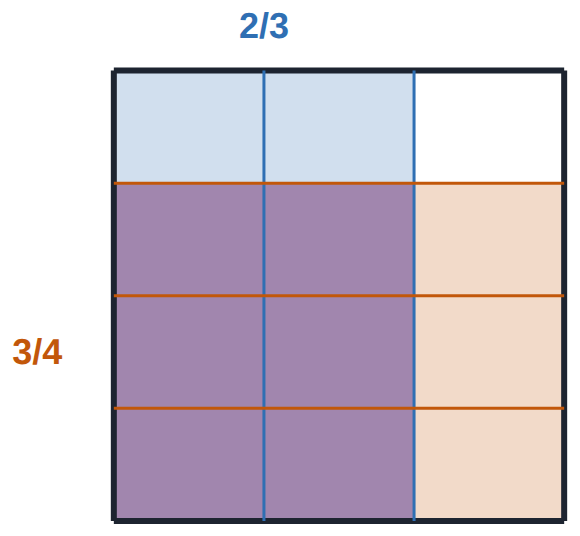
To multiply fractions, multiply the tops and multiply the bottoms, then simplify: 23×34=612=12\tfrac{2}{3} \times \tfrac{3}{4} = \tfrac{6}{12} = \tfrac{1}{2}. It is 34\tfrac{3}{4} of 23\tfrac{2}{3}: in a square, 3 of 4 rows of 2 of 3 columns is 6 of 12 parts.

Multiplying by a fraction less than 1 makes a number smaller (34×20=15\tfrac{3}{4} \times 20 = 15). Dividing asks how many fit: 3÷14=123 \div \tfrac{1}{4} = 12, the same as 3×43 \times 4. To divide by a fraction, multiply by it flipped (top and bottom swapped: 16\tfrac{1}{6} becomes 61=6\tfrac{6}{1} = 6).

\tfrac{3}{4} of \tfrac{2}{3}: the purple overlap is 6 of the 12 small parts, so \tfrac{2}{3} \times \tfrac{3}{4} = \tfrac{6}{12} = \tfrac{1}{2}.
34\tfrac{3}{4} of 23\tfrac{2}{3}: the purple overlap is 6 of the 12 small parts, so 23×34=612=12\tfrac{2}{3} \times \tfrac{3}{4} = \tfrac{6}{12} = \tfrac{1}{2}.
A fraction of a fraction · Sound on for the voiceover
Open the lesson →

Percentages of amounts

Try firstA $40 shirt is 35% off. Find the sale price.

Check your answer

35% of $40 = $14, so $26. Or 40 × 0.65 = 26.

A percentage is hundredths: 15%=0.1515\% = 0.15. So 15% of $80 is 0.15 × 80 = $12 (or 10% is $8 and 5% is $4).

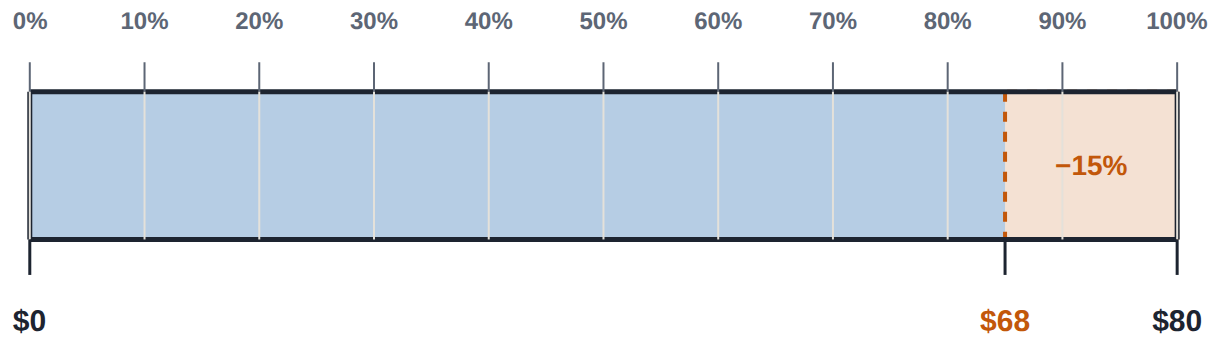
For a decrease, take it off or multiply by what is left: 80×0.85=6880 \times 0.85 = 68. For an increase, add it on or multiply by 1.151.15. To find what percentage 18 is of 24, divide and ×100\times 100: 18÷24=0.75=75%18 \div 24 = 0.75 = 75\%.

15% off 80: the orange 15% is 12, and the blue 85% left is 68. 80 × 0.85 = 68 in one step.
15% off $80: the orange 15% is $12, and the blue 85% left is $68. $80 × 0.85 = $68 in one step.
A percentage of an amount · Sound on for the voiceover
Open the lesson →

Choosing a strategy

Try firstWork out 5 × 3.6 × 2 and 40% of 15, each in a quick way. Say which move you used.

Check your answer

5 × 2 = 10, then × 3.6 = 36 (any order). 40% = 2/5: 15 ÷ 5 × 2 = 6 (change the form).

A quick strategy usually comes from one of three moves:

  • Change the order: multiplying can be done in any order, 4×2.7×25=100×2.7=2704 \times 2.7 \times 25 = 100 \times 2.7 = 270.
  • Change the form: 0.75=340.75 = \tfrac{3}{4}, so 0.75×36=270.75 \times 36 = 27; 25%=1425\% = \tfrac{1}{4}.
  • Split a number: 12×2.5=12×2+12×0.5=3012 \times 2.5 = 12 \times 2 + 12 \times 0.5 = 30.

Then check with an estimate: is the answer about the right size?

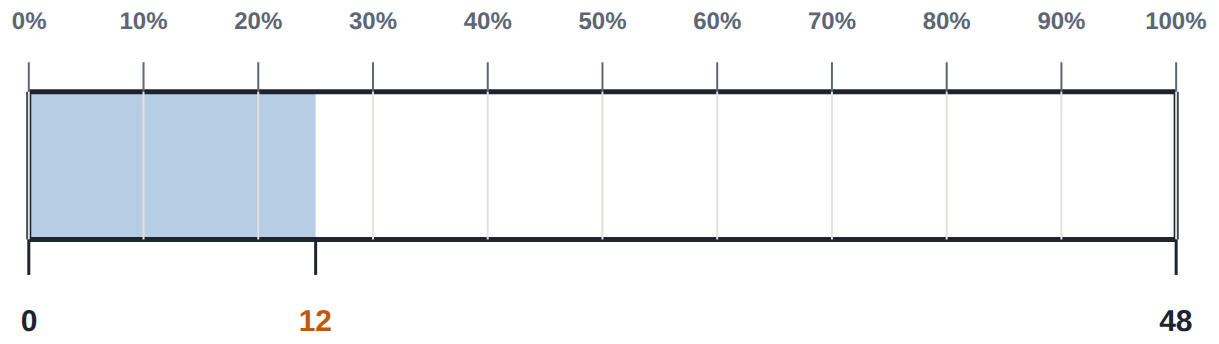
25% of 48 is a quarter of the bar: half of 48 is 24, half again is 12.
Halve, and halve again · Sound on for the voiceover
Open the lesson →

What is a ratio?

Try firstA jar has 4 black and 5 white beads. Write the ratio of black to white, and of black to all the beads.

Check your answer

4 : 5 and 4 : 9.

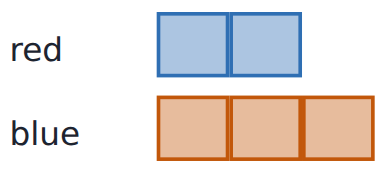
A ratio compares quantities in a stated order. With 2 red and 3 blue counters, red to blue is 2:32 : 3 (part to part). The whole is 2+3=52 + 3 = 5 counters, so red to all is 2:52 : 5 (part to whole), which is the fraction 25\tfrac{2}{5}.

The order matters: 2:32 : 3 is not 3:23 : 2. The first thing named is the first number.

2 red blocks and 3 blue blocks: red to blue is 2 : 3, red to all the blocks is 2 : 5.
Part to part and part to whole · Sound on for the voiceover
Open the lesson →

Equivalent and simplest ratios

Try firstSimplify 24 : 36, and find the missing term: 3 : 5 = 12 : ?

Check your answer

24 : 36 = 2 : 3. 3 → 12 is × 4, so 5 × 4 = 20.

Two ratios are equivalent when both terms of one are the other's both terms multiplied (or divided) by the same number: 2:3=4:6=6:92 : 3 = 4 : 6 = 6 : 9. Picture it as copies of the same pattern of blocks.

To simplify, divide both terms by their highest common factor: 12:18=2:312 : 18 = 2 : 3 (÷ 6). Adding the same number to both terms changes the ratio.

Three copies of 2 : 3 give 6 : 9. The groups repeat, so the ratio is the same.
Copies of the same ratio · Sound on for the voiceover
Open the lesson →

Sharing in a ratio

Try firstShare $84 between Sam and Tia in the ratio 3 : 4. How much does Tia get?

Check your answer

3 + 4 = 7 parts. 84 ÷ 7 = 12. Tia has 4 parts: $48.

To share a total in a ratio: add the parts (2+3=52 + 3 = 5), find one part (total ÷ parts: $$60 \div 5 = $12$), and multiply for each share (2×12=242 \times 12 = 24, 3×12=363 \times 12 = 36). The shares add back to the total.

To work backwards, use a known share to find one part: if 3 parts are $24, one part is $8.

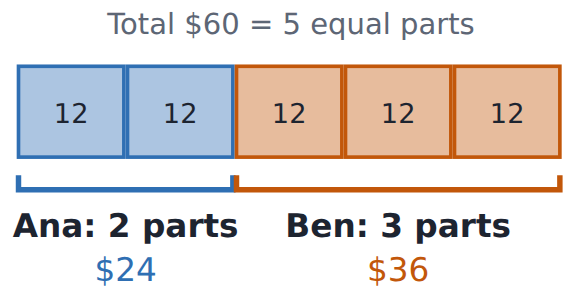
60 in the ratio 2 : 3: 5 equal parts of 12. Ana gets 2 parts (24), Ben 3 parts (36).
$60 in the ratio 2 : 3: 5 equal parts of $12. Ana gets 2 parts ($24), Ben 3 parts ($36).
Share in a ratio · Sound on for the voiceover
Open the lesson →

Modelling with money

Try firstA $80 jacket is marked up 25% then sold at 25% off the new price. Is the final price more than, less than or equal to $80? Work it out.

Check your answer

80 × 1.25 = 100, then 100 × 0.75 = 75: less than $80.

Modelling with money: formulate (known, unknown, which representation: fraction, decimal, percentage or ratio), solve (estimate, then calculate efficiently), interpret and justify (the answer in dollars, rounded to the cent, and why that representation).

A percentage is always of something. Profit is a percentage of the cost. Percentages of different amounts do not add: 20% off $200 then 10% off the new price is $200 × 0.8 × 0.9 = $144, not 30% off.

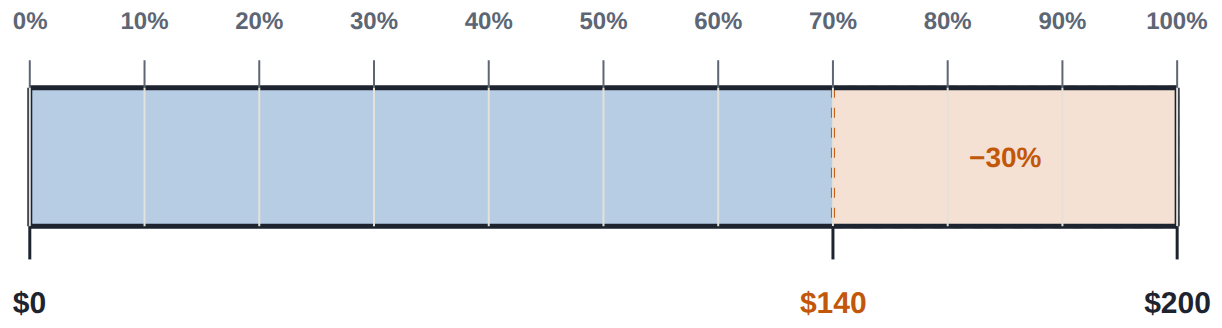
30% off 200 is 140. But 20% off then 10% off leaves 200 × 0.8 × 0.9 = 144: percentages of different amounts do not add.
30% off $200 is $140. But 20% off then 10% off leaves $200 × 0.8 × 0.9 = $144: percentages of different amounts do not add.
Percentages in steps · Sound on for the voiceover
Open the lesson →

Year 7 Algebra

Letters that vary

Try firstA taxi charges T = 2d + 4 dollars for d km. Name the variables and the constants, and say what the 4 means.

Check your answer

Variables: T and d. Constants: 2 and 4. The 4 is the fee to get in, paid even for 0 km.

In a formula, letters stand for quantities. A letter whose value can change is a variable; a number that stays the same is a constant.

In P=2l+2wP = 2l + 2w, PP, ll and ww are variables and the 2s are constants.

In an equation such as 3x+2=143x + 2 = 14, the letter is an unknown: one particular number (x=4x = 4) makes it true.

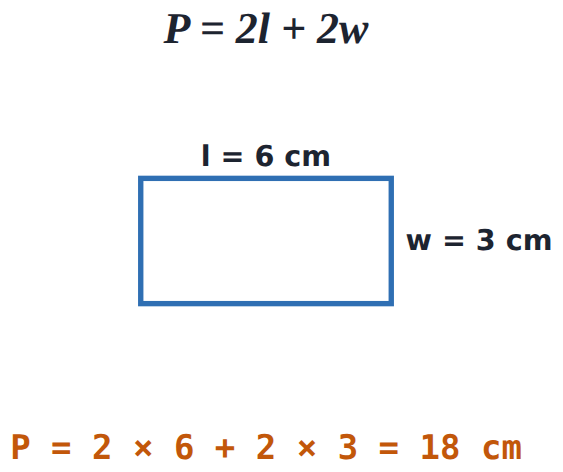
P = 2l + 2w: P, l and w are variables (each rectangle has its own); the 2s are constants (the same for every rectangle).
P=2l+2wP = 2l + 2w: PP, ll and ww are variables (each rectangle has its own); the 2s are constants (the same for every rectangle).
Variables change; constants stay the same · Sound on for the voiceover
Open the lesson →

Substituting into formulas

Try firstFind C = 8h + 15 when h = 3, and V = lwh when l = 2, w = 5, h = 3.

Check your answer

C = 8 × 3 + 15 = 39. V = 2 × 5 × 3 = 30.

To substitute, replace each letter with its value.

A number next to a letter means multiply: 2l2l means 2×l2 \times l. Two letters next to each other also multiply: lwlw means l×wl \times w. Write the × signs in before working anything out.

Then work it out in order: brackets first, then × and ÷, then + and −. Give the units.

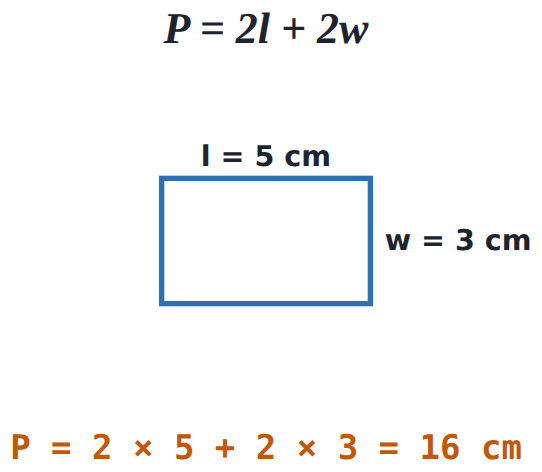
l = 5 and w = 3: write in the × signs, P = 2 \times 5 + 2 \times 3 = 10 + 6 = 16 cm.
l=5l = 5 and w=3w = 3: write in the × signs, P=2×5+2×3=10+6=16P = 2 \times 5 + 2 \times 3 = 10 + 6 = 16 cm.
Replace each letter with its value · Sound on for the voiceover
Open the lesson →

Finding an unknown

Try firstA gym costs T = 15w + 30 dollars for w weeks. Someone paid 120 dollars. How many weeks? Check your answer.

Check your answer

120 = 15w + 30, so 15w = 90 and w = 6. Check: 15 × 6 + 30 = 120.

When you know a formula's answer but not one of its letters, substitute the values you know. What is left is an equation with one unknown.

Solve it by undoing: undo the last operation first (+ and − before × and ÷).

Then check: put your answer back into the formula. It should give the value you started with.

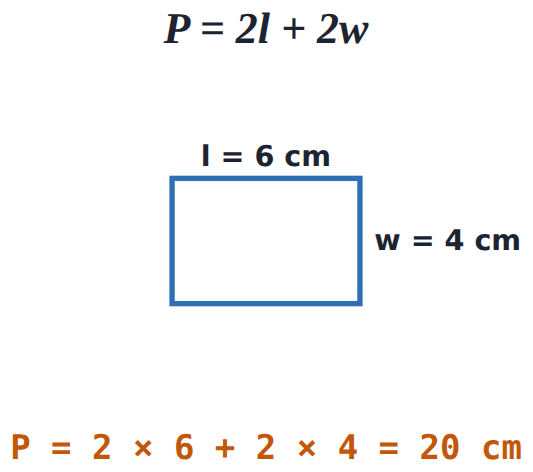
P = 20 and l = 6: 20 = 2 \times 6 + 2w, so 2w = 8 and w = 4. Check: 2 \times 6 + 2 \times 4 = 20.
P=20P = 20 and l=6l = 6: 20=2×6+2w20 = 2 \times 6 + 2w, so 2w=82w = 8 and w=4w = 4. Check: 2×6+2×4=202 \times 6 + 2 \times 4 = 20.
Substitute what you know, then solve for the rest · Sound on for the voiceover
Open the lesson →

Words into expressions

Try firstWrite an expression for: (a) 4 less than n; (b) 2 more than 5 times n; (c) n shared between 3.

Check your answer

(a) n − 4. (b) 5n + 2. (c) n/3.

Words about a number tell you what to do to it. More than means add; less than means subtract; times, twice and lots of mean multiply; divided by and shared between mean divide.

Write the operations in the order the words say them. "3 more than twice n" is twice n (2n) and then 3 more: 2n+32n + 3.

"Less than" starts from the number: 7 less than n is n−7n - 7, not 7−n7 - n.

Check an expression by trying a number you can work out in words.

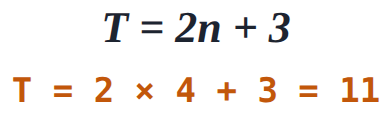
"3 more than twice n": twice n is 2n, then 3 more gives 2n + 3. With n = 4: 2 \times 4 + 3 = 11.
"3 more than twice nn": twice nn is 2n2n, then 3 more gives 2n+32n + 3. With n=4n = 4: 2×4+3=112 \times 4 + 3 = 11.
Say it in steps, then write each step · Sound on for the voiceover
Open the lesson →

When brackets are needed

Try firstWrite an expression for: (a) add 6 to n, then multiply by 3; (b) multiply n by 3, then add 6. Which one gives 15 when n = 3?

Check your answer

(a) 3(n + 6); (b) 3n + 6. (b): 3 × 3 + 6 = 15; (a) gives 27.

Brackets group a part so it is worked out first.

If a sentence says to do something to the whole result of an earlier step, put that earlier step in brackets. "Add 3 to n, then double the result" is 2(n+3)2(n + 3).

If the later step is adding or subtracting, brackets are not needed: "double n, then add 3" is 2n+32n + 3.

The two are different. With n=4n = 4: 2(n+3)=142(n + 3) = 14 and 2n+3=112n + 3 = 11.

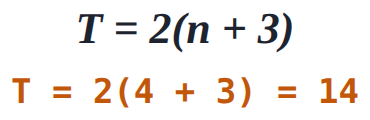
"Add 3 to n, then double the result": the brackets keep n + 3 together, so 2(n + 3). With n = 4: 2(4 + 3) = 14. Without brackets, 2n + 3 = 11.
"Add 3 to nn, then double the result": the brackets keep n+3n + 3 together, so 2(n+3)2(n + 3). With n=4n = 4: 2(4+3)=142(4 + 3) = 14. Without brackets, 2n+3=112n + 3 = 11.
Brackets keep a part together · Sound on for the voiceover
Open the lesson →

An expression for any case

Try firstA gym costs 30 dollars to join plus 15 dollars a week. Write what your letter stands for, an expression for the total, and the cost after 8 weeks.

Check your answer

Let w be the number of weeks. Total = 15w + 30. After 8 weeks: 15 × 8 + 30 = 150 dollars.

To write an expression for a situation: (1) say what the letter stands for: the number that changes, such as the number of guests; (2) multiply it by the amount for each one; (3) add anything paid only once.

A hall costing 60 dollars plus 5 dollars per guest, with gg guests, is 5g+605g + 60.

Test the expression with one case you can check in words, then use it for any number.

The letter stands for a number, not for the objects: in 3a3a, aa is how many apples.

Let g be the number of guests. A hall costs 60 dollars plus 5 dollars per guest: C = 5g + 60. With 10 guests: 5 \times 10 + 60 = 110 dollars.
Let gg be the number of guests. A hall costs 60 dollars plus 5 dollars per guest: C=5g+60C = 5g + 60. With 10 guests: 5×10+60=1105 \times 10 + 60 = 110 dollars.
Say what the letter stands for, then write the expression · Sound on for the voiceover
Open the lesson →

Growing patterns

Try firstA pattern has 6, 11, 16 tiles in Figures 1 to 3. Write the rule and find Figure 20.

Check your answer

s = 5n + 1; Figure 20 has 101 tiles.

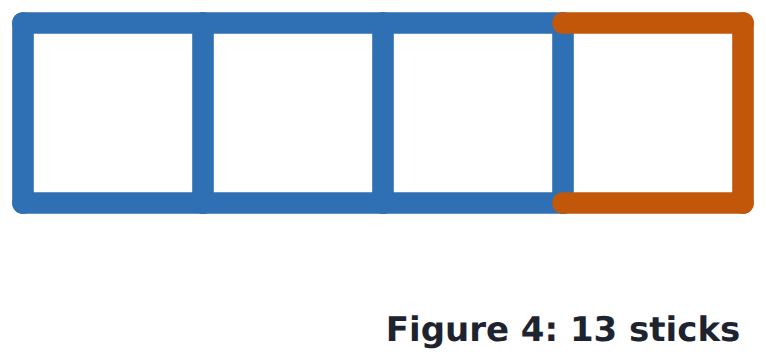
A growing pattern adds the same amount each time. Look at what each new figure adds: for a row of squares made of sticks, each new square adds 3 sticks (it shares a side).

So figure nn has nn lots of 3, plus what every figure has before that: 1 stick on the left. The rule is s=3n+1s = 3n + 1.

The rule gives any figure without drawing it: Figure 10 has 3×10+1=313 \times 10 + 1 = 31 sticks. To go backwards, solve: 3n+1=463n + 1 = 46 gives n=15n = 15.

Figure 4 has 13 sticks. Each new square adds 3 (orange), and there is 1 extra stick at the start: s = 3n + 1.
Figure 4 has 13 sticks. Each new square adds 3 (orange), and there is 1 extra stick at the start: s=3n+1s = 3n + 1.
Each figure adds the same amount: that gives the rule · Sound on for the voiceover
Open the lesson →

Tables from rules

Try firstMake a table for y = 4x − 3 with the inputs 0, 1, 2, 3. Write the pairs.

Check your answer

Outputs −3, 1, 5, 9. Pairs (0, −3), (1, 1), (2, 5), (3, 9).

A rule like y=2x+3y = 2x + 3 turns an input xx into an output yy. To make a table of values, choose some inputs, put each one in place of xx, and work out its output.

Each input and its output make an ordered pair (x,y)(x, y): input first, output second. For x=4x = 4: y=2(4)+3=11y = 2(4) + 3 = 11, so the pair is (4,11)(4, 11), not (11,4)(11, 4) and not (4,4)(4, 4).

To go backwards (which input gives an output of 15?), set the rule equal to it and solve: 2x+3=152x + 3 = 15, so x=6x = 6.

Input x, work out y, write the pair (x, y) · Sound on for the voiceover
Open the lesson →

Plotting a rule

Try firstPlot the pairs of y = 3x − 1 for x = 0 to 3. Describe the graph.

Check your answer

(0, −1), (1, 2), (2, 5), (3, 8): a straight line going up 3 for each step right, crossing the y-axis at −1.

To plot the point (x,y)(x, y), start at (0,0)(0, 0), go across xx and then up yy. A negative number goes left or down.

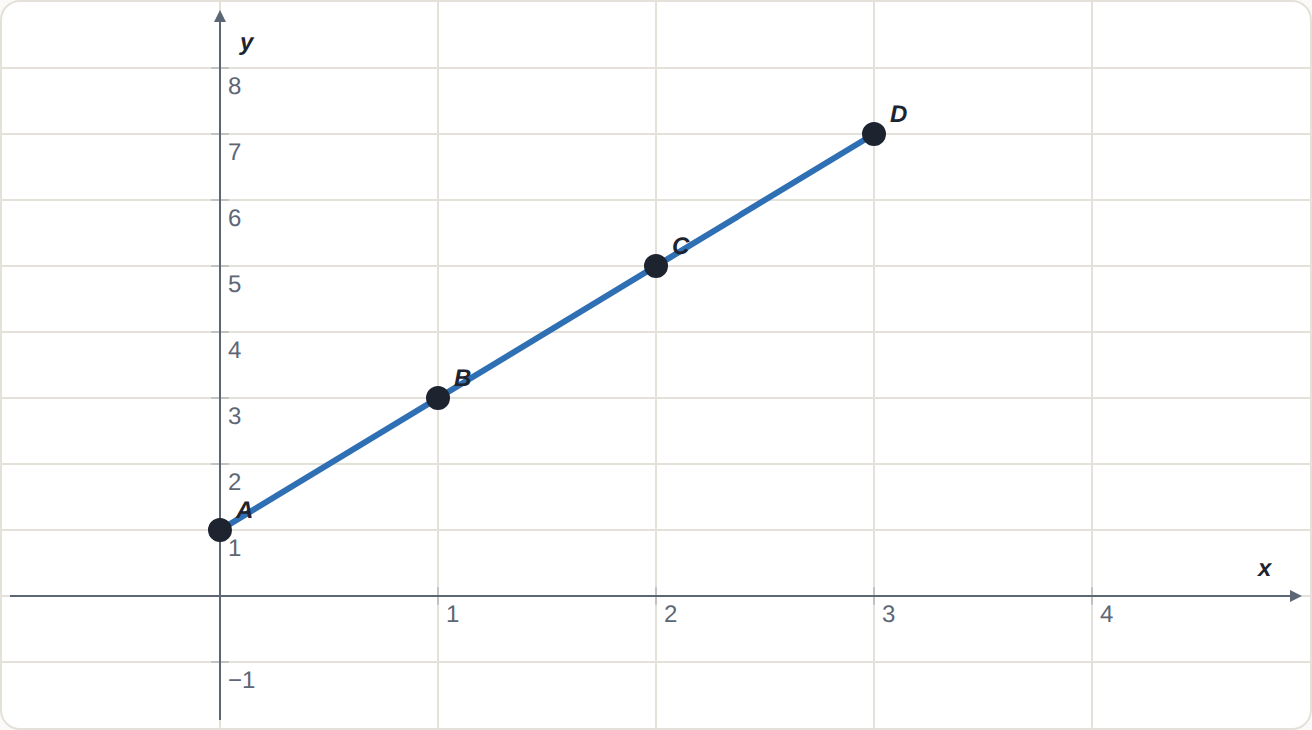
Plot each ordered pair from a rule's table. For y=2x+1y = 2x + 1 the pairs (0,1)(0, 1), (1,3)(1, 3), (2,5)(2, 5), (3,7)(3, 7) lie on a straight line, because each step of 1 across adds the same amount (2) to yy.

Describe the line by which way it goes and how much for each step: "up 2 for each step right, crossing the yy-axis at 1". If the steps in the table change, the points curve instead.

The pairs of y = 2x + 1: (0, 1), (1, 3), (2, 5), (3, 7). They lie on a straight line, going up 2 for each step right.
The pairs of y=2x+1y = 2x + 1: (0,1)(0, 1), (1,3)(1, 3), (2,5)(2, 5), (3,7)(3, 7). They lie on a straight line, going up 2 for each step right.
Open the lesson →

Reading a graph

Try firstA graph of height (cm) against age (years) has the point (12, 150). What does it say?

Check your answer

At 12 years the height is 150 cm.

A graph of real data pairs two measurements. Check the axis labels first: one measurement is across (the bottom axis) and the other is up the side.

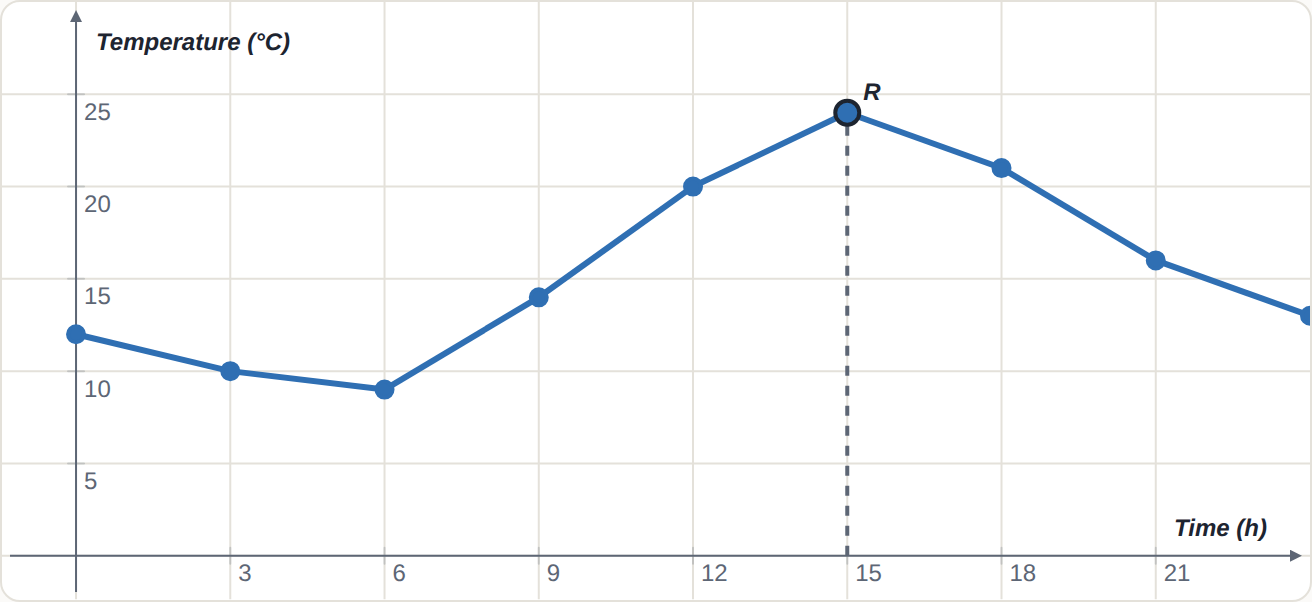
To read a graph, find the value you know on its own axis, go to the line, then read across to the other axis. The point (15,24)(15, 24) on a graph of temperature against time says: at 15 hours the temperature is 24 °C. Give the units in your answer.

The two numbers of a point belong to different axes. Swapping them gives a different (and wrong) statement.

At 15 hours the temperature is 24 °C: find 15 on the Time axis, go up to the line, read across to the Temperature axis. The point is (15, 24).
At 15 hours the temperature is 24 °C: find 15 on the Time axis, go up to the line, read across to the Temperature axis. The point is (15,24)(15, 24).
Find one value, go to the line, read the other · Sound on for the voiceover
Open the lesson →

Describing a relationship

Try firstA graph of a tap's water in a bucket (L) against time (min) goes up, then is flat. Describe it.

Check your answer

As time increases, the amount of water increases, then stays constant (the tap was turned off).

A graph shows how one measurement changes as another changes. Describe it one section at a time: as time increases, the other measurement increases, decreases or stays constant.

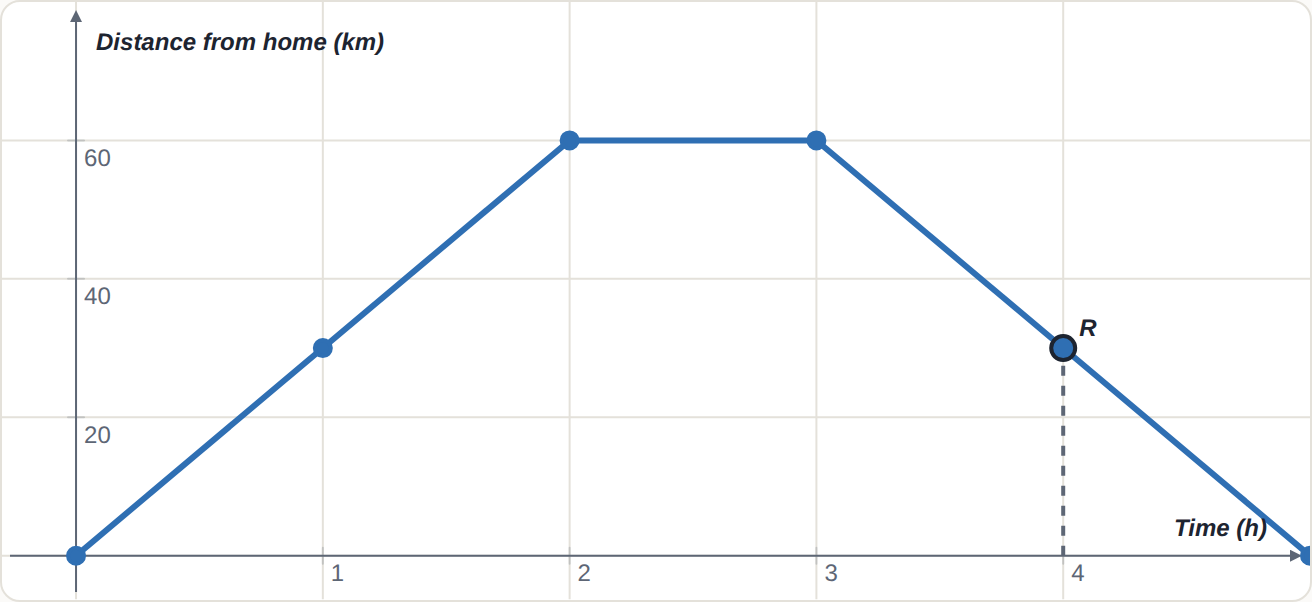
For the bike ride: from 0 to 2 hours the distance from home increases, from 2 to 3 hours it stays constant (the cyclist has stopped), and from 3 to 5 hours it decreases (riding home).

A graph is not a picture of the journey. A line going down does not mean going downhill: it means the measurement on the up-axis is getting smaller.

A bike ride. 0 to 2 hours: the distance from home increases. 2 to 3 hours: it stays constant (stopped). 3 to 5 hours: it decreases (riding home).
Describe one section at a time · Sound on for the voiceover
Open the lesson →

Changing one thing at a time

Try firstIn V = lwh with l = 2, w = 3, h = 4, h goes to 8 and nothing else changes. What is V?

Check your answer

48: 2 × 3 × 8, double the 24 it was.

To see what one variable does in a formula, change that variable only and keep the others the same, then record the results in a table.

In V=lwhV = lwh, doubling any one variable doubles VV. In A=s×sA = s \times s, doubling ss makes AA four times as big.

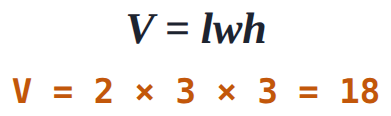
With l = 2 and w = 3 held still, a taller box (h = 3) has volume 2 \times 3 \times 3 = 18.
With l=2l = 2 and w=3w = 3 held still, a taller box (h = 3) has volume 2×3×3=182 \times 3 \times 3 = 18.
Only h changes · Sound on for the voiceover
Open the lesson →

Equations as a balance

Try firstIs x = 7 a solution of 3x − 5 = 16? Show how you know.

Check your answer

Yes. 3 × 7 − 5 = 21 − 5 = 16, which equals the right side.

An equation says two things are equal: 2x+3=112x + 3 = 11 says "two lots of something, plus 3, is 11".

The solution is the value that makes it true. To check a value, put it in place of the letter (this is called substitution) and work out each side. If both sides are the same, it is a solution.

Remember: 2x2x means 2×x2 \times x. If x=4x = 4, then 2x2x is 8, not 24.

Open the lesson →

Solving by backtracking

Try firstSolve 5x + 6 = 41 by backtracking. Show each step and check your answer.

Check your answer

41 − 6 = 35, then 35 ÷ 5 = 7. Check: 5 × 7 + 6 = 41.

Backtracking means running an equation backwards. In 2x+3=112x + 3 = 11, xx is multiplied by 2, then 3 is added, and the answer is 11.

To find xx, undo each step with its opposite, starting with the last one: take away 3 (11−3=811 - 3 = 8), then divide by 2 (8÷2=48 \div 2 = 4).

Then check by running forwards: 2×4+3=112 \times 4 + 3 = 11. If it matches, you have the solution.

Open the lesson →

The balance method

Try firstSolve 4x + 3 = 2x + 11. Show each step and check your answer in the first equation.

Check your answer

Take 2x from both sides: 2x + 3 = 11. Take 3: 2x = 8. Divide by 2: x = 4. Check: 4 × 4 + 3 = 19 and 2 × 4 + 11 = 19.

An equation is like a balanced scale. If you do the same thing to both sides, it stays balanced, so the equation stays true.

To solve 2x+3=112x + 3 = 11: take 3 from both sides (2x=82x = 8), then divide both sides by 2 (x=4x = 4).

When xx is on both sides, take the same number of xx from both sides first.

Always check in the first equation: 2×4+3=112 \times 4 + 3 = 11 ✓.

Open the lesson →

Year 7 Measurement

Area of parallelograms

Try firstA parallelogram has base 9 cm, slanted side 5 cm and perpendicular height 4 cm. Find its area.

Check your answer

9 × 4 = 36 cm² (the 5 cm slanted side is not used).

A parallelogram is a rectangle pushed over. Cut the triangle off one end along the perpendicular height and move it to the other end: it becomes a rectangle with the same base and height. So:

A=b×hA = b \times h

where hh is the perpendicular height, at a right angle to the base, not the slanted side. Area is in square units: cm², m².

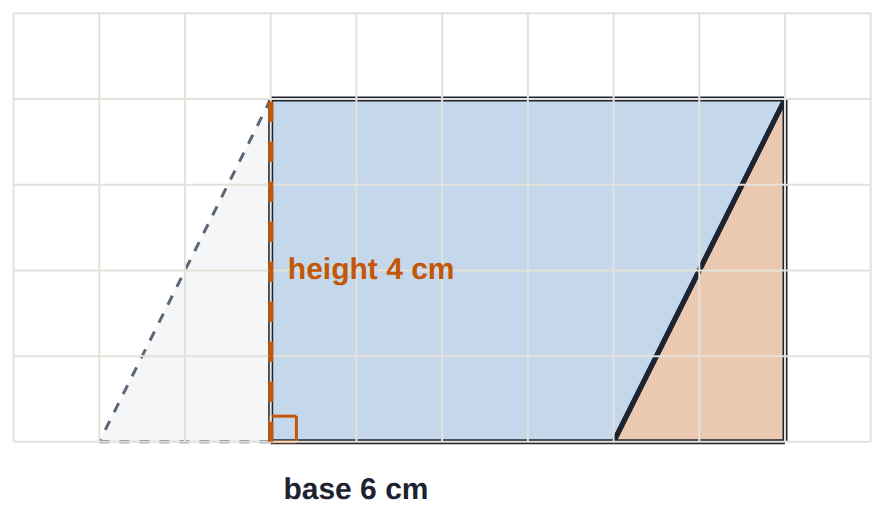
The triangle cut off the left end fills the gap on the right: a 6 by 4 rectangle, so the parallelogram's area is 6 \times 4 = 24 cm².
The triangle cut off the left end fills the gap on the right: a 6 by 4 rectangle, so the parallelogram's area is 6×4=246 \times 4 = 24 cm².
Cut and move · Sound on for the voiceover
Open the lesson →

Area of triangles

Try firstA triangle has base 9 cm and height 6 cm. Find its area. A triangle with area 24 cm² has base 8 cm: find its height.

Check your answer

½ × 9 × 6 = 27 cm². ½ × 8 × h = 24, so h = 6 cm.

Two copies of a triangle, one turned round, make a parallelogram with the same base and height. So the triangle's area is half of base × height:

A=12×b×hA = \tfrac{1}{2} \times b \times h

The height is perpendicular to the base. If the top leans past the end of the base, extend the base: the height meets it outside the triangle. Moving the top along a line parallel to the base keeps the area.

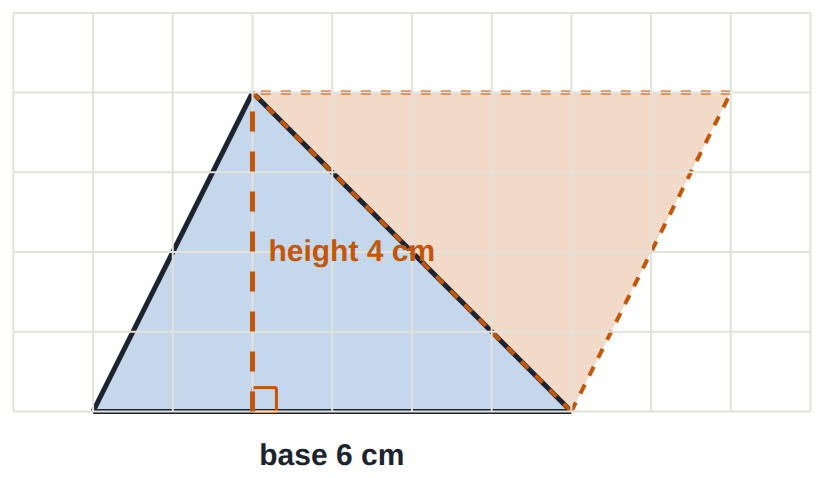
A turned copy (dashed) makes a parallelogram, 6 \times 4 = 24 cm². The triangle is half: \tfrac{1}{2} \times 6 \times 4 = 12 cm².
A turned copy (dashed) makes a parallelogram, 6×4=246 \times 4 = 24 cm². The triangle is half: 12×6×4=12\tfrac{1}{2} \times 6 \times 4 = 12 cm².
Half a parallelogram · Sound on for the voiceover
Open the lesson →

Area problems

Try firstA shape is a 7 m by 4 m rectangle with a triangle on top (base 7 m, height 2 m). Find its area.

Check your answer

28 + ½ × 7 × 2 = 28 + 7 = 35 m².

Area problems have three moves:

  • Choose the base and the height at a right angle to it; a slanted side is extra information.
  • Convert every length to the same unit first (250 cm = 2.5 m). Area is in square units, and 1 m² = 10 000 cm².
  • Split a shape into rectangles and triangles and add the parts, or subtract a missing part from a bigger shape.
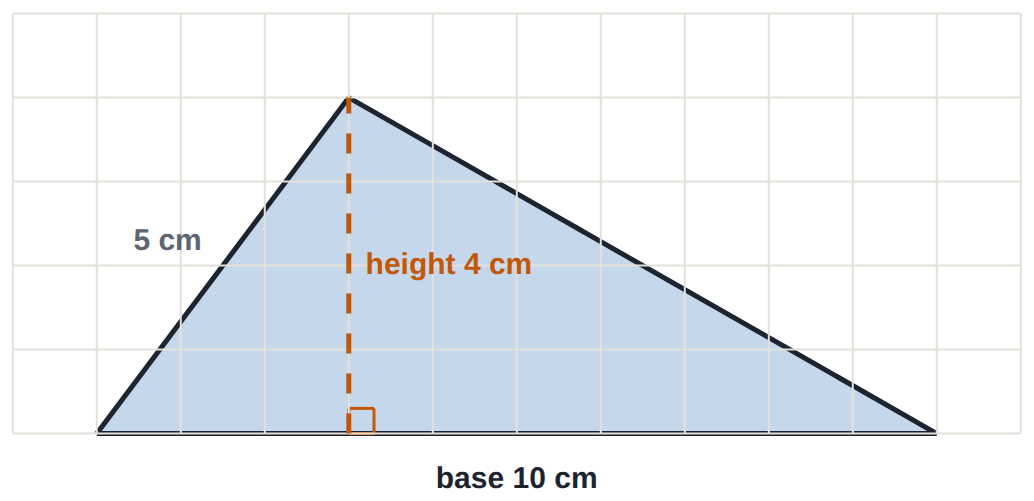
Base 10 cm, height 4 cm, and a slanted side of 5 cm. The area uses the base and the height at a right angle to it: \tfrac{1}{2} \times 10 \times 4 = 20 cm².
Base 10 cm, height 4 cm, and a slanted side of 5 cm. The area uses the base and the height at a right angle to it: 12×10×4=20\tfrac{1}{2} \times 10 \times 4 = 20 cm².
Choose the right lengths · Sound on for the voiceover
Open the lesson →

Volume in layers

Try firstA box is 5 cm by 4 cm by 3 cm. Find its volume. A box with base 6 cm² has volume 42 cm³: how high is it?

Check your answer

5 × 4 × 3 = 60 cm³. 42 ÷ 6 = 7 cm.

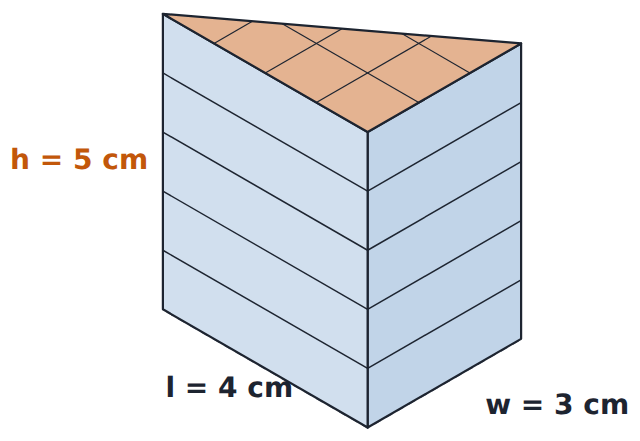
Volume counts unit cubes (cm³, m³). A prism fills up in layers: each layer covers the base, so it has as many cubes as the base has squares. The number of layers is the height:

V=A×hV = A \times h

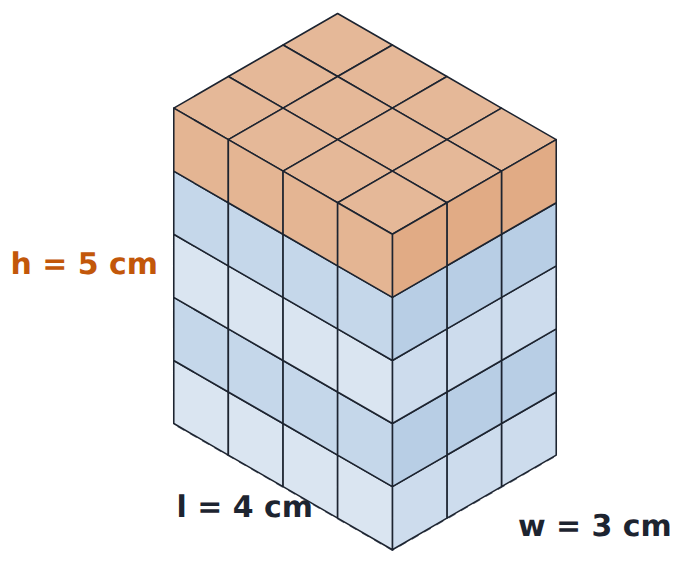
For a box, A=l×wA = l \times w, so V=l×w×hV = l \times w \times h. The cubes fill the inside, not just the outside you can see.

Each layer is the 4 by 3 base: 12 cubes. 5 layers: 12 \times 5 = 60 cm³.
Each layer is the 4 by 3 base: 12 cubes. 5 layers: 12×5=6012 \times 5 = 60 cm³.
Layer on layer · Sound on for the voiceover
Open the lesson →

Prisms and capacity

Try firstA prism's triangle end has base 5 cm and height 4 cm; it is 6 cm long. Find its volume and its capacity in mL.

Check your answer

½ × 5 × 4 = 10 cm², × 6 = 60 cm³ = 60 mL.

A right prism has the same cross-section all the way along. Its volume is that slice's area times the length:

V=A×hV = A \times h

For a triangular prism, the cross-section is a triangle: halve first (12×6×4=12\tfrac{1}{2} \times 6 \times 4 = 12 cm², then ×10=120\times 10 = 120 cm³). Capacity: 1 cm³ holds 1 mL, and 1000 cm³ = 1 L.

The triangle is half of a 4 by 3 rectangle: 6 cm². 5 layers of it: 6 \times 5 = 30 cm³.
The triangle is half of a 4 by 3 rectangle: 6 cm². 5 layers of it: 6×5=306 \times 5 = 30 cm³.
The same all the way along · Sound on for the voiceover
Open the lesson →

Parts of a circle

Try firstA circular pond has diameter 9 m. Find its radius. What is a chord?

Check your answer

4.5 m. A straight line joining two points on the circle.

A circle is all the points the same distance (the radius, rr) from its centre.

  • The diameter (dd) goes right across through the centre: d=2rd = 2r, and r=d÷2r = d \div 2.
  • A chord joins any two points; the diameter is the longest chord.
  • The circumference (CC) is the distance all the way round.
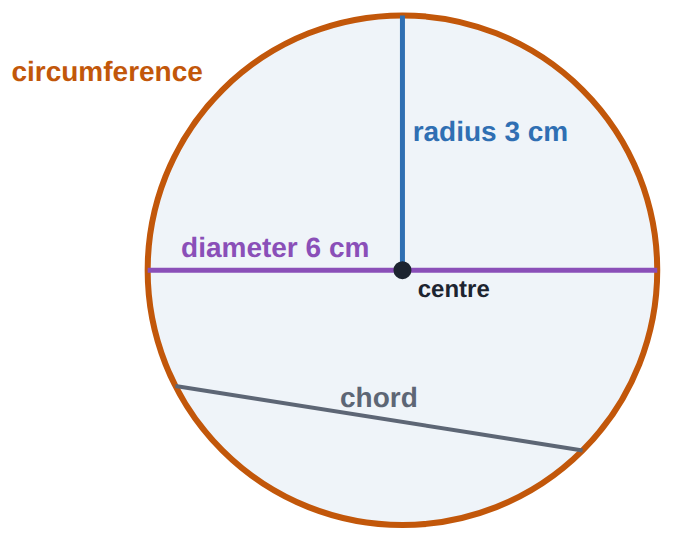
Centre, radius (3 cm), diameter (6 cm: two radii), a chord, and the circumference all the way round.
Radius and diameter · Sound on for the voiceover
Open the lesson →

Discovering π

Try firstWhat is π? Estimate the circumference of a circle with diameter 20 cm.

Check your answer

π is the circumference divided by the diameter, the same for every circle, about 3.14. C ≈ 3.14 × 20 = 62.8 cm.

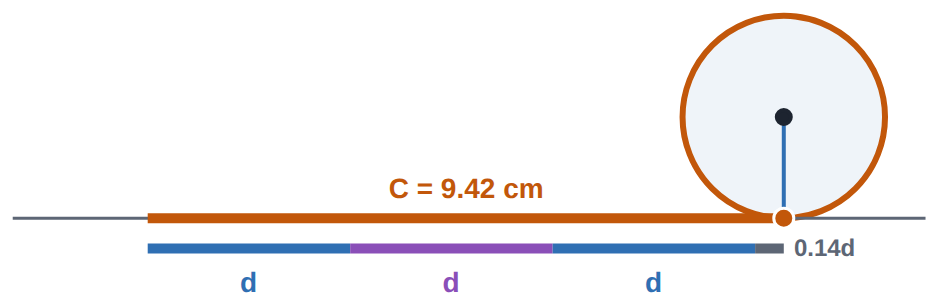
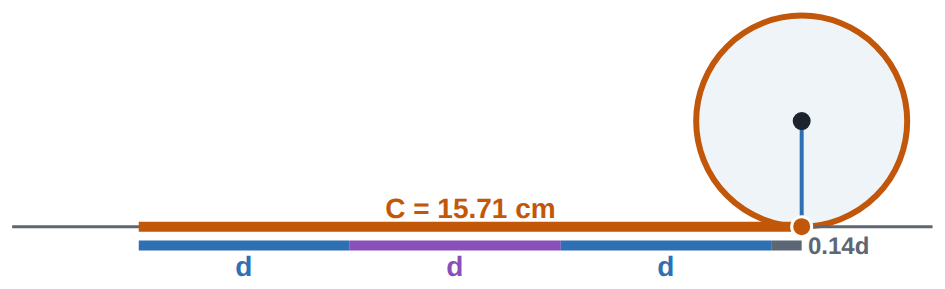
Roll a circle out flat for one turn and its circumference is a bit more than 3 diameters. For every circle, the circumference divided by the diameter is the same number, π:
π=Cd=3.14159…\pi = \frac{C}{d} = 3.14159\ldots

π's digits never end and never settle into a repeating pattern; 3.14 and 227\tfrac{22}{7} are approximations. A quick estimate: the circumference is a bit more than 3 diameters.
Rolled out flat, the circumference is 3 diameters and a little bit more (about 0.14 of a diameter): C \div d \approx 3.14.
Rolled out flat, the circumference is 3 diameters and a little bit more (about 0.14 of a diameter): C÷d≈3.14C \div d \approx 3.14.
Roll it out · Sound on for the voiceover
Open the lesson →

Circumference

Try firstFind the circumference of a circle with radius 4 cm. A circle has circumference 12.56 cm: find its diameter. (π ≈ 3.14)

Check your answer

2 × 3.14 × 4 = 25.12 cm. 12.56 ÷ 3.14 = 4 cm.

Because C÷d=πC \div d = \pi, the circumference is

C=πd=2πrC = \pi d = 2\pi r

Use the diameter (or double the radius). Going backwards, divide by π: d=C÷πd = C \div \pi. An exact answer keeps π: a circle with diameter 10 cm has C=10πC = 10\pi cm, about 31.4 cm.

Radius 2.5 cm, diameter 5 cm: rolled out, C = \pi \times 5 \approx 15.71 cm.
Radius 2.5 cm, diameter 5 cm: rolled out, C=π×5≈15.71C = \pi \times 5 \approx 15.71 cm.
C = πd · Sound on for the voiceover
Open the lesson →

Angles at parallel lines

Try firstA transversal crosses two parallel lines. Which angle pairs are equal, and which pair adds to 180°?
Check your answer

Corresponding angles and alternate angles are equal (so are vertically opposite angles); co-interior angles add to 180°.
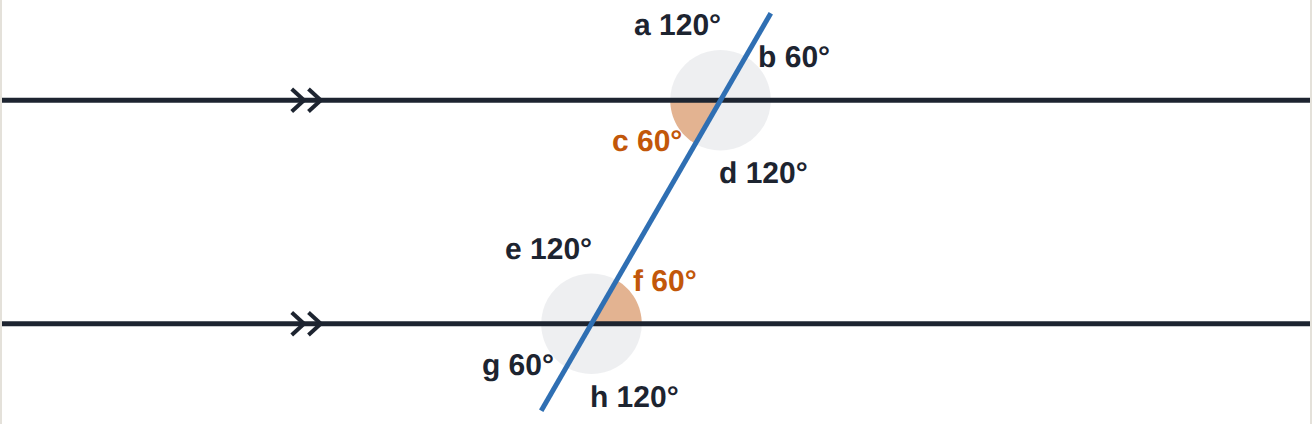
A line crossing two parallel lines (a transversal) makes eight angles, aa to hh. Each pair below takes one angle from each crossing:

  • corresponding: the same place at each crossing, such as aa and ee (an F shape);
  • alternate: between the parallel lines, on opposite sides of the transversal, such as cc and ff (a Z shape);
  • co-interior: between the parallel lines, on the same side, such as cc and ee (a C shape).

Two angles at one crossing, opposite each other, are vertically opposite: not one of these pairs.

c and f are alternate angles: between the parallel lines, on opposite sides of the crossing line. Both are 60^\circ.
cc and ff are alternate angles: between the parallel lines, on opposite sides of the crossing line. Both are 60∘60^\circ.
The angle pairs at parallel lines · Sound on for the voiceover
Open the lesson →

Finding angles with parallel lines

Try firstA transversal crosses two parallel lines. One angle is 75°. Find the angle corresponding to it, and the angle next to that one on a straight line, with a reason for each.

Check your answer

75° (corresponding angles are equal), then 180° − 75° = 105° (angles on a straight line).

When the lines are parallel:

  • corresponding angles are equal;
  • alternate angles are equal;
  • co-interior angles add to 180∘180^\circ (they are not equal unless both are 90∘90^\circ).

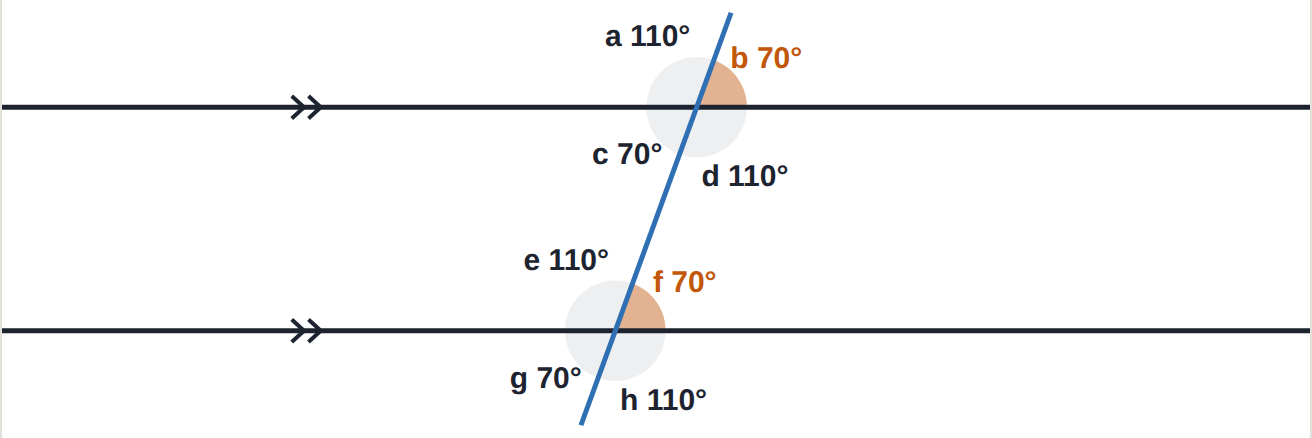
With vertically opposite angles (equal) and angles on a straight line (add to 180∘180^\circ), one angle gives all eight. Give a reason for each: "f=70∘f = 70^\circ, corresponding to bb". If the lines are not parallel, these rules do not hold.

b and f are corresponding, so both are 70^\circ. From one angle, every other is 70^\circ or 110^\circ.
bb and ff are corresponding, so both are 70∘70^\circ. From one angle, every other is 70∘70^\circ or 110∘110^\circ.
Equal pairs, and a pair that adds to 180° · Sound on for the voiceover
Open the lesson →

Reasoning with angles

Try firstA transversal crosses two parallel lines, making a 120° angle. Find the angle alternate to it and the angle co-interior to it, with reasons.

Check your answer

120° (alternate angles are equal) and 180° − 120° = 60° (co-interior angles add to 180°).

Most angle problems take more than one step. For each step:

  1. Know: an angle you already have.
  2. Choose: a rule that links it to a new angle: corresponding or alternate angles are equal, co-interior angles add to 180∘180^\circ, vertically opposite angles are equal, angles on a straight line add to 180∘180^\circ.
  3. Say why: write the rule as the reason.

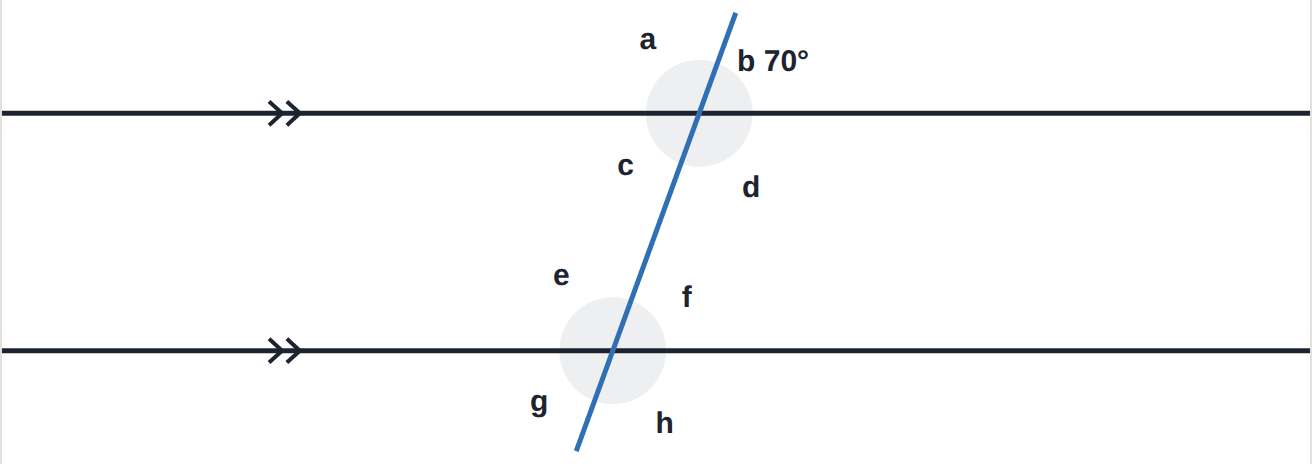
b=70∘b = 70^\circ: f=70∘f = 70^\circ (corresponding to bb), then h=110∘h = 110^\circ (ff and hh are on a straight line). If two angles only look related, find one in between that a rule links to both.

b = 70^\circ. Then f = 70^\circ (corresponding to b) and h = 110^\circ (f and h are on a straight line).
b=70∘b = 70^\circ. Then f=70∘f = 70^\circ (corresponding to bb) and h=110∘h = 110^\circ (ff and hh are on a straight line).
One step at a time, each with a reason · Sound on for the voiceover
Open the lesson →

Angles in a triangle

Try firstA student says the angles of a very large triangle add to more than 180°. Explain why they are wrong.

Check your answer

Every triangle's angles add to 180°: tear off the corners and they fill a straight line. Size changes the sides, not the angles.

The three angles of any triangle add to 180°180°.

When you change a triangle's shape, one angle grows and the others shrink by exactly as much. Making it bigger without changing its shape does not change the angles at all.

Why? Tear off the three corners and put their points together: they fill a straight line, and angles on a straight line add to 180°180°.

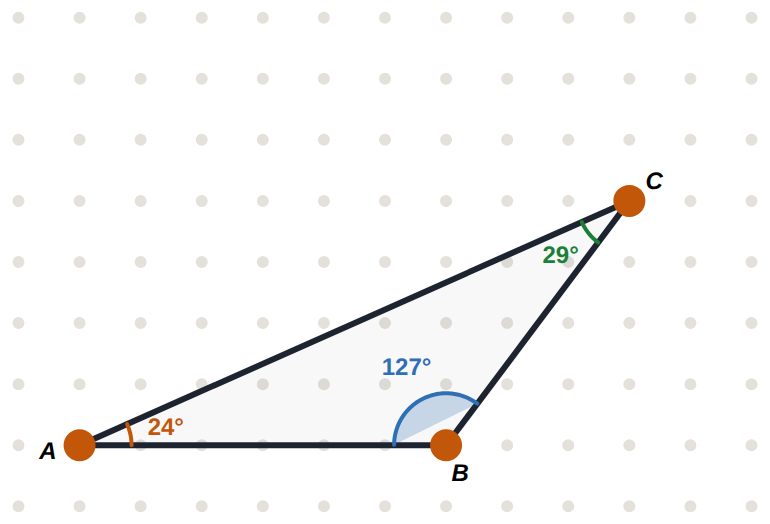
An obtuse triangle: 24° + 127° + 29° = 180°.
An obtuse triangle: 24°+127°+29°=180°24° + 127° + 29° = 180°.
A triangle's angles add to 180° · Sound on for the voiceover
Open the lesson →

Angles in a polygon

Try firstFind the angle sum of a heptagon (7 sides), and explain your method.

Check your answer

900°. From one corner it splits into 7 − 2 = 5 triangles, and 5 × 180° = 900°.

To find the angle sum of a polygon, split it into triangles from one corner: draw lines from that corner to every corner that is not next to it.

A shape with nn sides splits into n−2n - 2 triangles, and their angles exactly fill the polygon's corners. So the angle sum is (n−2)×180°(n - 2) \times 180°.

A quadrilateral: 2×180°=360°2 \times 180° = 360°. A pentagon: 3×180°=540°3 \times 180° = 540°. A hexagon: 4×180°=720°4 \times 180° = 720°.

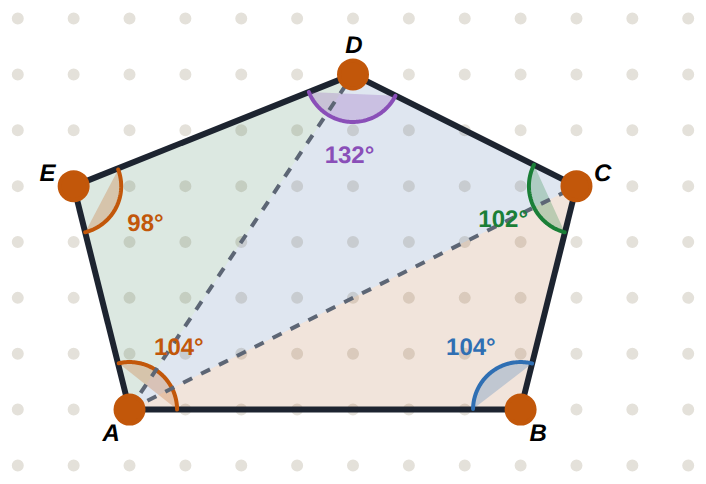
A pentagon splits into 3 triangles from A: 3 \times 180° = 540°.
A pentagon splits into 3 triangles from AA: 3×180°=540°3 \times 180° = 540°.
Split it into triangles · Sound on for the voiceover
Open the lesson →

Unknown angles in shapes

Try firstA triangle has angles of 48° and 67°. Find the third angle, and the exterior angle next to it, with reasons.

Check your answer

180° − 48° − 67° = 65° (angles in a triangle). Exterior angle 180° − 65° = 115° (a straight line). Check: 48° + 67° = 115°.

To find an unknown angle in a shape, choose the angle sum for the shape: 180∘180^\circ for a triangle, (n−2)×180∘(n - 2) \times 180^\circ for nn sides (360∘360^\circ for a quadrilateral, 540∘540^\circ for a pentagon). Add the angles you know and subtract from the sum.

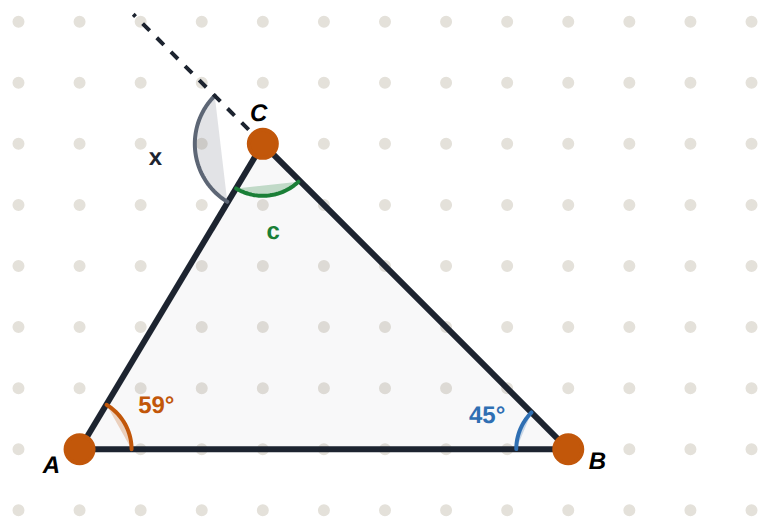
Combine it with other facts, one step at a time, each with a reason. Extend a side of a triangle and the outside angle xx makes a straight line with cc: x=180∘−cx = 180^\circ - c. Since a+b=180∘−ca + b = 180^\circ - c too, x=a+bx = a + b.

a = 59^\circ, b = 45^\circ. Then c = 76^\circ (angles in a triangle add to 180^\circ) and x = 104^\circ (c and x are on a straight line). And x = a + b.
a=59∘a = 59^\circ, b=45∘b = 45^\circ. Then c=76∘c = 76^\circ (angles in a triangle add to 180∘180^\circ) and x=104∘x = 104^\circ (cc and xx are on a straight line). And x=a+bx = a + b.
From the angle sum to the exterior angle · Sound on for the voiceover
Open the lesson →

Modelling with ratios

Try firstA recipe mixes juice and water 2 : 7. How much juice is in a 900 mL drink?

Check your answer

2 + 7 = 9 parts. 900 ÷ 9 = 100 mL a part. Juice is 200 mL.

Modelling with ratios: formulate (what is known, what is unknown, what relationship?), solve, then interpret (the answer in the situation's units, and does it make sense?).

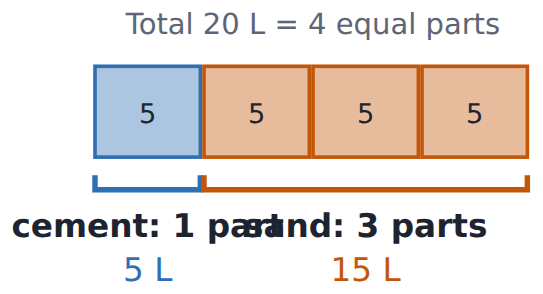
For a mix, add the parts and find one part: a dry mix 1 : 3 in 20 L has 4 parts of 5 L, so 5 L of cement and 15 L of sand. For a scale such as 1:501 : 50, each 1 cm on the drawing is 50 cm in real life.

20 L of mortar in the ratio 1 : 3: 4 equal parts of 5 L. Cement 5 L, sand 15 L.
From a problem to a ratio · Sound on for the voiceover
Open the lesson →

Year 7 Space

Classifying triangles

Try firstA triangle has angles 30°, 30° and 120°. Name it by its sides and its angles.

Check your answer

Isosceles (two equal angles, so two equal sides) and obtuse (120°).

Name a triangle by its sides: scalene (none equal), isosceles (two equal), equilateral (all three equal). And by its biggest angle: acute (all under 90°), right-angled (one is 90°), obtuse (one over 90°).

Equal sides sit opposite equal angles. So an equilateral triangle has three 60° angles, and can never be right-angled or obtuse.

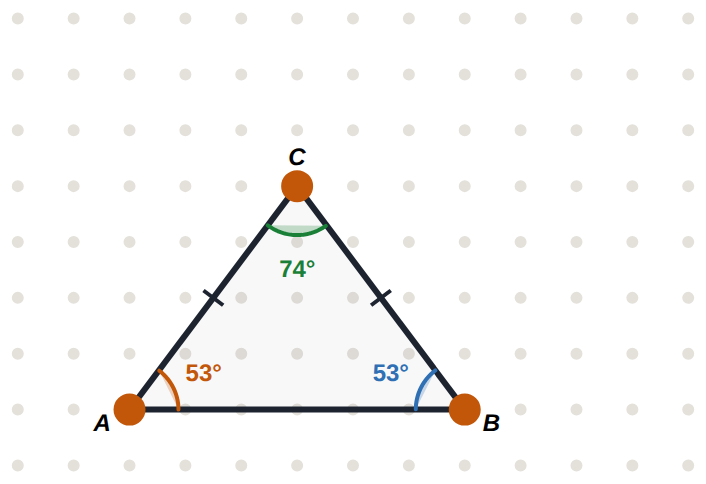
Two sides are marked with a tick: they are equal, so the triangle is isosceles. Every angle is less than 90°, so it is also acute.
Two names for a triangle · Sound on for the voiceover
Open the lesson →

The quadrilateral family

Try firstA shape has two pairs of parallel sides and four equal sides but no right angles. Give all its names.

Check your answer

Rhombus, parallelogram and kite.

A quadrilateral's name comes from its properties: a trapezium has at least one pair of parallel sides; a parallelogram two; a rhombus four equal sides; a rectangle four right angles; a square four equal sides and four right angles; a kite two pairs of equal sides next to each other.

A shape with all of another name's properties belongs to that family too: every square is a rectangle and a rhombus, every rhombus and rectangle is a parallelogram, and every parallelogram is a trapezium.

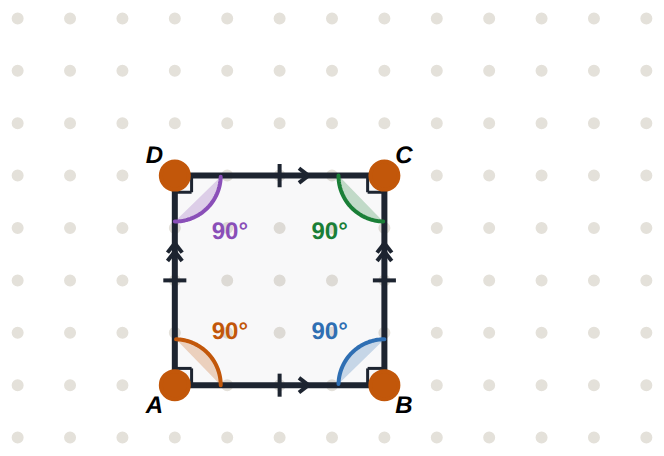
A square: four equal sides (ticks), two pairs of parallel sides (arrows) and four right angles. So it is also a rectangle, a rhombus, a parallelogram, a trapezium and a kite.
Named by properties · Sound on for the voiceover
Open the lesson →

Polygons

Try firstA pentagon has angles 100°, 110°, 110°, 100° and 120°. Is it regular? Convex or concave?

Check your answer

Irregular (its angles are not equal), convex (every angle under 180°).

A polygon is named by its number of sides: pentagon 5, hexagon 6, heptagon 7, octagon 8, nonagon 9, decagon 10.

It is regular when all its sides and all its angles are equal (a rhombus has equal sides but is not regular). It is concave when a corner points in (an angle over 180°), and convex when every corner points out.

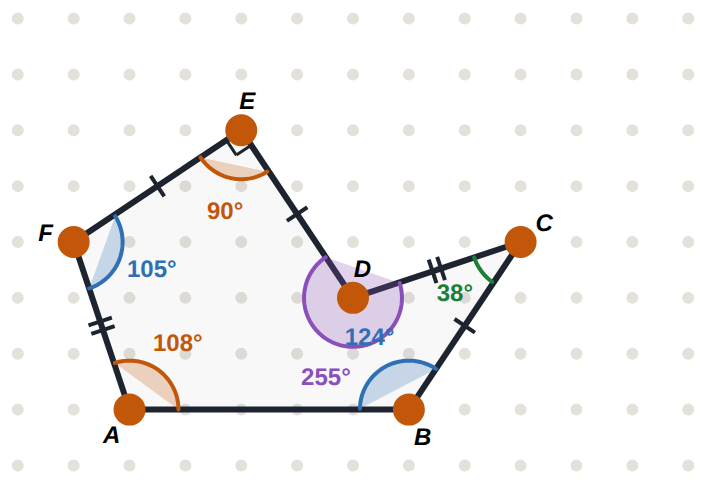
A hexagon with one corner pointing in: concave. Its sides are not all equal, so it is irregular too.
Regular, or not · Sound on for the voiceover
Open the lesson →

Nets

Try firstA net of six squares has four in a row, one above and one below. Does it fold into a cube? How can you tell?

Check your answer

Yes. The row of four wraps round the sides, and the extra two squares are the top and the bottom, so every face is covered once.

A net is a solid unfolded flat. A cube's net is six squares that fold to cover all six faces once; six squares alone is not enough, so test by folding.

A triangular prism's net is two triangles (the ends) and three rectangles (one for each side of the triangle). Its area is the surface area.

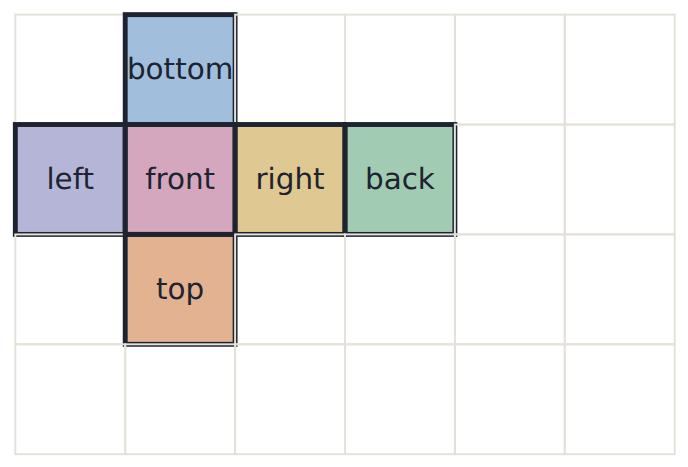
A cross of six squares folds into a cube: each square lands on a different face.
From a row to a net · Sound on for the voiceover
Open the lesson →

Views of a solid

Try firstA front view shows 3 squares. Does the pile have 3 cubes? Why or why not?

Check your answer

Not necessarily. The front view shows only the tallest pile in each column; there could be more cubes behind.

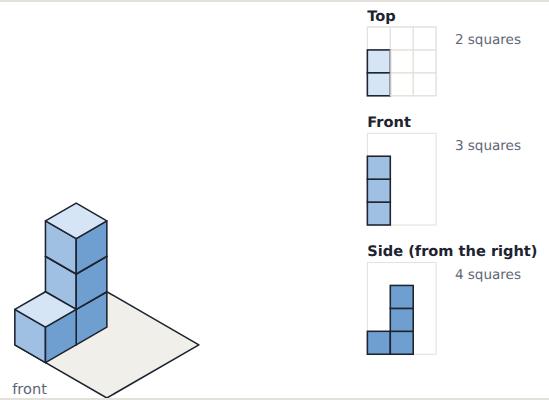
A view is what you see from one side. The top view (plan) looks down; the front and side views (elevations) look across. They show the tallest pile in each column, and hide cubes behind or beneath.

A top view with a number on each pile shows every cube. A net shows every face at its true size, but not what the solid looks like when built.

Three drawings of the same cubes: top, front and side. The tall pile hides the one behind it.
Build, then look · Sound on for the voiceover
Open the lesson →

Translations

Try firstA (2, 5) is translated 4 left and 3 down. Where is A′?

Check your answer

(−2, 2): x is 2 − 4 = −2 and y is 5 − 3 = 2.

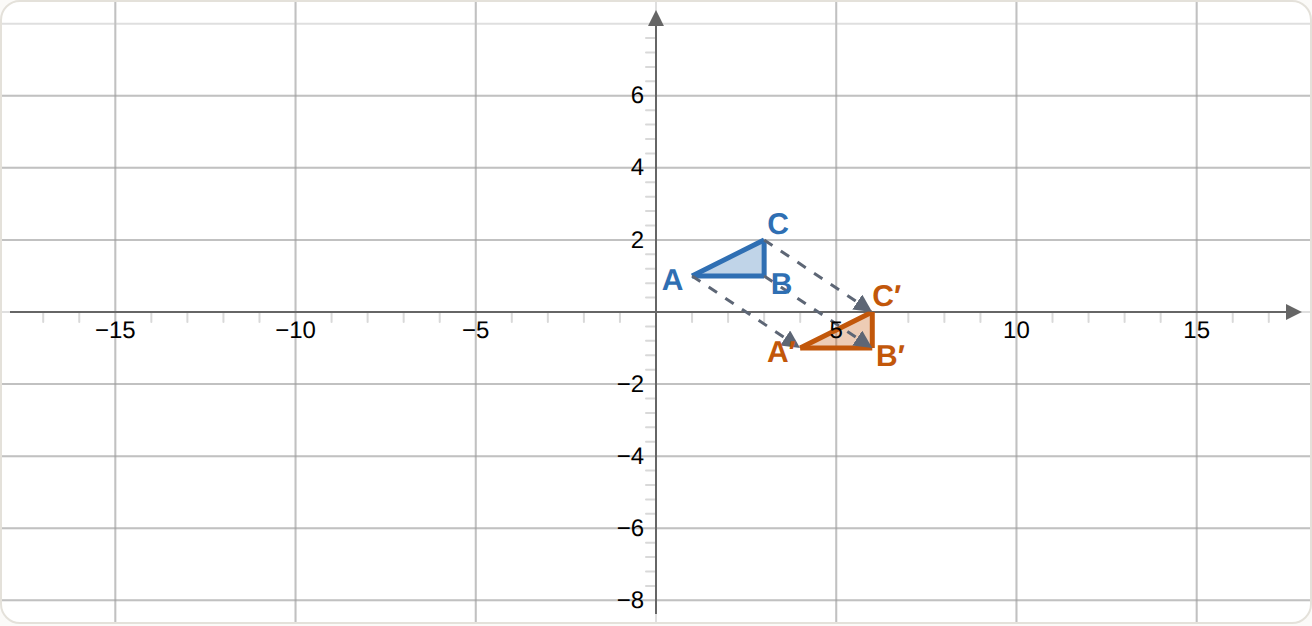
A translation slides every point of a shape the same distance in the same direction. The object becomes the image, and A becomes A′.

Right and up add; left and down take away. A translation of 3 right and 2 down changes (x,y)(x, y) to (x+3,y−2)(x + 3, y - 2).

The triangle moves 3 right and 2 down: every corner changes by (+3, -2).
The triangle moves 3 right and 2 down: every corner changes by (+3,−2)(+3, -2).
Slide, and read the change · Sound on for the voiceover
Open the lesson →

Reflections

Try firstThe point (5, −2) is reflected in the x-axis. Where is the image?

Check your answer

(5, 2): y changes sign.

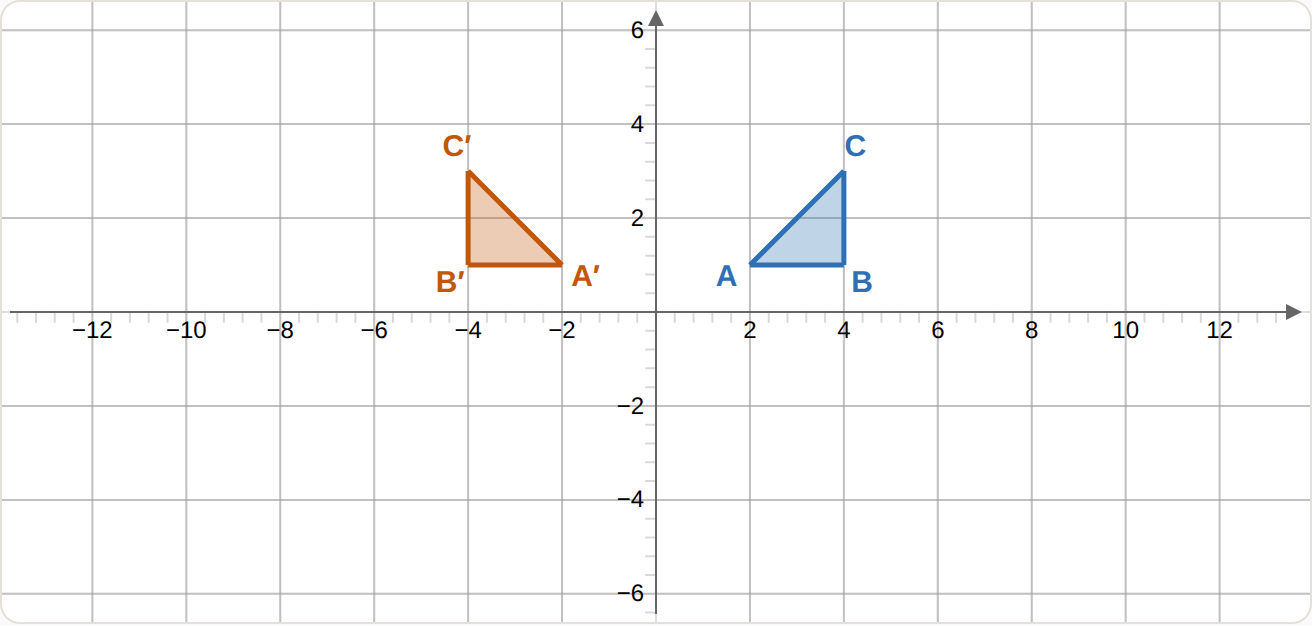
A reflection flips a shape over a mirror line; each point and its image are the same distance from the mirror, on opposite sides.

In the x-axis, (x,y)→(x,−y)(x, y) \to (x, -y). In the y-axis, (x,y)→(−x,y)(x, y) \to (-x, y).

The triangle reflected in the y-axis: (2, 1) becomes (-2, 1). The y-axis is halfway between each point and its image.
The triangle reflected in the y-axis: (2,1)(2, 1) becomes (−2,1)(-2, 1). The y-axis is halfway between each point and its image.
Two mirrors · Sound on for the voiceover
Open the lesson →

Rotations

Try firstThe point (2, 3) turns 180° about the origin. Where is the image?

Check your answer

(−2, −3): both signs change.

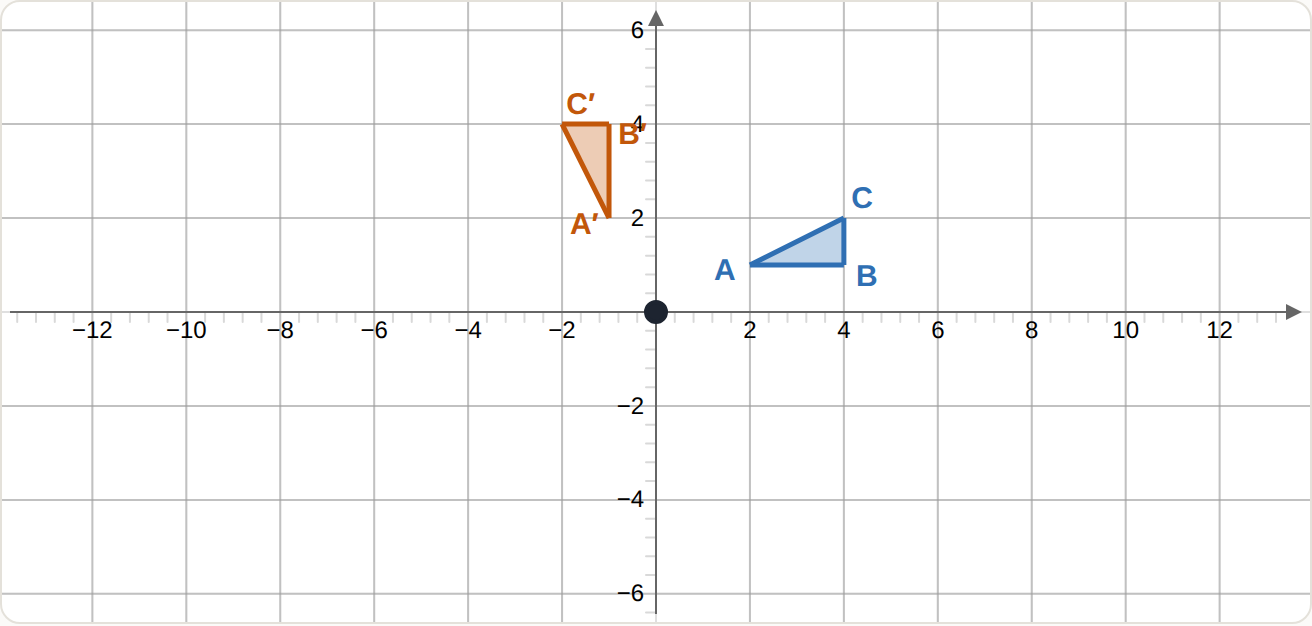
A rotation turns a shape about a centre by an angle in a direction (clockwise or anticlockwise). The shape keeps its size.

About the origin, anticlockwise: 90° changes (x,y)(x, y) to (−y,x)(-y, x); 180° changes it to (−x,−y)(-x, -y); 270° changes it to (y,−x)(y, -x).

A quarter turn anticlockwise about the origin: (2, 1) becomes (-1, 2).
A quarter turn anticlockwise about the origin: (2,1)(2, 1) becomes (−1,2)(-1, 2).
Turning about the origin · Sound on for the voiceover
Open the lesson →

Algorithms for classifying shapes

Try firstWhy must a classifier ask 'are all three sides equal?' before 'are two sides equal?'

Check your answer

An equilateral triangle has two equal sides too, so the wider question would give it the wrong name.

An algorithm is a precise series of steps and decisions. A classification algorithm asks yes/no questions about attributes and ends in one name for each shape.

Put the most specific question first, make sure every branch ends in a name, and test it on one shape of every class. A flowchart, a decision tree and numbered steps show the same algorithm.

Following an algorithm · Sound on for the voiceover
Open the lesson →

Year 7 Statistics

Counting and measuring

Try firstClassify: (a) number of apps on a phone, (b) battery temperature, (c) screen size in inches. Explain one.

Check your answer

(a) discrete (counted), (b) continuous (measured), (c) continuous (measured, though sold in common sizes).

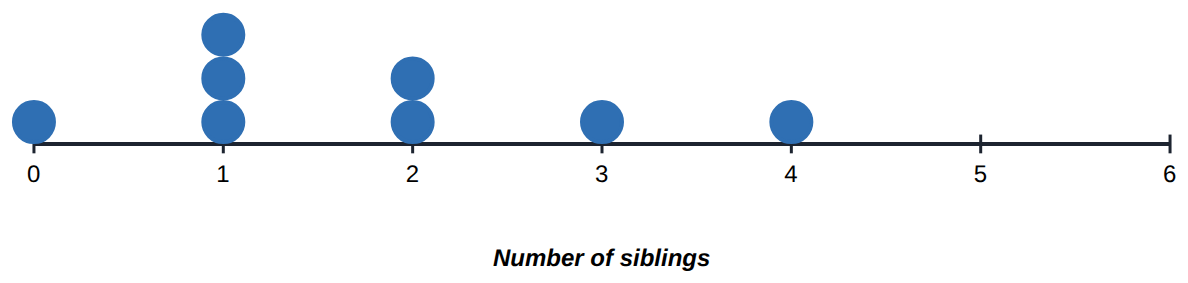
Discrete data is counted: it takes separate values, such as 0, 1, 2 siblings. Continuous data is measured: it can be any value in a range, such as a 100 m time of 14.37 s.

Measured values are always rounded: 152 cm to the nearest centimetre means from 151.5 cm up to 152.5 cm. Decimals alone do not make data continuous: shoe sizes (7, 7.5, 8) are discrete.

Number of siblings: counted, so only whole numbers (discrete). Nobody has 1.5 siblings.
Counted or measured? · Sound on for the voiceover
Open the lesson →

Mean, median, mode and range

Try firstFind the mean, median, mode and range of 6, 2, 9, 6, 7, 12.

Check your answer

Mean 42 ÷ 6 = 7; median (6 + 7) ÷ 2 = 6.5; mode 6; range 10.

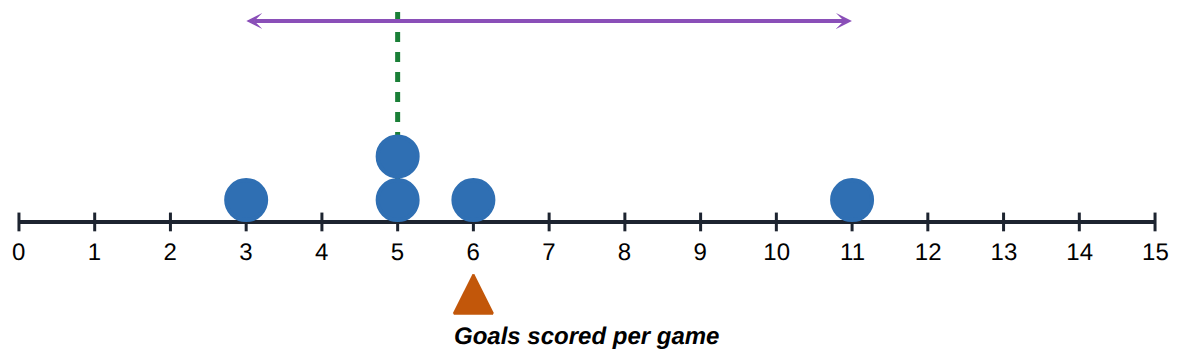
Four numbers sum up a data set:

  • mean: add the values, then divide by how many there are (3, 5, 5, 6, 11: 30 ÷ 5 = 6);
  • median: sort the values and take the middle one; for an even count, halfway between the two middle values;
  • mode: the most common value (there can be two, or none);
  • range: highest minus lowest (11 − 3 = 8), a measure of spread.
3, 5, 5, 6, 11: mean 6 (▲), median 5 (dashed), mode 5, range 11 − 3 = 8 (arrow).
Four numbers that sum up the data · Sound on for the voiceover
Open the lesson →

Which measure?

Try firstSalaries in a small company ($ thousands): 50, 52, 55, 58, 400. Which measure would you report as typical, and why?

Check your answer

The median, 55: the 400 is an outlier that pulls the mean up to 123, more than four of the five salaries.

The mean, median and mode can disagree. Look for outliers first (values far from the rest):

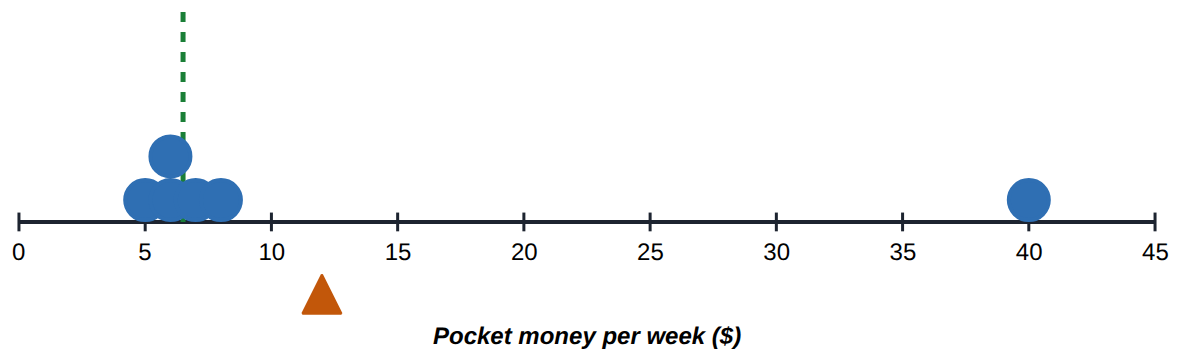
  • An outlier pulls the mean towards it, so with one the median usually describes a typical value better (5,6,6,7,8,405, 6, 6, 7, 8, 40: mean 12, median 6.5).
  • With no outliers, the mean is a fair summary because it uses every value.
  • For "which is most common?", use the mode.
One outlier (40) pulls the mean (▲) up to 12, past every other value; the median (dashed) stays at 6.5, among the typical values.
An outlier drags the mean · Sound on for the voiceover
Open the lesson →

Stem-and-leaf plots

Try firstDraw a stem-and-leaf plot of 17, 25, 22, 41, 18, 29, 26 and find its median.

Check your answer

1 | 7 8, 2 | 2 5 6 9, 3 | (empty), 4 | 1. Median: the 4th of 7 values, 25.

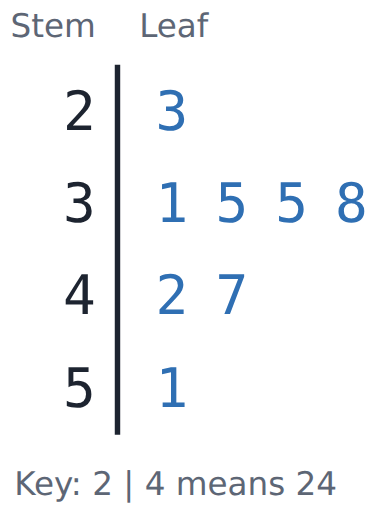
A stem-and-leaf plot keeps every value and shows the shape. For two-digit numbers the stem is the tens digit and the leaf is the units digit; leaves go in order along their stem's row. Include every stem from the smallest to the largest, even with no leaves, and give a key: 3∣53 \mid 5 means 3535.

Read the median by counting leaves to the middle; the range is the last value minus the first.

Stems are the tens, leaves the units, in order: 3 | 1 5 5 8 is 31, 35, 35 and 38.
Tens as stems, units as leaves · Sound on for the voiceover
Open the lesson →

Comparing data sets

Try firstGroup 1 reaction times (s): median 0.32, range 0.10. Group 2: median 0.28, range 0.35. Compare the groups in one sentence.

Check your answer

Group 2 was faster on a typical try (median 0.28 s against 0.32 s), but much less consistent (range 0.35 s against 0.10 s).

Describe a data set by its shape (symmetrical, or skewed with a tail; clusters, gaps, outliers), its centre (median or mean) and its spread (range).

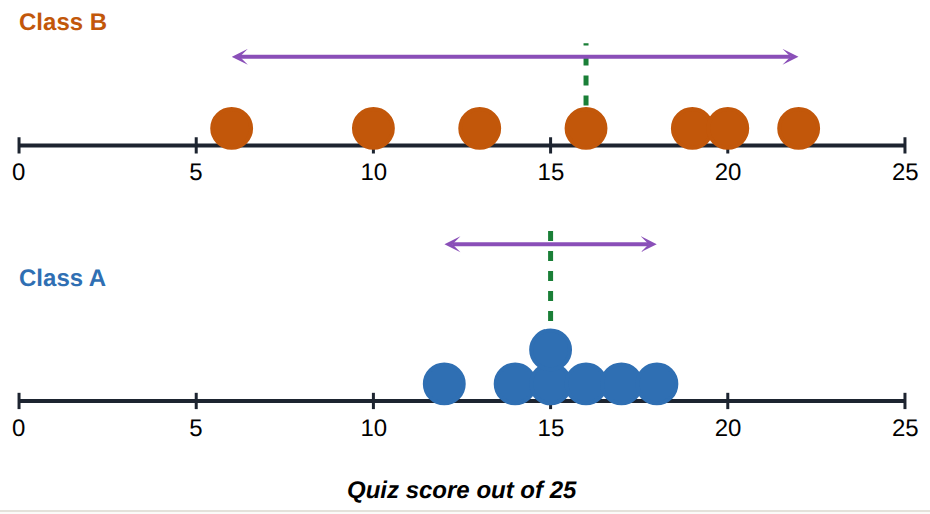
To compare two sets, compare the centres and the spreads, with numbers and in context: "Similar medians (15 and 16), but Class A is more consistent (range 6 against 16)." One value, such as the highest score, does not describe a set.

Class B's median (16) is a little higher, but its range (16) is much wider than Class A's (6): A is more consistent.
Compare centre and spread · Sound on for the voiceover
Open the lesson →

Statistical investigations

Try firstA survey asks only the first 10 students into school how they travel. Give one reason it may not represent the school.

Check your answer

Students who arrive early may travel differently (for example, by bus or parent drop-off), so the sample is biased.

A statistical investigation asks a question data can answer, plans the variable and a fair sample, collects and displays the data, summarises its shape, centre and spread, and reports an answer with its limits.

A sample that is small or chosen for convenience may be biased, so the report says who was measured and how.

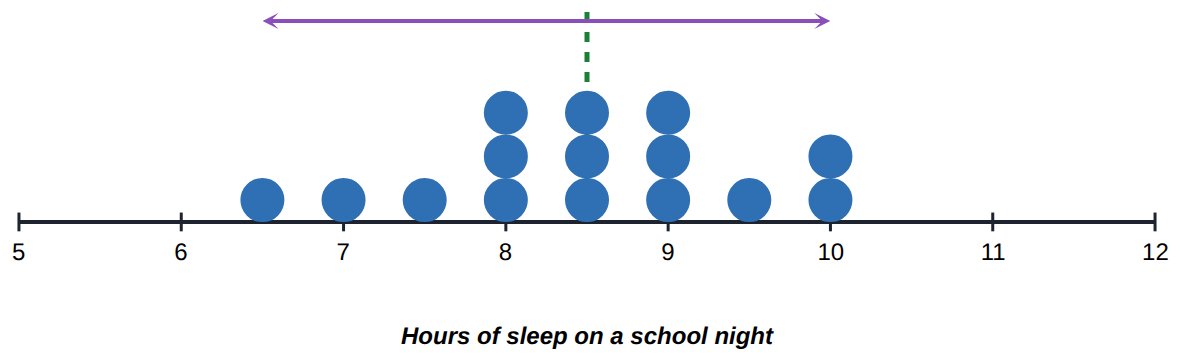
Fifteen students' hours of sleep: the median is 8.5 hours and the range is 3.5 hours.
From a question to a report · Sound on for the voiceover
Open the lesson →

Year 7 Probability

Sample spaces and probability

Try firstA bag has 2 red, 3 green and 5 yellow counters. List the sample space and give each probability.

Check your answer

{red, green, yellow}: P(red) = 2/10 = 1/5, P(green) = 3/10, P(yellow) = 5/10 = 1/2. They add to 1.

The sample space is the list of every possible outcome. If the outcomes are equally likely,

P(event)=favourable outcomestotal outcomesP(\text{event}) = \dfrac{\text{favourable outcomes}}{\text{total outcomes}}, so P(even on a dice)=36=12P(\text{even on a dice}) = \tfrac{3}{6} = \tfrac{1}{2}.

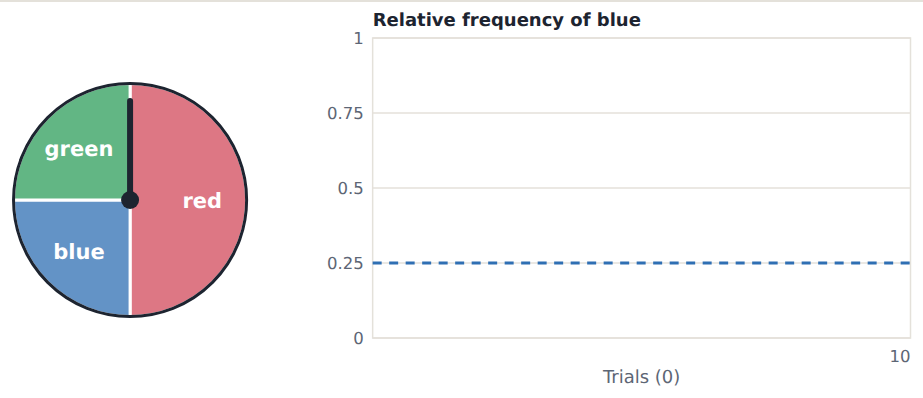
If they are not (a half-red spinner, a bag with more of one colour), use the sizes or the counts: P(red)=12P(\text{red}) = \tfrac{1}{2}. The probabilities of all the outcomes add to 1; 0 means impossible, 1 means certain.

Sample space {red, blue, green}, but not equally likely: P(red) = 1/2, P(blue) = 1/4, P(green) = 1/4. They add to 1.
List the outcomes, then share out the chance · Sound on for the voiceover
Open the lesson →

Predict and test

Try firstA spinner has P(blue) = 0.4. How many blues do you expect in 50 spins? You get 23. Is the spinner unfair?

Check your answer

20 expected. 23 is close to 20, so there is no reason to think it is unfair.

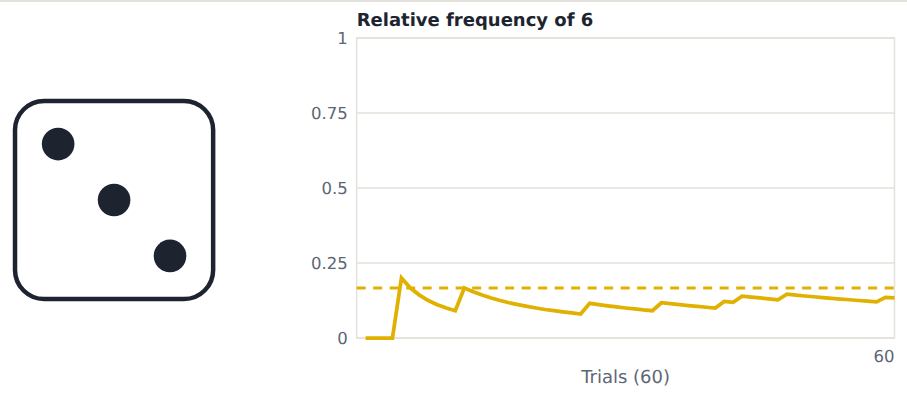
A probability predicts what happens over many trials: expected count = probability × number of trials. In 60 rolls of a fair dice, expect about 60×16=1060 \times \tfrac{1}{6} = 10 sixes.

Then test it: run the experiment and record the counts. The relative frequency is count ÷ trials. In a short experiment the results vary: 7 or 12 sixes in 60 rolls is normal, so do not judge a dice on a few rolls.

60 rolls: about 10 sixes expected (60 × 1/6). The actual count is near 10, but not exactly 10.
Expected count, then the real count · Sound on for the voiceover
Open the lesson →

Many trials

Try firstAfter 40 spins a spinner gave 18 reds; after 4000 spins, 1230 reds. Which estimate of P(red) is better, and what is it?

Check your answer

The 4000-spin one: 1230 ÷ 4000 ≈ 0.31. More trials give a more reliable estimate.

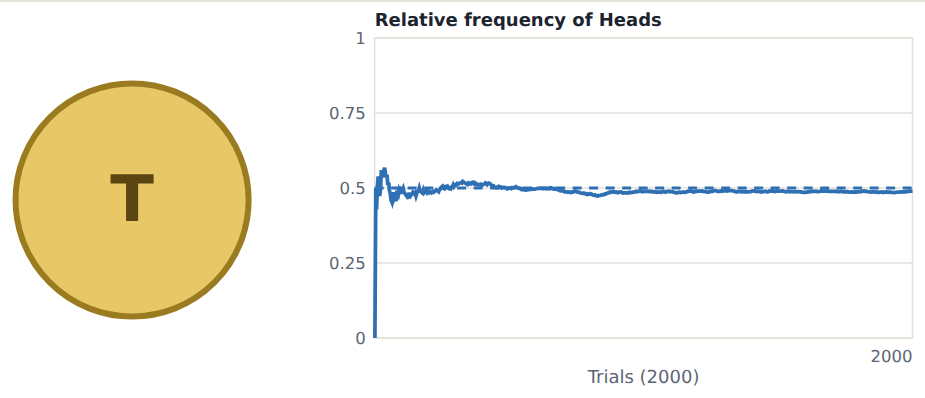
Over a few trials, the relative frequency (count ÷ trials) jumps about. Over many trials it settles close to the probability: the law of large numbers. One more head moves 7/10 a lot, but 501/1000 hardly at all.

It is not because results balance out: a coin has no memory, and after 5 tails heads is still exactly 1/2. Large experiments are how we estimate probabilities we cannot work out, such as a drawing pin landing point-up.

2000 flips: the relative frequency of heads jumps about at first, then settles near 0.5 (dashed).
More trials, a steadier estimate · Sound on for the voiceover
Open the lesson →