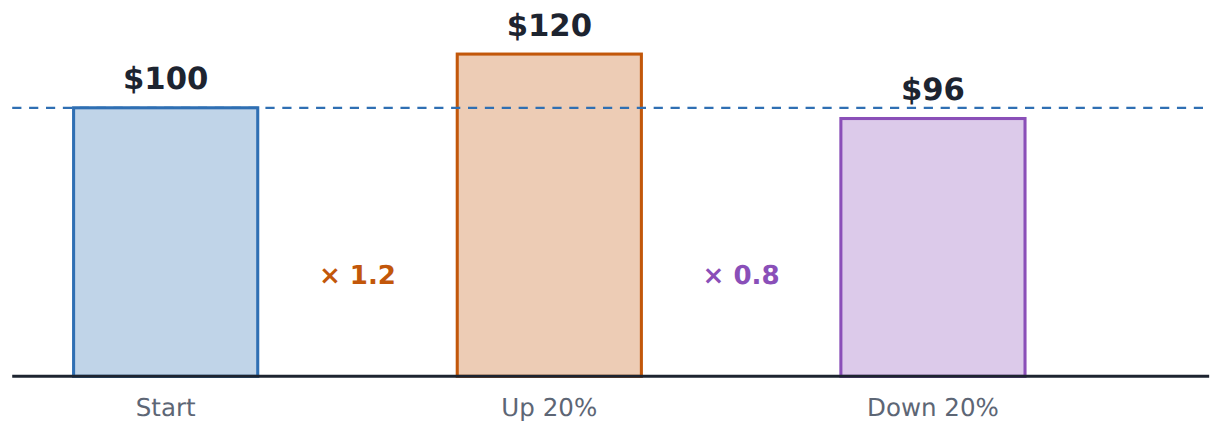
One change after another: multiply the multipliers. Up 20% then down 20% is × 0.96.
$100 up 20%, then down 20%: $96
each part of the income×its bracket’s rate
tax brackets
The marginal rate is the rate on the last dollar; the effective rate is total tax ÷ income.
Methods
−3×(−2)=63×(−2)=−6
multiplying integers
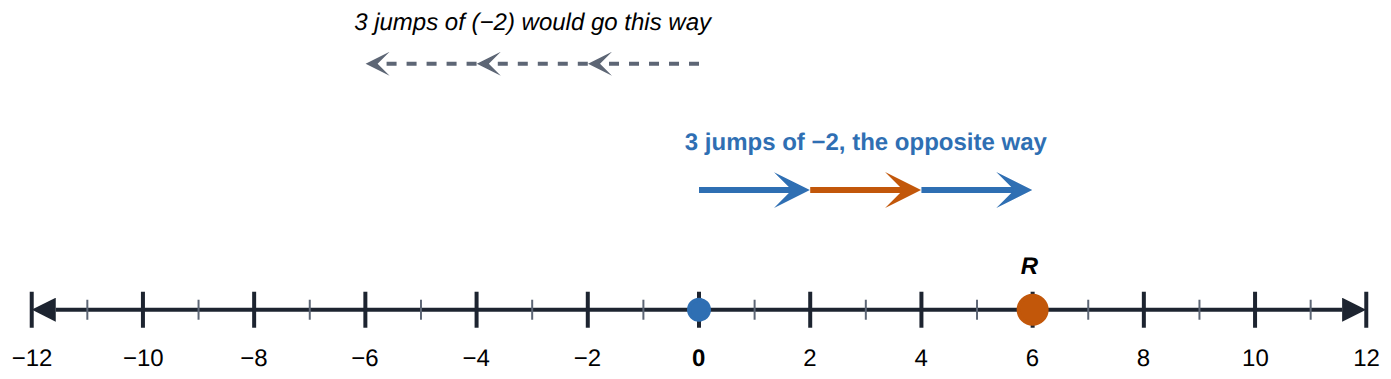
Same signs give a positive, different signs a negative. On the line: a jumps of b; a negative number of jumps goes the opposite way.
−3 jumps of −2 go the opposite way: to 6
−12÷3=−4
dividing integers
The same sign rule as multiplying, because dividing undoes it: check 3×(−4)=−12.
−141 is between −2 and −1
placing a negative fraction
Split each unit into equal parts and count from zero. A negative counts left, and the part counts further from zero, not back towards it.
Quarters: A at −1 1/4, B at −3/4
−43×52=−103
negative fractions and decimals
The integer sign rules hold for every fraction and decimal. Sign first, then size.
25×(−3.7)×4=100×(−3.7)=−370
efficient order
Multiply in any order, pairing friendly numbers; or split a number: 6×(−2.5)=6×(−2)+6×(−0.5).
200×0.8×0.9=144
percentages in two steps
Each percentage is of a different amount, so they cannot be added: 20% off then 10% off is not 30% off.
Recurring decimals
83=0.37571=0.142857
terminating and recurring
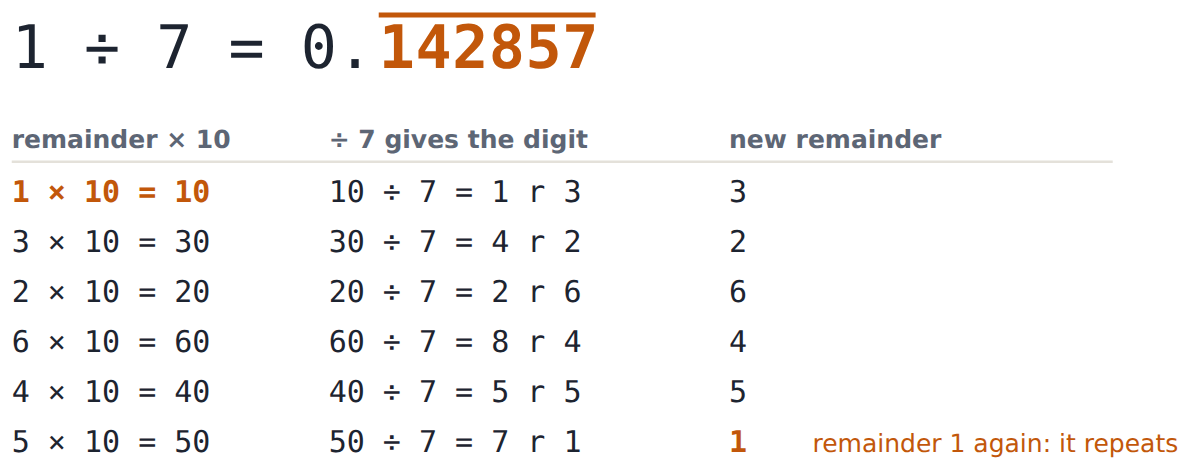
In long division a remainder of 0 means the decimal stops; a remainder that comes back means the digits repeat. A bar (or dots) marks the repeating block.
1 ÷ 7: the remainders come round again
simplest form, denominator only 2s and 5s⇒terminates
which decimals stop
Simplify first, then break the denominator into primes. Any prime other than 2 or 5 makes it recur, because 10 = 2 × 5.
Irrational numbers
rational: bairrational: 2,π
rational and irrational
Rational numbers are fractions: their decimals stop or repeat. Irrational numbers never stop and never repeat. √16 = 4 is rational.
A number line to zoom in on √2
25<30<36⇒5<30<6
placing a square root
Find the perfect squares either side, then square decimals to get closer. A rounded value is an approximation.
Index laws
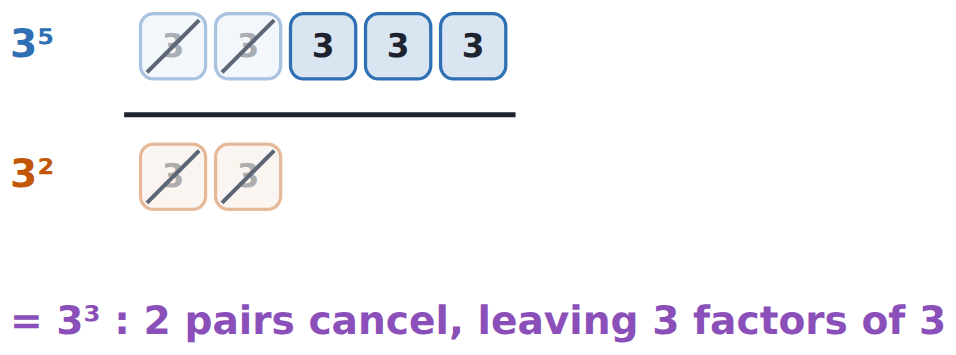
am×an=am+nam÷an=am−n(am)n=amn
index laws
Write the powers out as factors to see why. Only powers of the same base combine.