← Year 8 Number

Year 8 Number: recap

For after the lessons: one card per lesson, to check what you remember. Answer each question in your head or on paper first, then check it. Nothing here is marked.

Looking back over the whole year? See the Year 8 recap.

Recurring decimals

1. Recurring decimals

Try firstDoes 5/6 terminate or recur? Write it with a dot.

Check your answer

It recurs: 5/6 = 0.8333… = 0.83 with a dot over the 3.

A fraction's decimal terminates (stops) or recurs (repeats a block forever). In long division, a remainder of 0 means it stops; a remainder that comes back means the digits repeat.

Mark the repeating block with a bar or dots: 0.142857‾0.\overline{142857}, 0.16˙0.1\dot{6}. A recurring decimal is still a fraction, so it is rational.
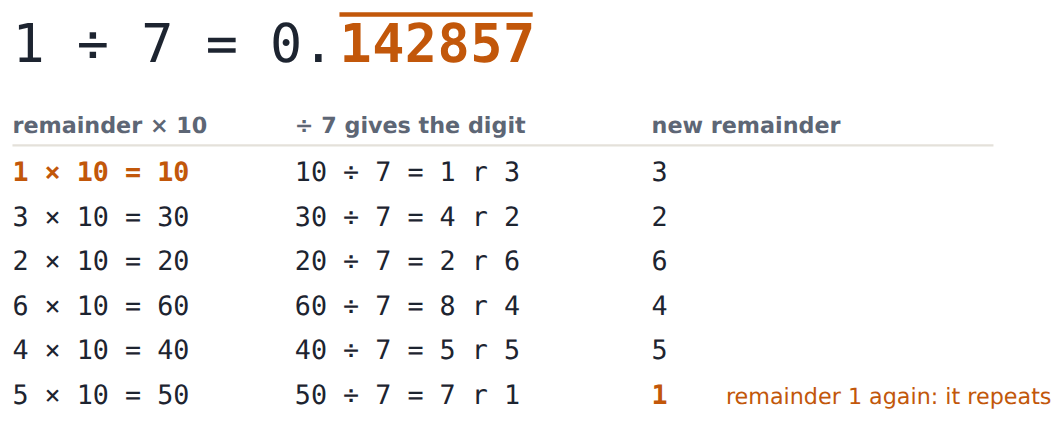
1 ÷ 7: the remainders go 3, 2, 6, 4, 5, then 1 again, so 142857 repeats forever.
Stops or repeats · Sound on for the voiceover
Open the lesson →

2. Which decimals stop?

Try firstDoes 9/24 terminate? Explain.

Check your answer

Yes: 9/24 = 3/8, and 8 = 2 × 2 × 2, only 2s, so it terminates (0.375).

Write the fraction in simplest form and break the denominator into prime factors. Only 2s and 5s: it terminates; any other prime: it recurs.

It works because a terminating decimal is a fraction over 10, 100, 1000…, and 10=2×510 = 2 \times 5.

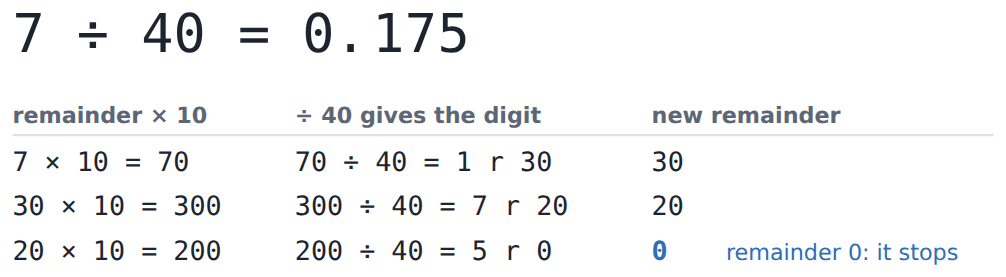
7/40 = 0.175: 40 = 2 × 2 × 2 × 5, only 2s and 5s, so it terminates.
Simplify first · Sound on for the voiceover
Open the lesson →

Irrational numbers

3. Irrational numbers

Try firstSort √20, √25, 0.4 and 0.454545… into rational and irrational.

Check your answer

Rational: √25 = 5, 0.4, 0.454545… (= 5/11). Irrational: √20.

A rational number is a fraction: its decimal stops or repeats. An irrational number is not a fraction: its decimal never stops and never repeats.

√2, √3, √5 and π are irrational; √16 = 4 and 22/7 are rational. Use the exact form or a rounded value to calculate.

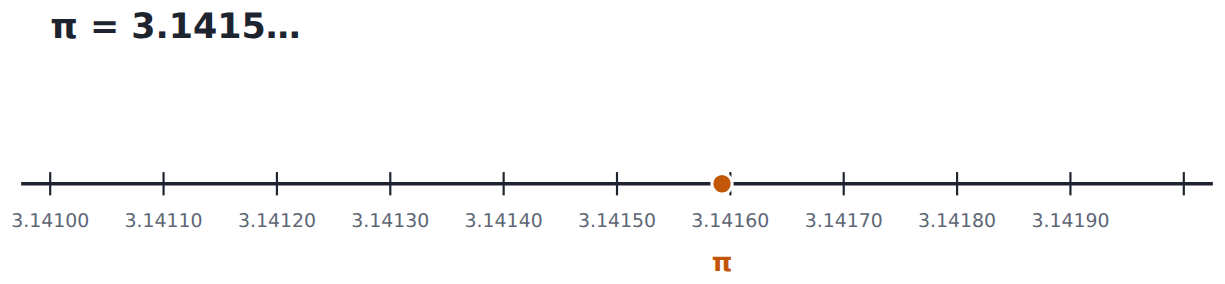
π = 3.14159…: zoom in as far as you like, the digits never stop and never settle into a repeat.
Zooming in on √2 · Sound on for the voiceover
Open the lesson →

4. Irrational numbers on the line

Try firstBetween which two whole numbers is √70? Which is it nearer?

Check your answer

64 < 70 < 81, so between 8 and 9, nearer 8 (√70 ≈ 8.37).

The real numbers fill the number line: rational and irrational. To place a square root, find the perfect squares either side (25<30<3625 < 30 < 36, so 5<30<65 < \sqrt{30} < 6), then square decimals to get closer.

A rounded value such as 5.48 is an approximation; 30\sqrt{30} is exact.

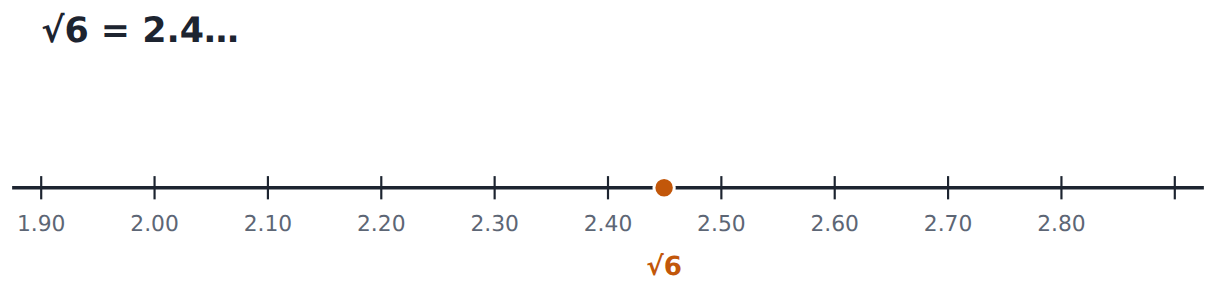
√6 is between 2 and 3 (4 < 6 < 9), then between 2.4 and 2.5 (2.4² = 5.76, 2.5² = 6.25).
Squares either side · Sound on for the voiceover
Open the lesson →

Index laws

5. Index laws

Try firstSimplify 4⁶ ÷ 4² and (3²)⁴, leaving each as a power.

Check your answer

4⁴ and 3⁸.

For powers of the same base: multiplying adds the indices (am×an=am+na^m \times a^n = a^{m+n}), dividing subtracts them (am÷an=am−na^m \div a^n = a^{m-n}), and a power of a power multiplies them ((am)n=amn(a^m)^n = a^{mn}). The base does not change.

a0=1a^0 = 1 (for a≠0a \ne 0), because an÷an=1a^n \div a^n = 1 and the quotient law gives a0a^0.

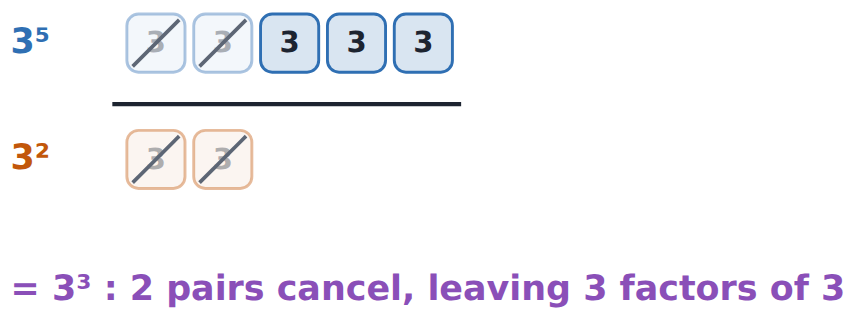
3⁵ ÷ 3²: two pairs of 3s cancel, leaving 3³ = 27. Subtract the indices: 5 − 2 = 3.
Count the factors · Sound on for the voiceover
Open the lesson →

6. Using the index laws

Try firstSimplify (5³)² × 5⁴ ÷ 5⁸.

Check your answer

5⁶ × 5⁴ ÷ 5⁸ = 5¹⁰ ÷ 5⁸ = 5².

Simplify one law at a time: powers of powers first, then multiply and divide from left to right. Only join powers with the same base: 23×322^3 \times 3^2 stays as it is (= 72).

Powers of 10 follow the laws, so (3×104)×(2×103)=6×10⁷(3 \times 10^4) \times (2 \times 10^3) = 6 \times 10^7.

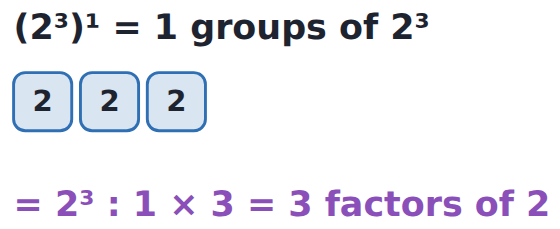
(2³)¹: one group of three 2s. More groups multiply the index.
Groups of factors · Sound on for the voiceover
Open the lesson →

Integers

7. Multiplying and dividing integers

Try firstWork out −7 × (−4), 24 ÷ (−6) and (−1)⁴.

Check your answer

28, −4 and 1.

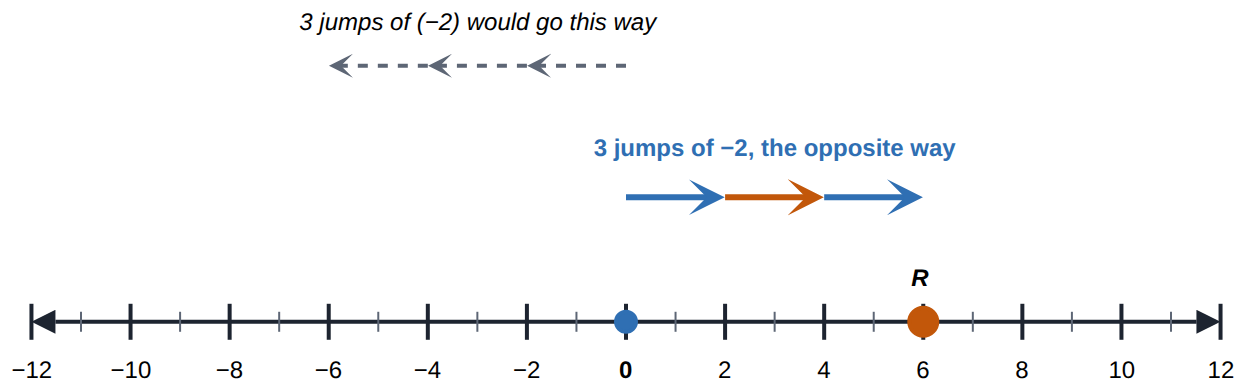
a×ba \times b is aa jumps of bb from zero. 3×(−2)3 \times (-2) is 3 jumps of −2-2: left to −6-6.

A negative number of jumps goes the opposite way: −3×(−2)=6-3 \times (-2) = 6. The pattern agrees: 3×(−2)=−63 \times (-2) = -6, 2×(−2)=−42 \times (-2) = -4, 1×(−2)=−21 \times (-2) = -2, 0×(−2)=00 \times (-2) = 0, so −1×(−2)=2-1 \times (-2) = 2.

The rule: same signs give a positive, different signs give a negative. Dividing follows the same rule, because it undoes multiplying: −12÷3=−4-12 \div 3 = -4, since 3×(−4)=−123 \times (-4) = -12.

-3 \times (-2): 3 jumps of -2 would go to -6; a negative number of jumps goes the opposite way, to 6.
−3×(−2)-3 \times (-2): 3 jumps of −2-2 would go to −6-6; a negative number of jumps goes the opposite way, to 66.
Multiplying is jumps from zero · Sound on for the voiceover
Open the lesson →

Fractions and decimals

8. Calculating with negative fractions and decimals

Try firstWork out −3/5 × 10/9 and −4 × (−2.25). Show one strategy.

Check your answer

−2/3. 9 (−4 × −2 = 8, −4 × −0.25 = 1, so 8 + 1 = 9).

The sign rules for integers work for every fraction and decimal: same signs give a positive, different signs a negative (for × and ÷). Work out the sign first, then the size: −34×25=−620=−310-\tfrac{3}{4} \times \tfrac{2}{5} = -\tfrac{6}{20} = -\tfrac{3}{10}.

Make the size easy: multiply in any order (25×(−3.7)×4=100×(−3.7)=−37025 \times (-3.7) \times 4 = 100 \times (-3.7) = -370), or split a number (6×(−2.5)=6×(−2)+6×(−0.5)=−156 \times (-2.5) = 6 \times (-2) + 6 \times (-0.5) = -15).

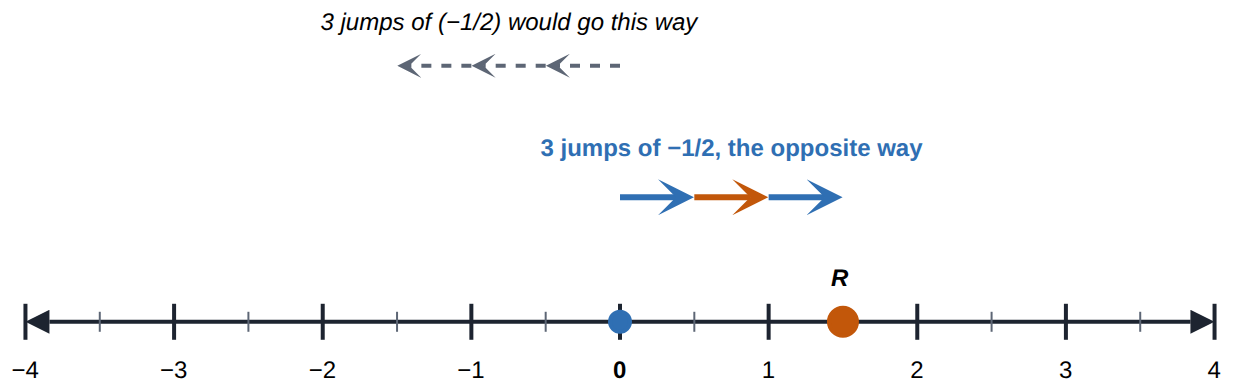
-3 \times (-\tfrac{1}{2}) = 1\tfrac{1}{2}: 3 jumps of -\tfrac{1}{2} would go left to -1\tfrac{1}{2}; a negative number of jumps goes the opposite way.
−3×(−12)=112-3 \times (-\tfrac{1}{2}) = 1\tfrac{1}{2}: 3 jumps of −12-\tfrac{1}{2} would go left to −112-1\tfrac{1}{2}; a negative number of jumps goes the opposite way.
The sign rules work for fractions too · Sound on for the voiceover
Open the lesson →

Modelling

9. Percentage change

Try firstA $60 item is discounted 25%, then the discounted price goes up 25%. What is the final price?

Check your answer

60 × 0.75 × 1.25 = $56.25.

An increase of p%p\% multiplies by 1+p1001 + \frac{p}{100}; a decrease multiplies by 1−p1001 - \frac{p}{100}.

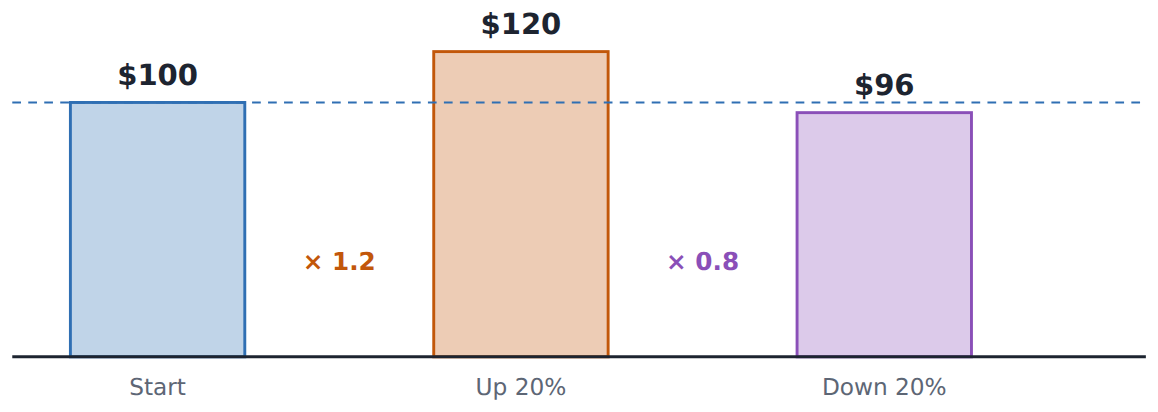
For one change after another, multiply the multipliers: each percentage is of the current amount. Up 20% then down 20% is 1.2×0.8=0.961.2 \times 0.8 = 0.96: 4% less.

100 up 20% is 120; then down 20% takes off 20% of 120 (24), leaving 96.
$100 up 20% is $120; then down 20% takes off 20% of $120 ($24), leaving $96.
Up 20%, down 20% · Sound on for the voiceover
Open the lesson →

10. Money models

Try firstTax is 0% on the first $18 200 of income, 15% on the next part up to $45 000, and 30% on the part from $45 000 to $135 000. Find the tax on $50 000.

Check your answer

15% of (45 000 − 18 200) = 15% of 26 800 = $4020, plus 30% of 5000 = $1500: $5520 in all.

To model a money problem: decide what to find, choose the calculation, work it out, and check it makes sense.

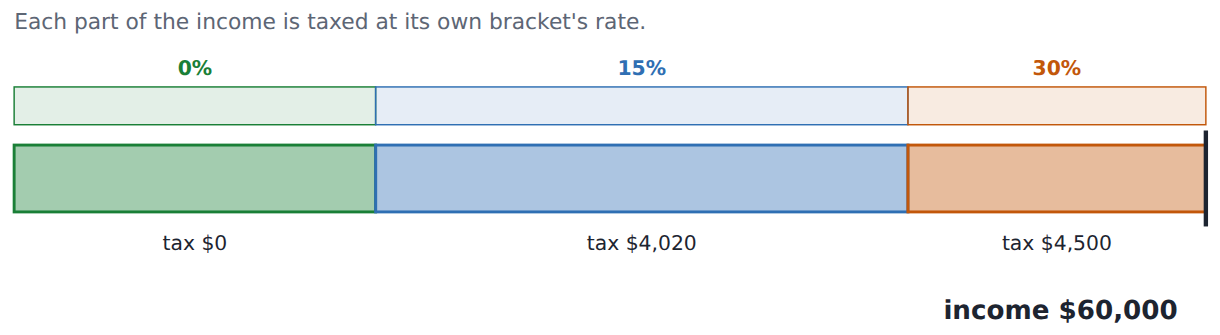
Income tax is worked out in brackets: each part of the income is taxed at its own rate. The marginal rate is the rate on the last dollar; the effective rate is total tax ÷ income, which is lower (for incomes above $18 200).

On 60 000: nothing on the first 18 200, 15% of the next 26 800 (4020), and 30% of the last 15 000 (4500). Tax 8520.
On $60 000: nothing on the first $18 200, 15% of the next $26 800 ($4020), and 30% of the last $15 000 ($4500). Tax $8520.
Tax in brackets · Sound on for the voiceover
Open the lesson →