← Maths

Year 8 maths: recap

Every idea from Year 8 maths in one place, for after you've done the year (or part of it). Answer each question in your head or on paper first, then check it. Nothing here is marked. If one is shaky, open the lesson and go over it again.

Getting ready for Year 8? Start with the Year 7 recap.

Year 8 Number

Recurring decimals

Try firstDoes 5/6 terminate or recur? Write it with a dot.

Check your answer

It recurs: 5/6 = 0.8333… = 0.83 with a dot over the 3.

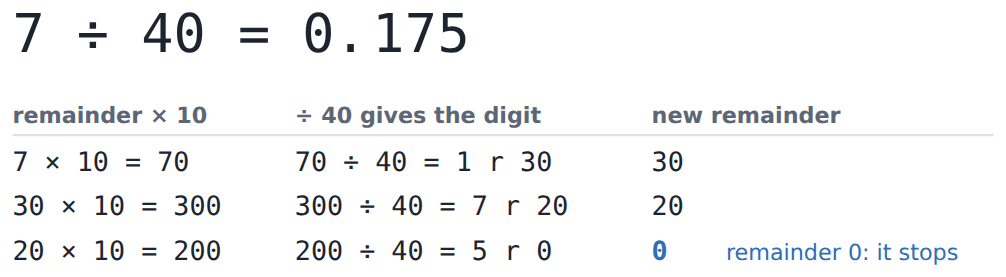
A fraction's decimal terminates (stops) or recurs (repeats a block forever). In long division, a remainder of 0 means it stops; a remainder that comes back means the digits repeat.

Mark the repeating block with a bar or dots: 0.142857‾0.\overline{142857}, 0.16˙0.1\dot{6}. A recurring decimal is still a fraction, so it is rational.
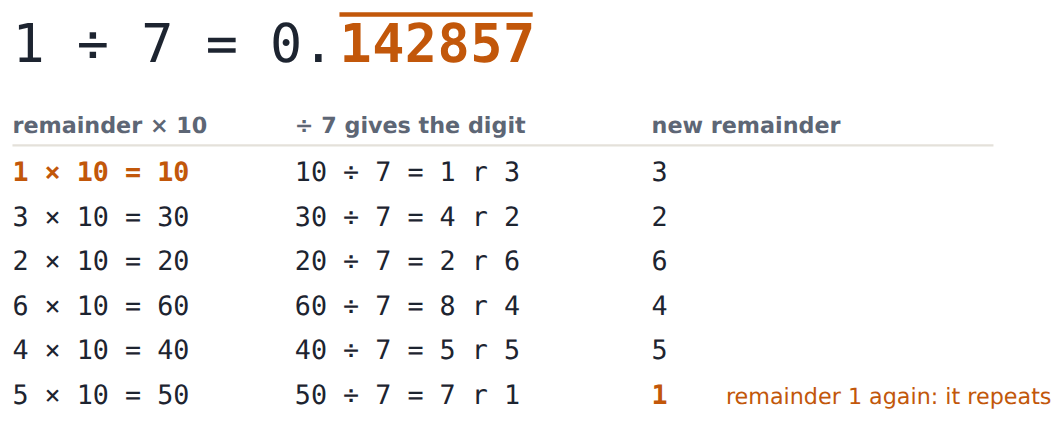
1 ÷ 7: the remainders go 3, 2, 6, 4, 5, then 1 again, so 142857 repeats forever.
Stops or repeats · Sound on for the voiceover
Open the lesson →

Which decimals stop?

Try firstDoes 9/24 terminate? Explain.

Check your answer

Yes: 9/24 = 3/8, and 8 = 2 × 2 × 2, only 2s, so it terminates (0.375).

Write the fraction in simplest form and break the denominator into prime factors. Only 2s and 5s: it terminates; any other prime: it recurs.

It works because a terminating decimal is a fraction over 10, 100, 1000…, and 10=2×510 = 2 \times 5.

7/40 = 0.175: 40 = 2 × 2 × 2 × 5, only 2s and 5s, so it terminates.
Simplify first · Sound on for the voiceover
Open the lesson →

Irrational numbers

Try firstSort √20, √25, 0.4 and 0.454545… into rational and irrational.

Check your answer

Rational: √25 = 5, 0.4, 0.454545… (= 5/11). Irrational: √20.

A rational number is a fraction: its decimal stops or repeats. An irrational number is not a fraction: its decimal never stops and never repeats.

√2, √3, √5 and π are irrational; √16 = 4 and 22/7 are rational. Use the exact form or a rounded value to calculate.

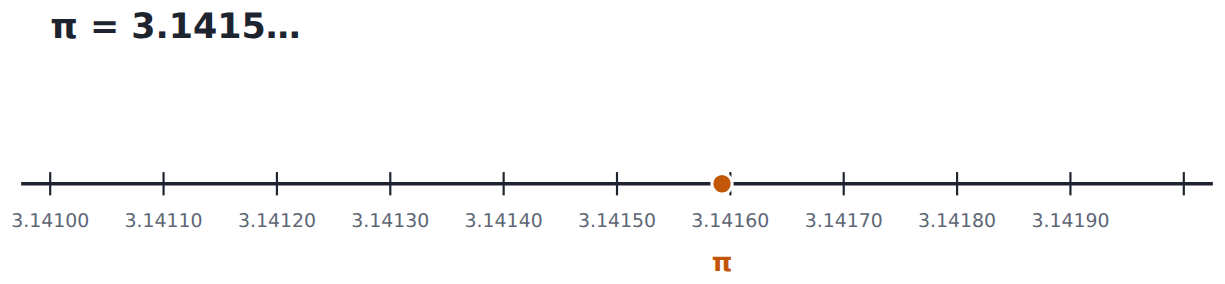
π = 3.14159…: zoom in as far as you like, the digits never stop and never settle into a repeat.
Zooming in on √2 · Sound on for the voiceover
Open the lesson →

Irrational numbers on the line

Try firstBetween which two whole numbers is √70? Which is it nearer?

Check your answer

64 < 70 < 81, so between 8 and 9, nearer 8 (√70 ≈ 8.37).

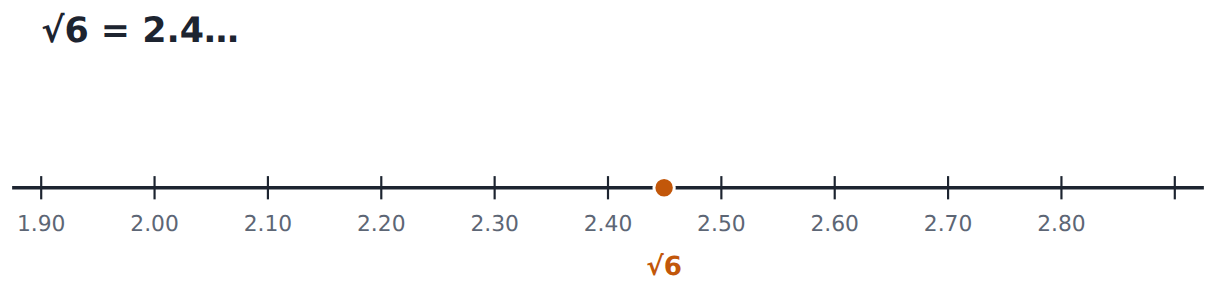
The real numbers fill the number line: rational and irrational. To place a square root, find the perfect squares either side (25<30<3625 < 30 < 36, so 5<30<65 < \sqrt{30} < 6), then square decimals to get closer.

A rounded value such as 5.48 is an approximation; 30\sqrt{30} is exact.

√6 is between 2 and 3 (4 < 6 < 9), then between 2.4 and 2.5 (2.4² = 5.76, 2.5² = 6.25).
Squares either side · Sound on for the voiceover
Open the lesson →

Index laws

Try firstSimplify 4⁶ ÷ 4² and (3²)⁴, leaving each as a power.

Check your answer

4⁴ and 3⁸.

For powers of the same base: multiplying adds the indices (am×an=am+na^m \times a^n = a^{m+n}), dividing subtracts them (am÷an=am−na^m \div a^n = a^{m-n}), and a power of a power multiplies them ((am)n=amn(a^m)^n = a^{mn}). The base does not change.

a0=1a^0 = 1 (for a≠0a \ne 0), because an÷an=1a^n \div a^n = 1 and the quotient law gives a0a^0.

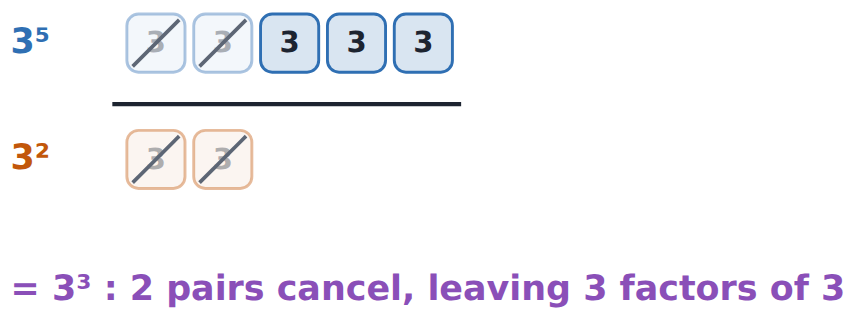
3⁵ ÷ 3²: two pairs of 3s cancel, leaving 3³ = 27. Subtract the indices: 5 − 2 = 3.
Count the factors · Sound on for the voiceover
Open the lesson →

Using the index laws

Try firstSimplify (5³)² × 5⁴ ÷ 5⁸.

Check your answer

5⁶ × 5⁴ ÷ 5⁸ = 5¹⁰ ÷ 5⁸ = 5².

Simplify one law at a time: powers of powers first, then multiply and divide from left to right. Only join powers with the same base: 23×322^3 \times 3^2 stays as it is (= 72).

Powers of 10 follow the laws, so (3×104)×(2×103)=6×10⁷(3 \times 10^4) \times (2 \times 10^3) = 6 \times 10^7.

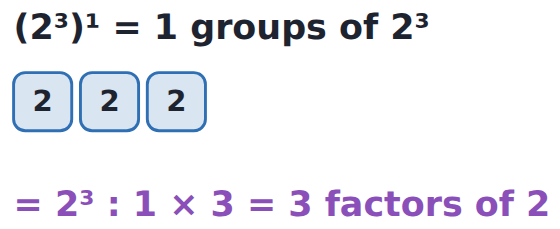
(2³)¹: one group of three 2s. More groups multiply the index.
Groups of factors · Sound on for the voiceover
Open the lesson →

Multiplying and dividing integers

Try firstWork out −7 × (−4), 24 ÷ (−6) and (−1)⁴.

Check your answer

28, −4 and 1.

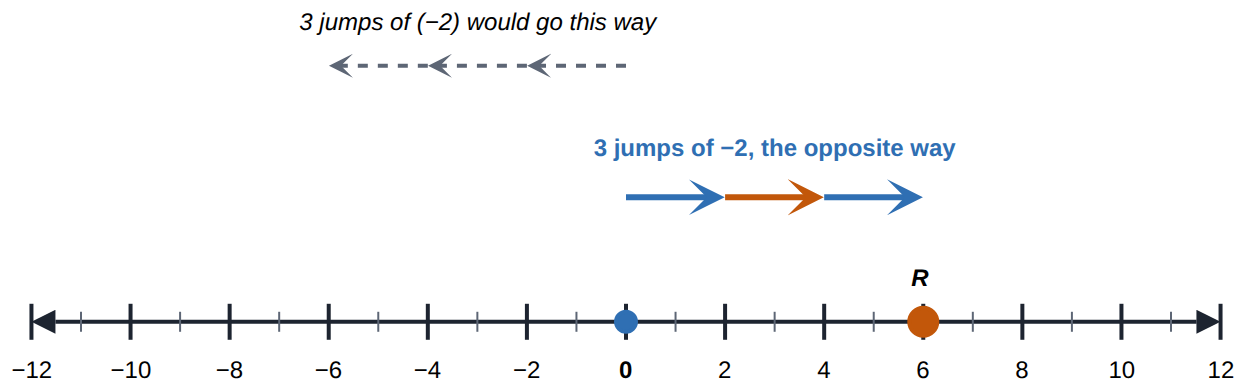
a×ba \times b is aa jumps of bb from zero. 3×(−2)3 \times (-2) is 3 jumps of −2-2: left to −6-6.

A negative number of jumps goes the opposite way: −3×(−2)=6-3 \times (-2) = 6. The pattern agrees: 3×(−2)=−63 \times (-2) = -6, 2×(−2)=−42 \times (-2) = -4, 1×(−2)=−21 \times (-2) = -2, 0×(−2)=00 \times (-2) = 0, so −1×(−2)=2-1 \times (-2) = 2.

The rule: same signs give a positive, different signs give a negative. Dividing follows the same rule, because it undoes multiplying: −12÷3=−4-12 \div 3 = -4, since 3×(−4)=−123 \times (-4) = -12.

-3 \times (-2): 3 jumps of -2 would go to -6; a negative number of jumps goes the opposite way, to 6.
−3×(−2)-3 \times (-2): 3 jumps of −2-2 would go to −6-6; a negative number of jumps goes the opposite way, to 66.
Multiplying is jumps from zero · Sound on for the voiceover
Open the lesson →

Calculating with negative fractions and decimals

Try firstWork out −3/5 × 10/9 and −4 × (−2.25). Show one strategy.

Check your answer

−2/3. 9 (−4 × −2 = 8, −4 × −0.25 = 1, so 8 + 1 = 9).

The sign rules for integers work for every fraction and decimal: same signs give a positive, different signs a negative (for × and ÷). Work out the sign first, then the size: −34×25=−620=−310-\tfrac{3}{4} \times \tfrac{2}{5} = -\tfrac{6}{20} = -\tfrac{3}{10}.

Make the size easy: multiply in any order (25×(−3.7)×4=100×(−3.7)=−37025 \times (-3.7) \times 4 = 100 \times (-3.7) = -370), or split a number (6×(−2.5)=6×(−2)+6×(−0.5)=−156 \times (-2.5) = 6 \times (-2) + 6 \times (-0.5) = -15).

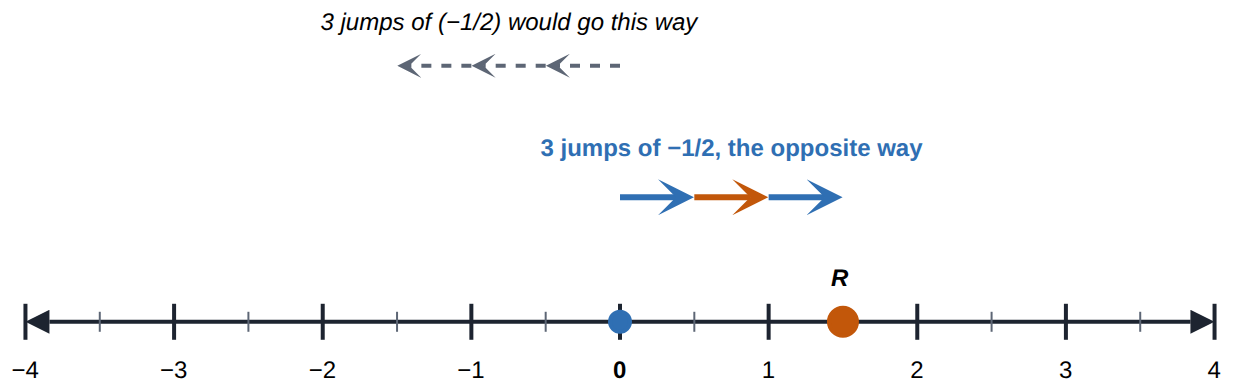
-3 \times (-\tfrac{1}{2}) = 1\tfrac{1}{2}: 3 jumps of -\tfrac{1}{2} would go left to -1\tfrac{1}{2}; a negative number of jumps goes the opposite way.
−3×(−12)=112-3 \times (-\tfrac{1}{2}) = 1\tfrac{1}{2}: 3 jumps of −12-\tfrac{1}{2} would go left to −112-1\tfrac{1}{2}; a negative number of jumps goes the opposite way.
The sign rules work for fractions too · Sound on for the voiceover
Open the lesson →

Percentage change

Try firstA $60 item is discounted 25%, then the discounted price goes up 25%. What is the final price?

Check your answer

60 × 0.75 × 1.25 = $56.25.

An increase of p%p\% multiplies by 1+p1001 + \frac{p}{100}; a decrease multiplies by 1−p1001 - \frac{p}{100}.

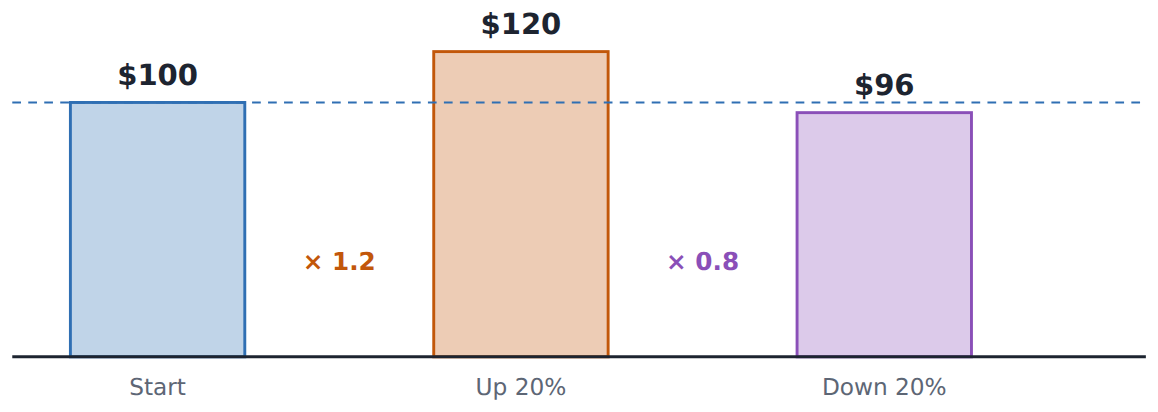
For one change after another, multiply the multipliers: each percentage is of the current amount. Up 20% then down 20% is 1.2×0.8=0.961.2 \times 0.8 = 0.96: 4% less.

100 up 20% is 120; then down 20% takes off 20% of 120 (24), leaving 96.
$100 up 20% is $120; then down 20% takes off 20% of $120 ($24), leaving $96.
Up 20%, down 20% · Sound on for the voiceover
Open the lesson →

Money models

Try firstTax is 0% on the first $18 200 of income, 15% on the next part up to $45 000, and 30% on the part from $45 000 to $135 000. Find the tax on $50 000.

Check your answer

15% of (45 000 − 18 200) = 15% of 26 800 = $4020, plus 30% of 5000 = $1500: $5520 in all.

To model a money problem: decide what to find, choose the calculation, work it out, and check it makes sense.

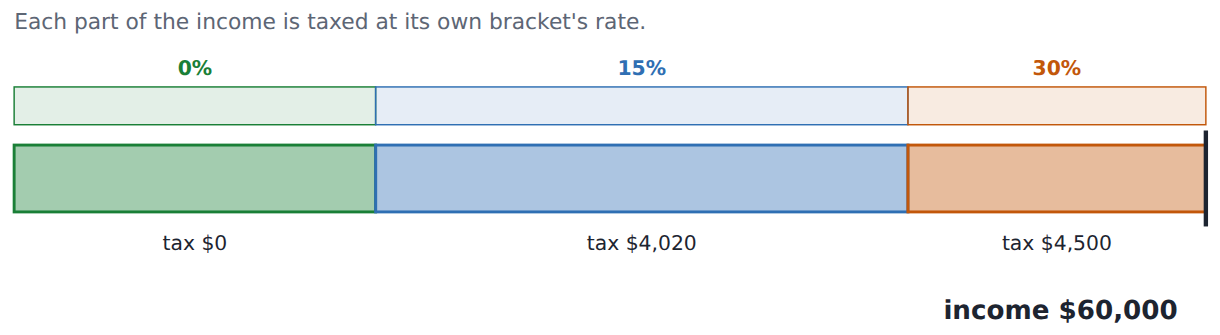
Income tax is worked out in brackets: each part of the income is taxed at its own rate. The marginal rate is the rate on the last dollar; the effective rate is total tax ÷ income, which is lower (for incomes above $18 200).

On 60 000: nothing on the first 18 200, 15% of the next 26 800 (4020), and 30% of the last 15 000 (4500). Tax 8520.
On $60 000: nothing on the first $18 200, 15% of the next $26 800 ($4020), and 30% of the last $15 000 ($4500). Tax $8520.
Tax in brackets · Sound on for the voiceover
Open the lesson →

Year 8 Algebra

Expanding brackets

Try firstExpand and simplify 5(x − 2) + 3x.

Check your answer

5x − 10 + 3x = 8x − 10.

The number outside a bracket multiplies every term inside.

3(2x+4)3(2x + 4) is 3 lots of 2x+42x + 4: 3×2x=6x3 \times 2x = 6x and 3×4=123 \times 4 = 12, so 6x+126x + 12. Signs come too: 4(3x−2)=12x−84(3x - 2) = 12x - 8, and −2(x−5)=−2x+10-2(x - 5) = -2x + 10.

After expanding, collect any like terms: 6x+12−x=5x+126x + 12 - x = 5x + 12.

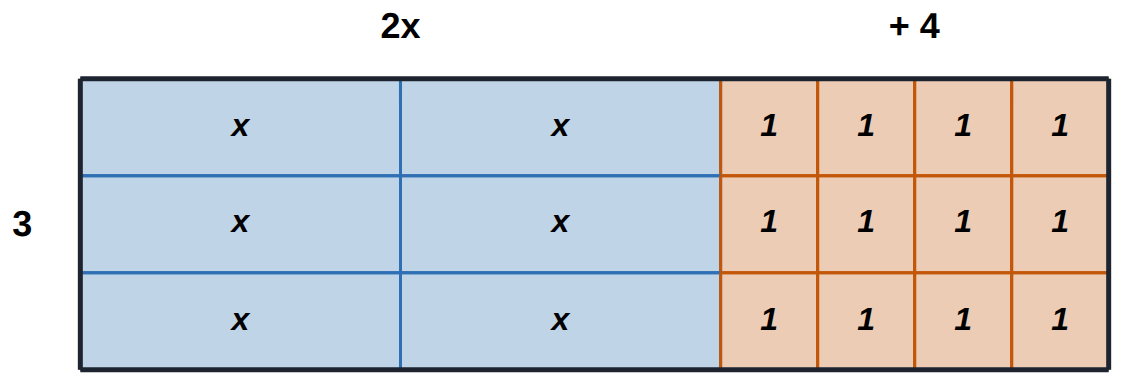
3(2x + 4): 3 rows of 2x + 4 make 6x + 12.
3(2x+4)3(2x + 4): 3 rows of 2x+42x + 4 make 6x+126x + 12.
The number outside multiplies every term inside · Sound on for the voiceover
Open the lesson →

Factorising

Try firstFactorise 14x − 21 fully, then check by expanding.

Check your answer

7(2x − 3). Check: 7 × 2x = 14x and 7 × (−3) = −21.

Factorising is expanding backwards. Find a number that goes into every term, divide every term by it, and put it outside the bracket.

6x+96x + 9: 3 goes into 6 and 9, so 6x+9=3(2x+3)6x + 9 = 3(2x + 3). Take out the highest common factor: 12x−8=4(3x−2)12x - 8 = 4(3x - 2), not 2(6x−4)2(6x - 4), which still shares a 2. A letter can be common too: 2x2+4x=2x(x+2)2x^2 + 4x = 2x(x + 2).

Check by expanding: you should get back to where you started.

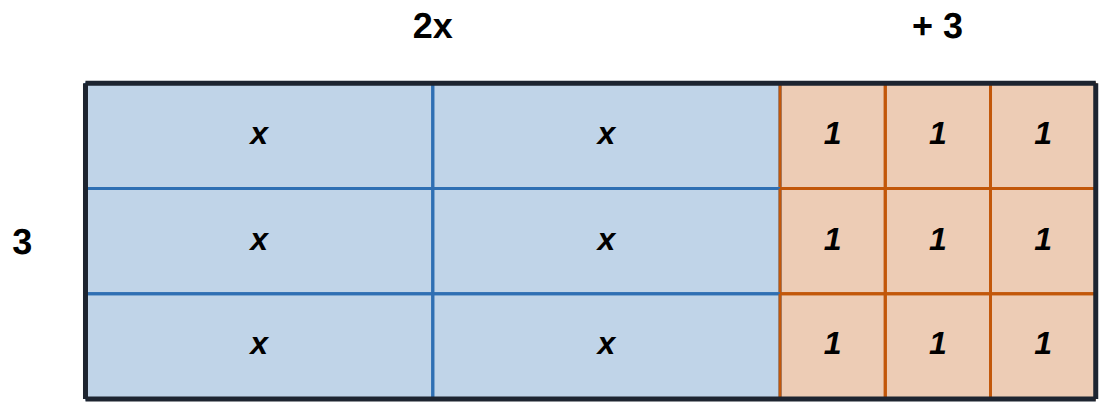
6x + 9 shared into 3 equal rows: each row is 2x + 3, so 6x + 9 = 3(2x + 3).
6x+96x + 9 shared into 3 equal rows: each row is 2x+32x + 3, so 6x+9=3(2x+3)6x + 9 = 3(2x + 3).
Share the tiles into equal rows · Sound on for the voiceover
Open the lesson →

Changing the subject

Try firstMake x the subject of y = 6x − 2, then check it with x = 3.

Check your answer

x = (y + 2)/6. Check: x = 3 gives y = 16, and (16 + 2)/6 = 3.

To change the subject, undo what was done to the letter you want, last step first, doing the same to the whole of both sides.

y=3x+5y = 3x + 5: xx was multiplied by 3, then 5 was added. Take 5 away: y−5=3xy - 5 = 3x. Divide by 3: x=y−53x = \dfrac{y - 5}{3}.

Check by putting in numbers: x=2x = 2 gives y=11y = 11, and 11−53=2\dfrac{11 - 5}{3} = 2.

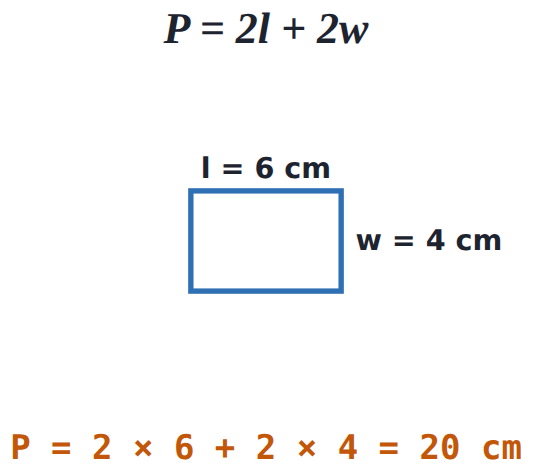
P = 2l + 2w rearranged: w = (P - 2l) \div 2. With P = 20 and l = 6: w = (20 - 12) \div 2 = 4.
P=2l+2wP = 2l + 2w rearranged: w=(P−2l)÷2w = (P - 2l) \div 2. With P=20P = 20 and l=6l = 6: w=(20−12)÷2=4w = (20 - 12) \div 2 = 4.
Turn the formula around · Sound on for the voiceover
Open the lesson →

Solving harder equations

Try firstSolve 4(x − 1) = 2x + 6 and check.

Check your answer

4x − 4 = 2x + 6, 2x = 10, x = 5. Check: 16 = 16.

To solve an equation, do the same to both sides until xx is on its own:

  1. Expand any brackets.
  2. Take the smaller xx term from both sides, so xx is on one side only.
  3. Undo the numbers with the inverse operation (add to undo −-, subtract to undo ++).
  4. Divide (or multiply) to get xx.

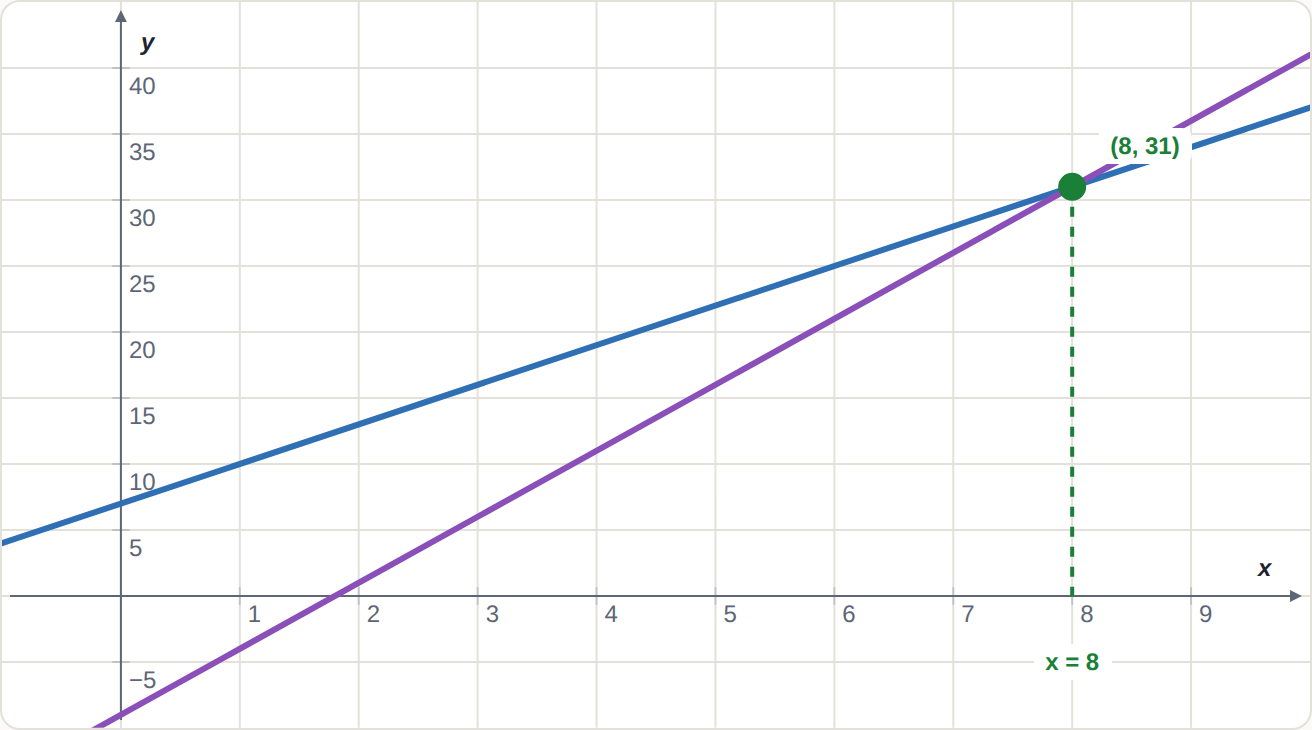
3x+7=5x−9→7=2x−9→16=2x→x=83x + 7 = 5x - 9 \to 7 = 2x - 9 \to 16 = 2x \to x = 8. Check: 3(8)+7=313(8) + 7 = 31 and 5(8)−9=315(8) - 9 = 31. On a graph, x=8x = 8 is where the two sides meet.

y = 3x + 7 and y = 5x - 9 meet at (8, 31): both sides of 3x + 7 = 5x - 9 equal 31 when x = 8.
y=3x+7y = 3x + 7 and y=5x−9y = 5x - 9 meet at (8,31)(8, 31): both sides of 3x+7=5x−93x + 7 = 5x - 9 equal 31 when x=8x = 8.
Same to both sides, then check · Sound on for the voiceover
Open the lesson →

Inequalities

Try firstSolve 7 − 2x ≥ 1 and show it on a number line.

Check your answer

−2x ≥ −6, x ≤ 3 (reversed): closed circle at 3, shaded left. Check x = 0: 7 ≥ 1.

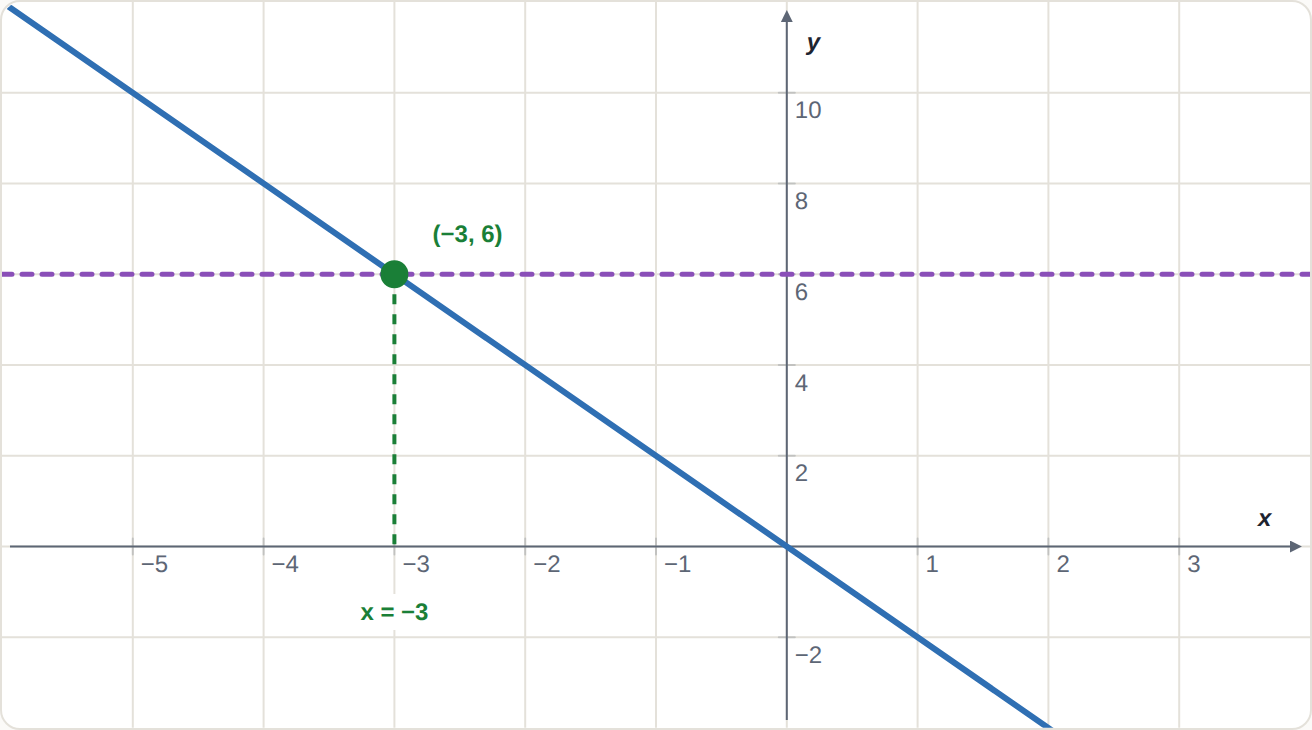
Solve an inequality like an equation, doing the same to both sides. Adding, subtracting, and multiplying or dividing by a positive keep the inequality sign. Multiplying or dividing by a negative reverses it: −2x>6-2x > 6 gives x<−3x < -3 (because 2<52 < 5 but −2>−5-2 > -5).

On a number line: an open circle for << and >> (the end is not included), closed for ≤\le and ≥\ge, shaded towards the solutions. Check by trying a value: x=−4x = -4 gives 8>68 > 6. ✓

-2x is more than 6 (the line above the dashed one) to the left of x = -3: the solution of -2x > 6 is x < -3.
−2x-2x is more than 6 (the line above the dashed one) to the left of x=−3x = -3: the solution of −2x>6-2x > 6 is x<−3x < -3.
Dividing by a negative turns it round · Sound on for the voiceover
Open the lesson →

What m does to a line

Try firstWithout plotting, describe the line y = −2x + 1: where does it cross the y-axis, which way does it go, and how steep is it?

Check your answer

It crosses the y-axis at 1 and goes down 2 for each step to the right (m = −2).

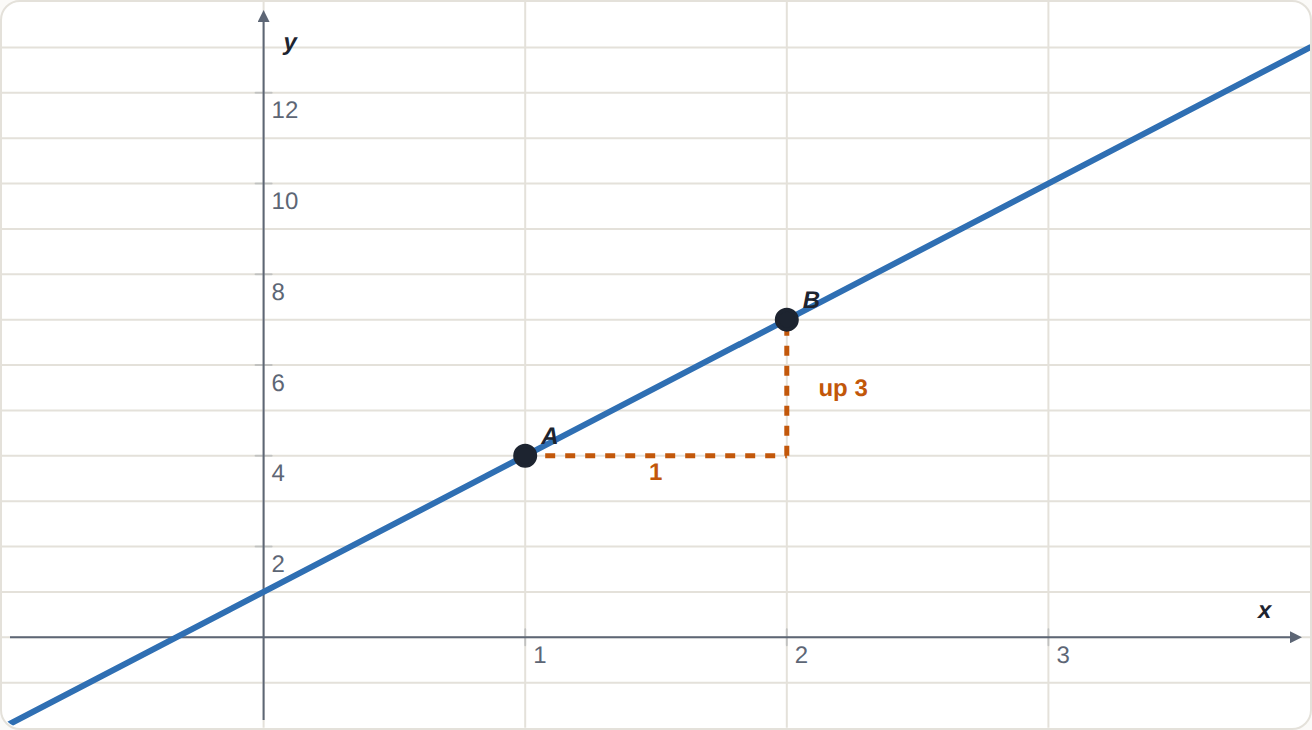
In a rule like y=3x+1y = 3x + 1, the number in front of xx is called mm. It tells you how far the line goes up for each step of 1 to the right.

Work it out one step at a time: when x=0x = 0, y=1y = 1; when x=1x = 1, y=4y = 4; when x=2x = 2, y=7y = 7. Each step right, yy goes up by 3. That is mm.

A bigger mm makes the line steeper. m=0m = 0 makes it flat. A negative mm makes it go down. Changing mm does not move where the line crosses the yy-axis: that is the number on its own, cc.

y = 3x + 1: one step right, up 3. That 3 is m.
y=3x+1y = 3x + 1: one step right, up 3. That 3 is mm.
m is how far the line goes up for each step right · Sound on for the voiceover
Open the lesson →

What c does to a line

Try firstAre y = 3x + 2 and y = 3x − 5 parallel? Where does each cross the y-axis?

Check your answer

Yes, both have m = 3. The first crosses at 2, the second at −5.

In y=mx+cy = mx + c, cc is the number on its own. It is where the line crosses the yy-axis: when x=0x = 0, mxmx is 0, so y=cy = c.

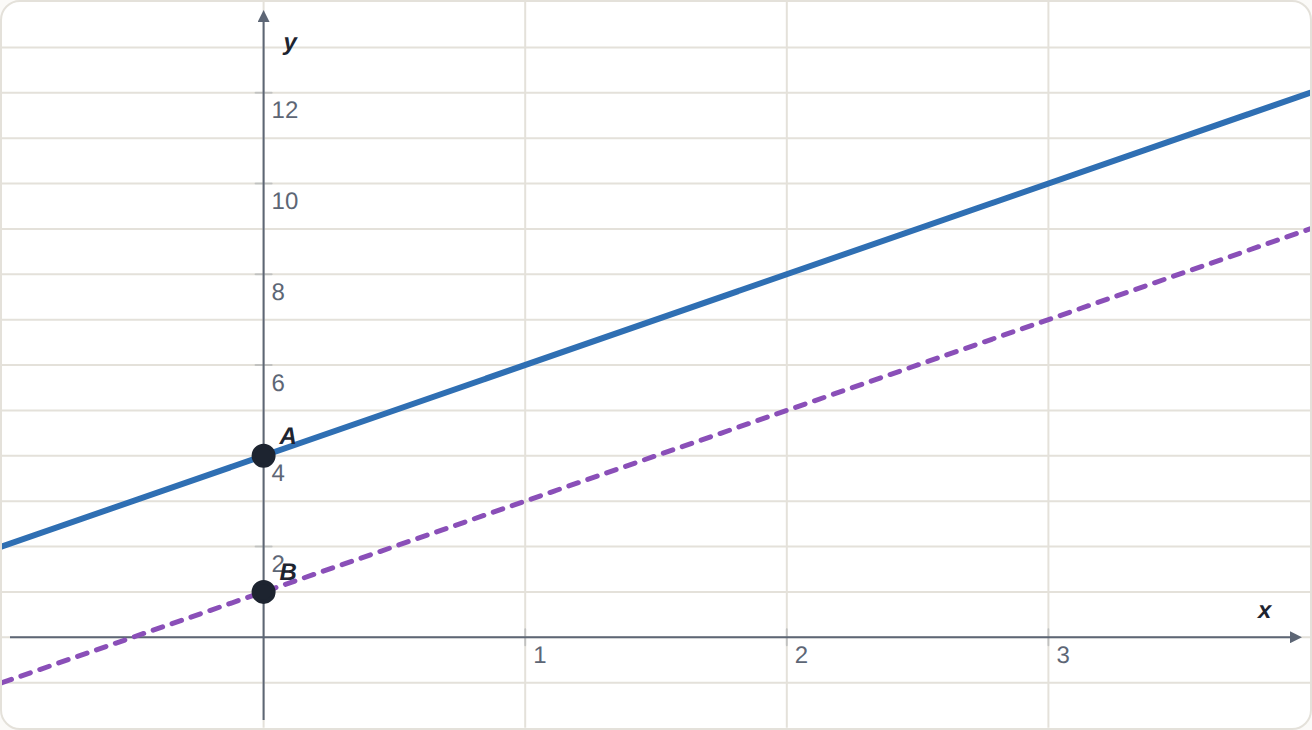
Changing cc moves the whole line up or down. It does not change the steepness, because mm stays the same: y=2x+4y = 2x + 4 is y=2x+1y = 2x + 1 moved up 3.

Lines with the same mm are parallel: equally steep, so they never meet.

y = 2x + 4 is y = 2x + 1 moved up 3. Same m, so they are parallel.
y=2x+4y = 2x + 4 is y=2x+1y = 2x + 1 moved up 3. Same mm, so they are parallel.
c moves the line up or down; the steepness stays the same · Sound on for the voiceover
Open the lesson →

Lines and regions

Try firstGraph y ≥ −2x + 3 (describe the boundary and the side). Is (1, 1) in it?

Check your answer

Solid line through (0, 3), down 2 for each step right; shade above. (1, 1): 1 ≥ 1, true: on the boundary, so in.

One-letter lines: x=3x = 3 is vertical (every point has x=3x = 3); y=−2y = -2 is horizontal.

An inequality such as y<2x+1y < 2x + 1 is a region: every point that makes it true. To graph it:

  1. Draw the boundary line y=2x+1y = 2x + 1: dashed for << and >> (its points are not included), solid for ≤\le and ≥\ge.
  2. Test a point not on the line, often (0,0)(0, 0): 0<10 < 1 is true.
  3. Shade the side of the test point if it was true, the other side if it was false.
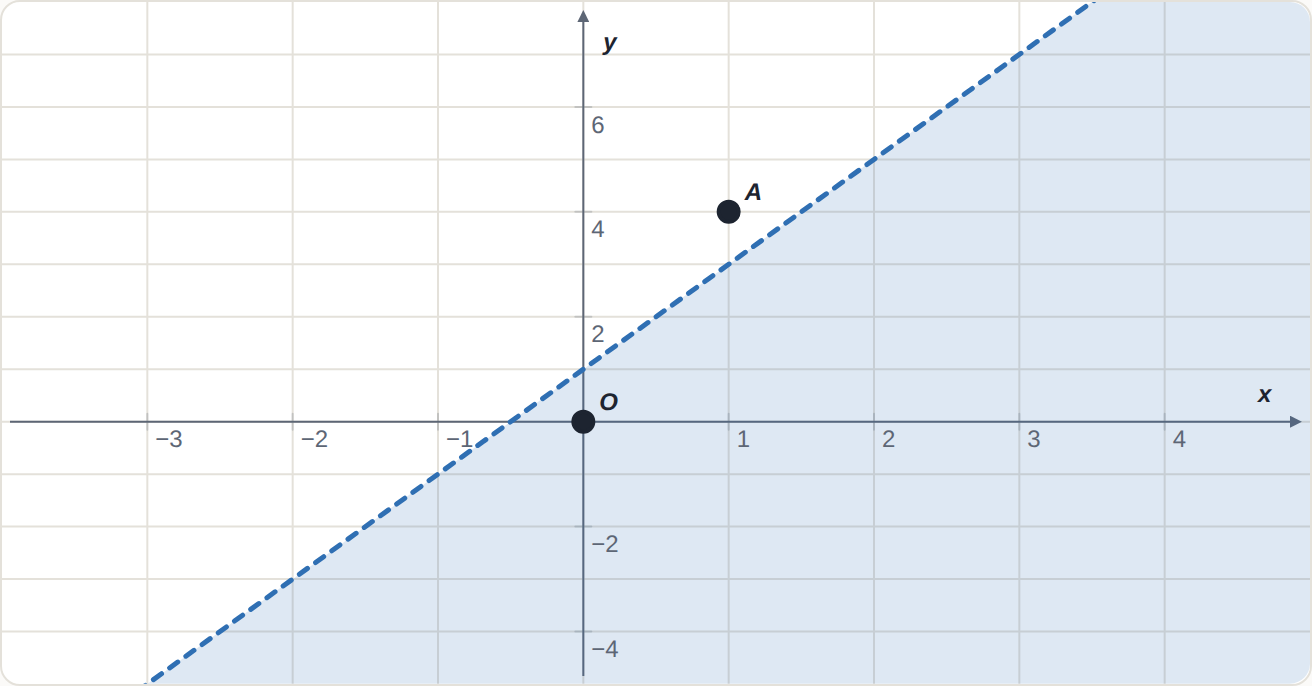
y < 2x + 1: below the dashed line. O(0, 0) is in it (0 < 1); A(1, 4) is not (4 < 3 is false).
y<2x+1y < 2x + 1: below the dashed line. O(0,0)O(0, 0) is in it (0<10 < 1); A(1,4)A(1, 4) is not (4<34 < 3 is false).
A line, then a region · Sound on for the voiceover
Open the lesson →

Solving equations with graphs

Try firstThe lines y = 2x − 3 and y = 5 meet at (4, 5). Solve 2x − 3 = 5 and check your answer.

Check your answer

x = 4. Check: 2 × 4 − 3 = 5.

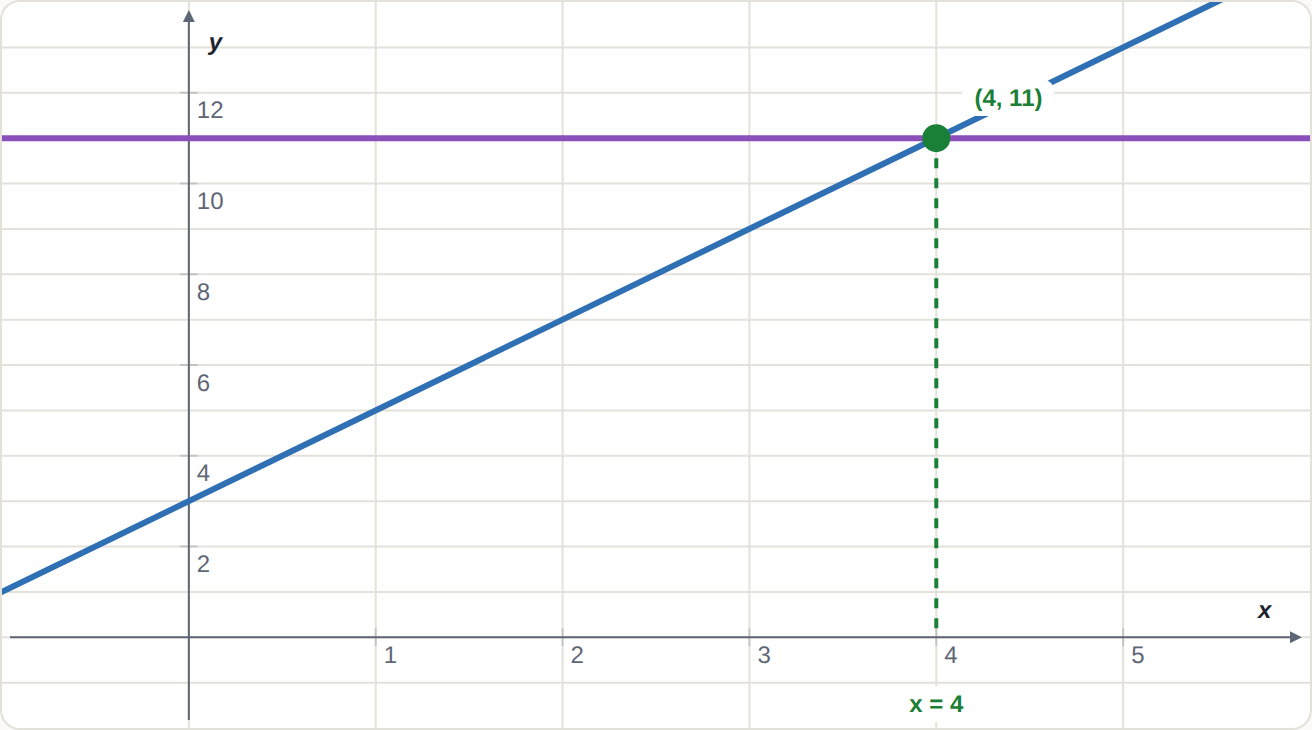
An equation says two things are equal. Draw each side as a line: for 2x+3=112x + 3 = 11, draw y=2x+3y = 2x + 3 and y=11y = 11.

Where the lines meet, both sides have the same value. The solution is the xx of that point: here the lines meet at (4,11)(4, 11), so x=4x = 4. The 11 is the value of both sides, not the answer.

Check by substitution: 2×4+3=112 \times 4 + 3 = 11. If the lines are parallel, they never meet, and the equation has no solution.

y = 2x + 3 meets y = 11 at (4, 11), so 2x + 3 = 11 when x = 4.
y=2x+3y = 2x + 3 meets y=11y = 11 at (4,11)(4, 11), so 2x+3=112x + 3 = 11 when x=4x = 4.
The solution is the x where the two lines meet · Sound on for the voiceover
Open the lesson →

Rules from real situations

Try firstA swimming pool charges a 50 dollar membership plus 4 dollars a visit. Write the rule for the total T for v visits, and say what each number means.

Check your answer

T = 4v + 50. 4 is the cost per visit (m); 50 is the membership, paid once (c).

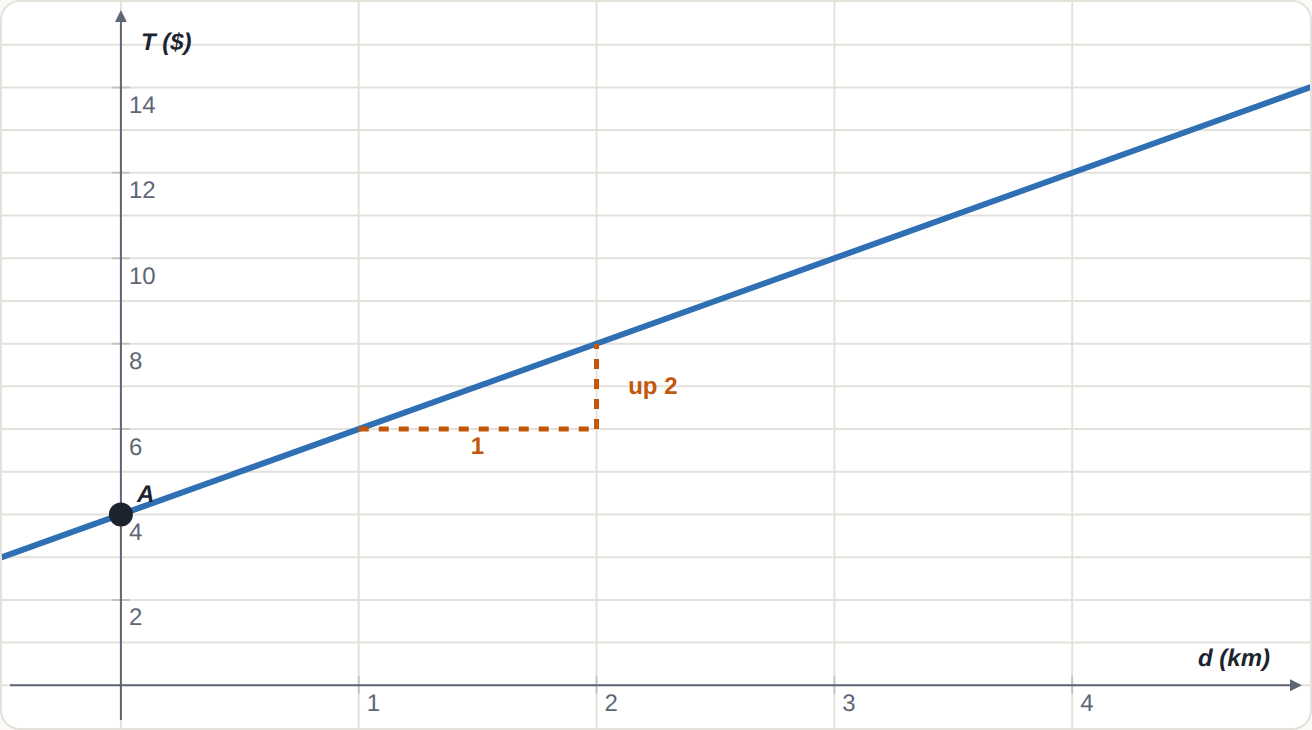
Many real amounts are a starting amount plus a rate. A taxi costs 4 dollars to get in, then 2 dollars for each km: T=2d+4T = 2d + 4.

The starting amount is cc: it is the value when nothing has happened yet (0 km), where the line crosses the axis. The rate is mm: the words "per", "each" or "every" tell you it is the amount for each one more, how far the line goes up for each step.

The order of the numbers in the words does not matter. Ask: which is paid once (c), and which is paid again and again (m)?

A taxi: 4 dollars to get in (where the line starts) and 2 dollars per km (up 2 for each km). T = 2d + 4.
A taxi: 4 dollars to get in (where the line starts) and 2 dollars per km (up 2 for each km). T=2d+4T = 2d + 4.
The starting amount is c; the rate is m · Sound on for the voiceover
Open the lesson →

Comparing two plans

Try firstPlan X costs 15 dollars plus 6 per GB; Plan Y costs 33 dollars flat. Which is cheaper for 2 GB and for 5 GB? Where do they cost the same?

Check your answer

2 GB: X (27 dollars vs 33). 5 GB: Y (45 vs 33). They cost the same at 3 GB (33 dollars).

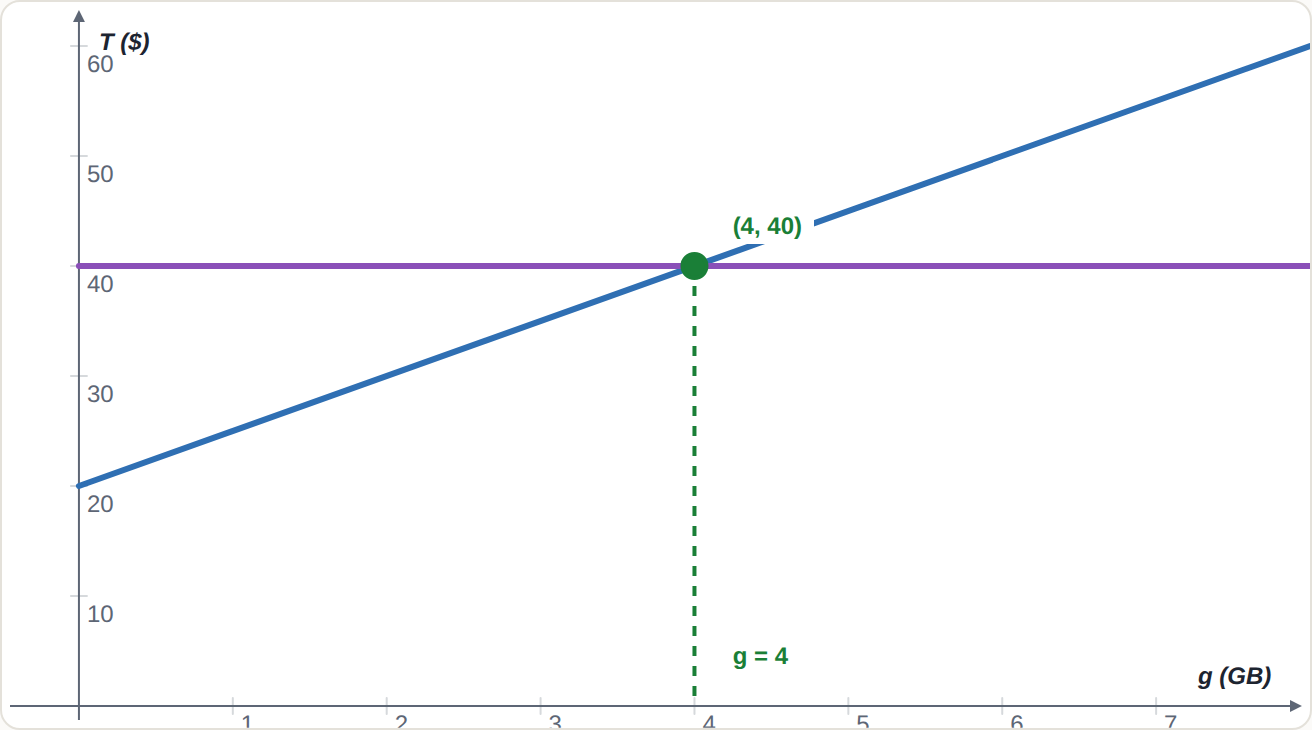
To compare two plans, draw both rules on one graph. Where the lines cross, the plans cost the same.

On each side of the crossing, the lower line is the cheaper plan. A plan with a lower fee is cheaper for small amounts, but a plan with a lower rate wins for large amounts.

Always answer in words ("Up to 4 GB, Plan A is cheaper"), and check the answer makes sense: you cannot use negative data or buy half a ticket, so a model only fits some values.

Plan A (T = 5g + 20) and Plan B (T = 40) cost the same at 4 GB. Below 4 GB, A is lower (cheaper); above 4 GB, B is.
Plan A (T=5g+20T = 5g + 20) and Plan B (T=40T = 40) cost the same at 4 GB. Below 4 GB, A is lower (cheaper); above 4 GB, B is.
Where the lines cross, the plans cost the same · Sound on for the voiceover
Open the lesson →

Year 8 Measurement

Composite shapes

Try firstA rectangle 12 m by 5 m has a 4 m by 2 m corner cut out. Find its area.

Check your answer

12 × 5 − 4 × 2 = 60 − 8 = 52 m².

A composite shape is made of shapes you know. Cut it into pieces and add their areas, or see a big rectangle and take away the missing pieces: both give the same area, if each piece uses its own lengths.

Missing sides are differences of other sides. The perimeter adds every side, in units of length.

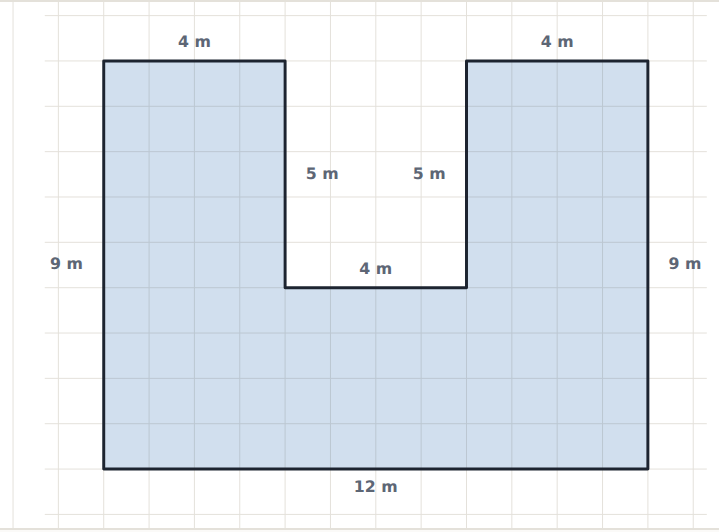
A U-shape: the 12 m by 9 m rectangle is 108 m², and the gap is 4 m by 5 m, so the area is 108 − 20 = 88 m².
Two ways, one area · Sound on for the voiceover
Open the lesson →

Irregular shapes

Try firstA shape covers 18 full squares and part of 10 more on a 1 cm grid. Estimate its area.

Check your answer

18 + 10 ÷ 2 = 23 cm².

For an irregular shape, put a grid over it: count the full squares, add half the part squares, and multiply by one square's area. A finer grid gives a better estimate.

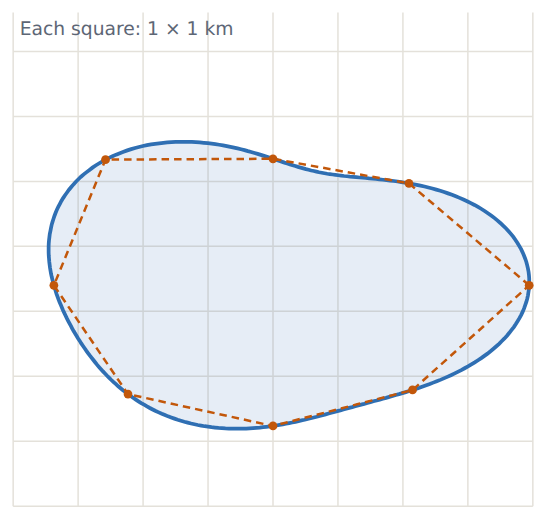
For the perimeter, join points on the edge with straight pieces and add them: more pieces get closer (always slightly short). State how precise the estimate is.

A lake on a grid of 1 km squares, with 8 straight pieces round its edge.
Count, then refine · Sound on for the voiceover
Open the lesson →

Volume and capacity

Try firstA fish tank is 50 cm by 30 cm by 40 cm. How many litres does it hold?

Check your answer

50 × 30 × 40 = 60 000 cm³ = 60 L.

Volume is in cubic units; capacity is in mL, L or kL. 1 cm³ holds 1 mL, 1000 cm³ holds 1 L, and 1 m³ holds 1000 L.

A cubic metre is 100 cm × 100 cm × 100 cm = 1 000 000 cm³: convert each of the three lengths.

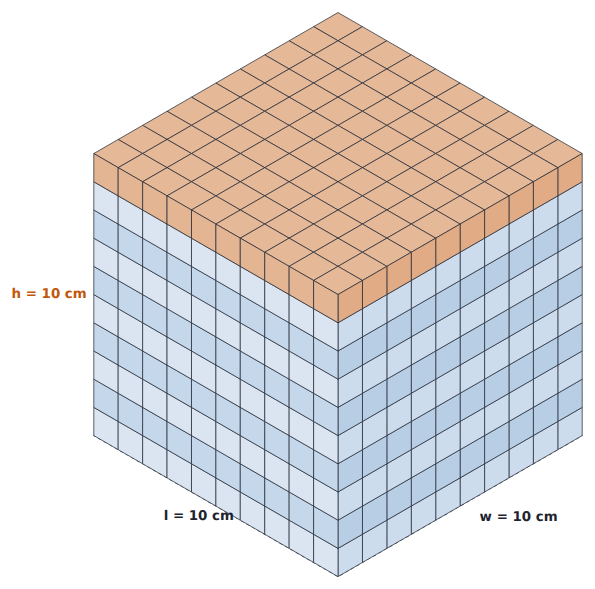
A 10 cm cube: 10 × 10 × 10 = 1000 cm³, which holds exactly 1 L.
A litre is a 10 cm cube · Sound on for the voiceover
Open the lesson →

Prism problems

Try firstA tank with a 2 m by 1.5 m base holds 4500 L. How deep is the water?

Check your answer

4500 L = 4.5 m³; 4.5 ÷ 3 = 1.5 m.

For any right prism, V=A×hV = A \times h: the area of the end times the length. Find the end's area with its own formula (rectangle, triangle or composite).

To find a missing length, divide: h=V÷Ah = V \div A. Convert units first, and answer in the units the problem asks for (mL, L or m³).

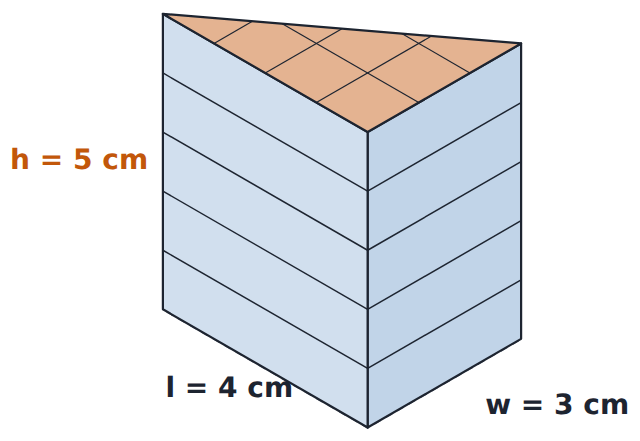
A triangular prism: the end is ½ × 4 × 3 = 6 cm², so 5 layers make 30 cm³.
End area times length · Sound on for the voiceover
Open the lesson →

Area of a circle

Try firstFind the area of a circle with diameter 8 cm.

Check your answer

r = 4 cm; A = π × 16 ≈ 50.3 cm².

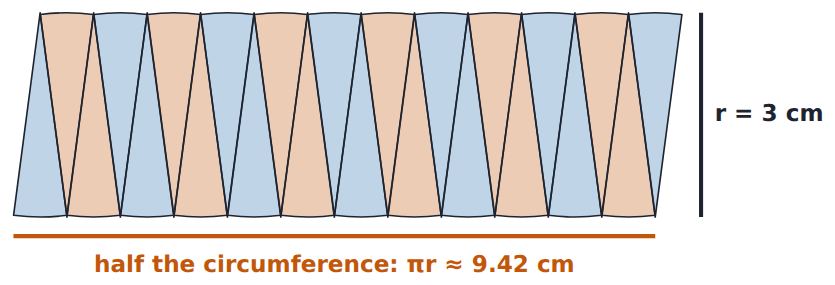
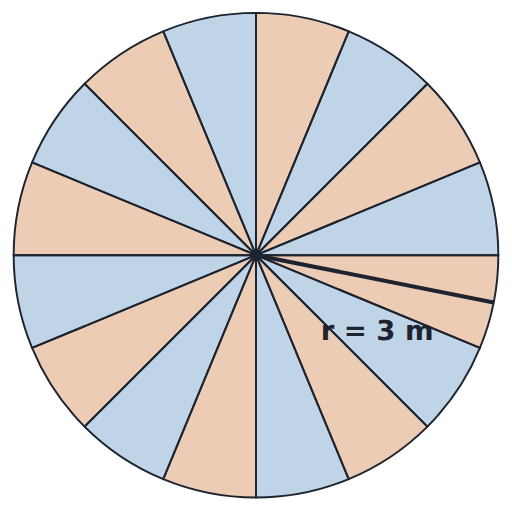
Cut a circle into thin slices and lay them top to tail: the shape is nearly a rectangle πr long (half the circumference) and r high. So A=πr2A = \pi r^2.

Check: the area is between 2r22r^2 and 4r24r^2. Do not mix it up with the circumference C=2πrC = 2\pi r, a length.

24 slices of a circle of radius 3 cm, top to tail: nearly a rectangle 3π ≈ 9.42 cm long and 3 cm high, so about 28.3 cm².
Slices into a rectangle · Sound on for the voiceover
Open the lesson →

Circle problems

Try firstA circular pond has an area of 28.3 m². What is its radius?

Check your answer

28.3 ÷ π ≈ 9, and √9 = 3 m.

Choose the formula: circumference C=2πrC = 2\pi r (a length) or area A=πr2A = \pi r^2 (a space). From an area, r=A÷πr = \sqrt{A \div \pi}.

Parts of circles: a semicircle is half the area; its perimeter is half the circumference plus the diameter. Say which value of π you used.

A circle of radius 3 m: A = π × 9 ≈ 28.27 m².
From area back to radius · Sound on for the voiceover
Open the lesson →

Pythagoras' theorem

Try firstA right-angled triangle has sides 10 cm and 24 cm at the right angle. Find the hypotenuse.

Check your answer

100 + 576 = 676, √676 = 26 cm.

In a right-angled triangle, the hypotenuse cc is the side opposite the right angle (the longest). Pythagoras' theorem: the squares on the two shorter sides add to the square on the hypotenuse,

a2+b2=c2a^2 + b^2 = c^2

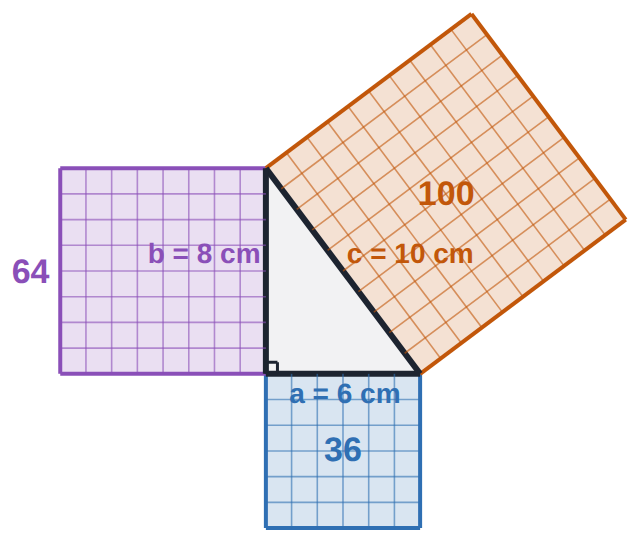
To find cc: square aa and bb, add, then take the square root. With 6 and 8: 36+64=10036 + 64 = 100, c=10c = 10.

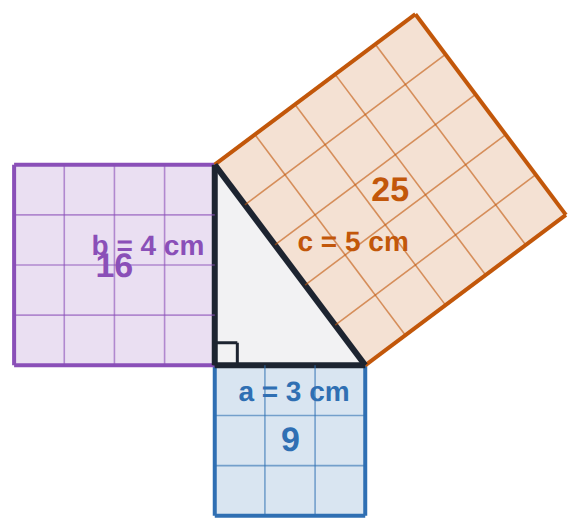
Squares on the sides of a 3-4-5 right-angled triangle: 9 + 16 = 25. The two smaller squares exactly make the biggest.
Squares on the sides of a 3-4-5 right-angled triangle: 9+16=259 + 16 = 25. The two smaller squares exactly make the biggest.
Squares on the sides · Sound on for the voiceover
Open the lesson →

Finding a side

Try firstA right-angled triangle has hypotenuse 17 cm and one side 8 cm. Find the other side.

Check your answer

289 − 64 = 225, √225 = 15 cm.

Pythagoras finds any side of a right-angled triangle:

  • the hypotenuse: add the squares, c2=a2+b2c^2 = a^2 + b^2;
  • a shorter side: subtract, b2=c2−a2b^2 = c^2 - a^2.

Then take the square root (to two decimal places if it is not whole). Check: the hypotenuse must be the longest side.

Hypotenuse 10 and one side 6: the missing square is 100 - 36 = 64, so the side is \sqrt{64} = 8.
Hypotenuse 10 and one side 6: the missing square is 100−36=64100 - 36 = 64, so the side is 64=8\sqrt{64} = 8.
A shorter side · Sound on for the voiceover
Open the lesson →

Right, acute or obtuse?

Try firstClassify triangles with sides (a) 8, 15, 17 and (b) 4, 6, 8.

Check your answer

(a) 64 + 225 = 289 = 17²: right-angled. (b) 16 + 36 = 52 < 64: obtuse.

To test a triangle, call its longest side cc and compare a2+b2a^2 + b^2 with c2c^2:

  • equal: right-angled;
  • a2+b2<c2a^2 + b^2 < c^2: obtuse (the angle opposite cc is over 90°);
  • a2+b2>c2a^2 + b^2 > c^2: acute.

Whole numbers that fit exactly are Pythagorean triples: 3-4-5, 5-12-13, 8-15-17, and their multiples.

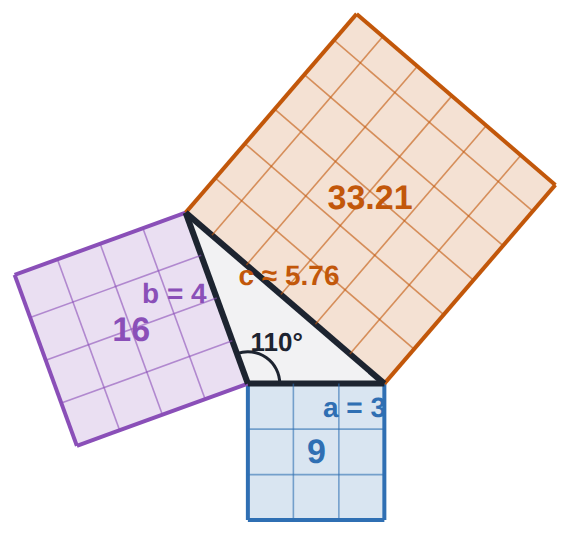
Open the angle to 110° and the biggest square grows: c^2 \approx 33.2, more than 9 + 16 = 25. The triangle is obtuse.
Open the angle to 110° and the biggest square grows: c2≈33.2c^2 \approx 33.2, more than 9+16=259 + 16 = 25. The triangle is obtuse.
Open the angle · Sound on for the voiceover
Open the lesson →

Time zones

Try firstIt is 18:30 Tuesday in Sydney (UTC+11). What time and day is it in Los Angeles (UTC−7)?

Check your answer

Los Angeles is 18 hours behind: 00:30 Tuesday.

A time zone is an offset from UTC. A city with a bigger offset is ahead; a smaller one is behind. Find the difference, add or take it away, and change the day when you cross midnight.

For a flight, add the flight time to the departure (in the departure zone), then change to the arrival zone. Use 24-hour time to avoid am and pm mistakes.

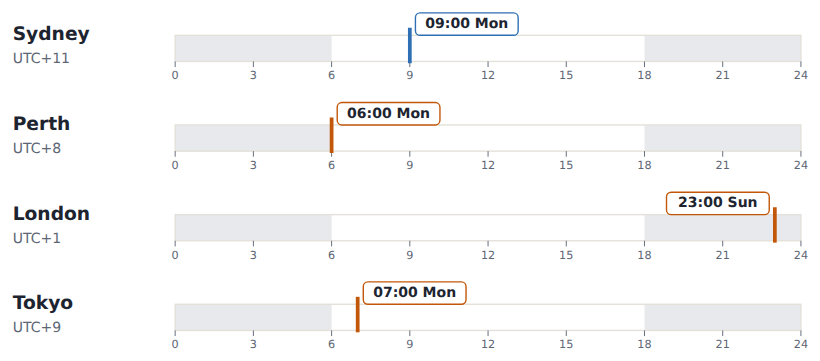
9:00 am Monday in Sydney is 6:00 am in Perth, 11:00 pm Sunday in London and 7:00 am in Tokyo.
One moment, four clocks · Sound on for the voiceover
Open the lesson →

Rates

Try firstA cyclist rides 45 km in 1.5 hours. Find her speed in km/h and m/s.

Check your answer

45 ÷ 1.5 = 30 km/h; 30 ÷ 3.6 ≈ 8.3 m/s.

A rate compares two quantities with different units (km per hour, $ per kg); a ratio compares the same kind of quantity.

The unit rate is the amount for one of the second quantity: divide the first by the second, and keep both units. To convert km/h to m/s, divide by 3.6.

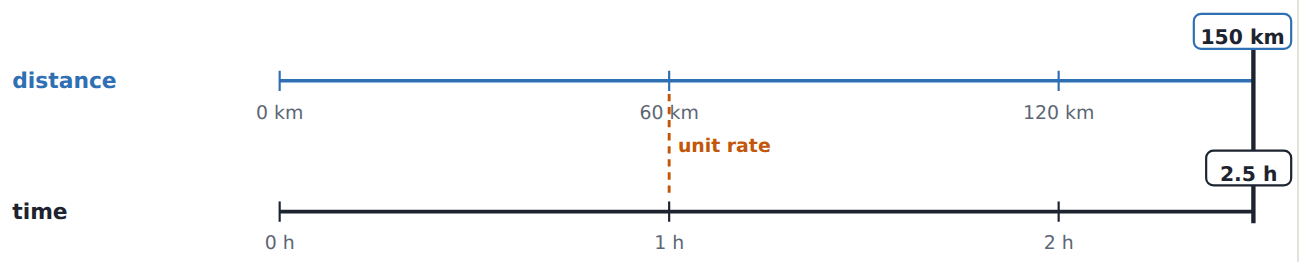
At 60 km per hour, 2.5 hours matches 150 km: each hour adds another 60 km.
Per one hour · Sound on for the voiceover
Open the lesson →

Using rates

Try firstA plane flies 2100 km at 700 km/h. How long does it take?

Check your answer

2100 ÷ 700 = 3 hours.

Use a rate both ways: total = rate × amount and amount = total ÷ rate. For speed, distance = speed × time and time = distance ÷ speed.

Write the units at each step (km ÷ km/h = h); they tell you whether to multiply or divide. Then check the size makes sense.

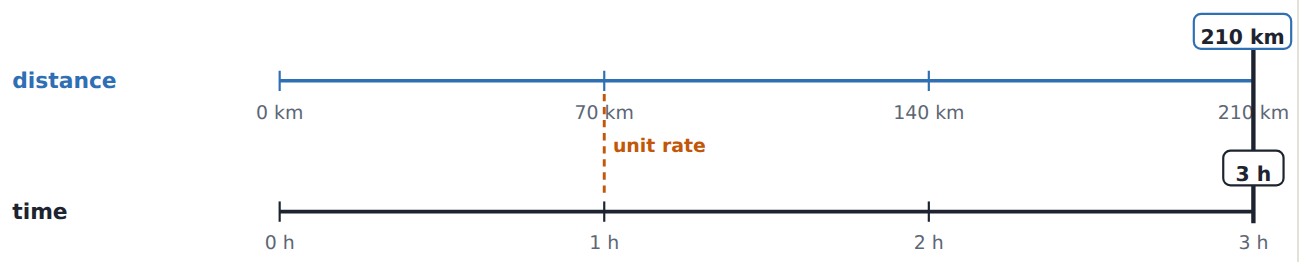
At 70 km/h, 3 hours covers 210 km; 210 km ÷ 70 km/h gives back the 3 hours.
Both ways along the line · Sound on for the voiceover
Open the lesson →

Ratio and rate models

Try firstA recipe uses 2 cups of rice to 3 cups of water. How much water for 5 cups of rice? Is this a ratio or a rate?

Check your answer

A ratio (cups to cups): 5 × 1.5 = 7.5 cups of water.

To model a problem: say what you need (with units), choose a ratio (same kind of quantity) or a rate (different units), solve, then interpret the answer in the situation.

Paint comes in whole tins and buses in whole buses: round up when you must have enough.

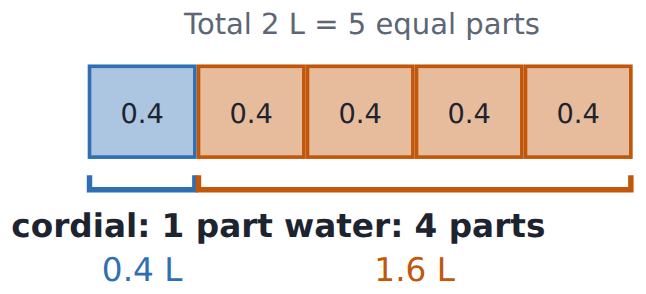
Cordial 1 : 4 water: 2 L of drink is 5 equal parts of 0.4 L, so 0.4 L of cordial and 1.6 L of water.
A ratio model · Sound on for the voiceover
Open the lesson →

Checking a model

Try firstA model says 4 kg of apples at $3.50 per kg cost $14. The shop charges $12.60 for 4 kg. Name a possible assumption that failed.

Check your answer

A fixed price per kg: the shop may give a discount for buying more (a bulk price).

Every model makes assumptions (steady speed, no fees, no starting charge). When the model and real life differ, check the arithmetic, then name the assumption that did not hold.

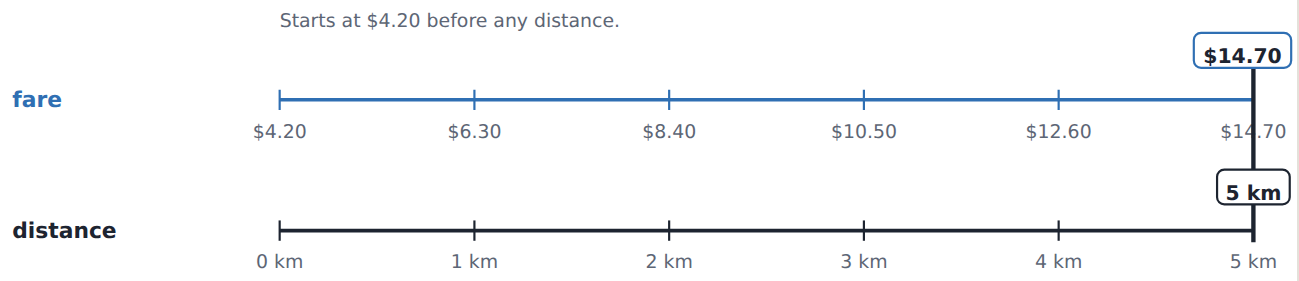
Refine the model by adding what was left out, such as a starting charge: fare = $4.20 + $2.10 × km. A simple model is good enough when its error does not change the decision.

A taxi fare: 4.20 to start, then 2.10 per km. A 5 km ride costs 4.20 + 10.50 = 14.70.
A taxi fare: $4.20 to start, then $2.10 per km. A 5 km ride costs $4.20 + $10.50 = $14.70.
A simple model · Sound on for the voiceover
Open the lesson →

Year 8 Space

Congruent triangles

Try firstTwo triangles have AB = PQ = 7 cm, BC = QR = 5 cm and angle B = angle Q = 60°. Are they congruent? Which test?

Check your answer

Yes, by SAS: angle B is between AB and BC.

Congruent triangles are the same shape and size. Each test fixes a triangle: SSS, SAS (the angle between the sides), ASA or AAS, and RHS.

SSA (an angle not between the two sides) is not a test: it can give two different triangles. Equal angles alone give the same shape, not always the same size.

AB = 8, BC = 6 and angle A = 40°: two different triangles fit, so SSA is not a congruence test.
When SSA fails · Sound on for the voiceover
Open the lesson →

Similar shapes

Try firstA 2 m by 3 m garden bed is enlarged so the 2 m side becomes 5 m. How long is the 3 m side now?

Check your answer

k = 5 ÷ 2 = 2.5, so 3 × 2.5 = 7.5 m.

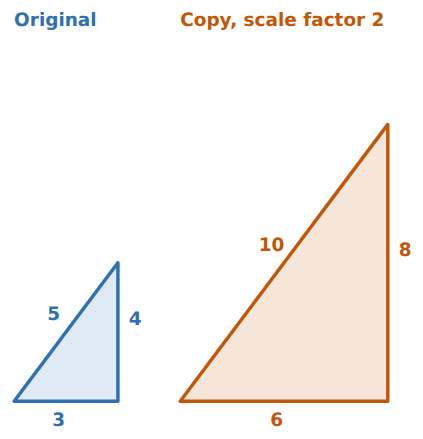
Similar shapes are the same shape, maybe a different size. Every length is multiplied by the same scale factor k = copy ÷ original, and the angles stay the same. Congruent is similar with k = 1.

Triangles are similar by AA, SSS (sides in one ratio) or SAS (two sides in one ratio, the angle between them equal). For other shapes, check both the angles and the ratios of the sides.

A 3, 4, 5 triangle and a copy with scale factor 2: sides 6, 8, 10, the same angles.
A scale factor · Sound on for the voiceover
Open the lesson →

Proving quadrilateral properties

Try firstKite ABCD has AB = AD and CB = CD. Prove that angle B = angle D.

Check your answer

Triangles ABC and ADC: AB = AD, CB = CD, AC shared, so they are congruent (SSS). Angle B and angle D match, so they are equal.

A proof gives a reason for every step and works for every shape of the kind; one measured drawing is only an example.

To prove a quadrilateral property: find two triangles (often either side of a diagonal), give the equal parts with reasons, name the congruence test, then use matching parts of congruent triangles. This proves, for example, that a rectangle's diagonals are equal.

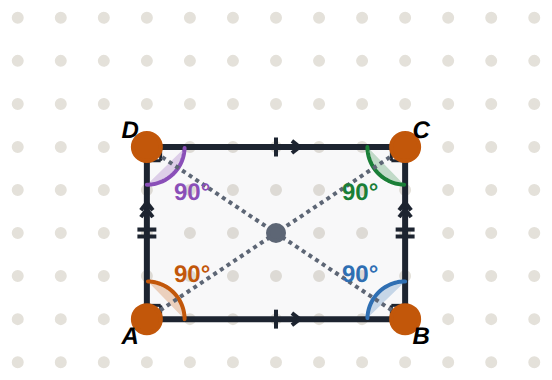
A rectangle and its diagonals AC and BD: equal, and they cut each other in half.
Diagonals of a rectangle · Sound on for the voiceover
Open the lesson →

Problems with quadrilaterals

Try firstIn parallelogram ABCD, angle B = 3 × angle A. Find all four angles.

Check your answer

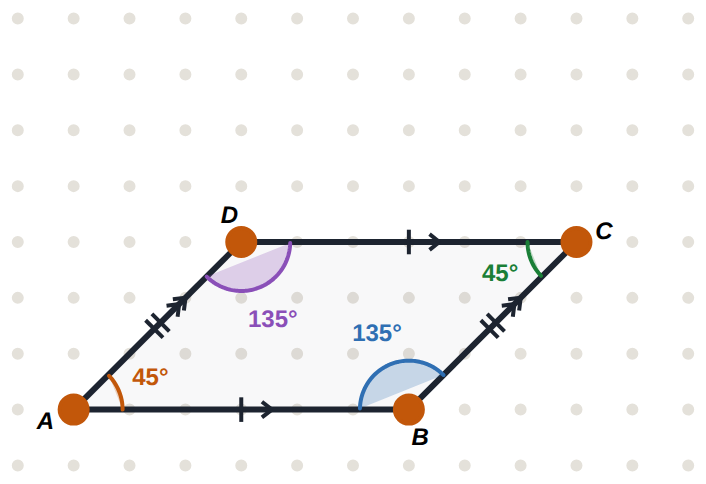
A + 3A = 180, so A = 45°. B = 135°, C = 45°, D = 135°.

Use the properties, with a reason for each step. A parallelogram's opposite angles are equal and its neighbouring (co-interior) angles add to 180°. A kite has one pair of equal opposite angles. A rectangle's diagonals are equal and cut each other in half; a rhombus's cut each other in half at 90°.

Every quadrilateral's angles add to 360°: use it to check.

A parallelogram: opposite angles are equal (45° and 45°, 135° and 135°), and neighbouring angles add to 180°.
Angles in a parallelogram · Sound on for the voiceover
Open the lesson →

Algorithms for congruence

Try firstWhy must an algorithm for congruence not answer 'congruent' when two sides and any angle are equal?

Check your answer

If the angle is not between the sides (SSA), two different triangles can fit, so they might not be congruent.

An algorithm for two triangles asks about their equal parts in order: the congruence tests first (SSS, SAS, ASA or AAS, RHS), then similarity (AA, sides in the same ratio), then not enough to tell.

Test it on one pair of every kind, including SSA (which must not be called congruent). When you fix it, test every pair again.

Following the algorithm · Sound on for the voiceover
Open the lesson →

Coordinates in 3D

Try firstA drone is 8 m east, 3 m north and 20 m up from its base, with x east, y north and z up. Write its position. Then it flies 5 m north: where is it now?

Check your answer

(8, 3, 20), then (8, 8, 20).

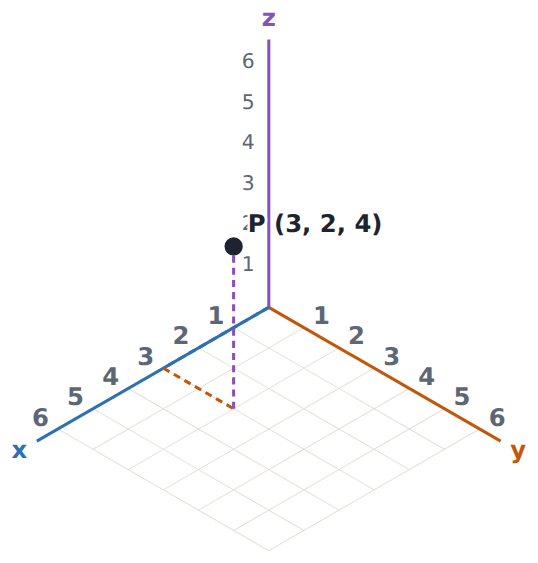
A third axis, z, points up from the x-y plane. A point in space is (x, y, z): along x, along y, then up. The order is always x, y, z; points with z = 0 are on the floor.

Real systems work the same way: east, north and up for a drone; across, back and floor in a building; latitude, longitude and altitude for a plane.

P (3, 2, 4): 3 along x, 2 along y, then 4 up the z-axis.
Three coordinates · Sound on for the voiceover
Open the lesson →

Year 8 Statistics

Census, sample, experiment or observation

Try firstA cereal company wants to check the weight of its boxes. Census or sample? Why?

Check your answer

A sample: weighing every box costs time; checking a random sample of boxes each hour is enough to spot problems.

The population is everyone the question is about. A census measures all of them (exact, but often slow and costly); a sample measures some (quicker and cheaper, an estimate).

An experiment changes something on purpose and measures the effect; an observation watches without changing anything. Choose the technique that fits the question, the cost and the time.

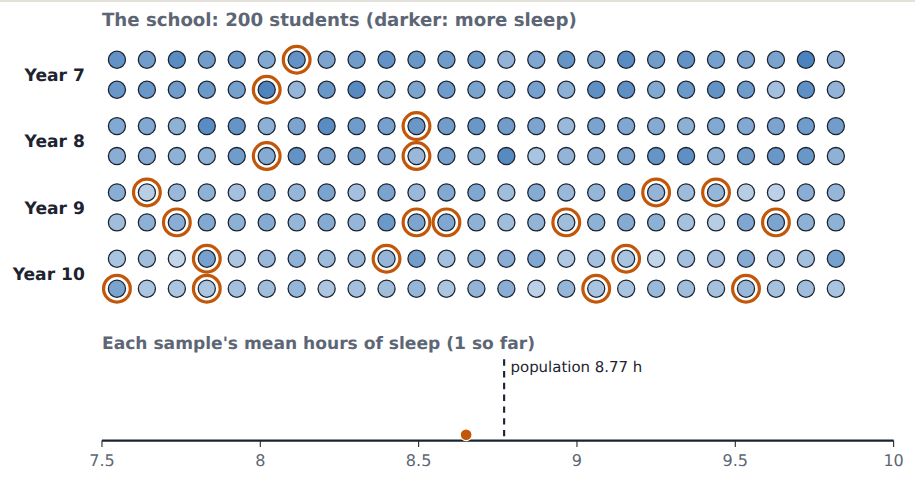
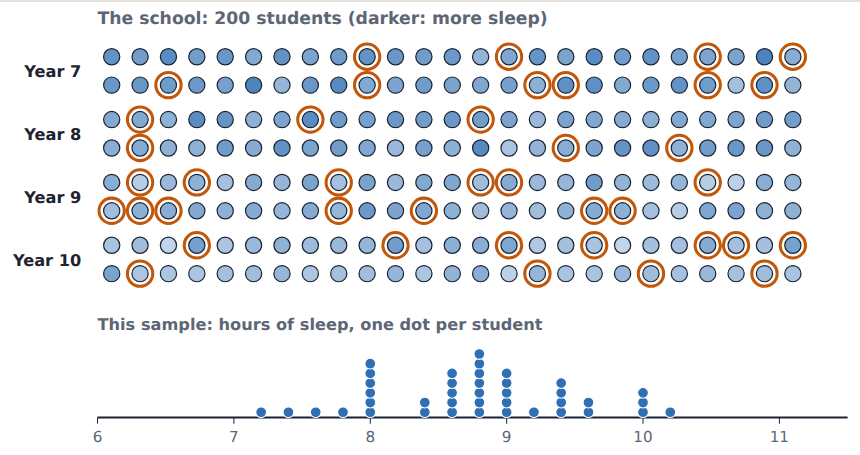
The population: 200 students in four year groups. A census measures all of them; this random sample (orange rings) measures 20.
Census or sample · Sound on for the voiceover
Open the lesson →

Bias in collecting data

Try firstA gym surveys its members on how often people exercise. Name the bias and which way it pushes the result.

Check your answer

Sampling bias: gym members exercise more than most people, so the result is too high.

Bias is anything in how data is collected that pushes the result one way. Sampling bias: the sample isn't like the population (only people at a gym). Response bias: the question or setting pushes answers (leading questions, no privacy). Measurement bias: the tool or method is off.

A bigger sample doesn't fix bias. Random choice, neutral questions, anonymous answers and checked tools do.

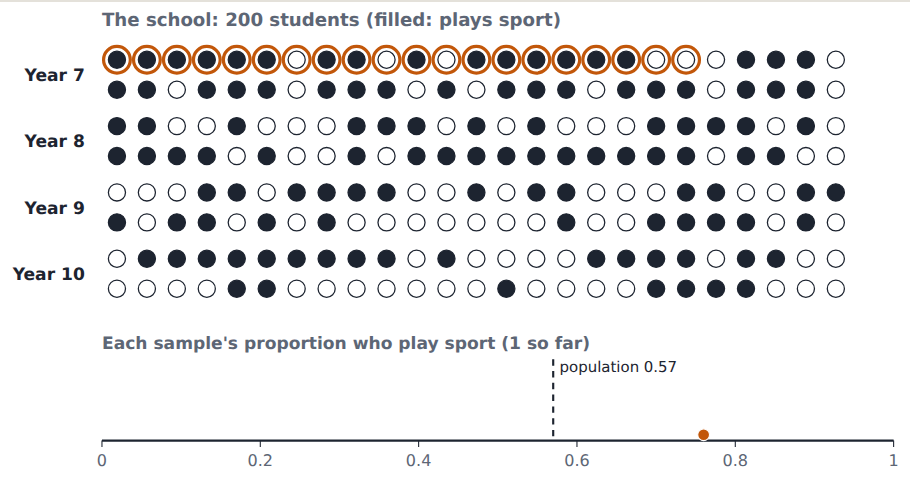
A convenience sample: the 20 students nearest the door, all from Year 7. Year 7s play more sport, so the sample overstates the school's proportion.
A biased sample · Sound on for the voiceover
Open the lesson →

Ways to choose a sample

Try firstA school has 400 Year 9 and 200 Year 10 students. Describe how to take a stratified sample of 30.

Check your answer

In proportion: 20 Year 9s and 10 Year 10s, each chosen at random from its year's list.

Simple random: every member has the same chance. Systematic: every kth member of a list from a random start (k = population ÷ sample size). Stratified: split into groups and choose at random within each, in proportion, so each group gets its fair share. Convenience: whoever is easiest, often biased. Quota: fixed shares, but the collector chooses, so it can be biased too.

A stratified sample of 20: 5 chosen at random from each year group, so every year has its fair share.
Four ways to choose · Sound on for the voiceover
Open the lesson →

Describing a sample

Try firstA random sample of 25 students spends a median of 40 minutes on homework a night (range 0 to 120). Write one sentence about the school.

Check your answer

Students at the school probably spend about 40 minutes on homework a night, though some spend much more, based on a random sample of 25.

To report on a sample: describe its shape (symmetric or skewed, clusters, outliers), centre (mean, median) and spread (range). Then give an estimate for the population, with the sampling method and size, using words like "about".

Primary data you collect yourself; secondary data someone else collected. Either way, say where it came from.

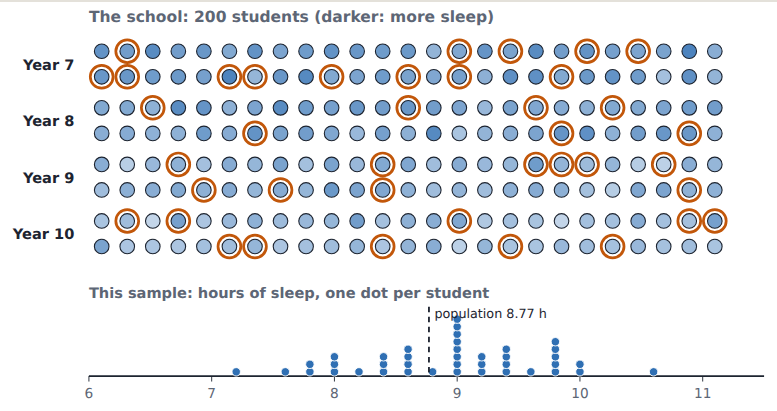
A random sample of 40 students' sleep: most between 8 and 10 hours, a few lower. The dashed line is the whole school's mean.
Reporting on a sample · Sound on for the voiceover
Open the lesson →

How samples vary

Try firstTwo random samples of 10 students give 0.4 and 0.7 for the proportion who walk to school. Is one wrong? What would you do?

Check your answer

Not necessarily: small samples vary a lot. Take bigger samples (or more of them) for a more reliable estimate.

Sampling variation: random samples from the same population give different results, because each holds different members. It isn't a mistake.
Bigger samples vary less, so their results are more reliable. Fair samples scatter around the population's value; bias pushes them all to one side.

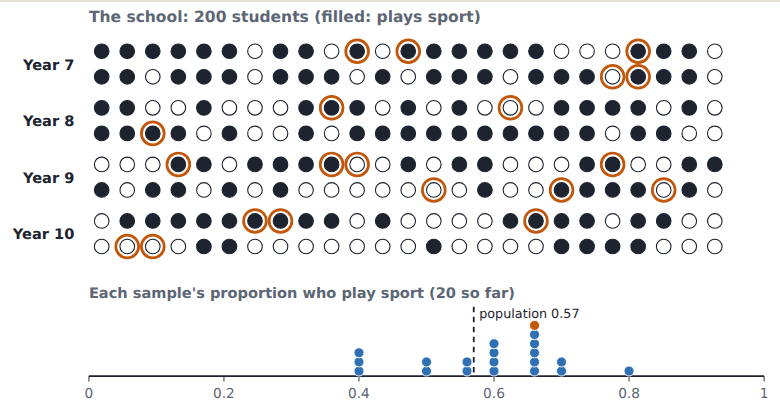
20 random samples of 20 students: each gives a different proportion who play sport, scattered around the school's 0.57 (dashed).
Samples vary · Sound on for the voiceover
Open the lesson →

Investigating with samples

Try firstA random sample of 50 students at your school shows a median of 2 hours of screen time on school nights. Write an inference with its uncertainty.

Check your answer

Students at our school probably have about 2 hours of screen time on school nights, from a random sample of 50; another sample might give a slightly different value.

An investigation with samples asks a question about a population, plans a fair and ethical sample (random, consent, anonymous, neutral questions), collects and describes the data, then makes an inference.

A good inference is about the population sampled, gives an estimate ("about"), and states the uncertainty: the sample's size and method, and that another sample might differ a little.

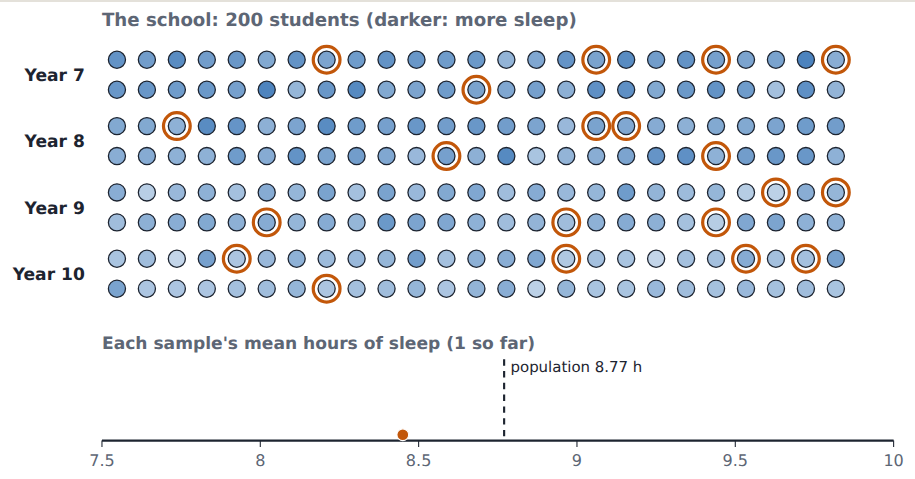
A random sample of 40 with the population hidden: the sample's centre is the estimate, and the population's value is unknown.
Inferring from a sample · Sound on for the voiceover
Open the lesson →

Year 8 Probability

Complementary events

Try firstP(it snows tomorrow) = 0.08. What is P(it does not snow)? Then: two coins are tossed; what is P(at least one tail)?

Check your answer

0.92. And 1 − P(HH) = 1 − 1/4 = 3/4.

The complement of an event A, written not A, is every other outcome. A and not A cover every outcome exactly once, so P(A) + P(not A) = 1, and P(not A) = 1 − P(A).

This makes at least one easy: count the outcomes with none, and subtract from 1. Two events that just can't happen together are not complementary unless they cover every outcome too.

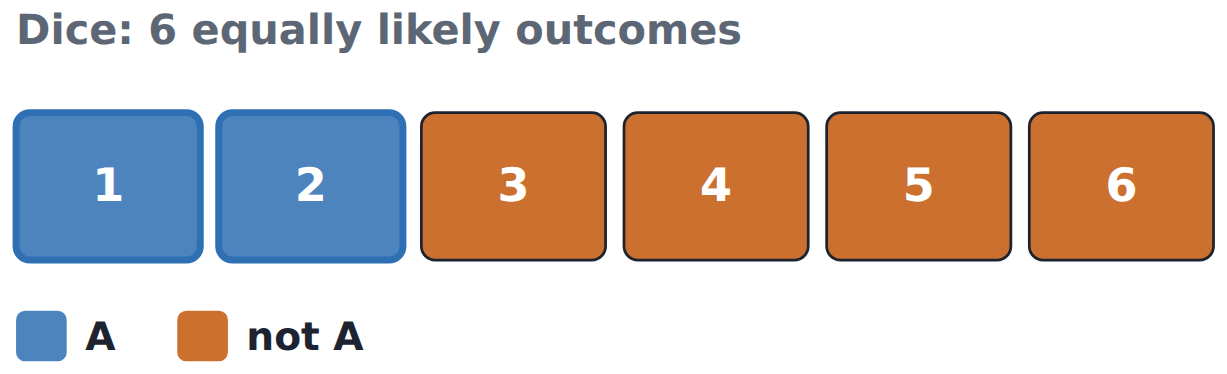
A dice: A is 'roll 1 or 2' (blue, 2 outcomes); not A is the other 4 (orange). 2/6 + 4/6 = 1.
An event and its complement · Sound on for the voiceover
Open the lesson →

Venn diagrams and two-way tables

Try first50 students: 30 study French, 25 study Japanese, 10 study both. How many study neither?

Check your answer

French only 20, Japanese only 15, both 10: 45, so 5 study neither.

Sorting a group by two yes/no properties makes four groups: one only, the other only, both and neither. Everyone is in exactly one.

A Venn diagram shows them as two overlapping circles in a box; a two-way table shows them as four cells with totals. Write both first, then take it from each total.

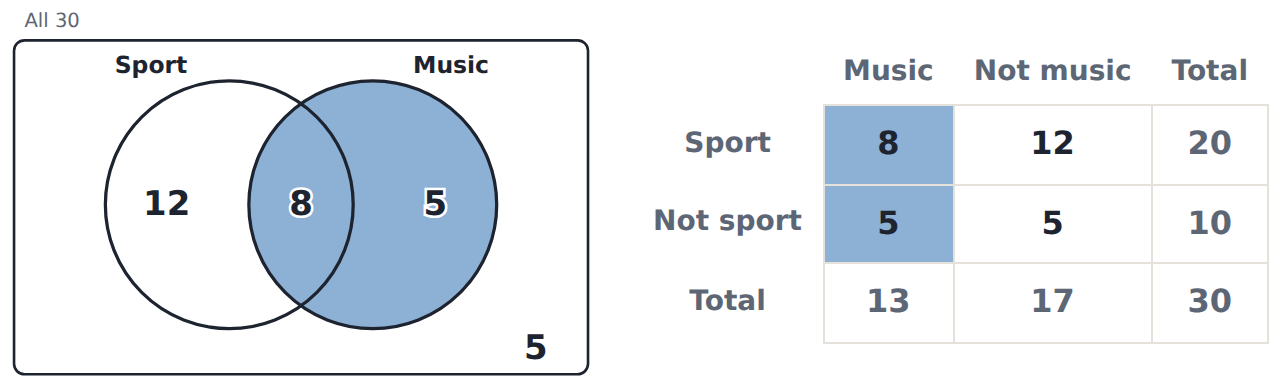
30 students: 12 sport only, 8 both, 5 music only, 5 neither. Music (shaded) is 8 + 5 = 13: the table's Music total.
Four groups, two pictures · Sound on for the voiceover
Open the lesson →

Grids and tree diagrams

Try firstA spinner shows 1, 2 or 3 (equal parts) and a coin is tossed. List the outcomes. What is P(an odd number and heads)?

Check your answer

1H, 1T, 2H, 2T, 3H, 3T: 6 outcomes. 1H and 3H, so 2/6 = 1/3.

Two events one after the other make pairs. A tree diagram splits each first outcome into every second outcome; a grid puts one event down the side and the other across. Both list every pair once, so each is equally likely.
The number of outcomes is the two counts multiplied. Order matters: HT and TH are different outcomes. Then P(event) = outcomes in the event ÷ all outcomes.

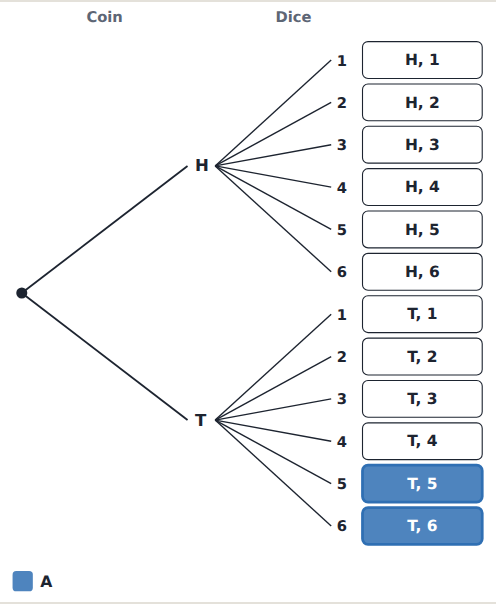
A coin then a dice: 2 branches, then 6 from each, makes 12 outcomes. Tails and more than 4: 2 of them.
A tree diagram · Sound on for the voiceover
Open the lesson →

And, or and not

Try first40 students: 25 like maths, 18 like art, 10 like both. Find P(maths or art) and P(neither).

Check your answer

25 + 18 − 10 = 33, so 33/40. Neither: 7/40.

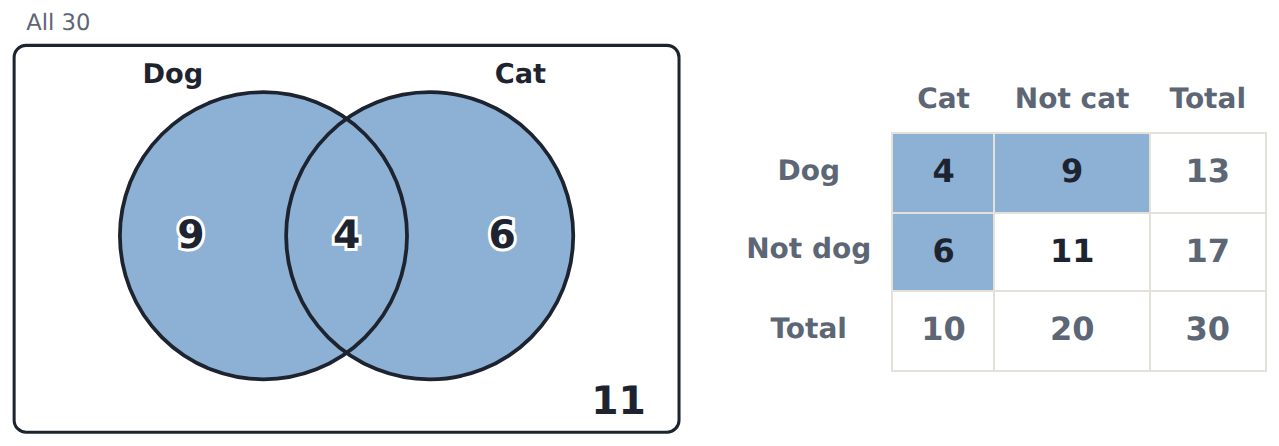
A and B: both happen (the overlap). A or B: at least one happens, both included (everything inside the circles). Not A: everything outside A. Neither: outside both.

Count each outcome once. From totals: P(A or B) = P(A) + P(B) − P(A and B), because the overlap is in both totals.

Dog or cat: everything inside the circles, 9 + 4 + 6 = 19. The 4 with both are counted once.
And, or · Sound on for the voiceover
Open the lesson →

Simulating compound events

Try firstA simulation gives a total of 8 on two dice 68 times in 500 trials. Find the relative frequency and compare it with the probability.

Check your answer

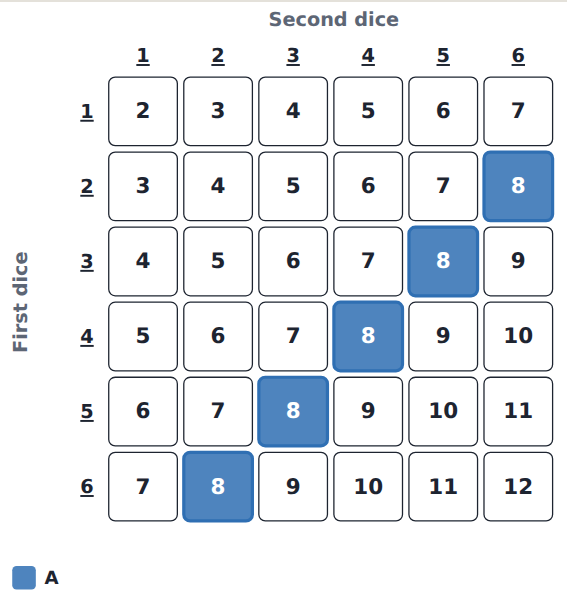
68 ÷ 500 = 0.136. P(8) = 5/36 ≈ 0.139: very close.

A simulation repeats a chance experiment many times with random numbers. Record each result in a frequency table, then relative frequency = count ÷ trials.

Compare it with the probability from the sample space. A short run can be well off; over many trials the relative frequency settles close to the probability. A simulation estimates; the grid gives the exact value.

Two dice: a total of 8 is 5 of the 36 outcomes, P = 5/36 ≈ 0.14. A simulation's relative frequency should come close to this over many trials.
A simulation · Sound on for the voiceover
Open the lesson →