← Year 8 Measurement

Year 8 Measurement: recap

For after the lessons: one card per lesson, to check what you remember. Answer each question in your head or on paper first, then check it. Nothing here is marked.

Looking back over the whole year? See the Year 8 recap.

Area

1. Composite shapes

Try firstA rectangle 12 m by 5 m has a 4 m by 2 m corner cut out. Find its area.

Check your answer

12 × 5 − 4 × 2 = 60 − 8 = 52 m².

A composite shape is made of shapes you know. Cut it into pieces and add their areas, or see a big rectangle and take away the missing pieces: both give the same area, if each piece uses its own lengths.

Missing sides are differences of other sides. The perimeter adds every side, in units of length.
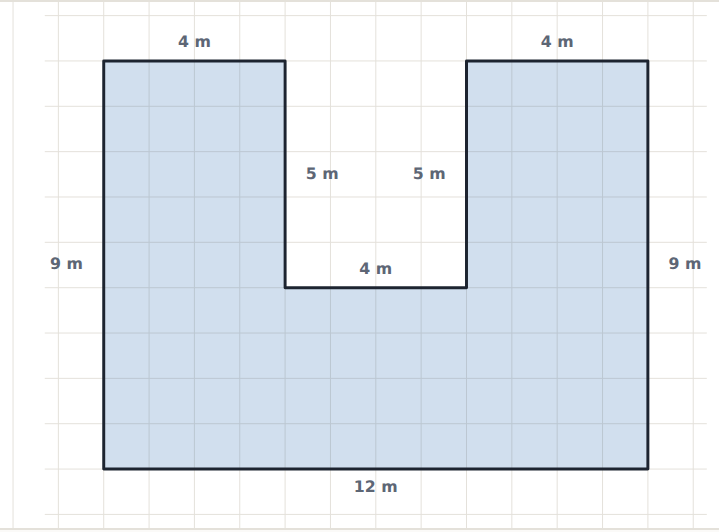
A U-shape: the 12 m by 9 m rectangle is 108 m², and the gap is 4 m by 5 m, so the area is 108 − 20 = 88 m².
Two ways, one area · Sound on for the voiceover
Open the lesson →

2. Irregular shapes

Try firstA shape covers 18 full squares and part of 10 more on a 1 cm grid. Estimate its area.

Check your answer

18 + 10 ÷ 2 = 23 cm².

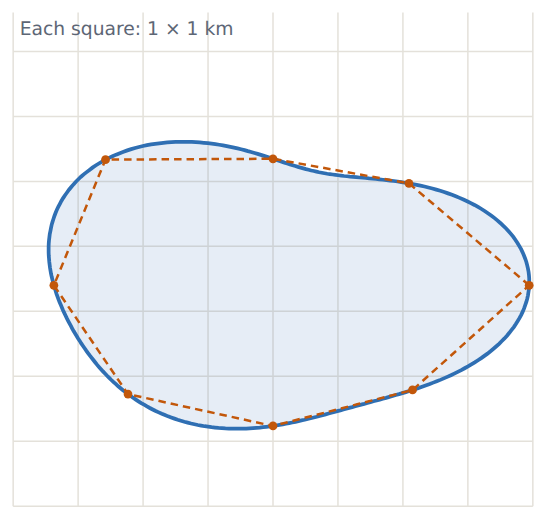
For an irregular shape, put a grid over it: count the full squares, add half the part squares, and multiply by one square's area. A finer grid gives a better estimate.

For the perimeter, join points on the edge with straight pieces and add them: more pieces get closer (always slightly short). State how precise the estimate is.

A lake on a grid of 1 km squares, with 8 straight pieces round its edge.
Count, then refine · Sound on for the voiceover
Open the lesson →

Volume

3. Volume and capacity

Try firstA fish tank is 50 cm by 30 cm by 40 cm. How many litres does it hold?

Check your answer

50 × 30 × 40 = 60 000 cm³ = 60 L.

Volume is in cubic units; capacity is in mL, L or kL. 1 cm³ holds 1 mL, 1000 cm³ holds 1 L, and 1 m³ holds 1000 L.

A cubic metre is 100 cm × 100 cm × 100 cm = 1 000 000 cm³: convert each of the three lengths.

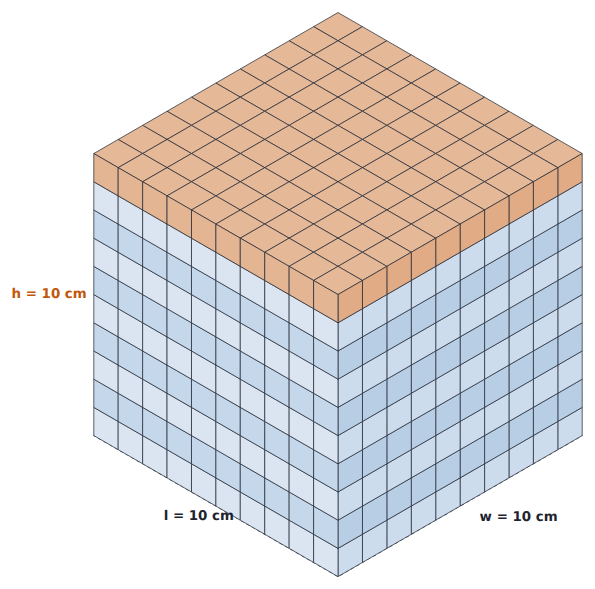
A 10 cm cube: 10 × 10 × 10 = 1000 cm³, which holds exactly 1 L.
A litre is a 10 cm cube · Sound on for the voiceover
Open the lesson →

4. Prism problems

Try firstA tank with a 2 m by 1.5 m base holds 4500 L. How deep is the water?

Check your answer

4500 L = 4.5 m³; 4.5 ÷ 3 = 1.5 m.

For any right prism, V=A×hV = A \times h: the area of the end times the length. Find the end's area with its own formula (rectangle, triangle or composite).

To find a missing length, divide: h=V÷Ah = V \div A. Convert units first, and answer in the units the problem asks for (mL, L or m³).

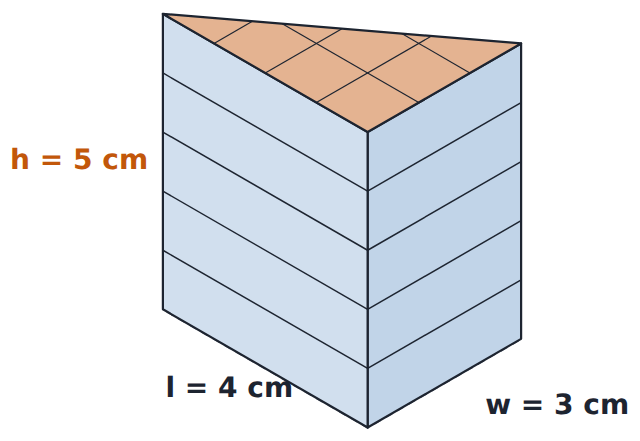
A triangular prism: the end is ½ × 4 × 3 = 6 cm², so 5 layers make 30 cm³.
End area times length · Sound on for the voiceover
Open the lesson →

Circles

5. Area of a circle

Try firstFind the area of a circle with diameter 8 cm.

Check your answer

r = 4 cm; A = π × 16 ≈ 50.3 cm².

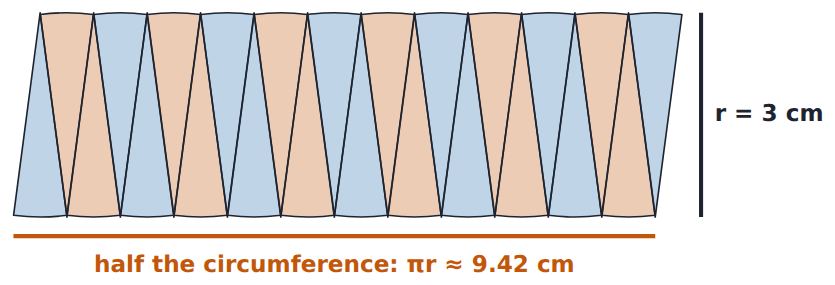
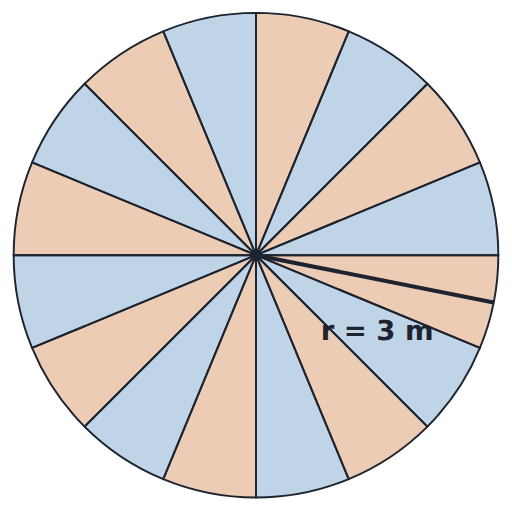
Cut a circle into thin slices and lay them top to tail: the shape is nearly a rectangle πr long (half the circumference) and r high. So A=πr2A = \pi r^2.

Check: the area is between 2r22r^2 and 4r24r^2. Do not mix it up with the circumference C=2πrC = 2\pi r, a length.

24 slices of a circle of radius 3 cm, top to tail: nearly a rectangle 3π ≈ 9.42 cm long and 3 cm high, so about 28.3 cm².
Slices into a rectangle · Sound on for the voiceover
Open the lesson →

6. Circle problems

Try firstA circular pond has an area of 28.3 m². What is its radius?

Check your answer

28.3 ÷ π ≈ 9, and √9 = 3 m.

Choose the formula: circumference C=2πrC = 2\pi r (a length) or area A=πr2A = \pi r^2 (a space). From an area, r=A÷πr = \sqrt{A \div \pi}.

Parts of circles: a semicircle is half the area; its perimeter is half the circumference plus the diameter. Say which value of π you used.

A circle of radius 3 m: A = π × 9 ≈ 28.27 m².
From area back to radius · Sound on for the voiceover
Open the lesson →

Pythagoras

7. Pythagoras' theorem

Try firstA right-angled triangle has sides 10 cm and 24 cm at the right angle. Find the hypotenuse.

Check your answer

100 + 576 = 676, √676 = 26 cm.

In a right-angled triangle, the hypotenuse cc is the side opposite the right angle (the longest). Pythagoras' theorem: the squares on the two shorter sides add to the square on the hypotenuse,

a2+b2=c2a^2 + b^2 = c^2

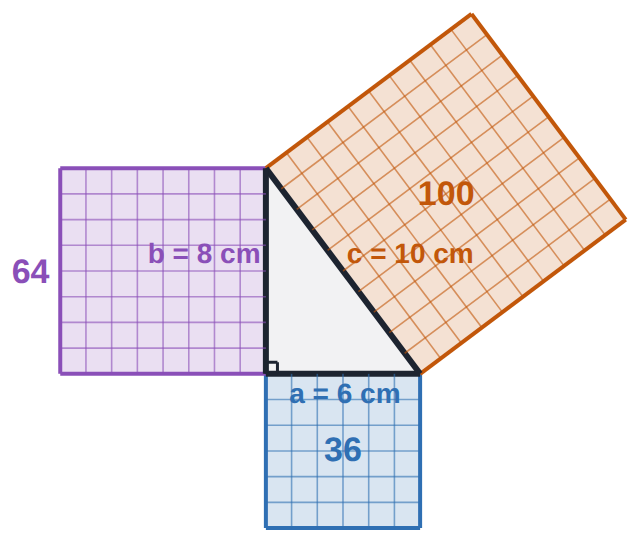
To find cc: square aa and bb, add, then take the square root. With 6 and 8: 36+64=10036 + 64 = 100, c=10c = 10.

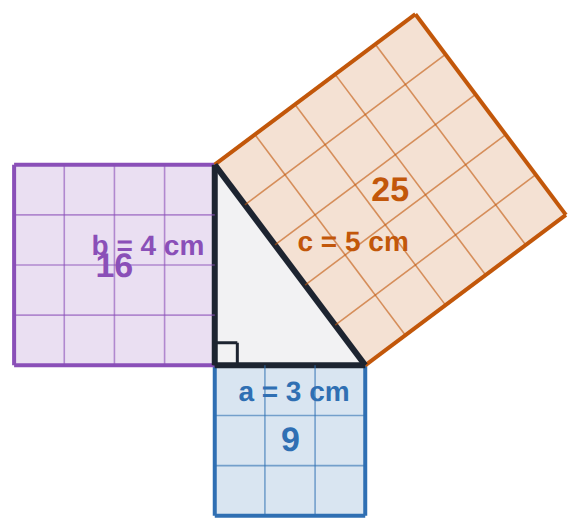
Squares on the sides of a 3-4-5 right-angled triangle: 9 + 16 = 25. The two smaller squares exactly make the biggest.
Squares on the sides of a 3-4-5 right-angled triangle: 9+16=259 + 16 = 25. The two smaller squares exactly make the biggest.
Squares on the sides · Sound on for the voiceover
Open the lesson →

8. Finding a side

Try firstA right-angled triangle has hypotenuse 17 cm and one side 8 cm. Find the other side.

Check your answer

289 − 64 = 225, √225 = 15 cm.

Pythagoras finds any side of a right-angled triangle:

  • the hypotenuse: add the squares, c2=a2+b2c^2 = a^2 + b^2;
  • a shorter side: subtract, b2=c2−a2b^2 = c^2 - a^2.

Then take the square root (to two decimal places if it is not whole). Check: the hypotenuse must be the longest side.

Hypotenuse 10 and one side 6: the missing square is 100 - 36 = 64, so the side is \sqrt{64} = 8.
Hypotenuse 10 and one side 6: the missing square is 100−36=64100 - 36 = 64, so the side is 64=8\sqrt{64} = 8.
A shorter side · Sound on for the voiceover
Open the lesson →

9. Right, acute or obtuse?

Try firstClassify triangles with sides (a) 8, 15, 17 and (b) 4, 6, 8.

Check your answer

(a) 64 + 225 = 289 = 17²: right-angled. (b) 16 + 36 = 52 < 64: obtuse.

To test a triangle, call its longest side cc and compare a2+b2a^2 + b^2 with c2c^2:

  • equal: right-angled;
  • a2+b2<c2a^2 + b^2 < c^2: obtuse (the angle opposite cc is over 90°);
  • a2+b2>c2a^2 + b^2 > c^2: acute.

Whole numbers that fit exactly are Pythagorean triples: 3-4-5, 5-12-13, 8-15-17, and their multiples.

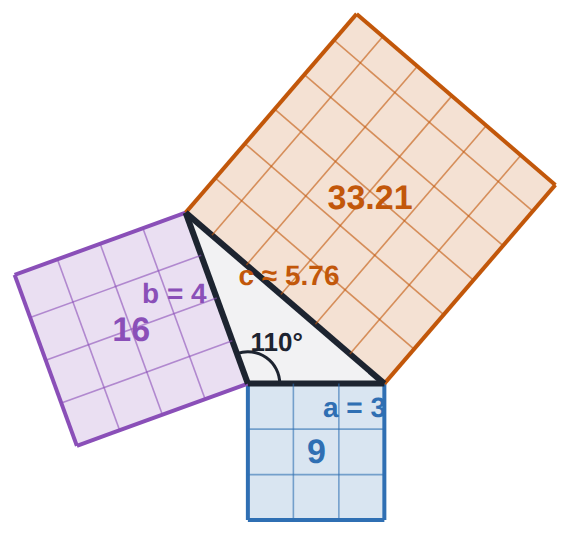
Open the angle to 110° and the biggest square grows: c^2 \approx 33.2, more than 9 + 16 = 25. The triangle is obtuse.
Open the angle to 110° and the biggest square grows: c2≈33.2c^2 \approx 33.2, more than 9+16=259 + 16 = 25. The triangle is obtuse.
Open the angle · Sound on for the voiceover
Open the lesson →

Time zones

10. Time zones

Try firstIt is 18:30 Tuesday in Sydney (UTC+11). What time and day is it in Los Angeles (UTC−7)?

Check your answer

Los Angeles is 18 hours behind: 00:30 Tuesday.

A time zone is an offset from UTC. A city with a bigger offset is ahead; a smaller one is behind. Find the difference, add or take it away, and change the day when you cross midnight.

For a flight, add the flight time to the departure (in the departure zone), then change to the arrival zone. Use 24-hour time to avoid am and pm mistakes.

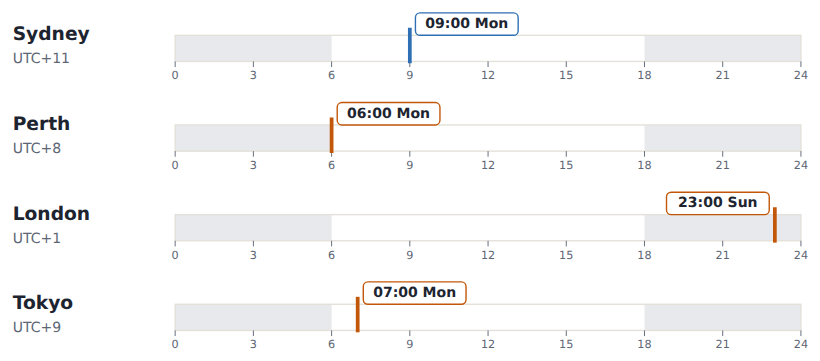
9:00 am Monday in Sydney is 6:00 am in Perth, 11:00 pm Sunday in London and 7:00 am in Tokyo.
One moment, four clocks · Sound on for the voiceover
Open the lesson →

Rates

11. Rates

Try firstA cyclist rides 45 km in 1.5 hours. Find her speed in km/h and m/s.

Check your answer

45 ÷ 1.5 = 30 km/h; 30 ÷ 3.6 ≈ 8.3 m/s.

A rate compares two quantities with different units (km per hour, $ per kg); a ratio compares the same kind of quantity.

The unit rate is the amount for one of the second quantity: divide the first by the second, and keep both units. To convert km/h to m/s, divide by 3.6.

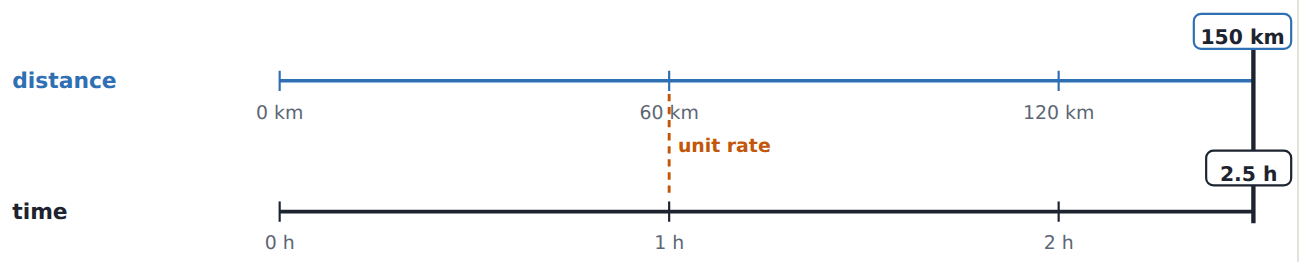
At 60 km per hour, 2.5 hours matches 150 km: each hour adds another 60 km.
Per one hour · Sound on for the voiceover
Open the lesson →

12. Using rates

Try firstA plane flies 2100 km at 700 km/h. How long does it take?

Check your answer

2100 ÷ 700 = 3 hours.

Use a rate both ways: total = rate × amount and amount = total ÷ rate. For speed, distance = speed × time and time = distance ÷ speed.

Write the units at each step (km ÷ km/h = h); they tell you whether to multiply or divide. Then check the size makes sense.

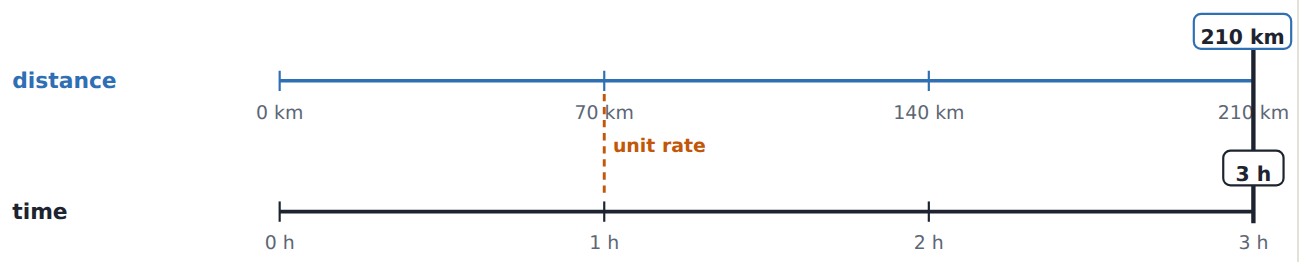
At 70 km/h, 3 hours covers 210 km; 210 km ÷ 70 km/h gives back the 3 hours.
Both ways along the line · Sound on for the voiceover
Open the lesson →

Modelling

13. Ratio and rate models

Try firstA recipe uses 2 cups of rice to 3 cups of water. How much water for 5 cups of rice? Is this a ratio or a rate?

Check your answer

A ratio (cups to cups): 5 × 1.5 = 7.5 cups of water.

To model a problem: say what you need (with units), choose a ratio (same kind of quantity) or a rate (different units), solve, then interpret the answer in the situation.

Paint comes in whole tins and buses in whole buses: round up when you must have enough.

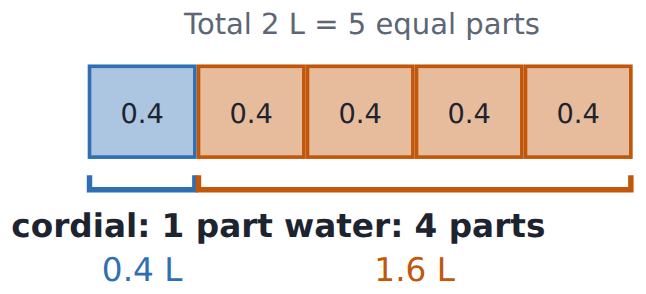
Cordial 1 : 4 water: 2 L of drink is 5 equal parts of 0.4 L, so 0.4 L of cordial and 1.6 L of water.
A ratio model · Sound on for the voiceover
Open the lesson →

14. Checking a model

Try firstA model says 4 kg of apples at $3.50 per kg cost $14. The shop charges $12.60 for 4 kg. Name a possible assumption that failed.

Check your answer

A fixed price per kg: the shop may give a discount for buying more (a bulk price).

Every model makes assumptions (steady speed, no fees, no starting charge). When the model and real life differ, check the arithmetic, then name the assumption that did not hold.

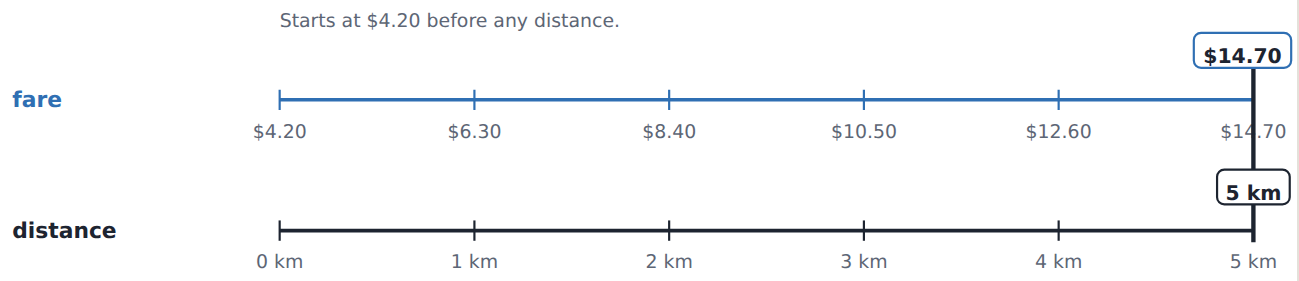
Refine the model by adding what was left out, such as a starting charge: fare = $4.20 + $2.10 × km. A simple model is good enough when its error does not change the decision.

A taxi fare: 4.20 to start, then 2.10 per km. A 5 km ride costs 4.20 + 10.50 = 14.70.
A taxi fare: $4.20 to start, then $2.10 per km. A 5 km ride costs $4.20 + $10.50 = $14.70.
A simple model · Sound on for the voiceover
Open the lesson →