Maths reference: Year 8 Measurement
The words and methods from Year 8 Measurement, each with an example and, where it helps, a picture of the board.
Print a cheat sheet (the whole course or one unit, with board pictures)
Words
A rate compares quantities with different units (km per h, $ per kg); a ratio compares the same kind. 1 km/h = 1000 m ÷ 3600 s: divide by 3.6 for m/s.

Write the units in: km ÷ km/h = h. Then check the size makes sense.
Every model assumes something (steady speed, no fees, no starting charge). When it disagrees with real life, name the assumption and refine the model.
Area
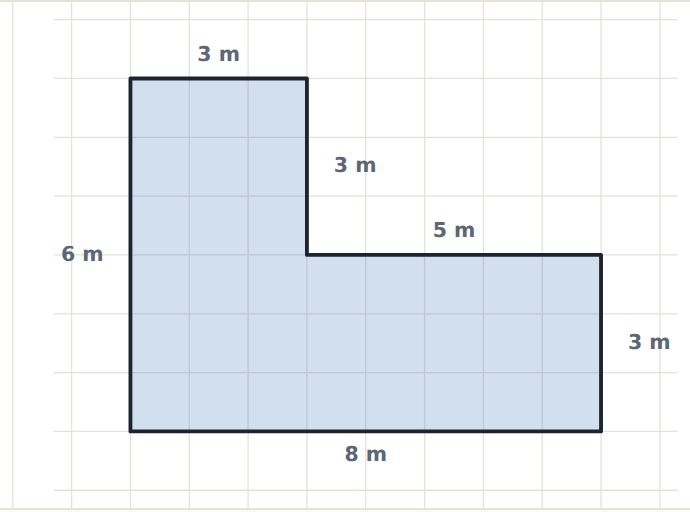
Cut the shape into pieces you know and add their areas, or take the missing pieces away from a big rectangle. Each piece uses its own lengths.
Count the full squares, add half the part squares, multiply by the area of one square. A finer grid gives a closer estimate.
Volume
A cubic metre is 100 × 100 × 100 = 1 000 000 cm³: convert each of the three lengths.
Circles
Slices of a circle make a near-rectangle πr long and r high. The area is between 2r² and 4r². Do not mix it up with C = 2πr.
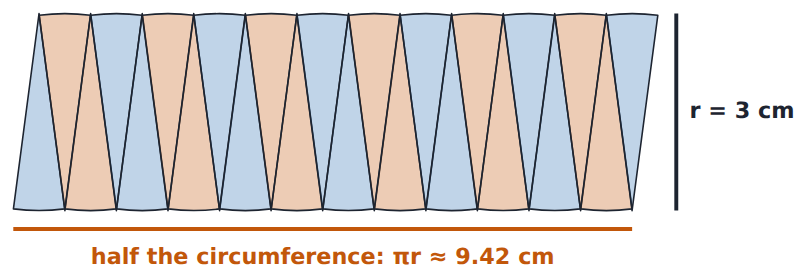
Divide by π, then take the square root. A semicircle is half the area; its perimeter is half the circumference plus the diameter.
Pythagoras
In a right-angled triangle, the squares on the two shorter sides add to the square on the hypotenuse c, the side opposite the right angle.
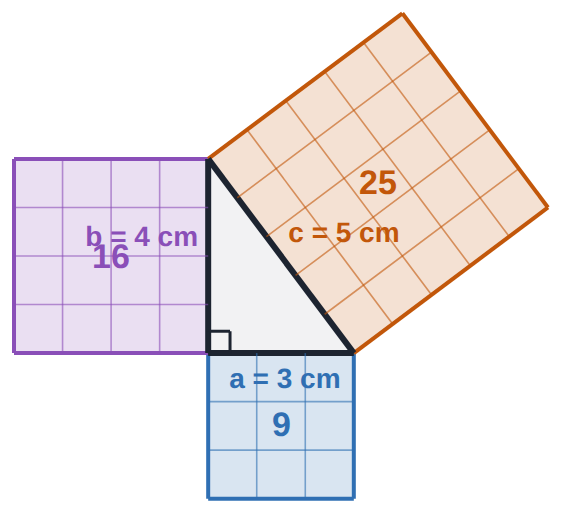
Add the squares for the hypotenuse; subtract for a shorter side. Check: the hypotenuse is the longest.
With c the longest side: equal, right-angled; a² + b² smaller, obtuse; bigger, acute. Pythagorean triples: 3-4-5, 5-12-13, 8-15-17 and multiples.
Time zones
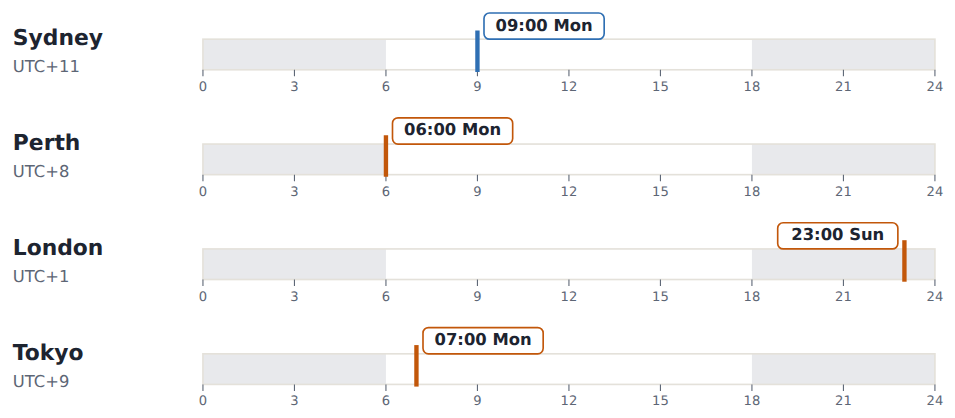
Find the difference between the UTC offsets, add or take it away, and change the day if you cross midnight. For a flight, add the flight time in the departure zone, then change zones.