← Year 7 Measurement

Year 7 Measurement: recap

For after the lessons: one card per lesson, to check what you remember. Answer each question in your head or on paper first, then check it. Nothing here is marked.

Looking back over the whole year? See the Year 7 recap.

Area

1. Area of parallelograms

Try firstA parallelogram has base 9 cm, slanted side 5 cm and perpendicular height 4 cm. Find its area.

Check your answer

9 × 4 = 36 cm² (the 5 cm slanted side is not used).

A parallelogram is a rectangle pushed over. Cut the triangle off one end along the perpendicular height and move it to the other end: it becomes a rectangle with the same base and height. So:

A=b×hA = b \times h

where hh is the perpendicular height, at a right angle to the base, not the slanted side. Area is in square units: cm², m².
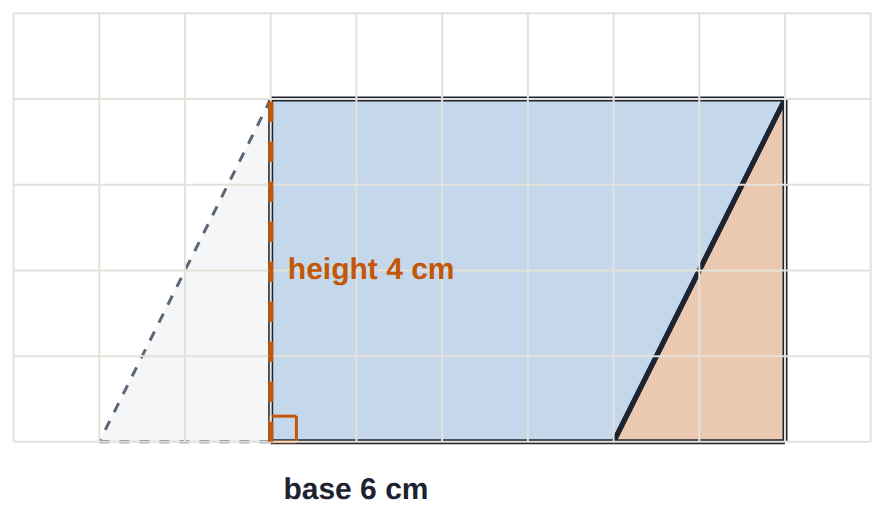
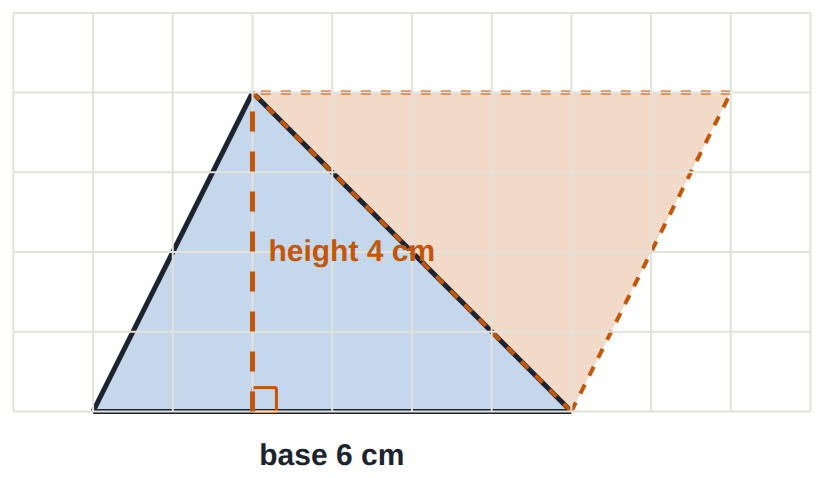
The triangle cut off the left end fills the gap on the right: a 6 by 4 rectangle, so the parallelogram's area is 6 \times 4 = 24 cm².
The triangle cut off the left end fills the gap on the right: a 6 by 4 rectangle, so the parallelogram's area is 6×4=246 \times 4 = 24 cm².
Cut and move · Sound on for the voiceover
Open the lesson →

2. Area of triangles

Try firstA triangle has base 9 cm and height 6 cm. Find its area. A triangle with area 24 cm² has base 8 cm: find its height.

Check your answer

½ × 9 × 6 = 27 cm². ½ × 8 × h = 24, so h = 6 cm.

Two copies of a triangle, one turned round, make a parallelogram with the same base and height. So the triangle's area is half of base × height:

A=12×b×hA = \tfrac{1}{2} \times b \times h

The height is perpendicular to the base. If the top leans past the end of the base, extend the base: the height meets it outside the triangle. Moving the top along a line parallel to the base keeps the area.

A turned copy (dashed) makes a parallelogram, 6 \times 4 = 24 cm². The triangle is half: \tfrac{1}{2} \times 6 \times 4 = 12 cm².
A turned copy (dashed) makes a parallelogram, 6×4=246 \times 4 = 24 cm². The triangle is half: 12×6×4=12\tfrac{1}{2} \times 6 \times 4 = 12 cm².
Half a parallelogram · Sound on for the voiceover
Open the lesson →

3. Area problems

Try firstA shape is a 7 m by 4 m rectangle with a triangle on top (base 7 m, height 2 m). Find its area.

Check your answer

28 + ½ × 7 × 2 = 28 + 7 = 35 m².

Area problems have three moves:

  • Choose the base and the height at a right angle to it; a slanted side is extra information.
  • Convert every length to the same unit first (250 cm = 2.5 m). Area is in square units, and 1 m² = 10 000 cm².
  • Split a shape into rectangles and triangles and add the parts, or subtract a missing part from a bigger shape.
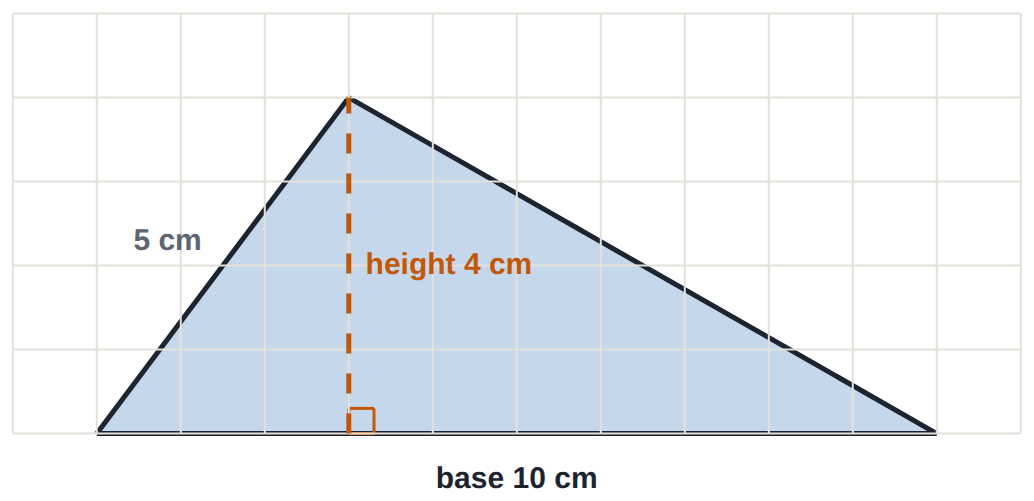
Base 10 cm, height 4 cm, and a slanted side of 5 cm. The area uses the base and the height at a right angle to it: \tfrac{1}{2} \times 10 \times 4 = 20 cm².
Base 10 cm, height 4 cm, and a slanted side of 5 cm. The area uses the base and the height at a right angle to it: 12×10×4=20\tfrac{1}{2} \times 10 \times 4 = 20 cm².
Choose the right lengths · Sound on for the voiceover
Open the lesson →

Volume

4. Volume in layers

Try firstA box is 5 cm by 4 cm by 3 cm. Find its volume. A box with base 6 cm² has volume 42 cm³: how high is it?

Check your answer

5 × 4 × 3 = 60 cm³. 42 ÷ 6 = 7 cm.

Volume counts unit cubes (cm³, m³). A prism fills up in layers: each layer covers the base, so it has as many cubes as the base has squares. The number of layers is the height:

V=A×hV = A \times h

For a box, A=l×wA = l \times w, so V=l×w×hV = l \times w \times h. The cubes fill the inside, not just the outside you can see.

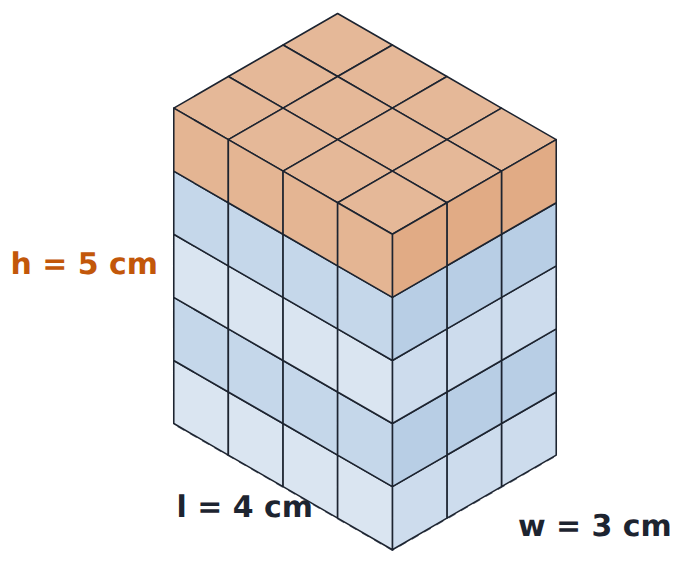
Each layer is the 4 by 3 base: 12 cubes. 5 layers: 12 \times 5 = 60 cm³.
Each layer is the 4 by 3 base: 12 cubes. 5 layers: 12×5=6012 \times 5 = 60 cm³.
Layer on layer · Sound on for the voiceover
Open the lesson →

5. Prisms and capacity

Try firstA prism's triangle end has base 5 cm and height 4 cm; it is 6 cm long. Find its volume and its capacity in mL.

Check your answer

½ × 5 × 4 = 10 cm², × 6 = 60 cm³ = 60 mL.

A right prism has the same cross-section all the way along. Its volume is that slice's area times the length:

V=A×hV = A \times h

For a triangular prism, the cross-section is a triangle: halve first (12×6×4=12\tfrac{1}{2} \times 6 \times 4 = 12 cm², then ×10=120\times 10 = 120 cm³). Capacity: 1 cm³ holds 1 mL, and 1000 cm³ = 1 L.

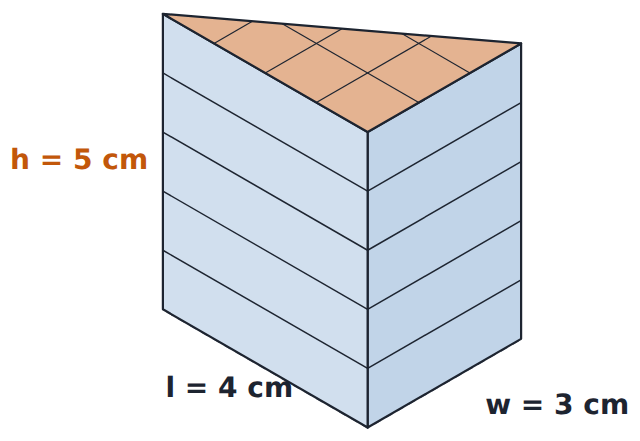
The triangle is half of a 4 by 3 rectangle: 6 cm². 5 layers of it: 6 \times 5 = 30 cm³.
The triangle is half of a 4 by 3 rectangle: 6 cm². 5 layers of it: 6×5=306 \times 5 = 30 cm³.
The same all the way along · Sound on for the voiceover
Open the lesson →

Circles

6. Parts of a circle

Try firstA circular pond has diameter 9 m. Find its radius. What is a chord?

Check your answer

4.5 m. A straight line joining two points on the circle.

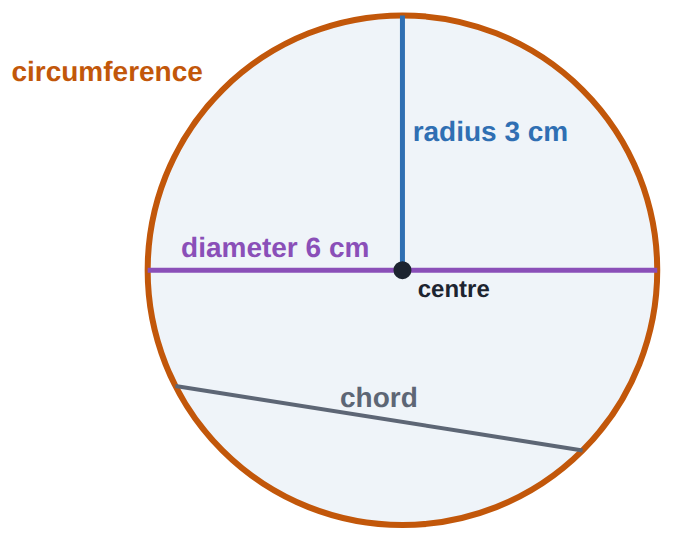
A circle is all the points the same distance (the radius, rr) from its centre.

  • The diameter (dd) goes right across through the centre: d=2rd = 2r, and r=d÷2r = d \div 2.
  • A chord joins any two points; the diameter is the longest chord.
  • The circumference (CC) is the distance all the way round.
Centre, radius (3 cm), diameter (6 cm: two radii), a chord, and the circumference all the way round.
Radius and diameter · Sound on for the voiceover
Open the lesson →

7. Discovering π

Try firstWhat is π? Estimate the circumference of a circle with diameter 20 cm.

Check your answer

π is the circumference divided by the diameter, the same for every circle, about 3.14. C ≈ 3.14 × 20 = 62.8 cm.

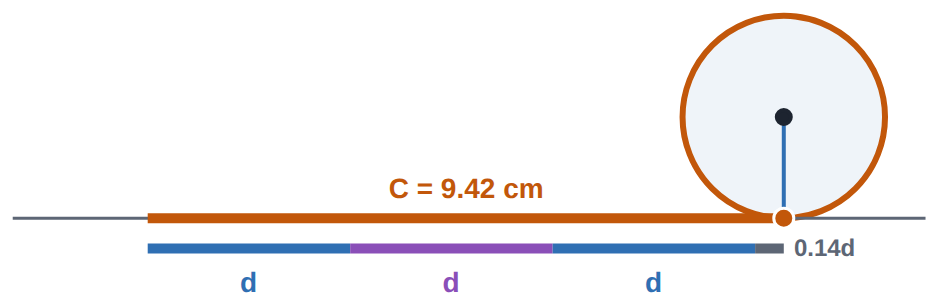
Roll a circle out flat for one turn and its circumference is a bit more than 3 diameters. For every circle, the circumference divided by the diameter is the same number, π:

π=Cd=3.14159…\pi = \frac{C}{d} = 3.14159\ldots

π's digits never end and never settle into a repeating pattern; 3.14 and 227\tfrac{22}{7} are approximations. A quick estimate: the circumference is a bit more than 3 diameters.

Rolled out flat, the circumference is 3 diameters and a little bit more (about 0.14 of a diameter): C \div d \approx 3.14.
Rolled out flat, the circumference is 3 diameters and a little bit more (about 0.14 of a diameter): C÷d≈3.14C \div d \approx 3.14.
Roll it out · Sound on for the voiceover
Open the lesson →

8. Circumference

Try firstFind the circumference of a circle with radius 4 cm. A circle has circumference 12.56 cm: find its diameter. (π ≈ 3.14)

Check your answer

2 × 3.14 × 4 = 25.12 cm. 12.56 ÷ 3.14 = 4 cm.

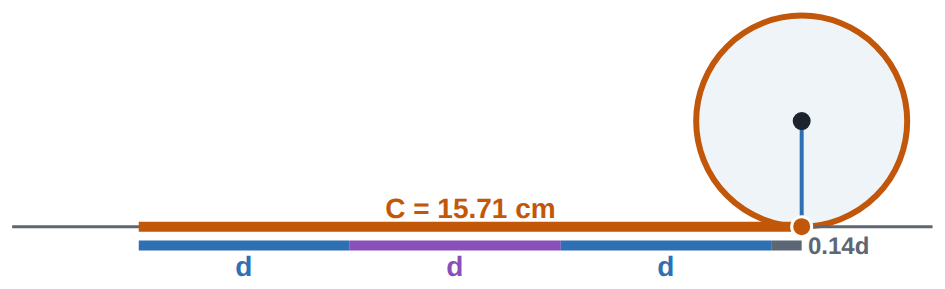
Because C÷d=πC \div d = \pi, the circumference is

C=πd=2πrC = \pi d = 2\pi r

Use the diameter (or double the radius). Going backwards, divide by π: d=C÷πd = C \div \pi. An exact answer keeps π: a circle with diameter 10 cm has C=10πC = 10\pi cm, about 31.4 cm.

Radius 2.5 cm, diameter 5 cm: rolled out, C = \pi \times 5 \approx 15.71 cm.
Radius 2.5 cm, diameter 5 cm: rolled out, C=π×5≈15.71C = \pi \times 5 \approx 15.71 cm.
C = πd · Sound on for the voiceover
Open the lesson →

Parallel lines

9. Angles at parallel lines

Try firstA transversal crosses two parallel lines. Which angle pairs are equal, and which pair adds to 180°?

Check your answer

Corresponding angles and alternate angles are equal (so are vertically opposite angles); co-interior angles add to 180°.

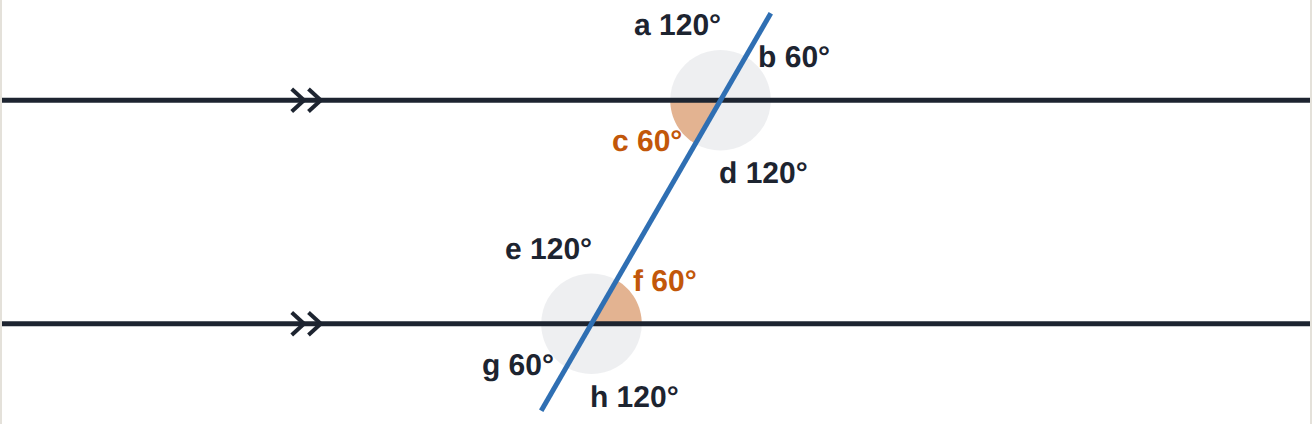
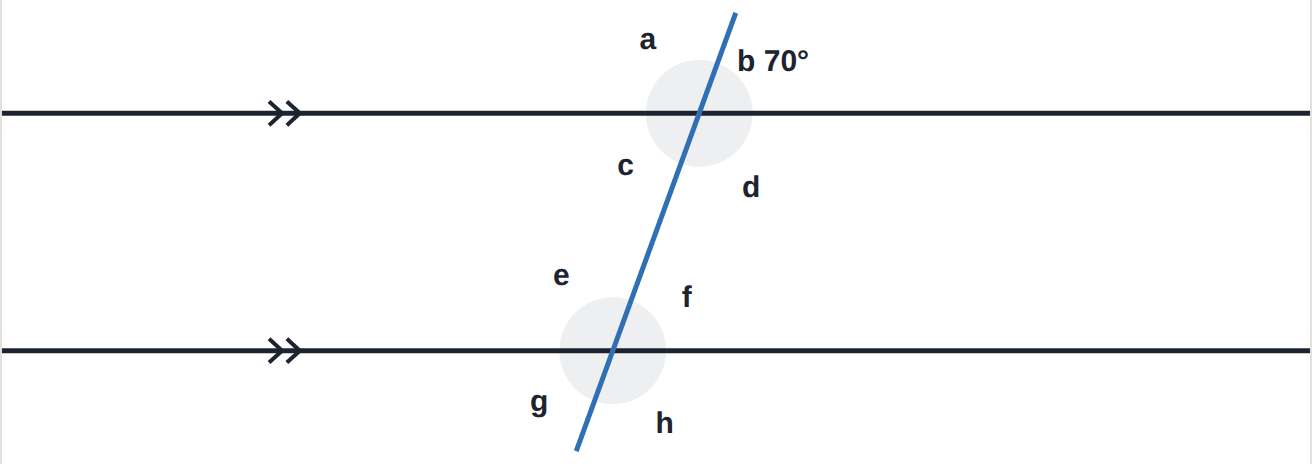
A line crossing two parallel lines (a transversal) makes eight angles, aa to hh. Each pair below takes one angle from each crossing:

  • corresponding: the same place at each crossing, such as aa and ee (an F shape);
  • alternate: between the parallel lines, on opposite sides of the transversal, such as cc and ff (a Z shape);
  • co-interior: between the parallel lines, on the same side, such as cc and ee (a C shape).

Two angles at one crossing, opposite each other, are vertically opposite: not one of these pairs.

c and f are alternate angles: between the parallel lines, on opposite sides of the crossing line. Both are 60^\circ.
cc and ff are alternate angles: between the parallel lines, on opposite sides of the crossing line. Both are 60∘60^\circ.
The angle pairs at parallel lines · Sound on for the voiceover
Open the lesson →

10. Finding angles with parallel lines

Try firstA transversal crosses two parallel lines. One angle is 75°. Find the angle corresponding to it, and the angle next to that one on a straight line, with a reason for each.

Check your answer

75° (corresponding angles are equal), then 180° − 75° = 105° (angles on a straight line).

When the lines are parallel:

  • corresponding angles are equal;
  • alternate angles are equal;
  • co-interior angles add to 180∘180^\circ (they are not equal unless both are 90∘90^\circ).

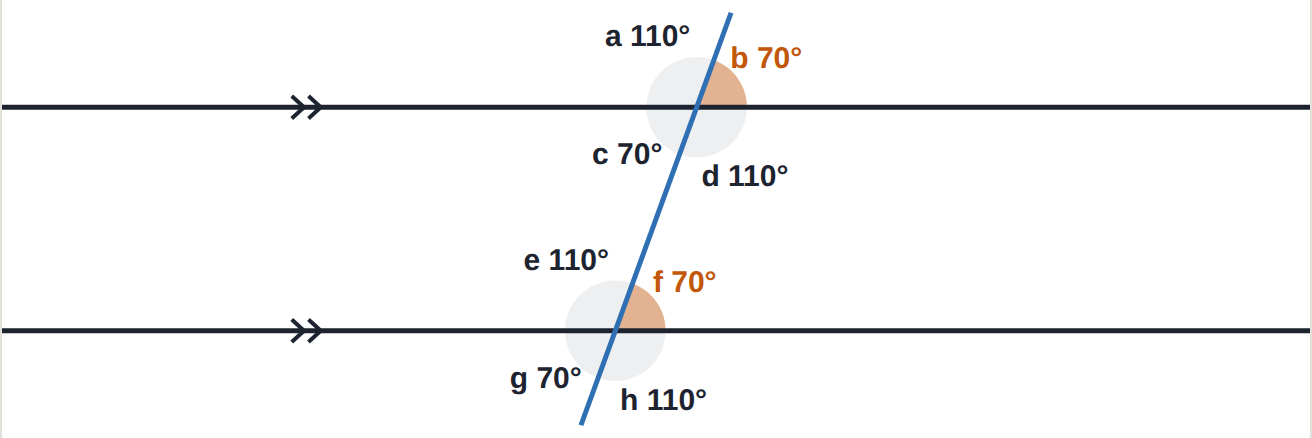
With vertically opposite angles (equal) and angles on a straight line (add to 180∘180^\circ), one angle gives all eight. Give a reason for each: "f=70∘f = 70^\circ, corresponding to bb". If the lines are not parallel, these rules do not hold.

b and f are corresponding, so both are 70^\circ. From one angle, every other is 70^\circ or 110^\circ.
bb and ff are corresponding, so both are 70∘70^\circ. From one angle, every other is 70∘70^\circ or 110∘110^\circ.
Equal pairs, and a pair that adds to 180° · Sound on for the voiceover
Open the lesson →

11. Reasoning with angles

Try firstA transversal crosses two parallel lines, making a 120° angle. Find the angle alternate to it and the angle co-interior to it, with reasons.

Check your answer

120° (alternate angles are equal) and 180° − 120° = 60° (co-interior angles add to 180°).

Most angle problems take more than one step. For each step:

  1. Know: an angle you already have.
  2. Choose: a rule that links it to a new angle: corresponding or alternate angles are equal, co-interior angles add to 180∘180^\circ, vertically opposite angles are equal, angles on a straight line add to 180∘180^\circ.
  3. Say why: write the rule as the reason.

b=70∘b = 70^\circ: f=70∘f = 70^\circ (corresponding to bb), then h=110∘h = 110^\circ (ff and hh are on a straight line). If two angles only look related, find one in between that a rule links to both.

b = 70^\circ. Then f = 70^\circ (corresponding to b) and h = 110^\circ (f and h are on a straight line).
b=70∘b = 70^\circ. Then f=70∘f = 70^\circ (corresponding to bb) and h=110∘h = 110^\circ (ff and hh are on a straight line).
One step at a time, each with a reason · Sound on for the voiceover
Open the lesson →

Angle sums

12. Angles in a triangle

Try firstA student says the angles of a very large triangle add to more than 180°. Explain why they are wrong.

Check your answer

Every triangle's angles add to 180°: tear off the corners and they fill a straight line. Size changes the sides, not the angles.

The three angles of any triangle add to 180°180°.

When you change a triangle's shape, one angle grows and the others shrink by exactly as much. Making it bigger without changing its shape does not change the angles at all.

Why? Tear off the three corners and put their points together: they fill a straight line, and angles on a straight line add to 180°180°.

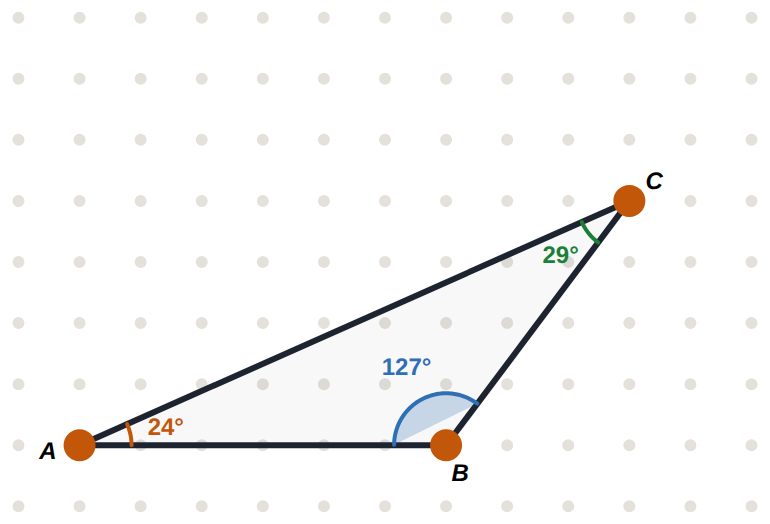
An obtuse triangle: 24° + 127° + 29° = 180°.
An obtuse triangle: 24°+127°+29°=180°24° + 127° + 29° = 180°.
A triangle's angles add to 180° · Sound on for the voiceover
Open the lesson →

13. Angles in a polygon

Try firstFind the angle sum of a heptagon (7 sides), and explain your method.

Check your answer

900°. From one corner it splits into 7 − 2 = 5 triangles, and 5 × 180° = 900°.

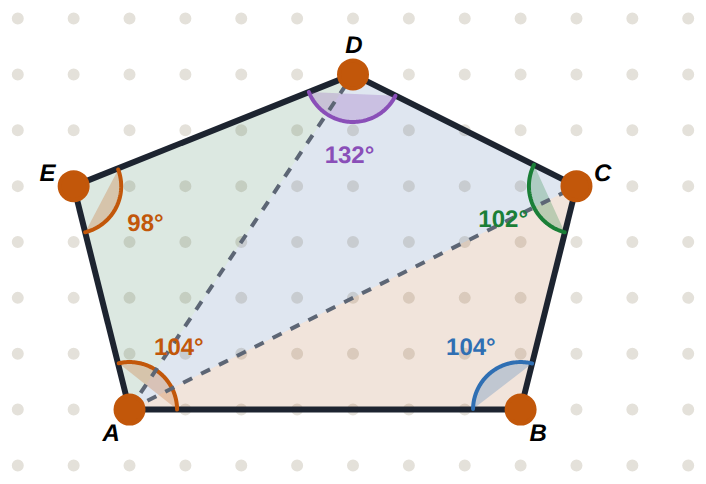
To find the angle sum of a polygon, split it into triangles from one corner: draw lines from that corner to every corner that is not next to it.

A shape with nn sides splits into n−2n - 2 triangles, and their angles exactly fill the polygon's corners. So the angle sum is (n−2)×180°(n - 2) \times 180°.

A quadrilateral: 2×180°=360°2 \times 180° = 360°. A pentagon: 3×180°=540°3 \times 180° = 540°. A hexagon: 4×180°=720°4 \times 180° = 720°.

A pentagon splits into 3 triangles from A: 3 \times 180° = 540°.
A pentagon splits into 3 triangles from AA: 3×180°=540°3 \times 180° = 540°.
Split it into triangles · Sound on for the voiceover
Open the lesson →

14. Unknown angles in shapes

Try firstA triangle has angles of 48° and 67°. Find the third angle, and the exterior angle next to it, with reasons.

Check your answer

180° − 48° − 67° = 65° (angles in a triangle). Exterior angle 180° − 65° = 115° (a straight line). Check: 48° + 67° = 115°.

To find an unknown angle in a shape, choose the angle sum for the shape: 180∘180^\circ for a triangle, (n−2)×180∘(n - 2) \times 180^\circ for nn sides (360∘360^\circ for a quadrilateral, 540∘540^\circ for a pentagon). Add the angles you know and subtract from the sum.

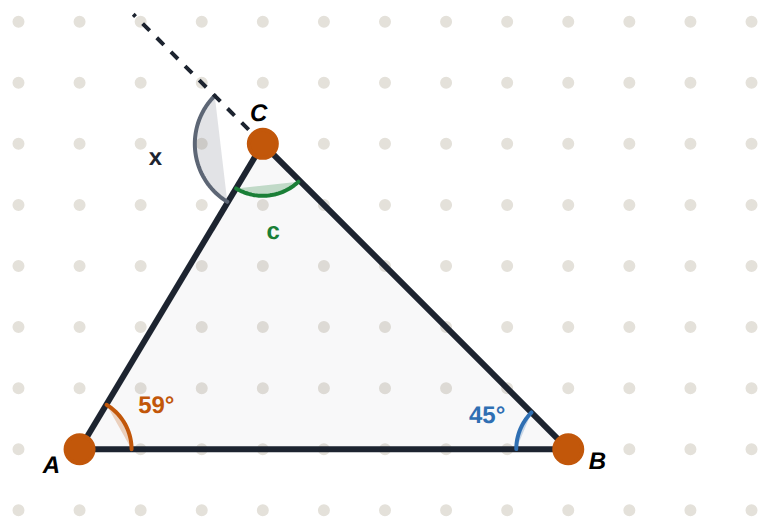
Combine it with other facts, one step at a time, each with a reason. Extend a side of a triangle and the outside angle xx makes a straight line with cc: x=180∘−cx = 180^\circ - c. Since a+b=180∘−ca + b = 180^\circ - c too, x=a+bx = a + b.

a = 59^\circ, b = 45^\circ. Then c = 76^\circ (angles in a triangle add to 180^\circ) and x = 104^\circ (c and x are on a straight line). And x = a + b.
a=59∘a = 59^\circ, b=45∘b = 45^\circ. Then c=76∘c = 76^\circ (angles in a triangle add to 180∘180^\circ) and x=104∘x = 104^\circ (cc and xx are on a straight line). And x=a+bx = a + b.
From the angle sum to the exterior angle · Sound on for the voiceover
Open the lesson →

Modelling

15. Modelling with ratios

Try firstA recipe mixes juice and water 2 : 7. How much juice is in a 900 mL drink?

Check your answer

2 + 7 = 9 parts. 900 ÷ 9 = 100 mL a part. Juice is 200 mL.

Modelling with ratios: formulate (what is known, what is unknown, what relationship?), solve, then interpret (the answer in the situation's units, and does it make sense?).

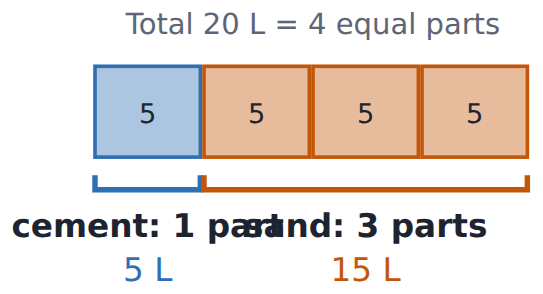
For a mix, add the parts and find one part: a dry mix 1 : 3 in 20 L has 4 parts of 5 L, so 5 L of cement and 15 L of sand. For a scale such as 1:501 : 50, each 1 cm on the drawing is 50 cm in real life.

20 L of mortar in the ratio 1 : 3: 4 equal parts of 5 L. Cement 5 L, sand 15 L.
From a problem to a ratio · Sound on for the voiceover
Open the lesson →