← Year 8 Algebra

Year 8 Algebra: recap

For after the lessons: one card per lesson, to check what you remember. Answer each question in your head or on paper first, then check it. Nothing here is marked.

Looking back over the whole year? See the Year 8 recap.

Brackets

1. Expanding brackets

Try firstExpand and simplify 5(x − 2) + 3x.

Check your answer

5x − 10 + 3x = 8x − 10.

The number outside a bracket multiplies every term inside.

3(2x+4)3(2x + 4) is 3 lots of 2x+42x + 4: 3×2x=6x3 \times 2x = 6x and 3×4=123 \times 4 = 12, so 6x+126x + 12. Signs come too: 4(3x−2)=12x−84(3x - 2) = 12x - 8, and −2(x−5)=−2x+10-2(x - 5) = -2x + 10.

After expanding, collect any like terms: 6x+12−x=5x+126x + 12 - x = 5x + 12.

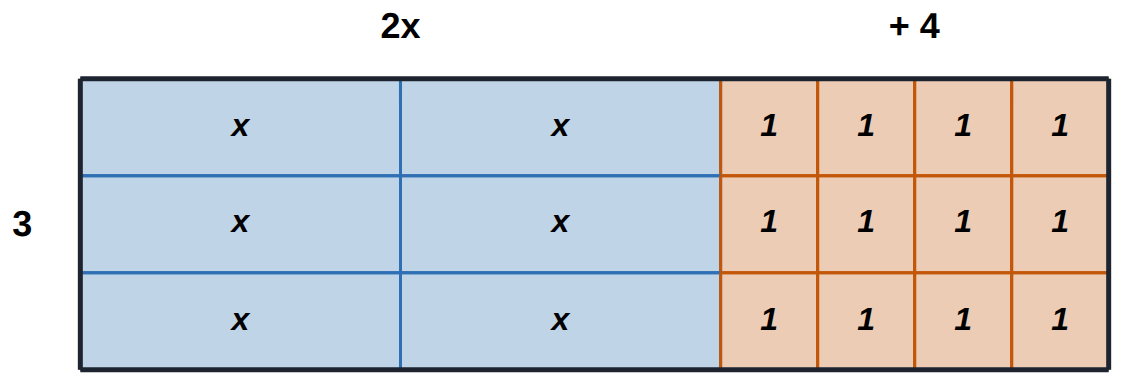
3(2x + 4): 3 rows of 2x + 4 make 6x + 12.
3(2x+4)3(2x + 4): 3 rows of 2x+42x + 4 make 6x+126x + 12.
The number outside multiplies every term inside · Sound on for the voiceover
Open the lesson →

2. Factorising

Try firstFactorise 14x − 21 fully, then check by expanding.

Check your answer

7(2x − 3). Check: 7 × 2x = 14x and 7 × (−3) = −21.

Factorising is expanding backwards. Find a number that goes into every term, divide every term by it, and put it outside the bracket.

6x+96x + 9: 3 goes into 6 and 9, so 6x+9=3(2x+3)6x + 9 = 3(2x + 3). Take out the highest common factor: 12x−8=4(3x−2)12x - 8 = 4(3x - 2), not 2(6x−4)2(6x - 4), which still shares a 2. A letter can be common too: 2x2+4x=2x(x+2)2x^2 + 4x = 2x(x + 2).

Check by expanding: you should get back to where you started.

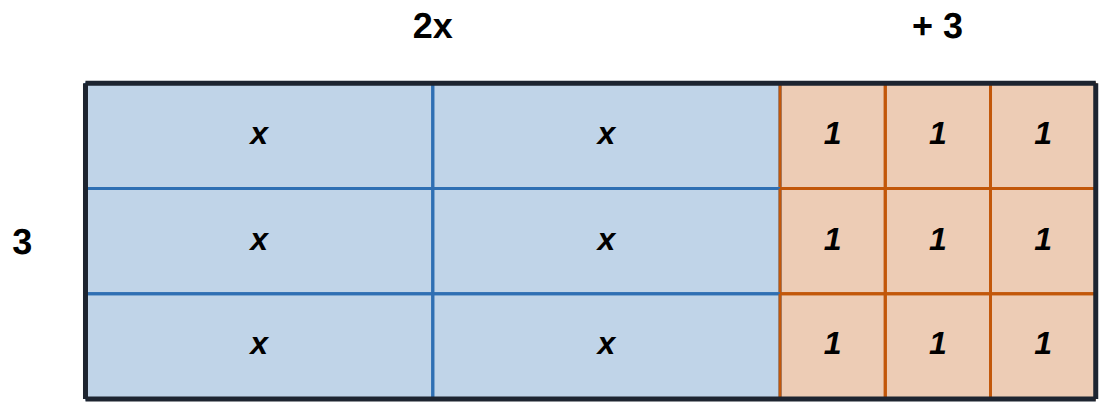
6x + 9 shared into 3 equal rows: each row is 2x + 3, so 6x + 9 = 3(2x + 3).
6x+96x + 9 shared into 3 equal rows: each row is 2x+32x + 3, so 6x+9=3(2x+3)6x + 9 = 3(2x + 3).
Share the tiles into equal rows · Sound on for the voiceover
Open the lesson →

3. Changing the subject

Try firstMake x the subject of y = 6x − 2, then check it with x = 3.

Check your answer

x = (y + 2)/6. Check: x = 3 gives y = 16, and (16 + 2)/6 = 3.

To change the subject, undo what was done to the letter you want, last step first, doing the same to the whole of both sides.

y=3x+5y = 3x + 5: xx was multiplied by 3, then 5 was added. Take 5 away: y−5=3xy - 5 = 3x. Divide by 3: x=y−53x = \dfrac{y - 5}{3}.

Check by putting in numbers: x=2x = 2 gives y=11y = 11, and 11−53=2\dfrac{11 - 5}{3} = 2.

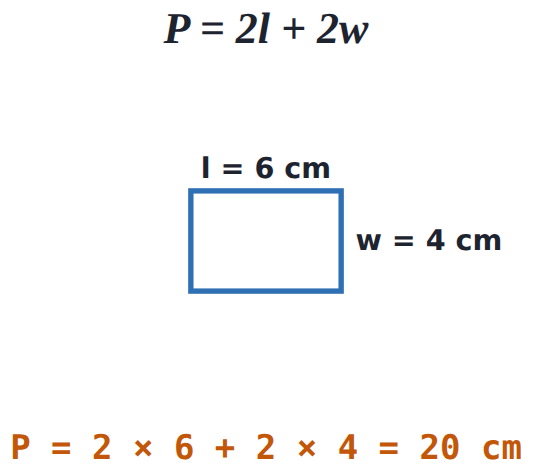
P = 2l + 2w rearranged: w = (P - 2l) \div 2. With P = 20 and l = 6: w = (20 - 12) \div 2 = 4.
P=2l+2wP = 2l + 2w rearranged: w=(P−2l)÷2w = (P - 2l) \div 2. With P=20P = 20 and l=6l = 6: w=(20−12)÷2=4w = (20 - 12) \div 2 = 4.
Turn the formula around · Sound on for the voiceover
Open the lesson →

Equations and inequalities

4. Solving harder equations

Try firstSolve 4(x − 1) = 2x + 6 and check.

Check your answer

4x − 4 = 2x + 6, 2x = 10, x = 5. Check: 16 = 16.

To solve an equation, do the same to both sides until xx is on its own:

  1. Expand any brackets.
  2. Take the smaller xx term from both sides, so xx is on one side only.
  3. Undo the numbers with the inverse operation (add to undo −-, subtract to undo ++).
  4. Divide (or multiply) to get xx.

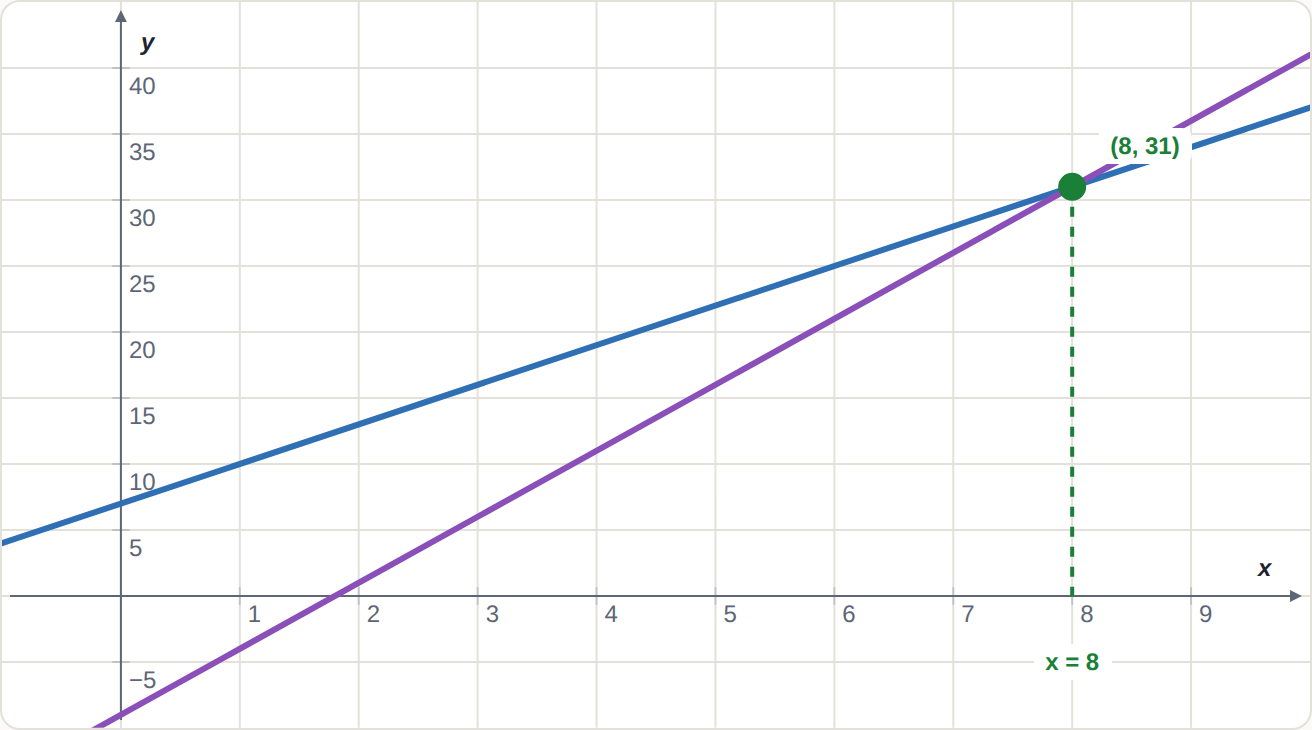
3x+7=5x−9→7=2x−9→16=2x→x=83x + 7 = 5x - 9 \to 7 = 2x - 9 \to 16 = 2x \to x = 8. Check: 3(8)+7=313(8) + 7 = 31 and 5(8)−9=315(8) - 9 = 31. On a graph, x=8x = 8 is where the two sides meet.

y = 3x + 7 and y = 5x - 9 meet at (8, 31): both sides of 3x + 7 = 5x - 9 equal 31 when x = 8.
y=3x+7y = 3x + 7 and y=5x−9y = 5x - 9 meet at (8,31)(8, 31): both sides of 3x+7=5x−93x + 7 = 5x - 9 equal 31 when x=8x = 8.
Same to both sides, then check · Sound on for the voiceover
Open the lesson →

5. Inequalities

Try firstSolve 7 − 2x ≥ 1 and show it on a number line.

Check your answer

−2x ≥ −6, x ≤ 3 (reversed): closed circle at 3, shaded left. Check x = 0: 7 ≥ 1.

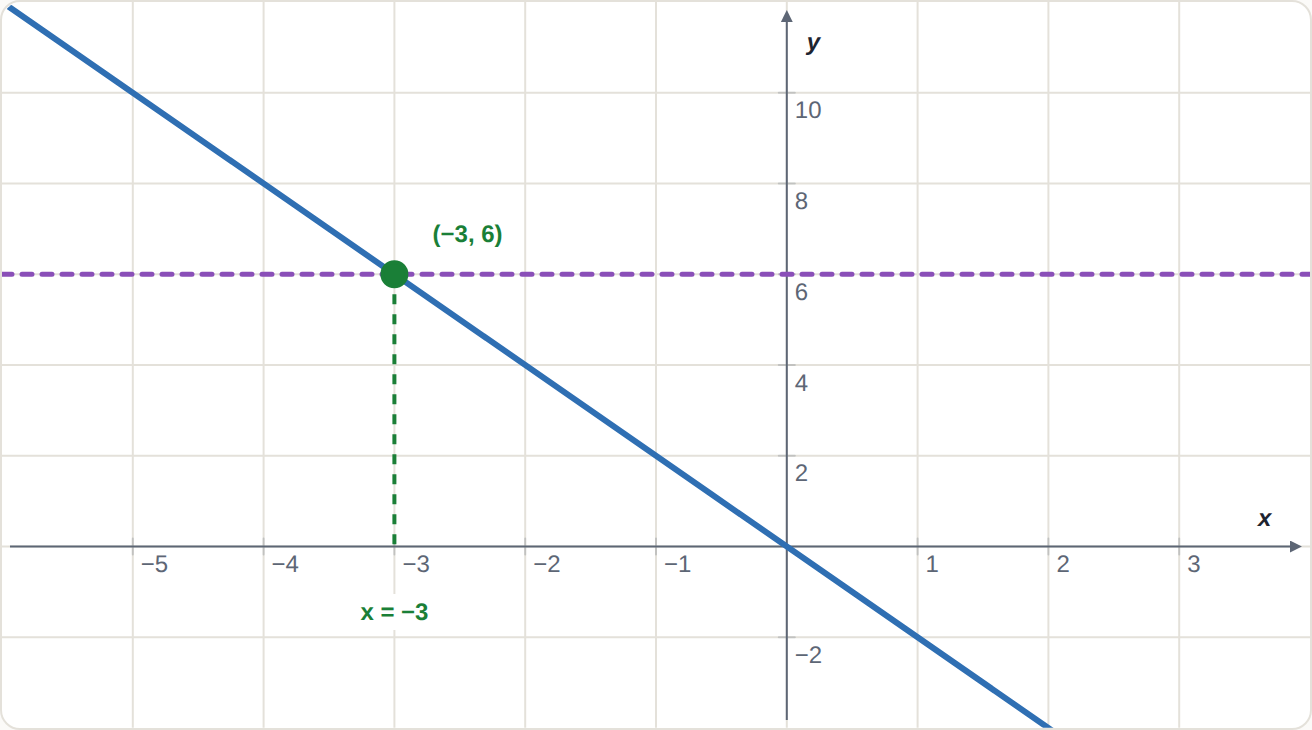
Solve an inequality like an equation, doing the same to both sides. Adding, subtracting, and multiplying or dividing by a positive keep the inequality sign. Multiplying or dividing by a negative reverses it: −2x>6-2x > 6 gives x<−3x < -3 (because 2<52 < 5 but −2>−5-2 > -5).

On a number line: an open circle for << and >> (the end is not included), closed for ≤\le and ≥\ge, shaded towards the solutions. Check by trying a value: x=−4x = -4 gives 8>68 > 6. ✓

-2x is more than 6 (the line above the dashed one) to the left of x = -3: the solution of -2x > 6 is x < -3.
−2x-2x is more than 6 (the line above the dashed one) to the left of x=−3x = -3: the solution of −2x>6-2x > 6 is x<−3x < -3.
Dividing by a negative turns it round · Sound on for the voiceover
Open the lesson →

Lines and their rules

6. What m does to a line

Try firstWithout plotting, describe the line y = −2x + 1: where does it cross the y-axis, which way does it go, and how steep is it?

Check your answer

It crosses the y-axis at 1 and goes down 2 for each step to the right (m = −2).

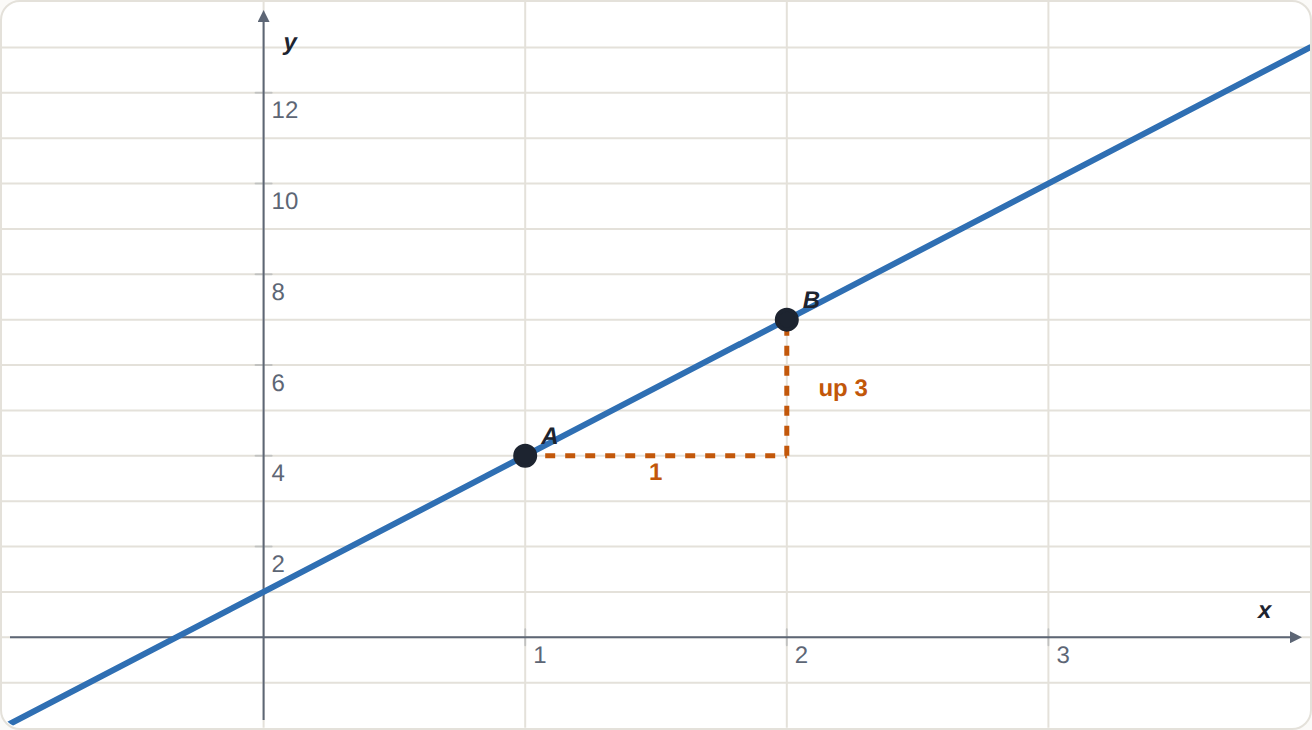
In a rule like y=3x+1y = 3x + 1, the number in front of xx is called mm. It tells you how far the line goes up for each step of 1 to the right.

Work it out one step at a time: when x=0x = 0, y=1y = 1; when x=1x = 1, y=4y = 4; when x=2x = 2, y=7y = 7. Each step right, yy goes up by 3. That is mm.

A bigger mm makes the line steeper. m=0m = 0 makes it flat. A negative mm makes it go down. Changing mm does not move where the line crosses the yy-axis: that is the number on its own, cc.

y = 3x + 1: one step right, up 3. That 3 is m.
y=3x+1y = 3x + 1: one step right, up 3. That 3 is mm.
m is how far the line goes up for each step right · Sound on for the voiceover
Open the lesson →

7. What c does to a line

Try firstAre y = 3x + 2 and y = 3x − 5 parallel? Where does each cross the y-axis?

Check your answer

Yes, both have m = 3. The first crosses at 2, the second at −5.

In y=mx+cy = mx + c, cc is the number on its own. It is where the line crosses the yy-axis: when x=0x = 0, mxmx is 0, so y=cy = c.

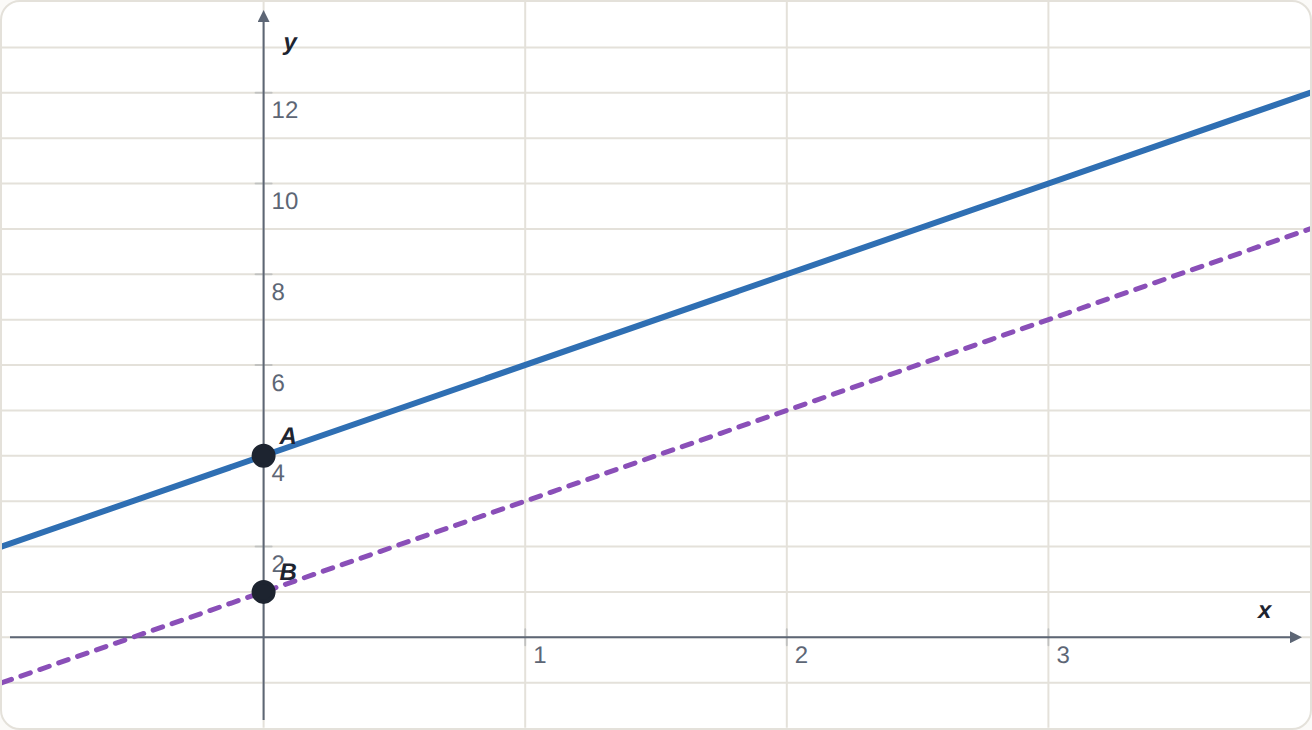
Changing cc moves the whole line up or down. It does not change the steepness, because mm stays the same: y=2x+4y = 2x + 4 is y=2x+1y = 2x + 1 moved up 3.

Lines with the same mm are parallel: equally steep, so they never meet.

y = 2x + 4 is y = 2x + 1 moved up 3. Same m, so they are parallel.
y=2x+4y = 2x + 4 is y=2x+1y = 2x + 1 moved up 3. Same mm, so they are parallel.
c moves the line up or down; the steepness stays the same · Sound on for the voiceover
Open the lesson →

8. Lines and regions

Try firstGraph y ≥ −2x + 3 (describe the boundary and the side). Is (1, 1) in it?

Check your answer

Solid line through (0, 3), down 2 for each step right; shade above. (1, 1): 1 ≥ 1, true: on the boundary, so in.

One-letter lines: x=3x = 3 is vertical (every point has x=3x = 3); y=−2y = -2 is horizontal.

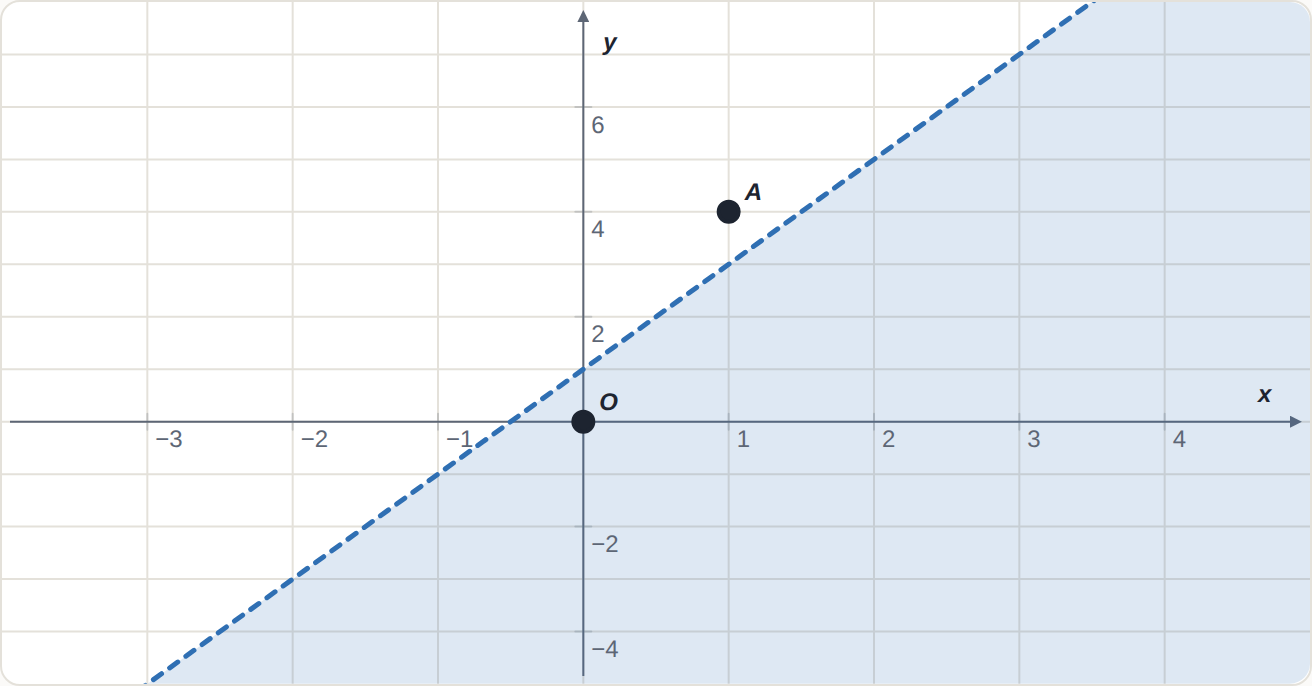
An inequality such as y<2x+1y < 2x + 1 is a region: every point that makes it true. To graph it:

  1. Draw the boundary line y=2x+1y = 2x + 1: dashed for << and >> (its points are not included), solid for ≤\le and ≥\ge.
  2. Test a point not on the line, often (0,0)(0, 0): 0<10 < 1 is true.
  3. Shade the side of the test point if it was true, the other side if it was false.
y < 2x + 1: below the dashed line. O(0, 0) is in it (0 < 1); A(1, 4) is not (4 < 3 is false).
y<2x+1y < 2x + 1: below the dashed line. O(0,0)O(0, 0) is in it (0<10 < 1); A(1,4)A(1, 4) is not (4<34 < 3 is false).
A line, then a region · Sound on for the voiceover
Open the lesson →

Solving and modelling with lines

9. Solving equations with graphs

Try firstThe lines y = 2x − 3 and y = 5 meet at (4, 5). Solve 2x − 3 = 5 and check your answer.

Check your answer

x = 4. Check: 2 × 4 − 3 = 5.

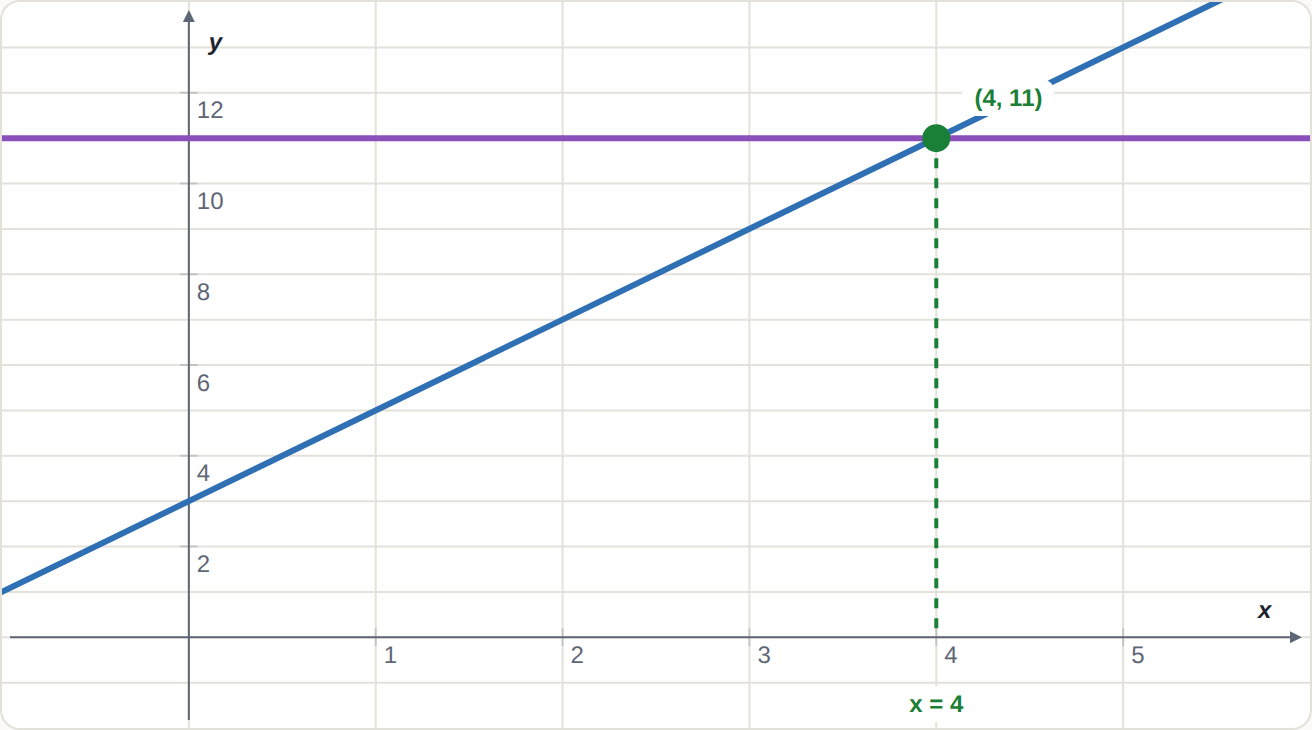
An equation says two things are equal. Draw each side as a line: for 2x+3=112x + 3 = 11, draw y=2x+3y = 2x + 3 and y=11y = 11.

Where the lines meet, both sides have the same value. The solution is the xx of that point: here the lines meet at (4,11)(4, 11), so x=4x = 4. The 11 is the value of both sides, not the answer.

Check by substitution: 2×4+3=112 \times 4 + 3 = 11. If the lines are parallel, they never meet, and the equation has no solution.

y = 2x + 3 meets y = 11 at (4, 11), so 2x + 3 = 11 when x = 4.
y=2x+3y = 2x + 3 meets y=11y = 11 at (4,11)(4, 11), so 2x+3=112x + 3 = 11 when x=4x = 4.
The solution is the x where the two lines meet · Sound on for the voiceover
Open the lesson →

10. Rules from real situations

Try firstA swimming pool charges a 50 dollar membership plus 4 dollars a visit. Write the rule for the total T for v visits, and say what each number means.

Check your answer

T = 4v + 50. 4 is the cost per visit (m); 50 is the membership, paid once (c).

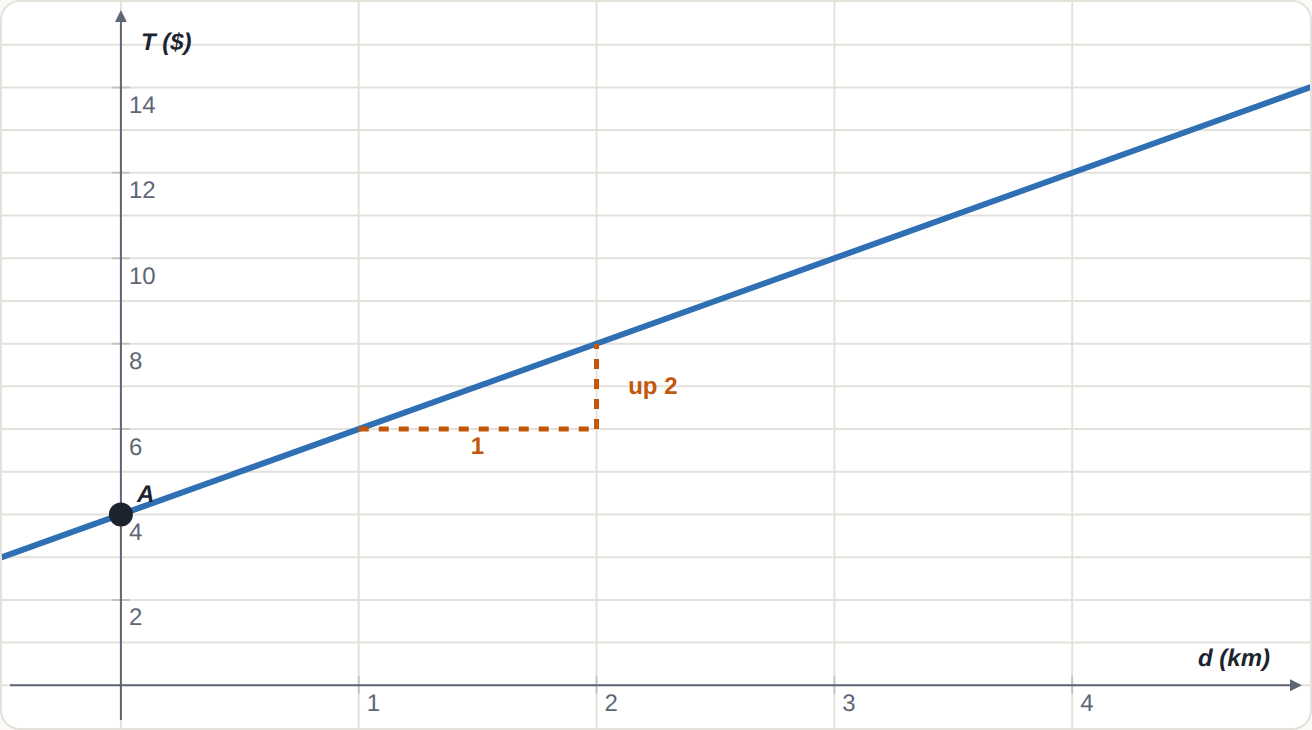
Many real amounts are a starting amount plus a rate. A taxi costs 4 dollars to get in, then 2 dollars for each km: T=2d+4T = 2d + 4.

The starting amount is cc: it is the value when nothing has happened yet (0 km), where the line crosses the axis. The rate is mm: the words "per", "each" or "every" tell you it is the amount for each one more, how far the line goes up for each step.

The order of the numbers in the words does not matter. Ask: which is paid once (c), and which is paid again and again (m)?

A taxi: 4 dollars to get in (where the line starts) and 2 dollars per km (up 2 for each km). T = 2d + 4.
A taxi: 4 dollars to get in (where the line starts) and 2 dollars per km (up 2 for each km). T=2d+4T = 2d + 4.
The starting amount is c; the rate is m · Sound on for the voiceover
Open the lesson →

11. Comparing two plans

Try firstPlan X costs 15 dollars plus 6 per GB; Plan Y costs 33 dollars flat. Which is cheaper for 2 GB and for 5 GB? Where do they cost the same?

Check your answer

2 GB: X (27 dollars vs 33). 5 GB: Y (45 vs 33). They cost the same at 3 GB (33 dollars).

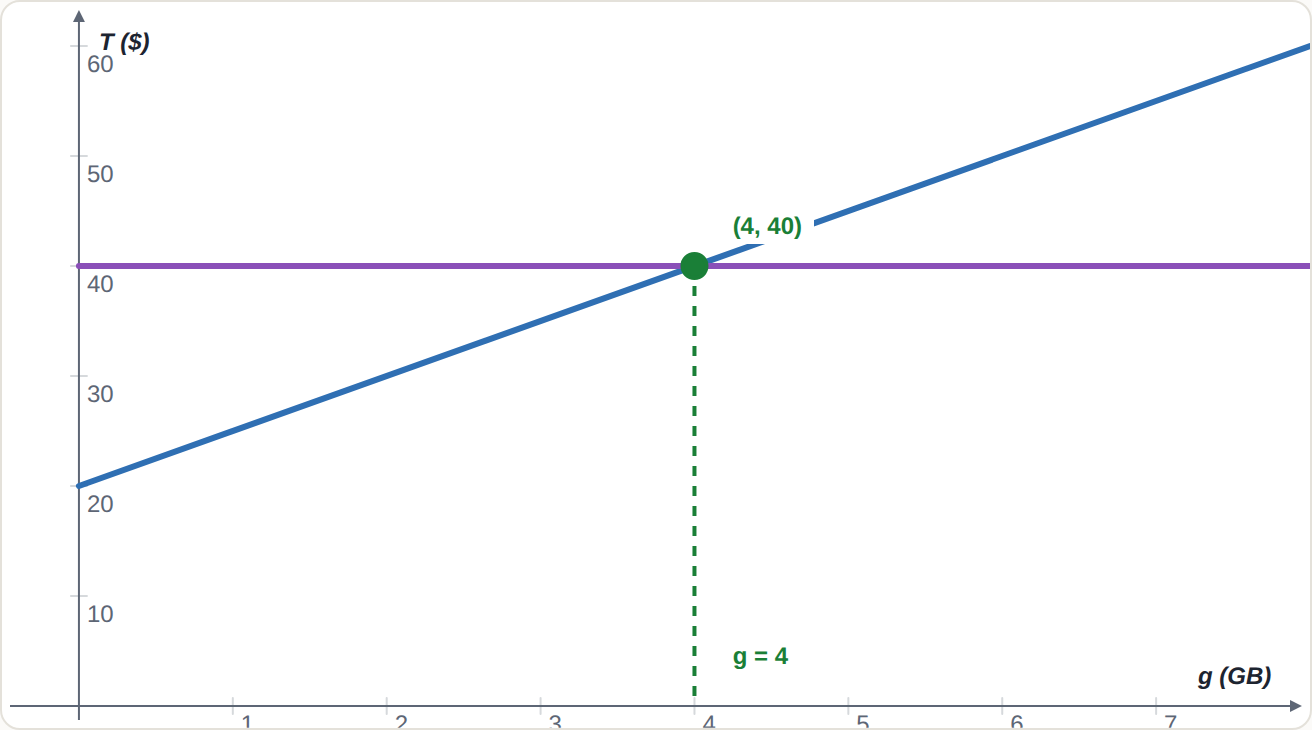
To compare two plans, draw both rules on one graph. Where the lines cross, the plans cost the same.

On each side of the crossing, the lower line is the cheaper plan. A plan with a lower fee is cheaper for small amounts, but a plan with a lower rate wins for large amounts.

Always answer in words ("Up to 4 GB, Plan A is cheaper"), and check the answer makes sense: you cannot use negative data or buy half a ticket, so a model only fits some values.

Plan A (T = 5g + 20) and Plan B (T = 40) cost the same at 4 GB. Below 4 GB, A is lower (cheaper); above 4 GB, B is.
Plan A (T=5g+20T = 5g + 20) and Plan B (T=40T = 40) cost the same at 4 GB. Below 4 GB, A is lower (cheaper); above 4 GB, B is.
Where the lines cross, the plans cost the same · Sound on for the voiceover
Open the lesson →