← Teacher guide

Year 7 Space: cheat sheet

Year 7 Space · The words and methods from the lessons, with an example of each.

Classifying shapes

triangles by sides and angles

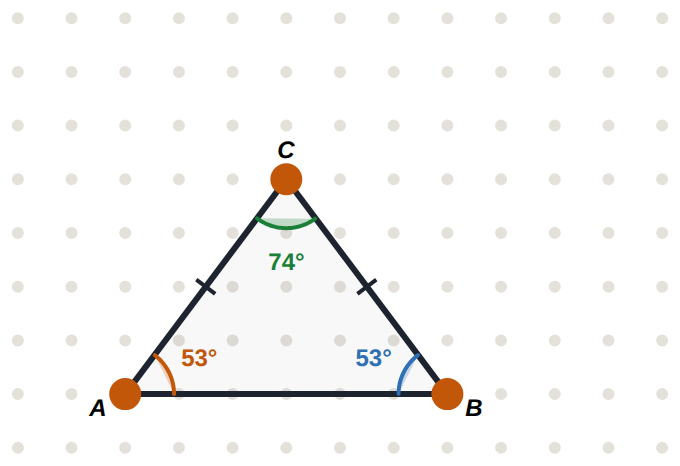
Give two names: one for the sides (how many are equal) and one for the biggest angle. Equal sides sit opposite equal angles.
scalene, isosceles, equilateral    acute, right-angled, obtuse\text{scalene, isosceles, equilateral} \;\; \text{acute, right-angled, obtuse}
An isosceles acute triangle, its equal sides ticked

regular polygon

Both are needed: a rhombus has equal sides but is not regular. Names: pentagon 5, hexagon 6, heptagon 7, octagon 8, nonagon 9, decagon 10.

equal sides  and  equal angles\text{equal sides} \;\text{and}\; \text{equal angles}

quadrilateral family

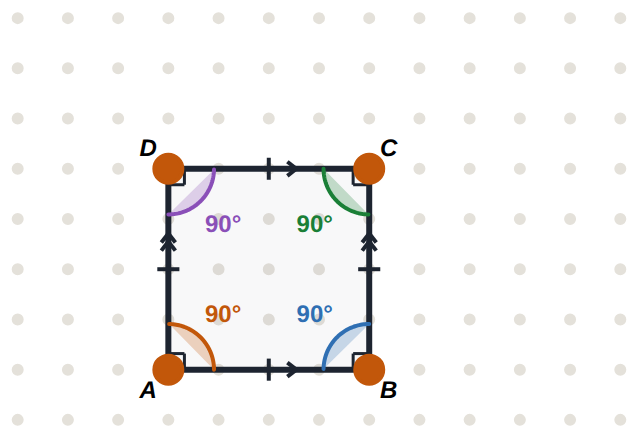
Trapezium: at least one pair of parallel sides. Parallelogram: two. Rhombus: four equal sides. Rectangle: four right angles. Square: both. Kite: two pairs of equal neighbouring sides. A square is also a rectangle and a rhombus.
every square is a rectangle; every rectangle is a parallelogram\text{every square is a rectangle; every rectangle is a parallelogram}
A square with equal sides, parallel sides and right angles marked

convex and concave

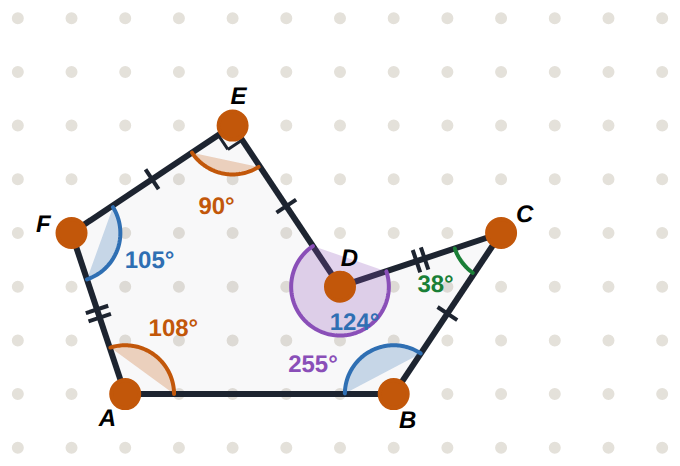
Convex: every corner points out. Concave: at least one corner points in.
concave: an angle>180∘\text{concave: an angle} > 180^\circ
A concave hexagon with one corner pointing in

Solids

net

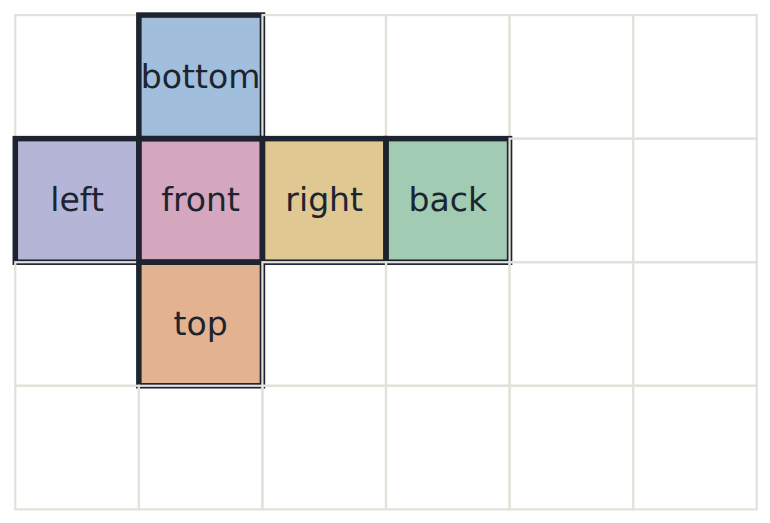
A net is a solid unfolded flat. Fold it, or roll a cube over it, to check that every face is covered once. Six squares is not enough.
cube: 6 squares on 6 different faces\text{cube: 6 squares on 6 different faces}
A cross of six squares that folds into a cube

prism net area

A triangular prism has two triangles and three rectangles. The net's area is the surface area.

A=2×triangle+length×(a+b+c)A = 2 \times \text{triangle} + \text{length} \times (a + b + c)

top, front and side views

A view shows what you can see from one side; hidden cubes do not show. The top view with heights shows every cube.
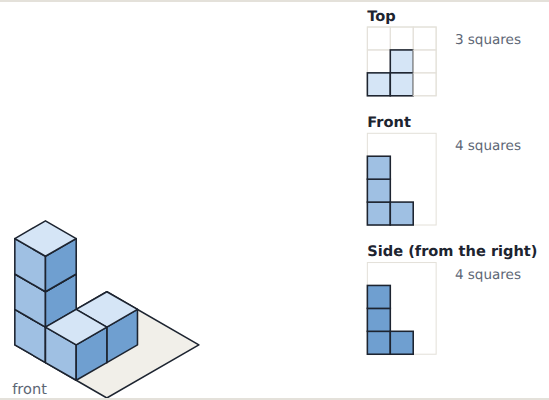
front=tallest pile in each column\text{front} = \text{tallest pile in each column}
Three drawings of the same cubes

Transformations

translation

Every point slides the same way. Right and up add; left and down take away.
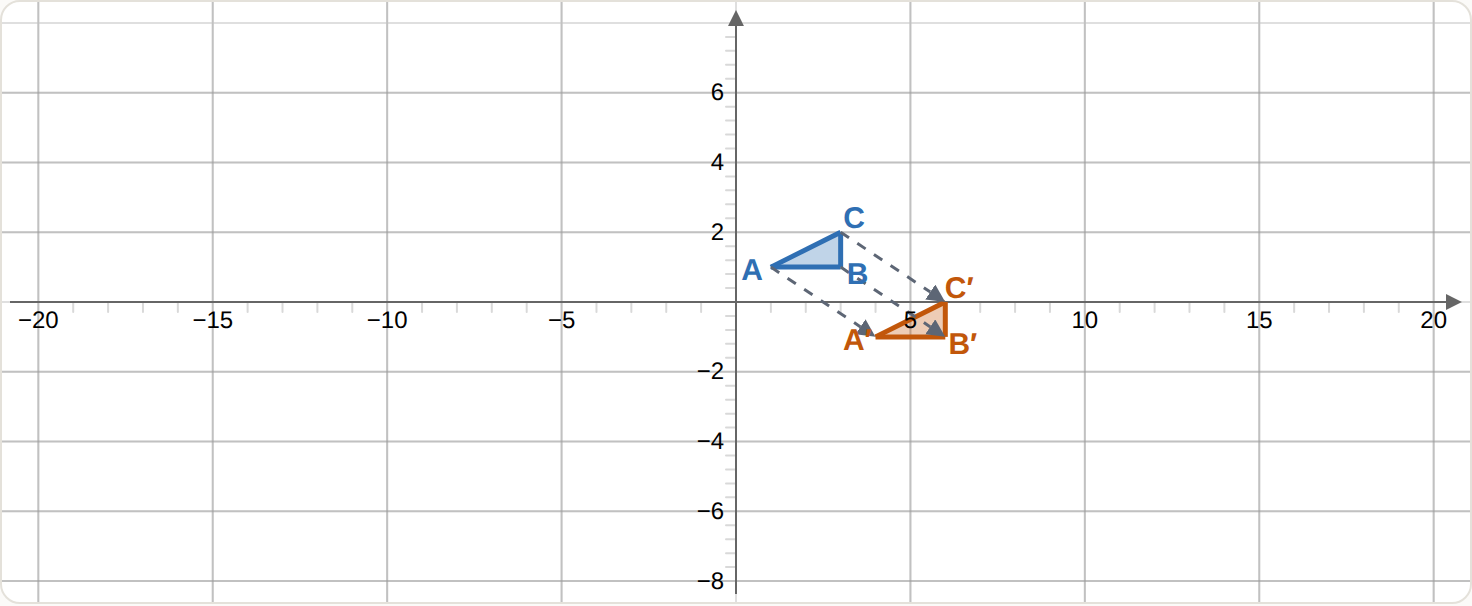
(x,y)→(x+a, y+b)(x, y) \to (x + a, \, y + b)
A triangle moved 3 right and 2 down

rotation

Give the centre, the angle and the direction. A half turn: (x, y) to (−x, −y). 90° clockwise is 270° anticlockwise.
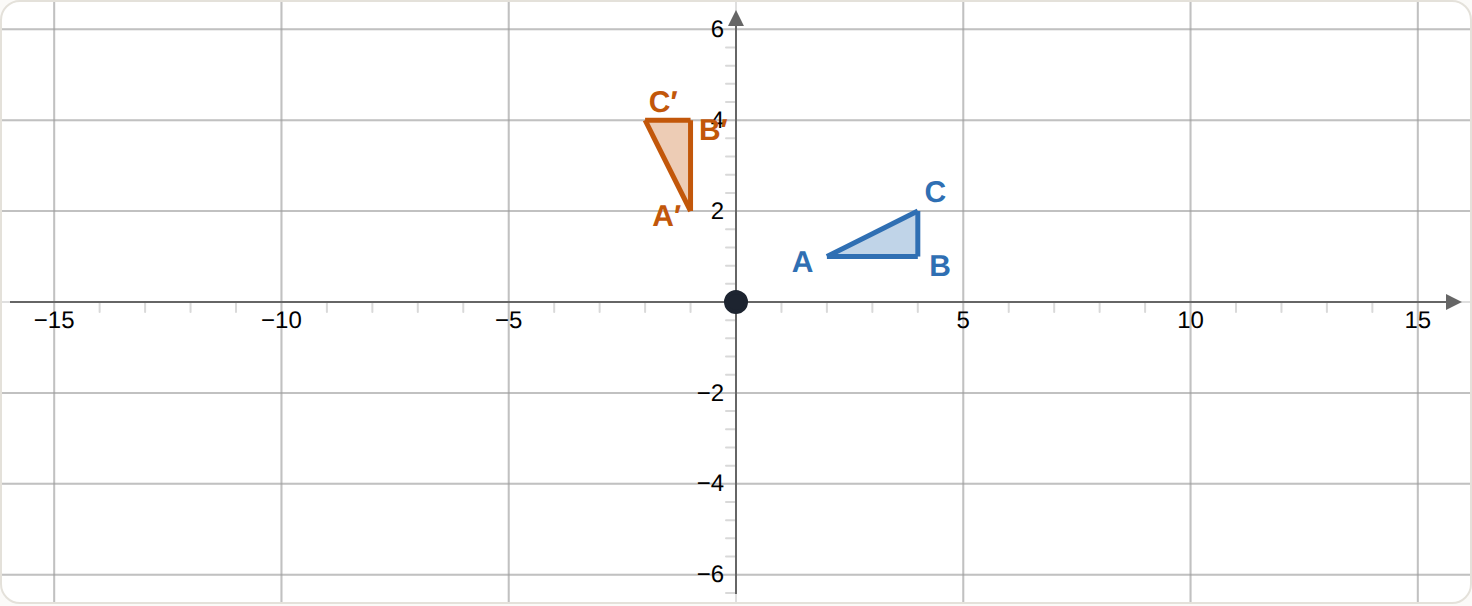
90∘ anticlockwise: (x,y)→(−y,x)90^\circ \text{ anticlockwise: } (x, y) \to (-y, x)
A triangle turned a quarter turn about the origin

reflection

Each point and its image are the same distance from the mirror, on opposite sides.
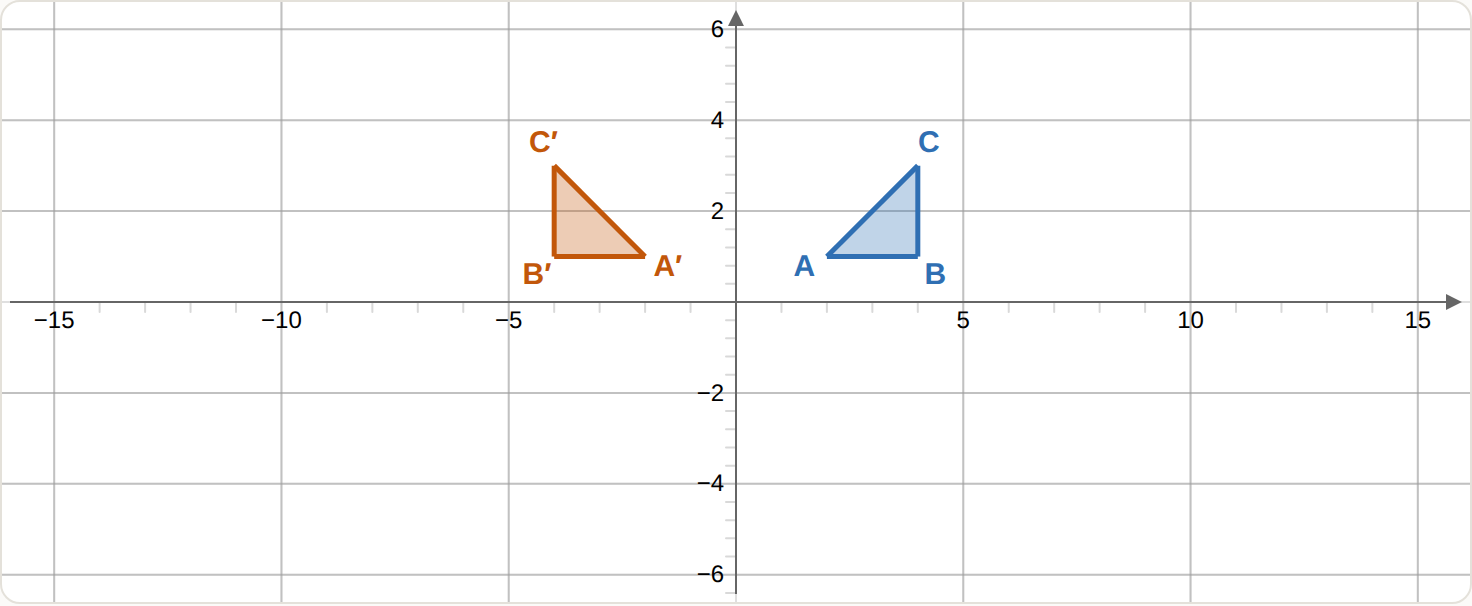
x-axis: (x,y)→(x,−y)y-axis: (x,y)→(−x,y)x\text{-axis: } (x, y) \to (x, -y) \qquad y\text{-axis: } (x, y) \to (-x, y)
A triangle reflected in the y-axis

Algorithms

algorithm

A set of steps and decisions that gives the right result every time. Test it on one shape of every class.

ask the most specific question first\text{ask the most specific question first}