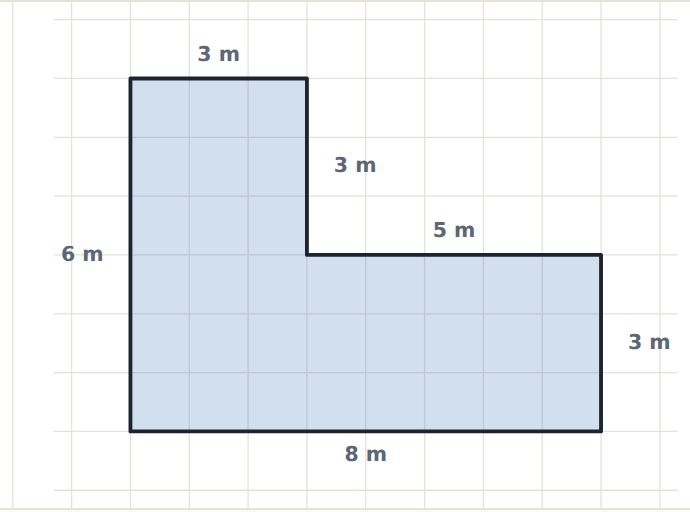
composite area
Cut the shape into pieces you know and add their areas, or take the missing pieces away from a big rectangle. Each piece uses its own lengths.
Year 8 Measurement · The words and methods from the lessons, with an example of each.
Cut the shape into pieces you know and add their areas, or take the missing pieces away from a big rectangle. Each piece uses its own lengths.
Count the full squares, add half the part squares, multiply by the area of one square. A finer grid gives a closer estimate.
A cubic metre is 100 × 100 × 100 = 1 000 000 cm³: convert each of the three lengths.
Slices of a circle make a near-rectangle πr long and r high. The area is between 2r² and 4r². Do not mix it up with C = 2πr.
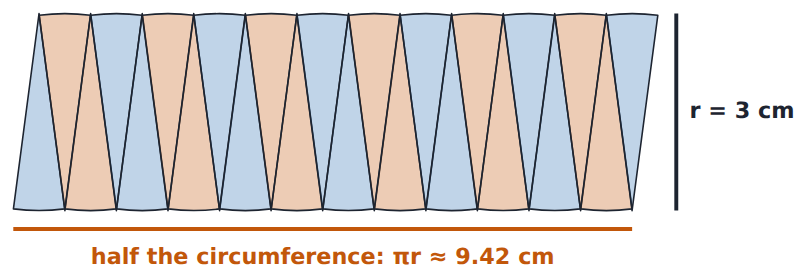
Divide by π, then take the square root. A semicircle is half the area; its perimeter is half the circumference plus the diameter.
In a right-angled triangle, the squares on the two shorter sides add to the square on the hypotenuse c, the side opposite the right angle.
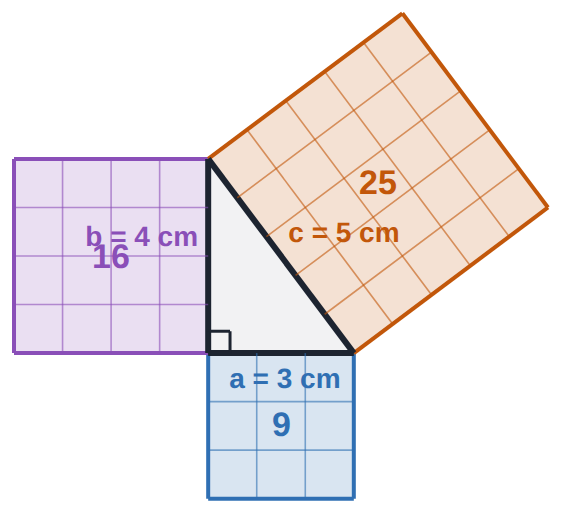
Add the squares for the hypotenuse; subtract for a shorter side. Check: the hypotenuse is the longest.
With c the longest side: equal, right-angled; a² + b² smaller, obtuse; bigger, acute. Pythagorean triples: 3-4-5, 5-12-13, 8-15-17 and multiples.
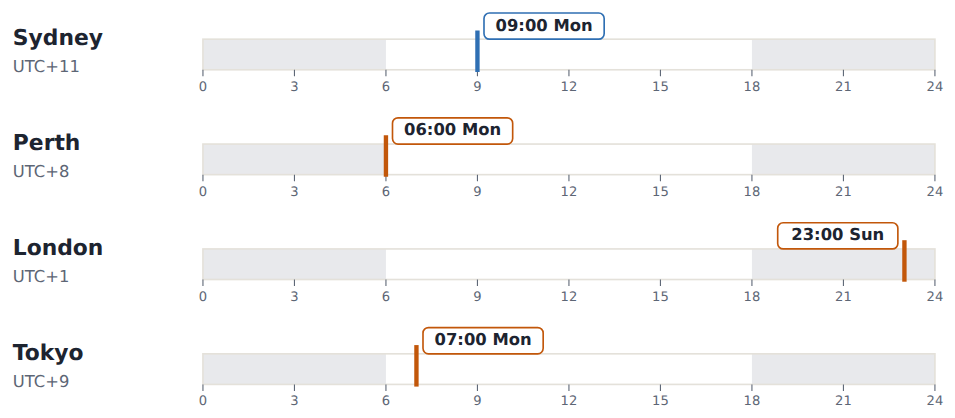
Find the difference between the UTC offsets, add or take it away, and change the day if you cross midnight. For a flight, add the flight time in the departure zone, then change zones.
A rate compares quantities with different units (km per h, $ per kg); a ratio compares the same kind. 1 km/h = 1000 m ÷ 3600 s: divide by 3.6 for m/s.

Write the units in: km ÷ km/h = h. Then check the size makes sense.
Every model assumes something (steady speed, no fees, no starting charge). When it disagrees with real life, name the assumption and refine the model.