← Teacher guide

Year 7 Measurement: cheat sheet

Year 7 Measurement · The words and methods from the lessons, with an example of each.

Area

perpendicular height

The distance from the base to the opposite side or corner, at a right angle (∟) to the base. A slanted side is longer, and is not the height.

h at 90∘ to bh \text{ at } 90^\circ \text{ to } b

area of a triangle

Two copies make a parallelogram with the same base and height; the triangle is half.
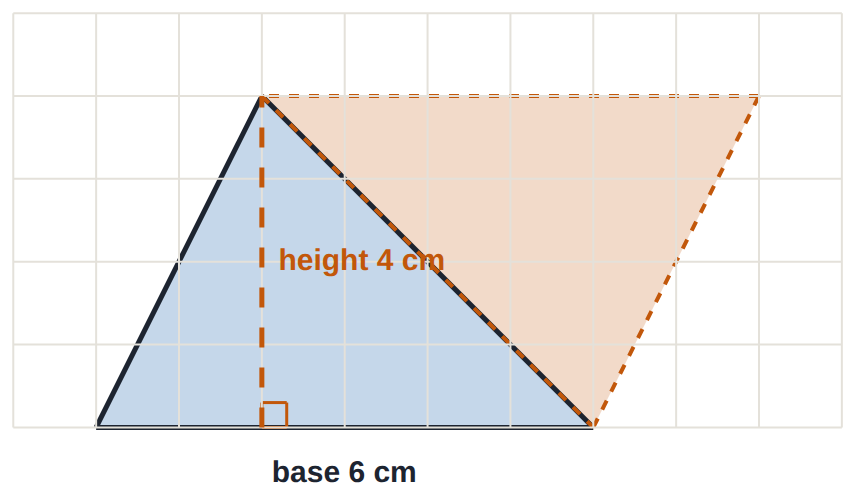
A=12×b×hA = \tfrac{1}{2} \times b \times h
A triangle and its turned copy make a parallelogram

square units

Area counts squares: cm², m². A 1 m square is 100 cm by 100 cm.

1 m2=10 000 cm21 \text{ m}^2 = 10\,000 \text{ cm}^2

area of a parallelogram

Cut the triangle off one end and move it: a rectangle with the same base and height.
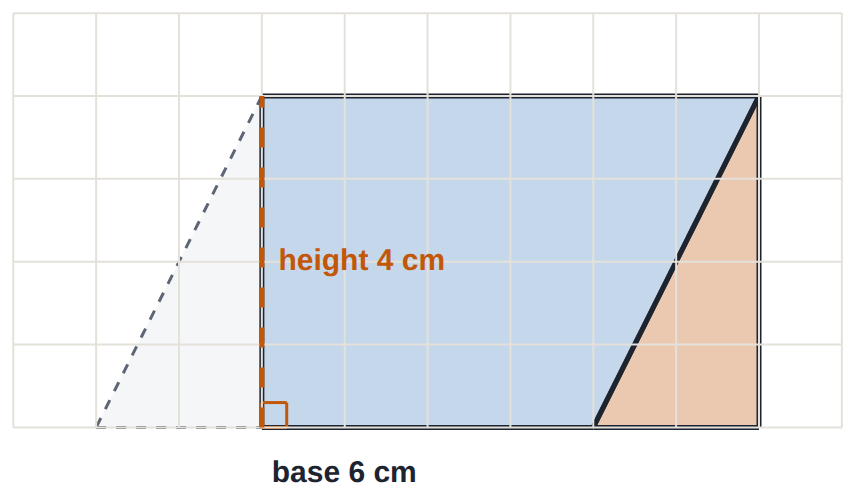
A=b×hA = b \times h
A parallelogram cut and rearranged into a 6 by 4 rectangle

composite area

Split the shape into rectangles and triangles and add the parts, or subtract a missing part from a bigger shape. Put every length in the same unit first.
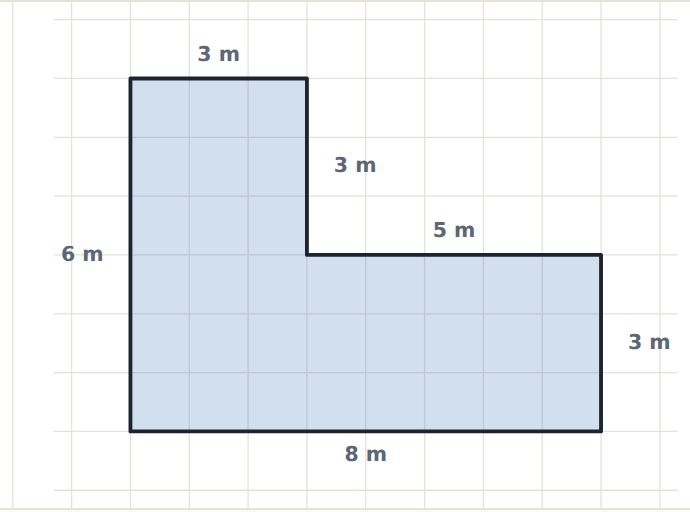
24+9=33 m224 + 9 = 33 \text{ m}^2
The board

Volume

volume of a prism

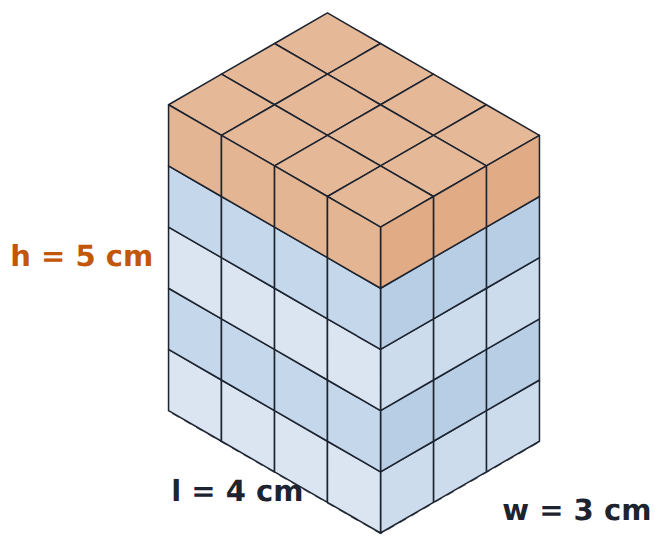
Each layer is the base (the cross-section); the height counts the layers. For a box, V=l×w×hV = l \times w \times h.

V=A×hV = A \times h
A 4 by 3 by 5 box in layers of 12 cubes

volume of a prism

The area of the end times the length, for any right prism. Divide to find a missing length.

V=Ahh=V÷AV = A h \qquad h = V \div A
The board

cross-section

The shape that is the same all the way along a prism, like a slice of bread. A triangular prism's cross-section is a triangle: halve first.
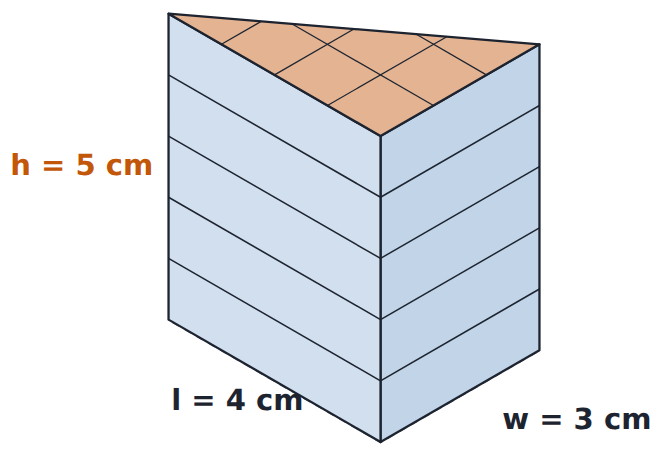
V=12×6×4×10=120 cm3V = \tfrac{1}{2} \times 6 \times 4 \times 10 = 120 \text{ cm}^3
A triangular prism, half of a 4 by 3 box, 5 layers high

capacity

How much a container holds. A 10 cm cube holds 1 litre.

1 cm3=1 mL1000 cm3=1 L1 \text{ cm}^3 = 1 \text{ mL} \qquad 1000 \text{ cm}^3 = 1 \text{ L}

Circles

radius and diameter

The radius goes from the centre to the edge; the diameter right across through the centre. A chord joins any two points; the diameter is the longest.
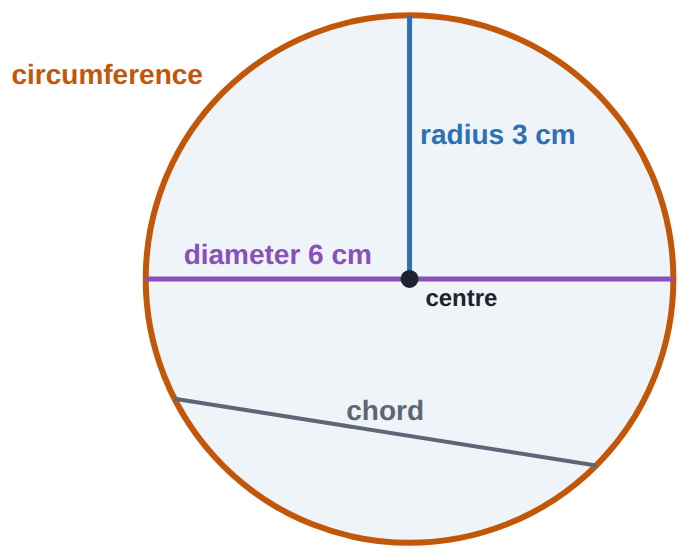
d=2rr=d÷2d = 2r \qquad r = d \div 2
A circle with its centre, radius, diameter, a chord and the circumference

pi

The circumference divided by the diameter: the same for every circle. 3.14 and 22/7 are approximations.
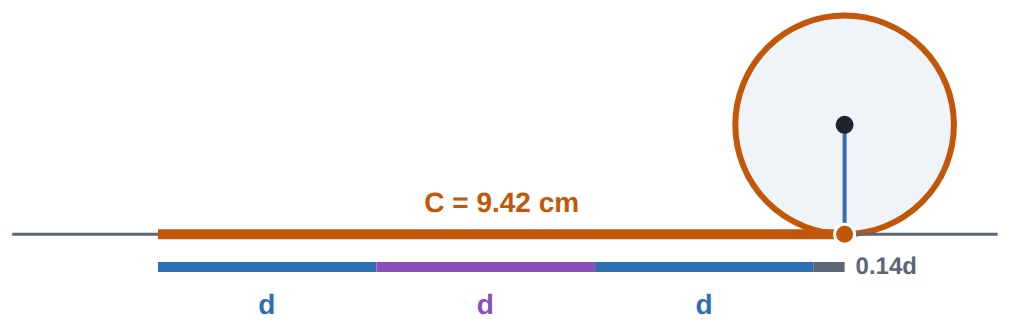
π=Cd=3.14159…\pi = \frac{C}{d} = 3.14159\ldots
A circle rolled out flat: just over 3 diameters

circumference

Use the diameter, or double the radius. Backwards: d=C÷πd = C \div \pi. Exact answers keep π: 10π10\pi cm.

C=πd=2πrC = \pi d = 2\pi r

Parallel lines

transversal

Parallel lines go the same way and never meet; arrows (>>) mark them. A transversal crosses both, making eight angles.

parallel lines≫ crossed by a transversal\text{parallel lines} \gg \text{ crossed by a transversal}

alternate angles

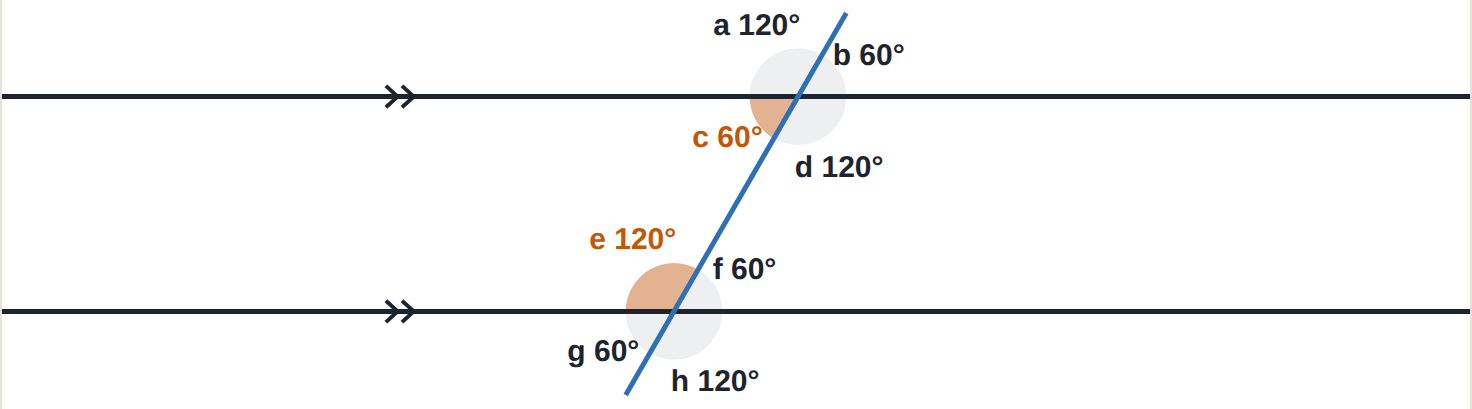
Between the parallel lines, on opposite sides of the transversal (a Z shape). With parallel lines they are equal.
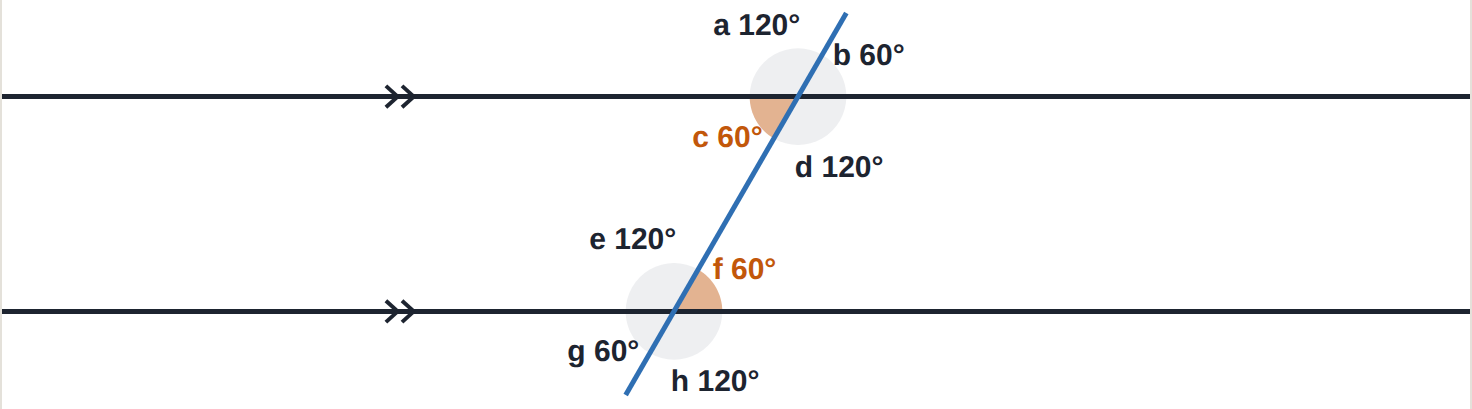
c=fc = f
c and f: between the lines, opposite sides, both 60°

vertically opposite angles

Opposite each other at one crossing: always equal, parallel lines or not. Not one of the parallel-line pairs.

b=cb = c

give a reason

For each angle you find, name the rule: corresponding or alternate angles are equal; co-interior angles add to 180∘180^\circ; angles on a straight line add to 180∘180^\circ.

f=70∘  (corresponding to b)f = 70^\circ \;\text{(corresponding to } b\text{)}

corresponding angles

The same place at each crossing (an F shape). With parallel lines they are equal.
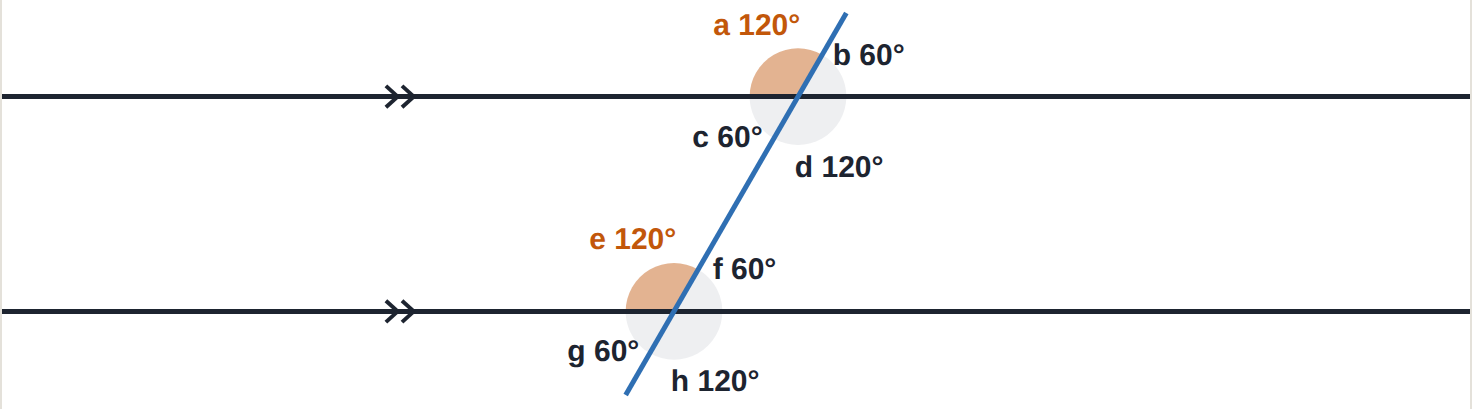
a=ea = e
a and e: the same place at each crossing, both 120°

co-interior angles

Between the parallel lines, on the same side (a C shape). With parallel lines they add to 180∘180^\circ: they are not equal unless both are 90∘90^\circ.

c+e=180∘c + e = 180^\circ
c and e: between the lines, same side, 60° + 120° = 180°

Angle sums

interior angle

An angle inside a shape, at one of its corners.

∠A\angle A

regular polygon

All sides and all angles are equal, so each angle is the angle sum shared equally: a regular hexagon has angles of 120∘120^\circ.

each angle=(n−2)×180∘n\text{each angle} = \dfrac{(n - 2) \times 180^\circ}{n}

angle sum of a polygon

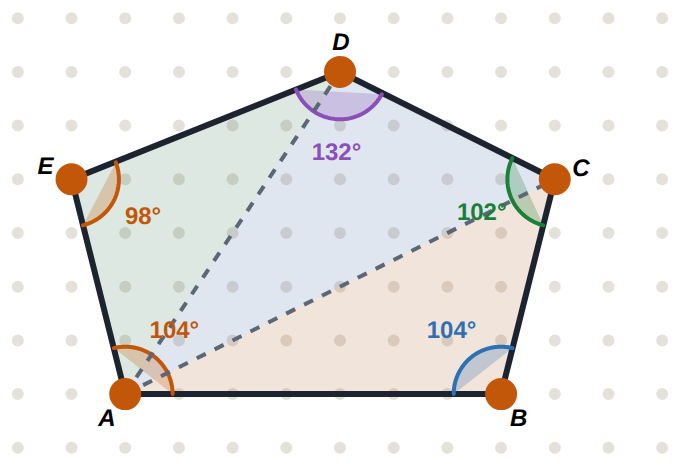
Split it into triangles from one corner: a shape with nn sides makes n−2n - 2 triangles. A pentagon: 3×180∘=540∘3 \times 180^\circ = 540^\circ.

(n−2)×180∘(n - 2) \times 180^\circ
A pentagon splits into 3 triangles from A: 540°

polygon

A closed shape with straight sides: triangle (3), quadrilateral (4), pentagon (5), hexagon (6), octagon (8).

n sides,  n cornersn \text{ sides}, \; n \text{ corners}

angle sum of a triangle

True for every triangle, whatever its shape or size: tear off the corners and they fill a straight line.
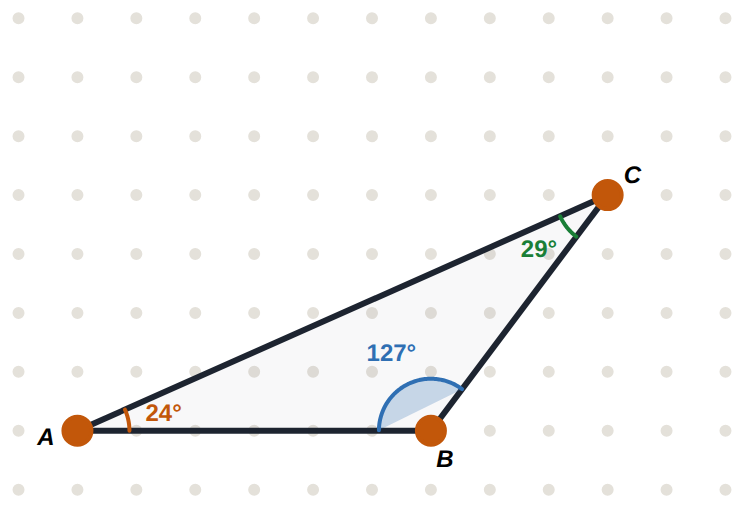
a+b+c=180∘a + b + c = 180^\circ
An obtuse triangle: 24° + 127° + 29° = 180°

Modelling

scale

A ratio of the drawing (or model) to the real thing. Each 1 unit on the drawing is 50 units in real life.

1:50⇒3 cm→150 cm1 : 50 \Rightarrow 3\text{ cm} \to 150\text{ cm}