Every idea from Year 9 science in one place, for after you've done the year (or part of it). Answer each question in your head or on paper first, then check it. Nothing here is marked. If one is shaky, open the lesson and go over it again.
Try firstOxygen has atomic number 8 and mass number 16. How many protons, neutrons and electrons does a neutral oxygen atom have?
Check your answer
8 protons, 8 neutrons (16 − 8), 8 electrons.
An atom has a tiny, dense nucleus of protons (+1, mass 1) and neutrons (0, mass 1), with electrons (−1, almost no mass) around it.
Atomic number = protons, and it decides the element. Mass number = protons + neutrons. A neutral atom has as many electrons as protons.
Revision summary
An atom has a tiny, dense nucleus of protons (charge +1, mass 1) and neutrons (no charge, mass 1), with electrons (charge −1, mass about 1/1840) in shells around it.
Atomic number = protons; it decides the element. Mass number = protons + neutrons.
A neutral atom has as many electrons as protons. An ion has gained or lost electrons.
The nuclear model replaced earlier models because of evidence, such as Rutherford's gold foil experiment.
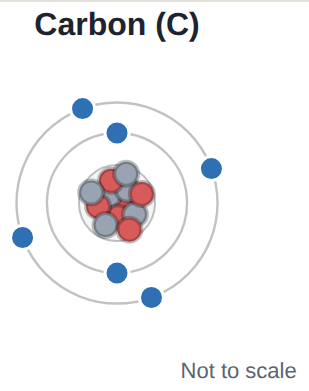
Carbon-12 as a Bohr model: 6 protons and 6 neutrons in the nucleus, 6 electrons in shells (not to scale).Inside an atom · Sound on for the voiceoverVoice: Open the lesson →
Still stuck? Try the lesson again first. Then, if your teacher has said you can, copy a coach prompt into the AI tool your school allows. It asks you questions; it won't give you the answers.
Try firstUranium-235 and uranium-238 both have 92 protons. How many neutrons does each have, and are they the same element?
Check your answer
143 and 146 neutrons. Both are uranium (92 protons): they are isotopes.
Isotopes are atoms of the same element (same number of protons) with different numbers of neutrons, so they have different mass numbers: carbon-12, carbon-13 and carbon-14.
They have the same electrons, so they react in the same way. Some isotopes are stable; others are unstable (radioactive) and their nuclei decay.
Revision summary
Isotopes are atoms of the same element (same number of protons) with different numbers of neutrons, so different mass numbers. We name them by mass number: carbon-12, carbon-13, carbon-14.
Isotopes have the same number of electrons, so they react in the same way.
Some isotopes are stable. Others are unstable (radioactive): their nuclei decay, giving out radiation.
Carbon-14 is made in the air from nitrogen-14 and taken in by living things, which is why it can date things that were once alive.
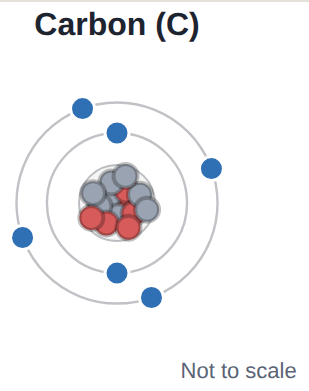
Carbon-14: 6 protons and 8 neutrons. Two more neutrons than carbon-12, but still carbon.Isotopes · Sound on for the voiceoverVoice: Open the lesson →
Still stuck? Try the lesson again first. Then, if your teacher has said you can, copy a coach prompt into the AI tool your school allows. It asks you questions; it won't give you the answers.
Try firstCobalt-60 (27 protons) decays by beta decay and gives out gamma rays. What is it now, and which of the radiation would get through 1 cm of aluminium?
Check your answer
Nickel-60 (28 protons, mass number still 60). Only the gamma rays get through the aluminium.
An unstable nucleus decays by giving out alpha (2 protons and 2 neutrons), beta (a fast electron made when a neutron turns into a proton) or gamma (energy only).
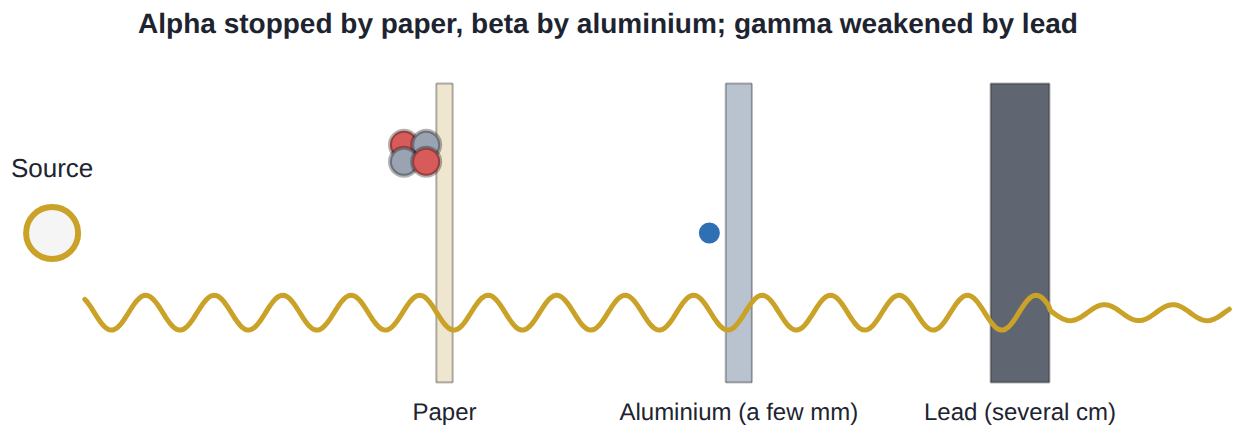
Alpha: atomic number −2, mass number −4. Beta: atomic number +1, mass number the same. Gamma: no change. Alpha is stopped by paper, beta by a few millimetres of aluminium, and gamma is only reduced by thick lead.
Revision summary
An unstable nucleus decays by giving out radiation. It is random for one atom, but predictable for many.
Alpha: 2 protons and 2 neutrons (a helium nucleus). Atomic number −2, mass number −4: a new element. Stopped by paper or a few centimetres of air.
Beta: a neutron turns into a proton and a fast electron, which leaves. Atomic number +1, mass number the same: a new element. Stopped by a few millimetres of aluminium.
Gamma: energy only, usually just after alpha or beta. No change to the atomic or mass number. Reduced by thick lead or concrete.
The more massive and charged the radiation, the sooner it is stopped, and the more damage it does close up.
Alpha is stopped by paper and beta by a few millimetres of aluminium; gamma gets through, weakened by thick lead.Alpha, beta and gamma · Sound on for the voiceoverVoice: Open the lesson →
Still stuck? Try the lesson again first. Then, if your teacher has said you can, copy a coach prompt into the AI tool your school allows. It asks you questions; it won't give you the answers.
Try firstIodine-131 has a half-life of 8 days. A hospital receives 40 g. How much is left after 24 days?
Check your answer
5 g (40 → 20 → 10 → 5: three half-lives).
Each unstable nucleus decays at random, but a large sample halves in a fixed time: its half-life. After 1 half-life, 1/2 is left; after 2, 1/4; after 3, 1/8.
Half-life doesn't change with heat or chemistry. Short half-lives suit medicine (fluorine-18, about 2 hours); long ones suit dating (carbon-14, 5730 years).
Revision summary
Each unstable nucleus decays at random: no one can say which will go next, or when.
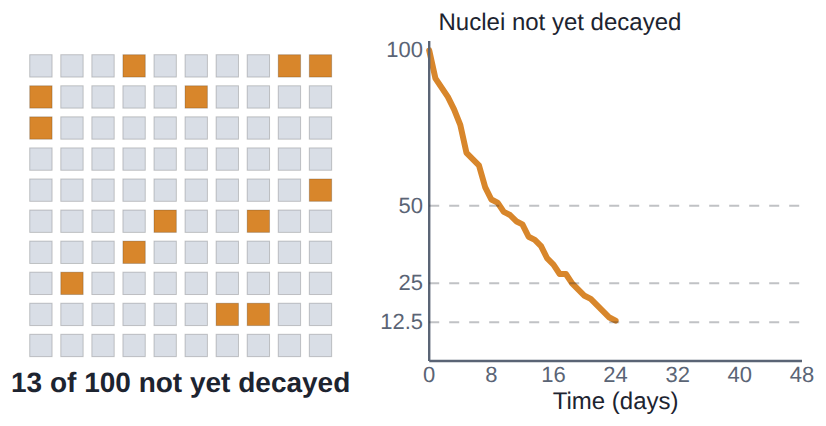
A large sample decays in a predictable way: half of it goes in one half-life, half of what is left in the next, and so on (1/2, 1/4, 1/8 …).
Half-life is a property of the isotope; heat, pressure and chemical reactions don't change it.
Short half-lives suit medical imaging (fluorine-18, about 2 hours); long ones suit dating (carbon-14, 5730 years; uranium-238, 4.5 billion years).
100 iodine-131 nuclei after 3 half-lives (24 days): about an eighth are left. The number halves every 8 days.Half-life · Sound on for the voiceoverVoice: Open the lesson →
Still stuck? Try the lesson again first. Then, if your teacher has said you can, copy a coach prompt into the AI tool your school allows. It asks you questions; it won't give you the answers.
Try firstRadium-226 (atomic number 88) decays by alpha emission. What are the new atomic and mass numbers?
Check your answer
Atomic number 86, mass number 222: radon-222.
A decay chain ends only at a stable nucleus. Alpha decay lowers the atomic number by 2 and the mass number by 4; beta decay raises the atomic number by 1 and leaves the mass number unchanged.
Revision summary
A decay chain is a series of decays that ends only at a stable nucleus.
Alpha decay: atomic number −2, mass number −4. Beta decay: atomic number +1, mass number unchanged.
Uranium-238 ends as lead-206 after 8 alpha and 6 beta decays.
Alpha decays make the nucleus smaller and beta decays fix its balance of neutrons to protons, until it is stable.
Still stuck? Try the lesson again first. Then, if your teacher has said you can, copy a coach prompt into the AI tool your school allows. It asks you questions; it won't give you the answers.
Try firstIron reacts with oxygen and water to make rust (hydrated iron oxide). Write the word equation and label the reactants and products.
Check your answer
iron + oxygen + water → hydrated iron oxide (rust). Reactants: iron, oxygen, water. Product: hydrated iron oxide.
In a chemical reaction the reactants are used up and new substances, the products, are made. A word equation names them: reactants → products ("react to make").
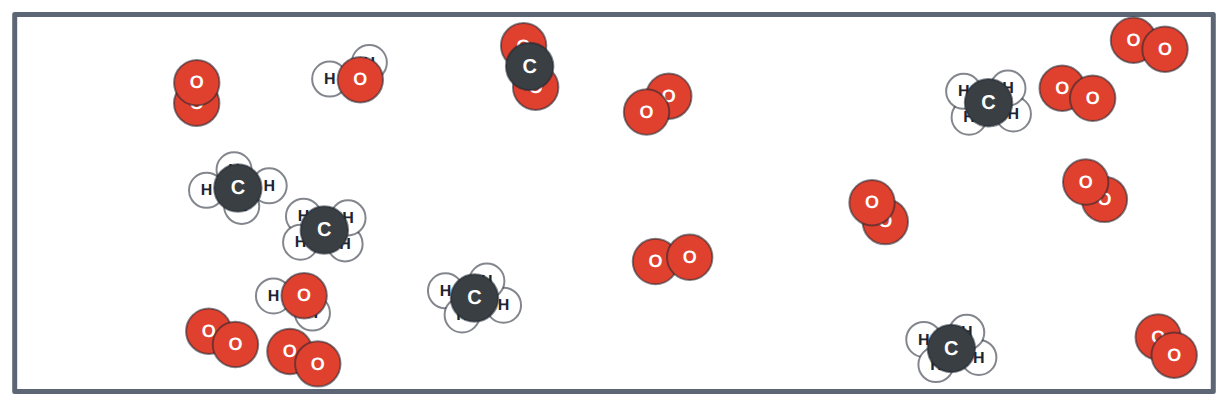
Include every reactant and product: methane + oxygen → carbon dioxide + water. A word equation shows no amounts and no atoms.
Revision summary
In a chemical reaction the reactants are used up and new substances, the products, are made. Products have different properties.
A word equation names them: reactants → products. Read the arrow as "react to make".
Include every reactant and product: burning a fuel that contains hydrogen makes water as well as carbon dioxide; oxygen from the air is a reactant.
Heat and light are energy, not substances, so they are not in the equation.
A word equation shows no amounts and no atoms: formulas and balanced equations do.
Methane and oxygen (the reactants) reacting to make carbon dioxide and water (the products).Reactants and products · Sound on for the voiceoverVoice: Open the lesson →
Still stuck? Try the lesson again first. Then, if your teacher has said you can, copy a coach prompt into the AI tool your school allows. It asks you questions; it won't give you the answers.
Try firstWhen charcoal burns in a sealed jar, does the total mass change? Why?
Check your answer
No: the carbon and oxygen atoms are rearranged into carbon dioxide, which stays in the jar. Same atoms, same mass.
In a chemical reaction the atoms are rearranged into new particles; none are made or destroyed. The same atoms means the same mass: conservation of mass.
A balanced equation shows the same number of each type of atom on both sides. Balance by changing the numbers in front, never the formulas.
Revision summary
In a chemical reaction, atoms are rearranged: bonds break and new bonds form. No atom is made or destroyed.
The same atoms means the same mass: the law of conservation of mass.
A balanced equation has the same number of each type of atom on both sides. Balance it by changing the numbers in front, never the formulas.
Mass seems to change only when a gas escapes or joins from the air.
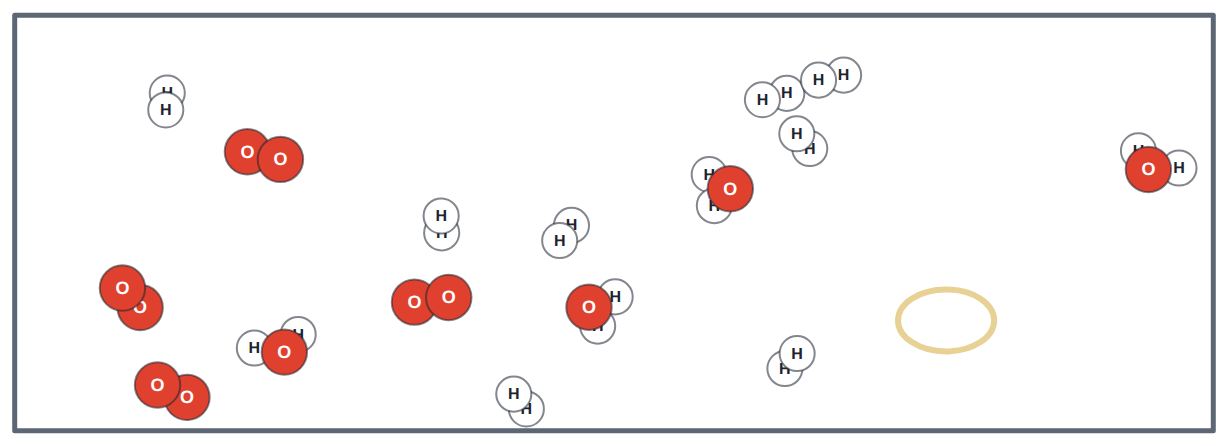
Hydrogen and oxygen before they react: the same atoms will be rearranged into water.Rearranging atoms · Sound on for the voiceoverVoice: Open the lesson →
Still stuck? Try the lesson again first. Then, if your teacher has said you can, copy a coach prompt into the AI tool your school allows. It asks you questions; it won't give you the answers.
Try firstBalance: H₂ + Cl₂ → HCl. How do you know it's balanced?
Check your answer
H₂ + Cl₂ → 2 HCl. Two hydrogen and two chlorine atoms on each side.
A balanced equation has the same number of each kind of atom on both sides, because atoms are only rearranged.
Change only the coefficients (numbers in front); the subscripts define the substance. Same atoms on both sides means the same mass: conservation of mass.
Revision summary
A balanced equation has the same number of each kind of atom on both sides.
Balance by changing coefficients (the numbers in front). Never change subscripts: they define the substance.
Use the smallest whole numbers, and check by counting atoms of each element.
A balanced equation shows conservation of mass: the same atoms, so the same mass.
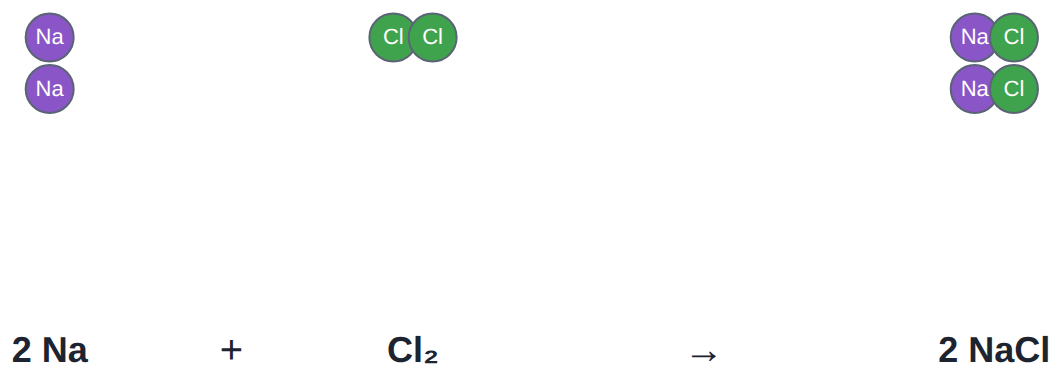
2 Na + Cl₂ → 2 NaCl: two sodium atoms and two chlorine atoms on each side.Balancing an equation · Sound on for the voiceoverVoice: Open the lesson →
Still stuck? Try the lesson again first. Then, if your teacher has said you can, copy a coach prompt into the AI tool your school allows. It asks you questions; it won't give you the answers.
Try firstA student weighs a candle before and after burning it in an open dish and finds it lighter. Is mass conserved?
Check your answer
Yes. The missing mass left as carbon dioxide and water vapour. Weighing the candle and the oxygen used against the gases would show the same total.
Atoms are rearranged, not made or destroyed, so total mass is conserved. In an open system the mass can seem to change when a gas escapes or enters. A balanced equation has the same atoms on both sides.
Revision summary
In a chemical reaction atoms are rearranged, not made or destroyed, so the total mass is conserved.
In a closed system the mass stays the same.
In an open system it can seem to change because a gas escapes or joins in from the air; counting the gas shows the mass is still conserved.
A balanced equation has the same atoms on both sides.
Still stuck? Try the lesson again first. Then, if your teacher has said you can, copy a coach prompt into the AI tool your school allows. It asks you questions; it won't give you the answers.
Try firstGive one internal stimulus and name its receptor and effector.
Check your answer
For example: body temperature rising; temperature receptors in the brain; sweat glands.
Stimulus: any change the body detects, inside or outside it. Pathway: stimulus → receptor (detects) → command centre (decides) → effector (muscle or gland) → response.
Revision summary
A stimulus is any change the body detects, external (light, heat, sound) or internal (blood sugar, temperature, water).
Stimulus → receptor → command centre → effector → response.
Receptors detect; the brain, spinal cord or a gland decides; muscles and glands are the effectors.
Stimulus to response · Sound on for the voiceoverVoice: Open the lesson →
Still stuck? Try the lesson again first. Then, if your teacher has said you can, copy a coach prompt into the AI tool your school allows. It asks you questions; it won't give you the answers.
Try firstName the command centre in a reflex and say why reflexes are fast.
Check your answer
The spinal cord; the impulse doesn't have to travel to the brain and wait for a decision.
The CNS (brain and spinal cord) is the command centre. Sensory neurons carry impulses in from receptors; motor neurons carry them out to effectors (muscles or glands). A reflex is automatic and fast because no decision is made: most go through the spinal cord, and reflexes in the head (blinking, pupils narrowing) go through the brain stem.
Revision summary
The central nervous system (brain and spinal cord) is the command centre.
Sensory neurons carry impulses from receptors to the CNS; motor neurons carry them to effectors (muscles or glands).
A reflex is automatic and fast: the impulse goes through the spinal cord without waiting for the brain.
Every response follows the same pathwayWho decides? · Sound on for the voiceoverVoice: Open the lesson →
Still stuck? Try the lesson again first. Then, if your teacher has said you can, copy a coach prompt into the AI tool your school allows. It asks you questions; it won't give you the answers.
Try firstGive one difference between how a nerve signal and a hormone travel, and one difference in how long their effects last.
Check your answer
Nerve signals are electrical, along nerves; hormones are chemicals in the blood. Nerve effects are brief; hormone effects last longer.
Both systems run stimulus → receptor → command centre → effector → response. The nervous system sends electrical signals along nerves: very fast, brief, to one place.
The endocrine system uses glands that release hormones into the blood: slower, longer-lasting, reaching target organs anywhere. Many responses use both.
Revision summary
Both systems follow stimulus → receptor → command centre → effector → response.
Nervous system: electrical signals along nerves, from the brain or spinal cord. Very fast, short-lived, to one place.
Endocrine system: hormones released by glands (pancreas, adrenal glands, pituitary) into the blood. Slower, longer-lasting, reaching target organs anywhere.
Many responses use both (a fright: a jump from nerves, a pounding heart from adrenaline).
Two ways to send a message · Sound on for the voiceoverVoice: Open the lesson →
Still stuck? Try the lesson again first. Then, if your teacher has said you can, copy a coach prompt into the AI tool your school allows. It asks you questions; it won't give you the answers.
Try firstWhich system would you give blinking to, and which growing, and why?
Check your answer
Blinking to nerves, because it has to be fast, short and in one place; growing to hormones, because it has to last for years and reach cells all over the body.
Nerves: fast electrical impulses to one place, short-lived. Hormones: chemicals released by glands into the blood, slower and longer-lasting; every cell gets them but only target cells (with matching receptors) respond.
Revision summary
To pick a system for a job, ask how fast it has to be, how long the effect should last and how many places it has to reach.
Nerves suit jobs that are fast, short and aimed at one place, like a blink or pulling your hand off a hot pan.
Hormones suit jobs that can take minutes or years, need to last, or reach many places at once, like growth. Every cell gets the hormone, but only target cells with matching receptors respond.
Many responses need both, like a swerve followed by a pounding heart.
Nerves and hormones · Sound on for the voiceoverVoice: Open the lesson →
Still stuck? Try the lesson again first. Then, if your teacher has said you can, copy a coach prompt into the AI tool your school allows. It asks you questions; it won't give you the answers.
Try firstDescribe what happens when your body temperature rises above 37 °C.
Check your answer
Temperature receptors detect it; the hypothalamus sends impulses to the sweat glands and skin blood vessels; sweating and widened vessels cool the body; as it comes back near 37 °C they ease off, and they stop once the heat has gone.
Homeostasis: keeping internal conditions near a set point. Negative feedback: a change is detected and the response reverses it, then eases off as conditions return to the set point (in steady heat a smaller response keeps going to hold it there; it stops once the stimulus has gone). Body temperature: sweating and flushed skin when too hot, shivering and pale skin when too cold.
Revision summary
Homeostasis: keeping internal conditions (temperature, blood sugar, water) near a set point.
Negative feedback has four parts around a set point: a deviation (a change away from it) is detected; a corrective response reverses it; return detection (receptors sensing it is back near the set point) eases the response off, and it stops once the stimulus has gone. "Negative" means it opposes the change.
Too hot: sweating, skin blood vessels widen. Too cold: shivering, skin blood vessels narrow, goosebumps. The hypothalamus is the control centre.
Negative feedback · Sound on for the voiceoverVoice: Open the lesson →
Still stuck? Try the lesson again first. Then, if your teacher has said you can, copy a coach prompt into the AI tool your school allows. It asks you questions; it won't give you the answers.
Try firstWhy do sperm and egg cells have 23 chromosomes, not 46?
Check your answer
So that when they fuse at fertilisation, the new cell has 46, the full number, again.
Gametes (sperm and egg) have half the usual number of chromosomes (23 in humans), so fertilisation restores the full number (46). Sperm swim (tail, mitochondria) and digest their way in (acrosome); the egg is large with a food store and lets only one sperm in.
Revision summary
Gametes are sex cells: sperm and egg in animals; the male nucleus in pollen and the egg in the ovule in flowering plants.
Gametes have half the chromosomes (23 in humans), so fertilisation restores the full number (46).
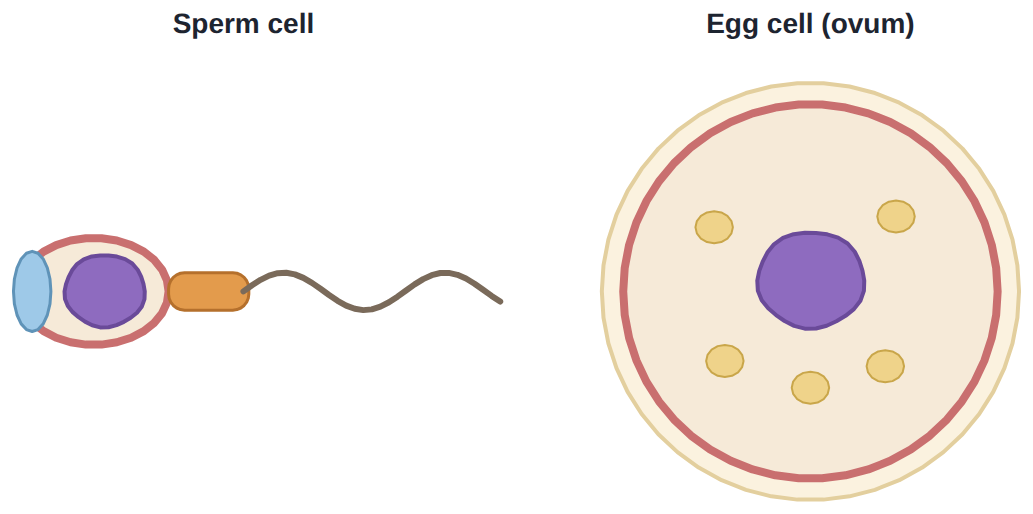
Sperm: tail, midpiece of mitochondria, acrosome. Egg: large, food store, a coat that lets in only one sperm.
A sperm (head, midpiece, tail) and an egg (much larger, with a food store): each carries 23 chromosomes.Sperm and egg · Sound on for the voiceoverVoice: Open the lesson →
Still stuck? Try the lesson again first. Then, if your teacher has said you can, copy a coach prompt into the AI tool your school allows. It asks you questions; it won't give you the answers.
Try firstWhy do two offspring of the same parents look different?
Check your answer
Each gets a random one of each parent's two copies of each gene, so each gets a different combination.
Sexual reproduction: two parents; each offspring gets a random half of each parent's genes, so offspring vary. Asexual reproduction: one parent makes clones. Variation helps a population survive change; asexual reproduction is fast and needs no partner.
Revision summary
Sexual reproduction: two parents, gametes fuse; each offspring gets a random half of each parent's genes, so offspring vary.
Asexual reproduction: one parent, no gametes; offspring are clones.
Variation helps a population survive a changing environment; asexual reproduction is fast and needs no partner.
Sexual and asexual reproduction · Sound on for the voiceoverVoice: Open the lesson →
Still stuck? Try the lesson again first. Then, if your teacher has said you can, copy a coach prompt into the AI tool your school allows. It asks you questions; it won't give you the answers.
Try firstWhy can convection happen in water but not in a metal spoon?
Check your answer
Convection needs the material to flow so heated parts can rise. Water's particles can move; a spoon's are held in place, so it can only conduct.
Conduction: particles vibrate harder and pass energy to their neighbours by collisions. The particles stay in place. Mostly in solids.
Convection: heated fluid becomes less dense and rises; cooler fluid sinks. The particles carry the energy. Only in liquids and gases.
Revision summary
Conduction: particles vibrate harder and pass energy to their neighbours by collisions. The particles stay in place. Mostly in solids; metals conduct well.
Convection: heated fluid becomes less dense and rises, cooler fluid sinks: a convection current. The particles move, carrying the energy. Only in liquids and gases.
Insulators (wood, plastic, trapped air) pass energy on poorly. Trapped air blocks convection too.
It is the hot fluid that rises, not "heat".
A metal bar heated at one end: the particles stay in place and pass energy along by collisions.Conduction · Sound on for the voiceoverVoice: Open the lesson →
Still stuck? Try the lesson again first. Then, if your teacher has said you can, copy a coach prompt into the AI tool your school allows. It asks you questions; it won't give you the answers.
Try firstA loud, high note is played. Say what is large or fast about the wave, and what the particles of air in between are doing.
Check your answer
Large amplitude (loud) and high frequency (high pitch). The particles vibrate to and fro in place while the squashed and spread-out patches travel.
A sound wave is a line of compressions (particles squashed together) and rarefactions (spread out) that travels through a medium. The particles only vibrate to and fro; the pattern moves.
Frequency sets the pitch and amplitude sets the loudness. With no particles, as in a vacuum, there is no sound.
Revision summary
Sound is a longitudinal wave: particles vibrate to and fro along the direction the wave travels.
A wave is a line of compressions (squashed) and rarefactions (spread out). The pattern travels; each particle keeps its random motion and is just nudged to and fro on top of it.
Frequency (vibrations per second) sets the pitch; amplitude (size of the vibration) sets the loudness.
Sound needs a medium: it cannot travel through a vacuum. It is faster in solids than in gases because the particles are held together by stiff bonds, so each push passes on almost at once.
A sound wave in air: squashed and spread-out patches travel along, while each particle (like the orange one) only moves to and fro.A sound wave · Sound on for the voiceoverVoice: Open the lesson →
Still stuck? Try the lesson again first. Then, if your teacher has said you can, copy a coach prompt into the AI tool your school allows. It asks you questions; it won't give you the answers.
Try firstA plastic ruler is rubbed on a cloth and becomes negative. What happened to the cloth, and why?
Check your answer
The cloth became positive. Electrons moved from the cloth to the ruler, so the cloth has more + than −.
Rubbing moves electrons from one material to the other. The material that gains them becomes negative; the one that loses them becomes positive, by the same amount. Protons never move.
Unlike charges attract; like charges repel. A spark is the extra electrons jumping across to neutralise the imbalance. On the board, Join with metal connects the balloon and the wool, so the electrons go back to the wool; touching an earthed tap instead sends them into the ground and leaves the wool positive.
Revision summary
Atoms have positive protons that stay put and negative electrons that can move.
Rubbing moves electrons from one material to the other: one becomes positive, the other negative, by equal amounts.
Unlike charges attract; like charges repel.
A spark is the extra electrons rushing across to neutralise the imbalance.
After rubbing, three electrons have moved from the wool to the balloon: the wool is +3 and the balloon −3, so they attract.Charging by rubbing · Sound on for the voiceoverVoice: Open the lesson →
Still stuck? Try the lesson again first. Then, if your teacher has said you can, copy a coach prompt into the AI tool your school allows. It asks you questions; it won't give you the answers.
Try firstA student says 'the bulb uses up the electrons so the wire after it is empty'. What would you say?
Check your answer
The same number of electrons leave the bulb as enter it. They carry on round the loop. The bulb transfers some of the energy they carry as light and heat.
A current is a flow of free electrons pushed round the circuit by the battery. A conductor has free electrons; an insulator has almost none because its electrons are tied to their atoms.
The electrons are not used up. More volts means a stronger push and a bigger current.
Revision summary
A conductor has free electrons; an insulator has almost none: its electrons are held tightly by their atoms.
A current is a flow of free electrons. The battery pushes them round; more volts means a stronger push.
The electrons are not used up; the bulb transfers the energy they carry.
Conventional current is drawn the opposite way to the electrons, by a historical choice.
A copper loop: the free electrons (blue −) are pushed round by the battery, and the bulb lights. The red + are atoms that have each let go of an electron (positive ions), fixed in place.Current in a wire · Sound on for the voiceoverVoice: Open the lesson →
Still stuck? Try the lesson again first. Then, if your teacher has said you can, copy a coach prompt into the AI tool your school allows. It asks you questions; it won't give you the answers.
Try firstA student says X-rays are dangerous because they are faster than light. Correct them in a sentence.
Check your answer
X-rays travel at the same speed as light. They are dangerous because they have a high frequency, so each packet carries a lot of energy, enough to damage cells.
Light is a transverse wave and part of the electromagnetic spectrum, which runs from radio to gamma. All travel at the same speed in a vacuum and need no medium.
Going from radio to gamma, the wavelength gets shorter, the frequency higher and the energy in each packet (photon) greater. That decides what each wave is used for and how careful we must be.
Revision summary
Light is a transverse wave and one part of the electromagnetic spectrum: radio, microwave, infrared, visible, ultraviolet, X-ray, gamma.
All travel at the same speed in a vacuum (300 000 km/s), with no medium needed.
Radio to gamma: shorter wavelength, higher frequency, more energy per packet.
Frequency decides use and risk: low-energy waves carry signals; high-energy waves can damage cells.
The electromagnetic spectrum: from radio waves (long, low energy) to gamma rays (short, high energy). Visible light is a narrow band in the middle.The electromagnetic spectrum · Sound on for the voiceoverVoice: Open the lesson →
Still stuck? Try the lesson again first. Then, if your teacher has said you can, copy a coach prompt into the AI tool your school allows. It asks you questions; it won't give you the answers.
Try firstA ray of light goes from air into water and bends towards the normal. What does that tell you about the speed of light in water?
Check your answer
It is slower in water than in air. The change of speed turns the wave fronts and so the ray.
Reflection: the angle of reflection equals the angle of incidence.
Refraction: light slows down in an optically denser material (one where it travels more slowly), so the wave fronts bunch up and the direction bends towards the normal. Going straight in, it slows without bending.
Revision summary
Reflection: the angle of reflection equals the angle of incidence, both measured from the normal.
Refraction: light slows down in an optically denser material (one where it travels more slowly), so the wave fronts bunch up and the direction bends towards the normal. Going out, it bends away.
Light going straight in (along the normal) slows down but doesn't bend.
The more the light slows, the more it bends.
Light enters glass at 45°. The wave fronts slow down and bunch together, so the direction bends towards the normal (28°).Refraction · Sound on for the voiceoverVoice: Open the lesson →
Still stuck? Try the lesson again first. Then, if your teacher has said you can, copy a coach prompt into the AI tool your school allows. It asks you questions; it won't give you the answers.
Try firstGive one phenomenon where the wave model is more useful than the particle model, and one where it is the other way round.
Check your answer
Wave: sound, reflection or refraction of light. Particle: conduction of heat, static charge. Any one of each, with a reason.
The particle model explains conduction, convection and static charge. The wave model explains sound, reflection, refraction and the electromagnetic spectrum. Light also behaves as photons when it gives energy to single electrons.
A model is a tool that doesn't tell the whole story: each one shows some things well and leaves others out.
Revision summary
The particle model explains conduction, convection and static charge; the wave model explains sound, reflection, refraction and the electromagnetic spectrum.
Light behaves like a wave when it bends and spreads, and like photons when it gives energy to single electrons.
A scientific model is a tool that doesn't tell the whole story: each one shows some things well and leaves others out.
Still stuck? Try the lesson again first. Then, if your teacher has said you can, copy a coach prompt into the AI tool your school allows. It asks you questions; it won't give you the answers.
Try firstA skateboarder has 2000 J at the top of a ramp and 1700 J of kinetic energy at the bottom. Where are the other 300 J?
Check your answer
Transferred as heat and sound because of friction and air resistance. The total is still 2000 J.
Conservation of energy: energy is never made or destroyed, only transferred or transformed. The total in a system always stays the same.
Energy that seems lost or used up has been transferred to the surroundings, usually as heat and sound.
Revision summary
Conservation of energy: energy is never made or destroyed; it is only transferred or transformed. The total stays the same.
Energy that seems "lost" or "used up" has been transferred to the surroundings, usually as heat and sound.
Total energy in = total energy out, so you can account for every joule.
Potential, kinetic, and heat and sound: the three bars always add up to the same total, marked by the dashed line.Conservation of energy · Sound on for the voiceoverVoice: Open the lesson →
Still stuck? Try the lesson again first. Then, if your teacher has said you can, copy a coach prompt into the AI tool your school allows. It asks you questions; it won't give you the answers.
Try firstA phone charger takes in 20 J and stores 15 J in the battery. What is its efficiency, and where did the rest go?
Check your answer
15 ÷ 20 × 100% = 75%. The other 5 J became heat (the charger gets warm).
Efficiency = useful energy out ÷ total energy in × 100%. It is a proportion, so a device that gives out more useful energy can still be less efficient.
No real device is 100% efficient: some energy always becomes by-products, usually heat.
Revision summary
Efficiency = useful energy out ÷ total energy in × 100%.
It is a proportion: a device that gives out more useful energy can still be less efficient.
No real device is 100% efficient: some energy always becomes by-products, usually heat.
More efficient devices need less energy input for the same job.
A filament bulb: of 100 J of electrical energy in, only 10 J comes out as light. 90 J becomes heat. Efficiency 10%.Efficiency · Sound on for the voiceoverVoice: Open the lesson →
Still stuck? Try the lesson again first. Then, if your teacher has said you can, copy a coach prompt into the AI tool your school allows. It asks you questions; it won't give you the answers.
Try firstA wind turbine takes in 500 J of kinetic energy and gives out 200 J of electricity. What is its efficiency, and how would its Sankey diagram show the rest?
Check your answer
200 ÷ 500 × 100% = 40%. The other 300 J would bend away as wasted bands (heat and sound), together as wide as 300 J.
A Sankey diagram shows energy as bands whose widths are proportional to the amounts. The input splits into the useful output (straight on) and wasted outputs (bending away), which always add up to the input.
Read the efficiency as useful ÷ input, and find the biggest waste by the widest wasted band.
Revision summary
A Sankey diagram shows energy flows as bands whose widths are proportional to the amounts.
The input band splits into the useful output (straight on) and wasted outputs (bending away); outputs always add up to the input.
Read the efficiency as useful ÷ input, and find the biggest waste by the widest wasted band.
Sankey diagrams show energy only, not cost or pollution.
A coal power station: of 1000 J of chemical energy, 350 J becomes electricity; the rest heats the cooling water and goes up the chimney. Efficiency 35%.Sankey diagrams · Sound on for the voiceoverVoice: Open the lesson →
Still stuck? Try the lesson again first. Then, if your teacher has said you can, copy a coach prompt into the AI tool your school allows. It asks you questions; it won't give you the answers.
Try firstName the four spheres and give one example of something where two of them meet.
Check your answer
Atmosphere, biosphere, hydrosphere, geosphere. For example, soil (geosphere and biosphere) or a cloud (atmosphere and hydrosphere).
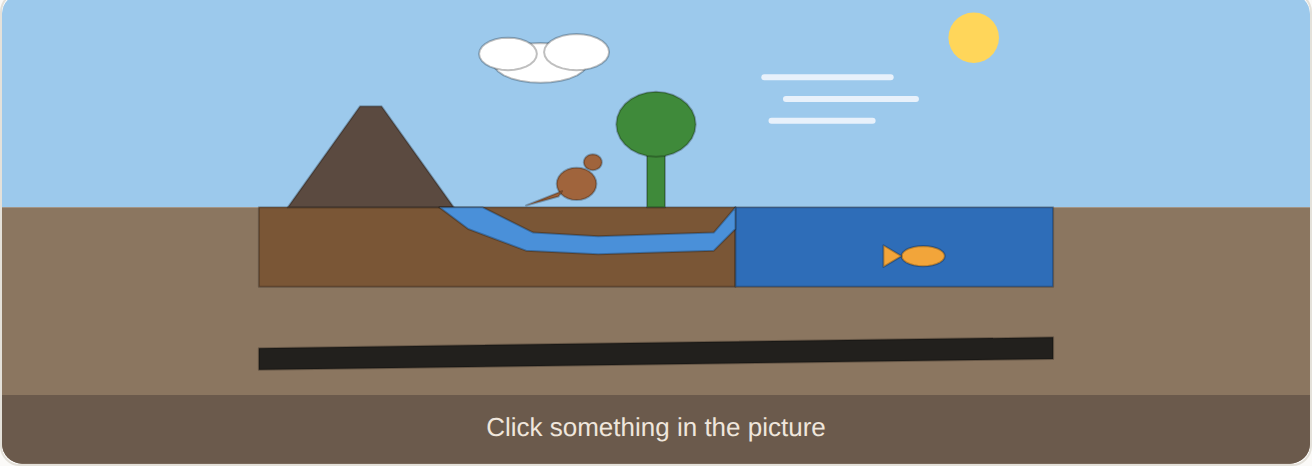
Earth's spheres: atmosphere (air), biosphere (living things), hydrosphere (water), geosphere (rock, soil, magma). They overlap and interact as one system.
Revision summary
Atmosphere: air. Biosphere: living things. Hydrosphere: water. Geosphere: rock, soil, magma.
Many things sit where spheres meet (soil, clouds), and processes move matter between spheres.
Earth works as one system of interacting spheres.
A landscape with things from all four spheres: air, living things, water and rock.Earth's spheres · Sound on for the voiceoverVoice: Open the lesson →
Still stuck? Try the lesson again first. Then, if your teacher has said you can, copy a coach prompt into the AI tool your school allows. It asks you questions; it won't give you the answers.
Try firstName a carbon store in the hydrosphere and one in the geosphere, and one flow that moves carbon into the atmosphere.
Check your answer
Hydrosphere: carbon dioxide dissolved in the oceans. Geosphere: fossil fuels or limestone. Flow into the air: respiration, decay, burning or release from the oceans.
Carbon is stored in every sphere: carbon dioxide in the air, dissolved carbon in the oceans, living things and soil in the biosphere, and fossil fuels and rocks in the geosphere.
Carbon is never made or destroyed; it flows between stores. The carbon cycle is the map of those flows.
Revision summary
Carbon is stored in every sphere: atmosphere (carbon dioxide), hydrosphere (dissolved in the oceans), biosphere (living things, dead matter, soil) and geosphere (fossil fuels, limestone and other rocks).
The oceans hold far more than the air; rocks hold the most of all.
Carbon is never made or destroyed. It flows between stores: the carbon cycle is the map of those flows.
A store stays steady when the flows into it balance the flows out.
Still stuck? Try the lesson again first. Then, if your teacher has said you can, copy a coach prompt into the AI tool your school allows. It asks you questions; it won't give you the answers.
Try firstDescribe how carbon moves between the air and living things.
Check your answer
Photosynthesis takes CO₂ from the air into plants; respiration by plants, animals and decomposers returns it to the air as CO₂.
Photosynthesis moves carbon from the atmosphere into the biosphere; respiration and decomposition move it back. When these flows balance, the air's CO₂ stays steady.
Revision summary
Photosynthesis: carbon moves from the atmosphere (CO₂) into the biosphere (sugars, then wood, leaves and animals).
Respiration (plants, animals, decomposers) and decomposition move carbon back to the atmosphere.
When the flows balance, CO₂ in the air stays steady; change one and the store changes.
Photosynthesis and respiration · Sound on for the voiceoverVoice: Open the lesson →
Still stuck? Try the lesson again first. Then, if your teacher has said you can, copy a coach prompt into the AI tool your school allows. It asks you questions; it won't give you the answers.
Try firstPlants and the oceans take up about half of the CO₂ we add each year. Why does CO₂ in the air still keep rising?
Check your answer
Burning moves carbon stored in the geosphere over millions of years into the air in years. The natural flows were balanced, so the half that plants and oceans don't take up builds up, year after year.
Combustion of fossil fuels moves carbon from the geosphere, where it was stored over millions of years, to the atmosphere in years. Oceans and plants take up part of it; the rest builds up, so CO₂ in the air rises.
Revision summary
Fossil fuels are carbon stored in the geosphere over millions of years.
Combustion moves it to the atmosphere in years: a new flow added to a balanced cycle.
Oceans and plants take up part of it (in the real world a bit over half); the rest builds up, so CO₂ in the air rises (280 ppm before 1800, about 420 ppm today).
Burning fossil fuels · Sound on for the voiceoverVoice: Open the lesson →
Still stuck? Try the lesson again first. Then, if your teacher has said you can, copy a coach prompt into the AI tool your school allows. It asks you questions; it won't give you the answers.