Every idea from Year 10 science in one place, for after you've done the year (or part of it). Answer each question in your head or on paper first, then check it. Nothing here is marked. If one is shaky, open the lesson and go over it again.
Try firstWrite the electron arrangement of aluminium (13 electrons). How many outer electrons does it have?
Check your answer
2, 8, 3: three outer electrons.
Electrons fill shells in order: 2, then 8, then 8. The outermost occupied shell is the outer shell, and its electrons decide how the element reacts.
Revision summary
Electrons fill shells in order: 2, then 8, then 8 (then 2 more for potassium and calcium). This is the Bohr model for elements 1 to 20; in heavier atoms the third shell holds more.
The outer shell is the outermost occupied one; its electrons decide how the element reacts.
A full shell is followed by a new shell, which is why rows of the periodic table end and begin.
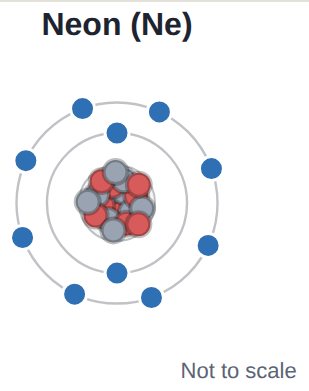
Neon: 10 electrons in shells 2, 8. Both shells are full.Electron shells · Sound on for the voiceoverVoice: Open the lesson →
Still stuck? Try the lesson again first. Then, if your teacher has said you can, copy a coach prompt into the AI tool your school allows. It asks you questions; it won't give you the answers.
Try firstBromine is in group 17. Predict how many outer electrons it has and how it reacts. Explain.
Check your answer
Seven outer electrons; it gains one easily, so it is a reactive non-metal, like chlorine.
Elements in the same group have the same number of outer-shell electrons, so they react in similar ways.
Group 1: one outer electron, easily lost: very reactive metals. Group 17: seven, one short of full: reactive non-metals. Group 18: full outer shell: hardly react.
Revision summary
Elements in the same group have the same number of outer-shell electrons, so they react in similar ways.
Group 1 (alkali metals): one outer electron, easily lost: very reactive metals.
Group 17 (halogens): seven outer electrons, one short of full: very reactive non-metals.
Group 18 (noble gases): full outer shells: hardly react. (Full outer shells being stable is a useful rule for the first 20 elements.)
The period (row) tells you how many shells an atom has.
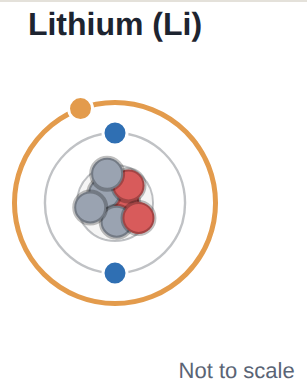
Lithium (2, 1): one outer electron (orange), like every element in group 1.Groups and outer electrons · Sound on for the voiceoverVoice: Open the lesson →
Still stuck? Try the lesson again first. Then, if your teacher has said you can, copy a coach prompt into the AI tool your school allows. It asks you questions; it won't give you the answers.
Try firstElement X has electrons 2, 8, 3. Which period and group is it in, and is it more likely a metal or a non-metal?
Check your answer
Period 3 (three shells), group 13 (three outer electrons): aluminium, a metal.
Each period fills one shell, so the period number is the number of shells. Across a period the outer electrons go from 1 to 8; then a new shell starts and the count goes back to 1.
Because the outer electrons repeat, so do the properties: that is why elements in a group behave alike. Across a period, elements change from metals to non-metals.
Revision summary
For the first 20 elements, each period fills one electron shell. The period number is the number of shells an element uses.
Across a period, the outer electrons go up by 1 each time, from 1 to 8 (a full shell). Then a new shell starts and the count goes back to 1.
Because the outer electrons repeat, properties repeat: elements in the same group behave alike.
Across a period, elements change from metals (few outer electrons, easily lost) to non-metals (nearly full shells).
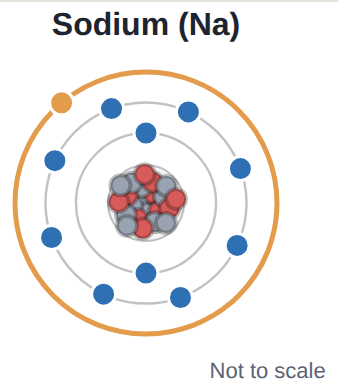
Sodium (2, 8, 1): a third shell has started, so a new period, and 1 outer electron (orange), like lithium.Periods and outer electrons · Sound on for the voiceoverVoice: Open the lesson →
Still stuck? Try the lesson again first. Then, if your teacher has said you can, copy a coach prompt into the AI tool your school allows. It asks you questions; it won't give you the answers.
Try firstPredict the number of outer electrons and the ion formed by calcium, which is in group 2, period 4.
Check your answer
Two outer electrons; it loses them to form a Ca²⁺ ion.
Group gives the outer electrons; period gives the shells. Outer electrons decide reactivity and bonding, so the table is a predictive model, not a list.
Revision summary
The group gives the number of outer electrons; the period gives the number of shells.
Outer electrons decide reactivity and bonding: group 1 loses one electron, group 17 gains one, group 18 is stable.
Reactivity grows down group 1 and falls down group 17.
The table is a predictive model: Mendeleev's gaps predicted elements before anyone found them.
Still stuck? Try the lesson again first. Then, if your teacher has said you can, copy a coach prompt into the AI tool your school allows. It asks you questions; it won't give you the answers.
Try firstClassify magnesium + zinc sulfate → magnesium sulfate + zinc, and say why it happens.
Check your answer
Displacement: magnesium is more reactive than zinc, so it takes zinc's place.
Synthesis: substances join into one (A + B → AB). Decomposition: one substance breaks into simpler ones (AB → A + B). Displacement: a more reactive element takes a less reactive one's place (A + BC → AC + B).
Spot the pattern to classify a reaction and predict its products. Displacement only goes from more reactive to less reactive.
Revision summary
Synthesis: substances join into one (A + B → AB), such as magnesium burning.
Decomposition: one substance breaks into simpler ones (AB → A + B), such as hydrogen peroxide → water + oxygen, often with heat or electricity.
Displacement: a more reactive element takes a less reactive one's place (A + BC → AC + B). It doesn't happen the other way round. In a double displacement two compounds swap partners (AB + CD → AD + CB), as in neutralisation: acid + base → salt + water.
Spot the pattern to classify a reaction and predict its products.
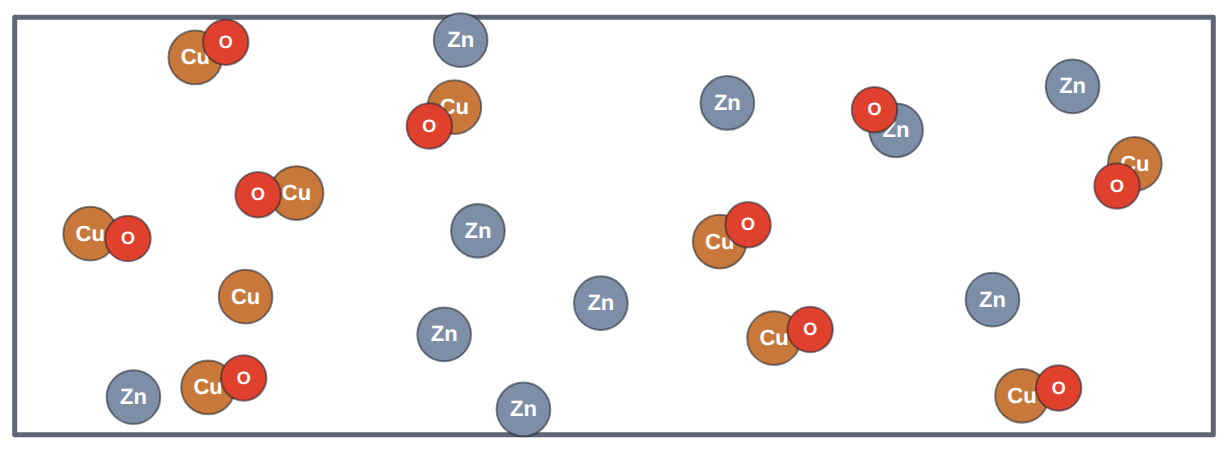
Zinc and copper oxide: zinc, the more reactive metal, takes the oxygen and leaves copper behind. A displacement reaction.Three kinds of reaction · Sound on for the voiceoverVoice: Open the lesson →
Still stuck? Try the lesson again first. Then, if your teacher has said you can, copy a coach prompt into the AI tool your school allows. It asks you questions; it won't give you the answers.
Try firstWhy does crushing a tablet make it dissolve and react faster in water?
Check your answer
Crushing increases the surface area, so more particles are exposed and collisions happen more often.
Particles react only when they collide with at least the activation energy.
Temperature: particles collide more often and harder (the biggest effect).
Concentration and surface area: more collisions each second.
Catalyst: lowers the activation energy; not used up.
Revision summary
Particles react only when they collide with at least the activation energy (and the right way round). Most collisions just bounce.
Temperature: faster particles collide more often and, much more importantly, harder.
Concentration and surface area: more collisions each second.
Catalyst: a lower activation energy, so more collisions succeed. It is not used up.
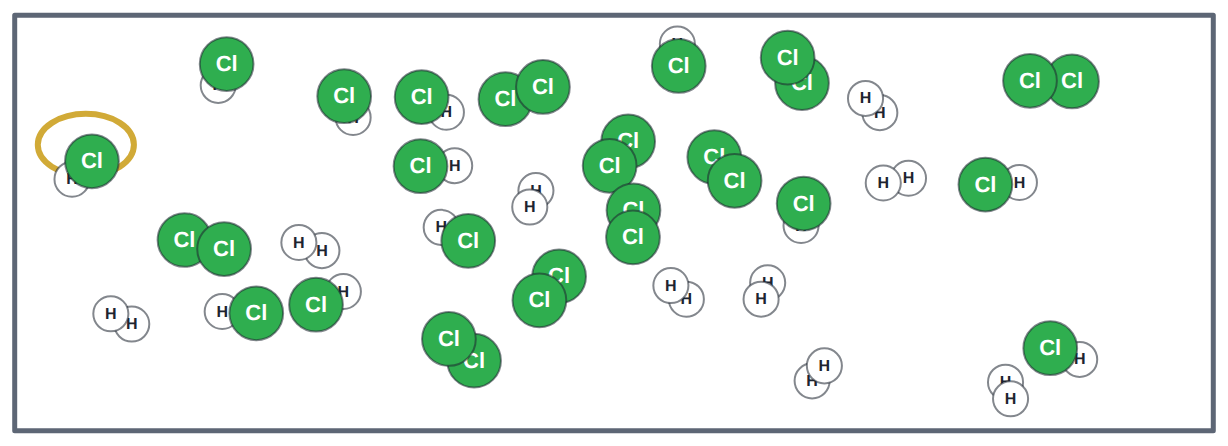
Hydrogen and chlorine molecules colliding: only collisions with enough energy react.Collision theory · Sound on for the voiceoverVoice: Open the lesson →
Still stuck? Try the lesson again first. Then, if your teacher has said you can, copy a coach prompt into the AI tool your school allows. It asks you questions; it won't give you the answers.
Try firstWhat's the difference between a gene and an allele?
Check your answer
A gene is a section of DNA coding for a protein; an allele is one version of that gene.
DNA carries the instructions; a chromosome is one long coiled DNA molecule; a gene is a section of DNA coding for a protein; alleles are versions of a gene. Chromosomes come in pairs, one from each parent.
Revision summary
DNA carries coded instructions as a sequence of bases (A, T, C, G).
A chromosome is one long DNA molecule, coiled; humans have 46, in 23 pairs (one of each pair from each parent).
A gene is a section of DNA; most genes code for a protein; alleles are different versions of one gene.
Genotype: the alleles you have (such as A and O). Phenotype: the characteristic that shows (blood group A).
From body to gene · Sound on for the voiceoverVoice: Open the lesson →
Still stuck? Try the lesson again first. Then, if your teacher has said you can, copy a coach prompt into the AI tool your school allows. It asks you questions; it won't give you the answers.
Try firstWhy does meiosis make every gamete different?
Check your answer
Each gamete gets one chromosome from each pair, and which one is random, so the combination differs.
Meiosis makes gametes with half the chromosomes: one from each pair, chosen at random, so almost every gamete is a different combination (over 8 million possible in humans). Mitosis makes identical cells for growth and repair.
Revision summary
Meiosis makes gametes: chromosome pairs separate; each gamete gets one from each pair, so it has half the number.
Which of each pair goes into a gamete is random: 2 × 2 × 2 … for 23 pairs, over 8 million combinations.
Random fertilisation (and crossing over) multiply the variety.
Still stuck? Try the lesson again first. Then, if your teacher has said you can, copy a coach prompt into the AI tool your school allows. It asks you questions; it won't give you the answers.
Try firstComplete Bb × Bb. What fraction of offspring are expected to show the recessive trait?
Check your answer
BB, Bb, Bb, bb: 1 in 4 (25%).
Punnett square: each parent's possible gametes along the edges, every combination in the grid. It gives probabilities: Pp × Pp gives 1 PP : 2 Pp : 1 pp, so 3 dominant : 1 recessive phenotype. Genotype is the alleles; phenotype is the characteristic seen.
Revision summary
Genotype: the alleles (PP, Pp, pp). Phenotype: the characteristic seen.
A dominant allele shows when present; a recessive one only in homozygous form (pp).
A Punnett square gives the probability of each offspring: Pp × Pp gives 1 PP : 2 Pp : 1 pp, so 3 : 1 purple to white; Bb × bb gives 1 : 1.
Real numbers vary around the prediction, especially when there are few offspring.
Punnett squares here are for one-gene traits such as pea flower colour; most human traits involve many genes.
A Punnett square · Sound on for the voiceoverVoice: Open the lesson →
Still stuck? Try the lesson again first. Then, if your teacher has said you can, copy a coach prompt into the AI tool your school allows. It asks you questions; it won't give you the answers.
Try firstGive an example of inherited variation and one of environmental variation in humans.
Check your answer
For example: blood group (inherited); a scar or a language spoken (environmental).
Variation: individuals in a population differ. Continuous (any value, such as height) or discontinuous (groups, such as blood group); inherited, environmental, or both. Only inherited variation is passed on, so only it drives evolution.
Revision summary
Individuals in a population vary; measuring a characteristic gives a spread.
Continuous variation takes any value (height); discontinuous falls into groups (blood group).
Variation can be inherited, environmental or both; only inherited variation is passed on, so only it matters for evolution.
New inherited variation comes from mutations and from meiosis and fertilisation.
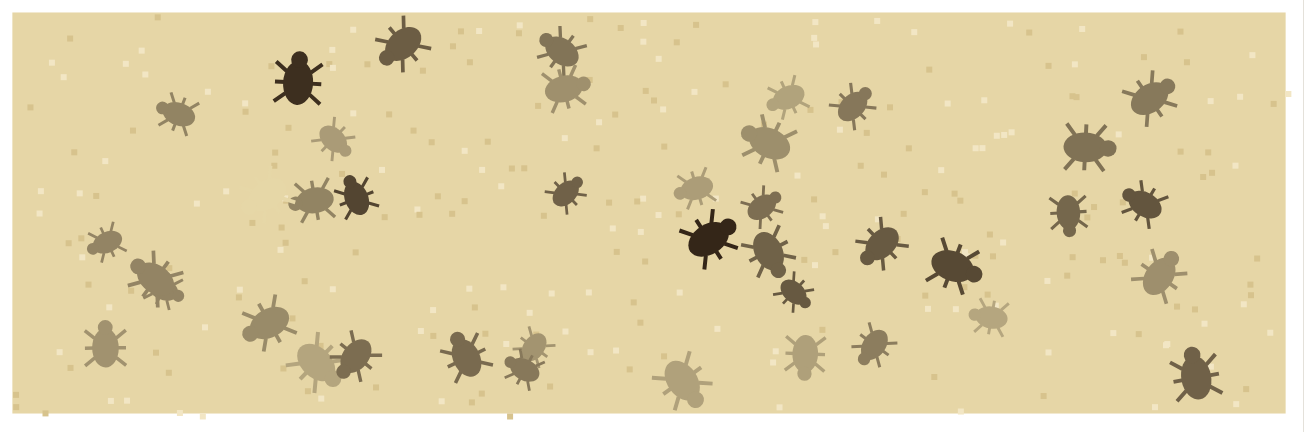
No two beetles quite the same colour: continuous variation in one population.Variation · Sound on for the voiceoverVoice: Open the lesson →
Still stuck? Try the lesson again first. Then, if your teacher has said you can, copy a coach prompt into the AI tool your school allows. It asks you questions; it won't give you the answers.
Try firstExplain why the beetle population got paler on pale ground.
Check your answer
Beetles varied in colour; birds ate the darker, more visible ones; paler beetles survived and bred, passing on their colour; over generations, the average colour got paler.
Natural selection: individuals vary; those best suited to the environment are more likely to survive and reproduce, passing on their alleles; over generations the population changes. Individuals don't change: the population does. "Fittest" depends on the environment.
Over millions of years this branches into a tree of life: all living things share ancestors, and DNA shows how closely they are related.
Revision summary
Natural selection: individuals vary; more are born than survive; those best suited to the environment are more likely to survive and reproduce; they pass on their alleles; over generations, the population changes.
Individuals don't change to suit the environment; the population does.
"Fittest" means best suited to the current environment. Selection needs variation.
Over millions of years, populations split and diverge: all living things are related in a branching tree of life, not a ladder. The more recent the common ancestor, the more similar the DNA.
Features can mislead about relatedness (fungi are closer to animals than to plants), so modern classification uses shared ancestry, and changes as evidence improves.
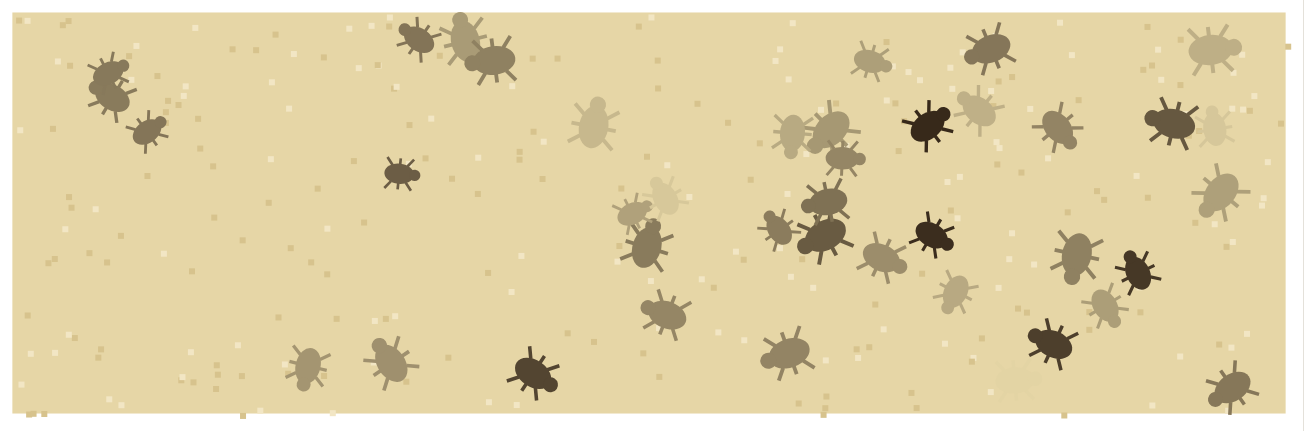
A population of beetles: each one a slightly different colour, on pale ground.Natural selection · Sound on for the voiceoverVoice: Open the lesson →
Still stuck? Try the lesson again first. Then, if your teacher has said you can, copy a coach prompt into the AI tool your school allows. It asks you questions; it won't give you the answers.
Try firstA cyclist pedals with a forward force of 120 N. Air resistance is 70 N and friction 20 N. Find the net force and say what happens to her speed.
Check your answer
120 − (70 + 20) = 30 N forward: she speeds up.
A force is a vector: it has a size and a direction. Along one line, forces pointing the same way add, and forces pointing opposite ways subtract.
What is left is the net force, in the direction of the bigger side. A net force changes motion; a net force of zero leaves it unchanged.
Revision summary
A force is a vector: it has a size (in newtons) and a direction.
Along one line, forces in the same direction add; forces in opposite directions subtract. Choose one direction as positive.
What is left is the net force (resultant force), in the direction of the bigger side.
A net force changes motion (speeds up, slows down, turns). A net force of zero leaves the motion unchanged: still, or at a steady speed.
A driving force of 1200 N against 500 N of air resistance and 300 N of rolling resistance: a net force of 400 N forward.Net force · Sound on for the voiceoverVoice: Open the lesson →
Still stuck? Try the lesson again first. Then, if your teacher has said you can, copy a coach prompt into the AI tool your school allows. It asks you questions; it won't give you the answers.
Try firstA spacecraft coasts through empty space with its engines off. Describe its motion and explain.
Check your answer
It keeps moving at a constant velocity: there is no net force (no friction or air resistance), so by the first law its motion doesn't change.
Newton's first law: an object stays at rest or keeps moving at a constant velocity unless a net force acts on it.
Moving things don't need a push to keep going; they need a force to change their motion. Friction and air resistance are why everyday things slow down.
Revision summary
Newton's first law: an object stays at rest, or keeps moving at a constant velocity, unless a net force acts on it.
A moving object does not need a force to keep moving. A force is needed to change motion.
Everyday objects slow down because of friction and air resistance: hidden forces that are the net force.
Inertia is an object's resistance to changes in its motion; more mass, more inertia.
Newton's first law · Sound on for the voiceoverVoice: Open the lesson →
Still stuck? Try the lesson again first. Then, if your teacher has said you can, copy a coach prompt into the AI tool your school allows. It asks you questions; it won't give you the answers.
Try firstA sprinter goes from 0 to 9 m/s in 3 s. What is her acceleration?
Check your answer
a = (9 − 0) ÷ 3 = 3 m/s², forwards.
Acceleration is the rate of change of velocity: a = Δv ÷ Δt, in m/s². It points the same way as the net force; slowing down is acceleration backwards.
On a speed–time graph, acceleration is the gradient. A steady speed means zero acceleration, however fast.
Revision summary
Acceleration is the rate of change of velocity: a = Δv ÷ Δt, in m/s².
It has a direction, the same as the net force. Slowing down is acceleration opposite to the motion (negative).
A fast object at a steady speed has zero acceleration.
On a speed–time graph of motion in a straight line, acceleration is the gradient. (Going round a bend at steady speed is still acceleration, because the direction changes.)
Net force 8 N on 2 kg: acceleration 4 m/s², in the direction of the net force.Acceleration · Sound on for the voiceoverVoice: Open the lesson →
Still stuck? Try the lesson again first. Then, if your teacher has said you can, copy a coach prompt into the AI tool your school allows. It asks you questions; it won't give you the answers.
Try firstWhat acceleration does a net force of 30 N give a 6 kg trolley?
Check your answer
a = F ÷ m = 30 ÷ 6 = 5 m/s², in the direction of the net force.
Newton's second law: F = ma. F is the net force (N), m the mass (kg), a the acceleration (m/s²), in the direction of the net force.
Double the net force, double the acceleration; double the mass, half the acceleration.
Revision summary
Newton's second law:F = ma. F is the net force (N), m the mass (kg), a the acceleration (m/s²).
Rearranged: a = F ÷ m and m = F ÷ a.
Double the net force, double the acceleration. Double the mass, half the acceleration.
The acceleration points the same way as the net force.
F = ma: the same 8 N on twice the mass (4 kg) gives half the acceleration, 2 m/s².F = ma · Sound on for the voiceoverVoice: Open the lesson →
Still stuck? Try the lesson again first. Then, if your teacher has said you can, copy a coach prompt into the AI tool your school allows. It asks you questions; it won't give you the answers.
Try firstA swimmer pushes the water backwards. Name the other force in the pair, and say which way it acts and on what.
Check your answer
The water pushes the swimmer forwards, on the swimmer, with a force of the same size.
Newton's third law: when A pushes or pulls B, B pushes or pulls A with a force of the same size in the opposite direction.
The two forces act on different objects, so they never cancel. Balanced forces (weight and support on a book) act on the same object and are not a third-law pair.
Revision summary
Newton's third law: when object A pushes or pulls object B, B pushes or pulls A with a force of the same size in the opposite direction.
The two forces in a pair act on different objects, so they never cancel each other.
Balanced forces act on the same object (weight and support on a book); they are not a third-law pair.
You move by pushing on something else: it pushes you (walking, swimming, rockets).
The forces on a book: the Earth pulls it down; the table pushes it up. These two balance, but they are not a third-law pair: they both act on the book.Newton's third law · Sound on for the voiceoverVoice: Open the lesson →
Still stuck? Try the lesson again first. Then, if your teacher has said you can, copy a coach prompt into the AI tool your school allows. It asks you questions; it won't give you the answers.
Try firstA 1000 kg car has 3000 N of driving force and 1000 N of drag. Find the net force and the acceleration.
Check your answer
2000 N forward; a = 2000 ÷ 1000 = 2 m/s².
A free body diagram shows one object and every force acting on it, as labelled arrows from the object.
Work out the net force in each direction separately. Zero in every direction: no change in motion. A net force: the object accelerates that way, a = F ÷ m.
Revision summary
A free body diagram shows one object and every force acting on it, as labelled arrows from the object.
Work out the net force in each direction separately (up–down, left–right).
Net force zero in every direction: no change in motion (still, or steady speed in a straight line).
A net force: the object accelerates in that direction, with a = F ÷ m.
A free body diagram of a sled: weight and the snow's push up balance; the rope's pull (60 N) is bigger than friction (40 N), so there is a net force of 20 N forward.Free body diagrams · Sound on for the voiceoverVoice: Open the lesson →
Still stuck? Try the lesson again first. Then, if your teacher has said you can, copy a coach prompt into the AI tool your school allows. It asks you questions; it won't give you the answers.
Try firstA 50 kg skateboarder is pushed with a net force of 100 N from rest. How fast is she moving after 4 s?
Check your answer
a = 100 ÷ 50 = 2 m/s². After 4 s: 2 × 4 = 8 m/s.
A routine: net force, then F = ma, then a = Δv ÷ t, then check the answer and the units. On a speed–time graph the gradient is the acceleration.
Revision summary
A routine: list what you know, find the net force, use F = ma for acceleration, use a = Δv ÷ t for speed and time, then check the answer is reasonable.
Keep units with every number: N, kg, m/s², m/s, s.
On a speed–time graph, the gradient is the acceleration.
Still stuck? Try the lesson again first. Then, if your teacher has said you can, copy a coach prompt into the AI tool your school allows. It asks you questions; it won't give you the answers.
Try firstA car stops from 20 m/s in 0.5 s with one crumple zone, and in 1.0 s with a better one. By what factor does the force on the occupants change?
Check your answer
It halves. Twice the time means half the acceleration, so half the force.
Newton's laws explain design: seat belts (first law), airbags and crumple zones (second law: a longer stopping time means a smaller force), rockets (third law), and a ball-thrower, which lengthens the push on the ball so it leaves faster.
Revision summary
First law (inertia): seat belts and head restraints stop passengers carrying on moving when the car stops.
Second law: airbags and crumple zones lengthen the stopping time, so the acceleration and the force are smaller. A ball-thrower extends the push, so the ball gets a higher launch speed.
Third law: a rocket pushes gas back and the gas pushes the rocket forward.
Numbers show how much a design helps: twice the stopping time halves the force.
Still stuck? Try the lesson again first. Then, if your teacher has said you can, copy a coach prompt into the AI tool your school allows. It asks you questions; it won't give you the answers.
Try firstOutline three stages of the universe after the big bang.
Check your answer
For example: the first nuclei of hydrogen and helium (3 minutes), atoms forming and light set free (380 000 years), the first stars (about 200 million years), galaxies (about 1 billion years).
The big bang theory: The universe was very hot and dense 13.8 billion years ago, and has been expanding since; whether time itself began then is still an open question. As it expanded it cooled, forming nuclei, atoms, stars and galaxies. Heavier elements were made in stars.
Revision summary
The big bang theory: the universe was very hot and dense 13.8 billion years ago, and has been expanding and cooling since; whether time itself began then is still an open question.
Stages: inflation (a leading idea) → protons and neutrons → hydrogen and helium nuclei (3 min) → atoms and free light (380 000 years) → first stars (about 200 million years) → galaxies → the sun and Earth (9.2 billion years).
Heavier elements were made in stars.
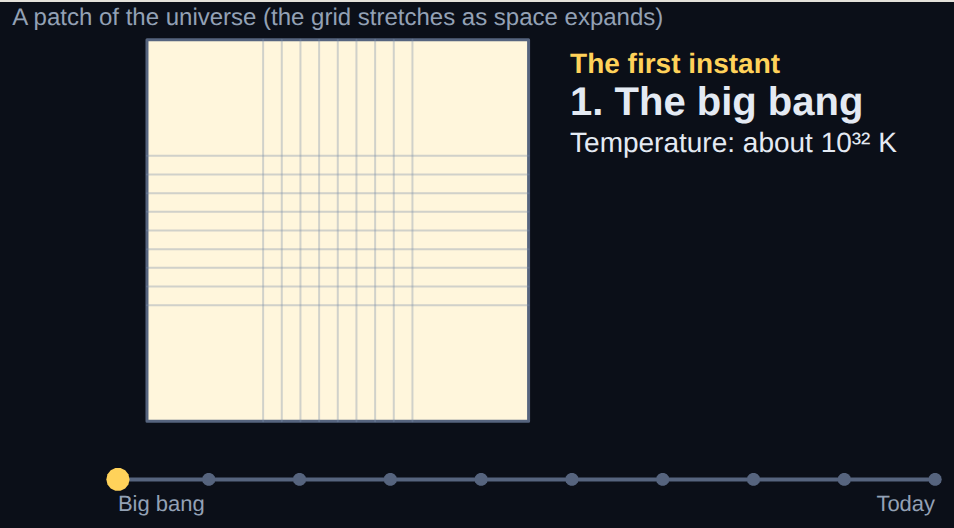
A patch of the universe soon after the big bang: extremely hot and dense.The big bang · Sound on for the voiceoverVoice: Open the lesson →
Still stuck? Try the lesson again first. Then, if your teacher has said you can, copy a coach prompt into the AI tool your school allows. It asks you questions; it won't give you the answers.
Try firstWhat does redshift show, and how does it support the big bang?
Check your answer
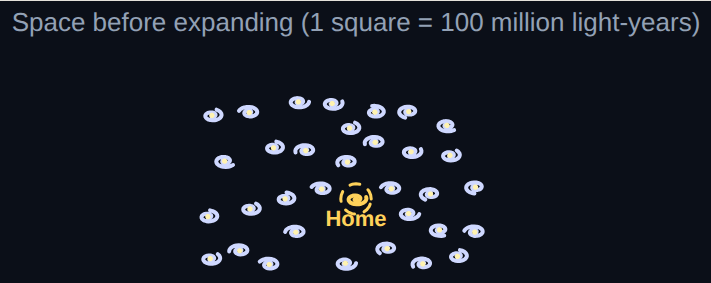
Galaxies are moving away, farther ones faster: the universe is expanding. Run backwards, everything was once together in a hot, dense state.
Redshift: light from distant galaxies is stretched to longer wavelengths, so they are moving away. Farther galaxies move faster (Hubble's law): an expanding universe with no centre. Run backwards, it began together: the big bang.
Revision summary
Redshift: light from distant galaxies is shifted to longer wavelengths: they are moving away. (Strictly, space stretches the light on its way to us; it isn't a Doppler shift from galaxies moving through space.)
Hubble's law (built on Vesto Slipher's redshift measurements): farther galaxies move away faster, in proportion to distance.
This is what an expanding universe looks like from any galaxy (no centre). Run backwards, everything was once together: evidence for the big bang.
A field of galaxies. When space expands, every galaxy moves away from every other, farther ones faster.An expanding universe · Sound on for the voiceoverVoice: Open the lesson →
Still stuck? Try the lesson again first. Then, if your teacher has said you can, copy a coach prompt into the AI tool your school allows. It asks you questions; it won't give you the answers.
Try firstWhy does replacing sea ice with open ocean warm the area?
Check your answer
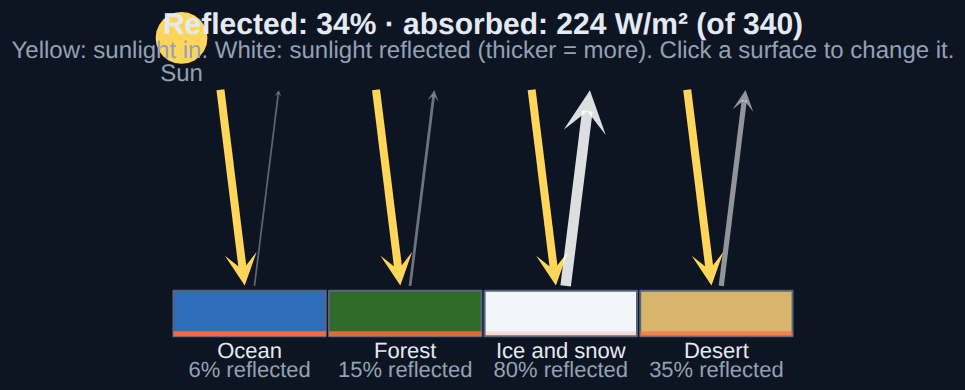
Ice reflects most sunlight (about 80%); dark ocean absorbs most (reflects about 6%), so more energy is absorbed.
Sunlight is Earth's energy input. Some is reflected (the albedo, about 30% overall) and the rest absorbed. Bright surfaces reflect most; dark surfaces absorb most.
Revision summary
The sun is Earth's main energy source: about 340 W/m² on average at the top of the atmosphere.
Some sunlight is reflected (about 30% on average: the albedo); the rest is absorbed and warms Earth.
Bright surfaces (ice, snow, cloud) reflect most; dark ones (ocean, forest) absorb most. Melting ice means more absorbed.
Surfaces under the sun: bright ones (ice) reflect most sunlight; dark ones (ocean, forest) absorb most.Where sunlight goes · Sound on for the voiceoverVoice: Open the lesson →
Still stuck? Try the lesson again first. Then, if your teacher has said you can, copy a coach prompt into the AI tool your school allows. It asks you questions; it won't give you the answers.
Try firstWhat is energy balance, and what happens if more energy comes in than goes out?
Check your answer
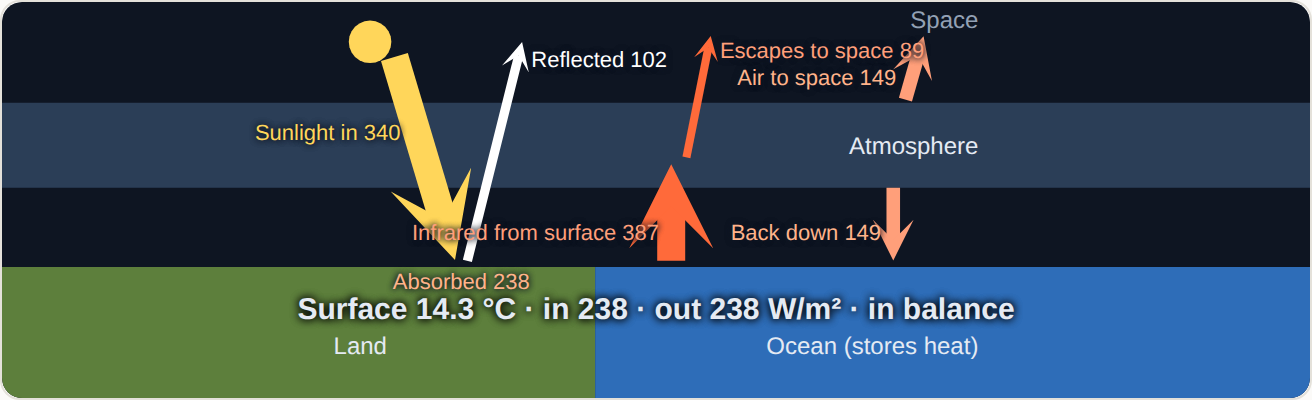
Energy in equals energy out over time. If more comes in, Earth warms until it gives off enough extra infrared to balance again.
Energy balance: absorbed sunlight = infrared given off to space. If in exceeds out, Earth warms until out catches up. Energy moves between spheres by radiation, conduction and convection; the oceans store and carry heat.
Revision summary
Energy balance: energy absorbed from the sun = energy given off to space as infrared, over time. Then temperature is steady.
Upset it (more in or less out) and Earth warms or cools until out = in again.
Energy moves between the spheres by radiation, conduction and convection; the oceans store heat and carry it around the world.
Sunlight in, some reflected, the rest absorbed; infrared given off to space.Energy balance · Sound on for the voiceoverVoice: Open the lesson →
Still stuck? Try the lesson again first. Then, if your teacher has said you can, copy a coach prompt into the AI tool your school allows. It asks you questions; it won't give you the answers.
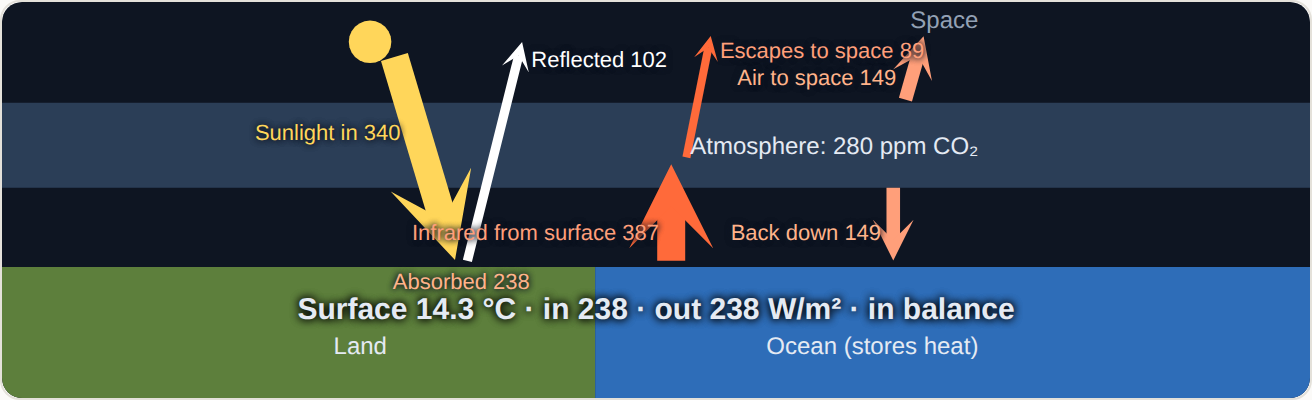
CO₂ absorbs infrared from the surface and sends some back down, so less energy escapes; energy in exceeds energy out, and Earth warms until it gives off enough to balance again.
Greenhouse gases absorb outgoing infrared and send some back down, slowing energy loss. The natural effect keeps Earth about 15 °C (not −18 °C); the enhanced effect from extra greenhouse gases upsets the balance, so Earth warms. Not the ozone hole.
Revision summary
Earth's surface gives off infrared. Greenhouse gases (water vapour, CO₂, methane, nitrous oxide) absorb some and send part back down: they slow energy going out, not sunlight coming in.
Natural greenhouse effect: keeps Earth about 15 °C on average instead of about −18 °C.
Enhanced greenhouse effect: extra greenhouse gases from human activity reduce the outgoing infrared, so energy in exceeds energy out and Earth warms until balance is restored.
It is not the ozone hole.
Sunlight in; infrared from the surface, part absorbed by greenhouse gases and sent back down.The greenhouse effect · Sound on for the voiceoverVoice: Open the lesson →
Still stuck? Try the lesson again first. Then, if your teacher has said you can, copy a coach prompt into the AI tool your school allows. It asks you questions; it won't give you the answers.