← Year 7 Physics

Year 7 Physics: recap

For after the lessons: one card per lesson, to check what you remember. Answer each question in your head or on paper first, then check it. Nothing here is marked.

Looking back over the whole year? See the Year 7 recap.

Forces and motion

1. How big, which way?

Try firstA box sits on the floor. Name the two forces on it and describe their arrows.

Check your answer

Weight, pointing down, and support from the floor, pointing up; the same length because they are equal.

A force has a size (N) and a direction, drawn as an arrow: longer for bigger, pointing the way the force acts.

A force diagram shows every force on one object, each named: weight, support, friction, air resistance, pushes and pulls.

Revision summary
  • A force has a size (newtons, N) and a direction, so it is drawn as an arrow.
  • The arrow's length shows the size; it points the way the force acts.
  • A force diagram shows every force on one object, each one named.
  • Common forces: weight (down), support (up from a surface), friction (against sliding), air resistance (against motion through air), pushes and pulls.
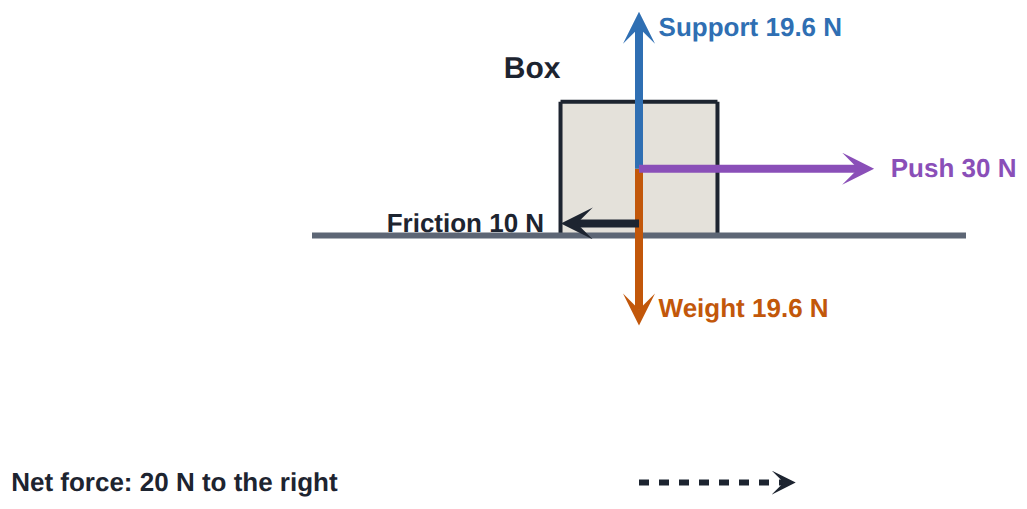
A force diagram: each force on the box as a named arrow, its length showing the size.
Forces as arrows · Sound on for the voiceover
Open the lesson →

2. Does balanced mean no forces?

Try firstA cyclist rides at a steady 20 km/h on a flat road. Are the forces on her balanced? Explain.

Check your answer

Yes: she isn't speeding up or slowing down, so her forward force equals the backward forces (air resistance and friction).

Balanced forces are equal and opposite: the net force is zero. They are still acting; they cancel. The motion doesn't change: still stays still, moving keeps a steady speed.

Unbalanced forces change the motion, in the direction of the net force.

Revision summary
  • Balanced forces are equal and opposite: the net force is zero. They are still acting; they cancel.
  • Balanced forces mean no change in motion: still objects stay still; moving objects keep a steady speed in a straight line.
  • Unbalanced forces change the motion: the object speeds up, slows down or changes direction, the way the net force points.
  • A car at a steady speed has balanced forces: the engine's push equals air resistance plus friction.
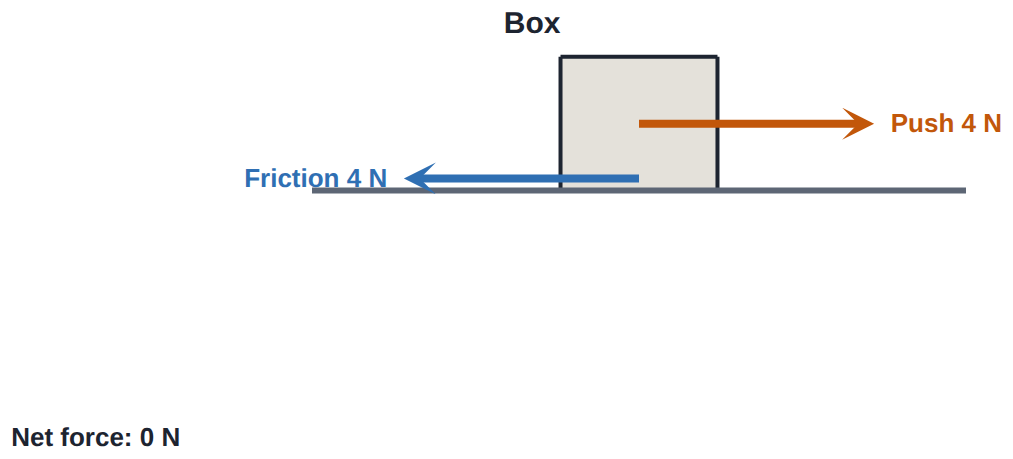
Push 4 N, friction 4 N: balanced, so the net force is 0 N and the motion doesn't change.
Balanced forces · Sound on for the voiceover
Open the lesson →

3. What does an unbalanced force do?

Try firstA netball flies towards the ring and bounces back off the backboard. Give the change in motion and the force that caused it.

Check your answer

It reversed direction (and slowed, then sped up the other way). The backboard pushed it back: an unbalanced force away from the board.

An unbalanced force changes an object's motion, in the direction of the net force: it can start, speed up, slow down, stop, reverse or turn an object.

A force against the motion doesn't only stop things: if it keeps acting, the object turns round and speeds up the other way. A steady speed round a bend is a change in direction, so it needs an unbalanced force too.

Revision summary
  • An unbalanced force (a net force that isn't zero) changes the motion, in the direction of the net force.
  • A change in motion can be starting, speeding up, slowing down, stopping, reversing or changing direction. Every one needs an unbalanced force.
  • A force against the motion doesn't just stop an object: if it keeps acting, the object turns round and speeds up the other way.
  • Steady speed round a bend is still a change in motion (direction), so the forces are unbalanced.
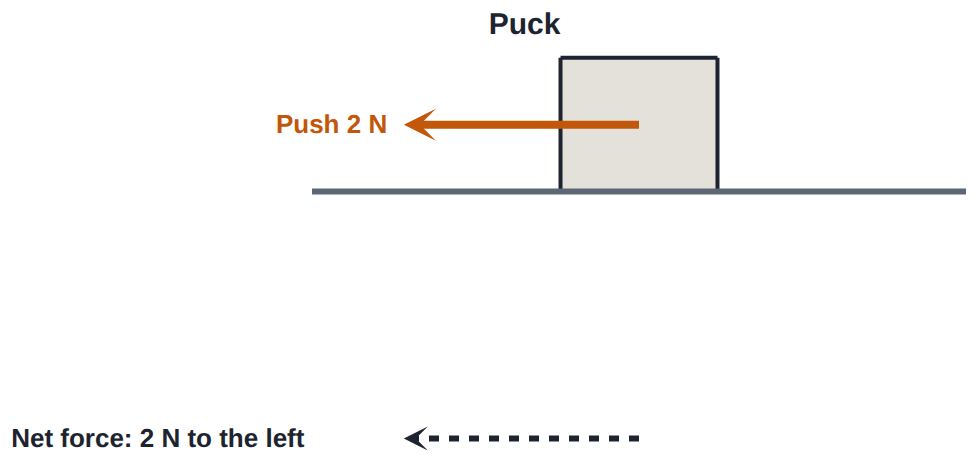
Net force 2 N to the left: the motion changes towards the left, whichever way the puck was moving.
What an unbalanced force does · Sound on for the voiceover
Open the lesson →

4. Would you weigh less on the Moon?

Try firstA 2 kg rock on Earth (g = 9.8 N/kg). What are its mass and its weight on the Moon (g = 1.6 N/kg)?

Check your answer

Mass 2 kg (unchanged); weight 2 × 1.6 = 3.2 N.

Mass (kg) is how much matter an object has; it is the same everywhere. Weight (N) is the force of gravity on it: weight = mass × g.

g is 9.8 N/kg on Earth, 1.6 on the Moon, 3.7 on Mars, 24.8 on Jupiter.

Revision summary
  • Mass (kg): how much matter. The same everywhere.
  • Weight (N): the force of gravity on an object. Weight = mass × g.
  • g is the gravitational field strength: 9.8 N/kg on Earth (about 10), 1.6 on the Moon, 3.7 on Mars, 24.8 on Jupiter.
  • Gravity depends on mass: the Moon has far less mass than Earth, so it pulls less (smaller g, smaller weight).
  • Without air, all objects fall together, whatever their mass.
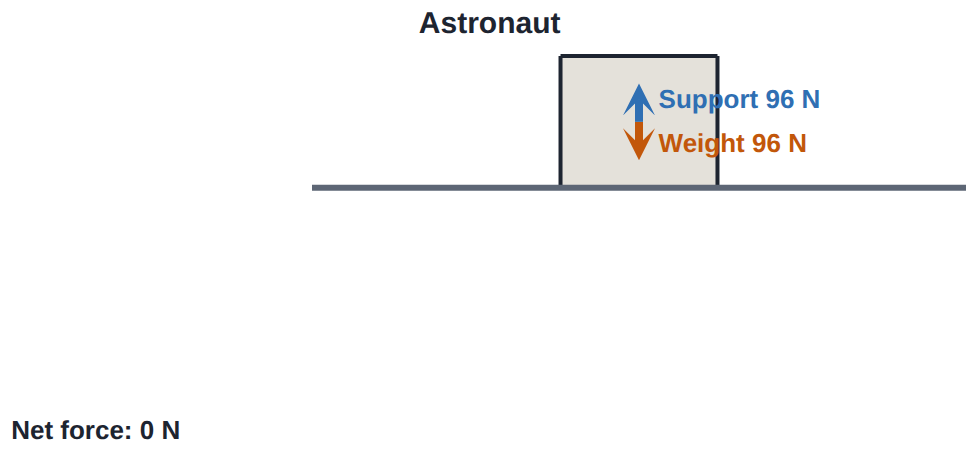
On the Moon: mass 60 kg, weight 96 N (on Earth the same astronaut weighs 588 N).
Mass and weight · Sound on for the voiceover
Open the lesson →

5. Same push, different mass

Try firstThe same push is given to a 3 kg box and a 6 kg box. Which accelerates more, and by how much compared with the other?

Check your answer

The 3 kg box. It accelerates twice as much, because it has half the mass.

For the same unbalanced force, a larger mass gives a smaller acceleration. For the same mass, a larger unbalanced force gives a larger acceleration.

Revision summary
  • For the same unbalanced force, a larger mass gives a smaller acceleration.
  • For the same mass, a larger unbalanced force gives a larger acceleration.
  • Data show the pattern: acceleration rises with force and falls as mass rises.
Open the lesson →