Every idea from Year 7 science in one place, for after you've done the year (or part of it). Answer each question in your head or on paper first, then check it. Nothing here is marked. If one is shaky, open the lesson and go over it again.
Try firstName the four key ideas of particle theory.
Check your answer
All matter is made of particles; there is empty space between them; they are always moving; they attract each other.
Everything is made of particles far too small to see.
All matter is made of particles.
There is empty space between them: nothing at all, not even air.
They are always moving. In a solid they vibrate in place.
They attract each other: strongly in a solid, weakly in a gas.
Solids, liquids and gases are the same kind of particles arranged and moving differently.
Revision summary
All matter is made of tiny particles; there is empty space between them; they are always moving; they attract each other.
Solid: close together in a fixed pattern, vibrating in place.
Liquid: close together with no pattern, sliding past each other.
Gas: far apart, moving fast in all directions.
There is nothing between particles: not air, not water.
Ice, zoomed in: particles packed in a fixed pattern, with empty space between them.The particle model · Sound on for the voiceoverVoice: Open the lesson →
Still stuck? Try the lesson again first. Then, if your teacher has said you can, copy a coach prompt into the AI tool your school allows. It asks you questions; it won't give you the answers.
Try firstA solid keeps its shape but a gas does not. Use arrangement, motion and attraction to explain the difference.
Check your answer
In a solid the particles are close, held in fixed places by strong attraction, and only vibrate, so the shape stays. In a gas they are far apart, move fast in all directions and barely attract, so they spread out.
Each state is described by three features of its particles:
Arrangement: solid, close in a fixed pattern; liquid, close with no pattern; gas, far apart.
Motion: solid, vibrate in place; liquid, slide past each other; gas, move fast in all directions.
Attraction: strong in a solid, weaker in a liquid, very weak in a gas.
That is why a solid keeps its shape, a liquid flows, and a gas fills its container.
Revision summary
Solid: close together, fixed pattern, vibrating in place, strong attraction. It keeps its shape.
Liquid: close together, no pattern, sliding past each other, weaker attraction. It flows and spreads across the bottom of its container.
Gas: far apart, moving fast in all directions, very weak attraction. It spreads to fill its whole container.
A gas spreads in every direction, including down. It is not floating up.
A gas in a jar: particles far apart and moving fast. Remove the jar and it spreads to fill the whole box.States of matter · Sound on for the voiceoverVoice: Open the lesson →
Still stuck? Try the lesson again first. Then, if your teacher has said you can, copy a coach prompt into the AI tool your school allows. It asks you questions; it won't give you the answers.
Particles never shrink or squash. Only the spaces between them change.
Revision summary
Gases can be squashed because their particles are far apart, with lots of empty space between them.
Solids and liquids hardly squash at all: their particles are already close together.
Gases are much less dense because there are far fewer particles in each cm³. The same substance as a solid or a liquid has a similar density: its particles are close together in both.
The particles themselves never shrink or squash. Only the spaces between them change.
Wax in a syringe: its particles are already touching, so pushing the plunger can't squash it. Air, with space between its particles, squashes easily.Properties from particles · Sound on for the voiceoverVoice: Open the lesson →
Still stuck? Try the lesson again first. Then, if your teacher has said you can, copy a coach prompt into the AI tool your school allows. It asks you questions; it won't give you the answers.
Try firstWater vapour condenses on a cold window. Is energy taken in or given out, and what are the particles doing?
Check your answer
Given out. The water particles slow down and come close together, forming a liquid on the glass.
Melting and boiling take energy in: the particles move faster and pull free of each other. Freezing and condensing give energy out.
While a substance is changing state its temperature stays the same: the energy goes into separating the particles (or comes out as they settle). A heating curve shows this as flat parts.
Revision summary
Melting, boiling and evaporating take energy in; freezing and condensing give energy out.
Adding energy to a substance makes its particles move faster (the temperature rises), until it reaches a change of state.
During a change of state the temperature stays the same: the energy goes into separating the particles (or comes out as they settle).
A heating curve shows this as flat parts at the melting and boiling points.
Ice: water particles held in fixed places, vibrating. Heat them and they move faster, then break free.Energy and changes of state · Sound on for the voiceoverVoice: Open the lesson →
Still stuck? Try the lesson again first. Then, if your teacher has said you can, copy a coach prompt into the AI tool your school allows. It asks you questions; it won't give you the answers.
Try firstName one thing the particle model explains well and one thing it can't, with a reason for each.
Check your answer
For example: explains diffusion (particles move and mix); can't explain colour (particles are plain balls with no parts).
The particle model treats matter as tiny particles that move and attract each other. It explains states, diffusion, compressing gases and expansion very well.
It can't explain colour, reactions or electricity, because its particles have no parts. Every model has limits; scientists use the one that suits the job.
Revision summary
The particle model says matter is made of tiny particles that move and attract each other.
It explains states, diffusion, compressing gases and expansion very well, and evidence such as diffusion and Brownian motion supports it.
It can't explain colour, reactions or electricity, because its particles are plain balls with no parts.
Every model has a scope and limits. Scientists keep a model for what it does well and use or build other models for the rest.
Two substances either side of a barrier. The particle model predicts they will spread into each other when it lifts: diffusion.A model's scope and limits · Sound on for the voiceoverVoice: Open the lesson →
Still stuck? Try the lesson again first. Then, if your teacher has said you can, copy a coach prompt into the AI tool your school allows. It asks you questions; it won't give you the answers.
Try firstIs salt water a pure substance or a mixture? Explain using particles.
Check your answer
A mixture: it contains two kinds of particles, water and salt, even though they are evenly spread.
A pure substance has only one kind of particle (distilled water, copper, sugar).
A mixture has two or more kinds (salt water, air, milk).
A homogeneous mixture is evenly mixed, like salt water. A heterogeneous mixture is uneven, like sandy water.
You can't tell by looking: salt water looks like one substance but is a mixture.
Revision summary
A pure substance contains only one kind of particle. A mixture contains two or more.
You can't tell by looking: salt water and air look the same all the way through, but both are mixtures.
"Pure" on a food label means nothing added. It does not mean a pure substance.
Distilled water: only one kind of particle, so it is a pure substance.Pure substances and mixtures · Sound on for the voiceoverVoice: Open the lesson →
Still stuck? Try the lesson again first. Then, if your teacher has said you can, copy a coach prompt into the AI tool your school allows. It asks you questions; it won't give you the answers.
Try firstWhy does a magnet separate iron filings from sand?
Check your answer
Iron is magnetic and sand isn't: the magnet uses that difference in property.
Every separation technique uses a difference in a property between the parts of a mixture:
Magnetism: a magnet pulls out iron.
Particle size: a sieve or filter paper holds back big pieces; dissolved particles pass through.
Boiling point: evaporation boils off the water and leaves dissolved solids.
Density: let it settle, then pour off the top.
Order matters when one technique would trap several parts together.
Revision summary
Every separation technique uses a difference in a physical property between the parts of a mixture.
Magnetism → magnet. Particle size → sieving or filtration. Boiling point → evaporation. Density → letting it settle and pouring off.
Separating doesn't change the particles: you get back the same substances you mixed.
Order matters: use the technique that picks out one part before one that traps several together.
A mixture of water, dissolved salt, sand and iron filings: each part is separated by a different property.Separating mixtures · Sound on for the voiceoverVoice: Open the lesson →
Still stuck? Try the lesson again first. Then, if your teacher has said you can, copy a coach prompt into the AI tool your school allows. It asks you questions; it won't give you the answers.
Try firstIn filtering sandy salt water, what is the residue and what is the filtrate?
Check your answer
The residue is the sand left in the paper; the filtrate is the salt water that passes through.
Filtration separates a solid that hasn't dissolved from a liquid. The residue stays in the paper; the filtrate passes through.
Evaporation gets a dissolved solid back: the liquid boils off and the solid is left as crystals.
Sandy salt water needs both: filter out the sand, then evaporate the filtrate to get the salt.
Revision summary
Filtration separates an undissolved solid from a liquid. The solid left in the paper is the residue; the liquid that passes through is the filtrate.
It works because the solid's particles are too big for the holes. Dissolved particles pass straight through.
Evaporation separates a dissolved solid from the liquid: the liquid's particles escape as a gas; the solid's particles stay and form crystals.
For a solid that dissolves plus one that doesn't: filter first, then evaporate the filtrate.
Sand and salt water above filter paper: the sand grains are too big to pass through.Filtration · Sound on for the voiceoverVoice: Open the lesson →
Still stuck? Try the lesson again first. Then, if your teacher has said you can, copy a coach prompt into the AI tool your school allows. It asks you questions; it won't give you the answers.
Try firstWhy would a ship use distillation, not evaporation, to get drinking water from seawater?
Check your answer
Distillation collects the water vapour as liquid; evaporation lets it escape and keeps only the salt.
Distillation: boil the liquid, cool the vapour in a condenser, collect the liquid somewhere else. The dissolved solid stays behind.
Evaporation uses the same property (boiling point) but lets the vapour escape: you only keep the solid.
Chromatography: a solvent soaks up paper and carries each dissolved substance a different distance, so a mixture like ink splits into separate spots.
Revision summary
Distillation separates a liquid from what is dissolved in it by boiling the liquid and cooling the vapour back into a liquid somewhere else.
Evaporation and distillation use the same property (boiling point), but distillation collects the vapour and evaporation lets it escape.
Chromatography separates a mixture of dissolved substances, such as dyes, because each is carried a different distance.
Distillation suits seawater (to get water). Chromatography suits inks, food colourings and plant pigments.
Distillation: heat the seawater, cool the vapour in the condenser, collect pure water.Distillation · Sound on for the voiceoverVoice: Open the lesson →
Still stuck? Try the lesson again first. Then, if your teacher has said you can, copy a coach prompt into the AI tool your school allows. It asks you questions; it won't give you the answers.
Try firstA new beetle is found in a Queensland rainforest. Give two ways classifying it helps scientists.
Check your answer
Any two of: others can identify it from its features; one scientific name lets scientists everywhere talk about the same beetle; its group shows which beetles it is related to.
Scientists classify living things to identify them, to talk about them clearly (one name everyone understands) and to see how they are related.
Classification groups things by shared features, unlike a plain list. Every system is built for a purpose.
Revision summary
Scientists classify living things to identify them, to communicate clearly (one name everyone understands) and to show how they are related.
Classification groups by shared features; a list (alphabetical, by date) does not.
Every classification is built for a purpose; different purposes can suit different systems.
Still stuck? Try the lesson again first. Then, if your teacher has said you can, copy a coach prompt into the AI tool your school allows. It asks you questions; it won't give you the answers.
Try firstA white, fuzzy growth spreads over a dead log. It isn't green and it absorbs food from the wood. Which kingdom? Why?
Check your answer
Fungi: it can't make food from sunlight and it absorbs food from dead material.
Living things are grouped into kingdoms by observable features: animals (eat other living things), plants (make food from sunlight), fungi (absorb food from other material), protists (mostly one cell with a nucleus) and bacteria (one tiny cell, no nucleus).
Kingdoms sort by features; they don't always show who is related (fungi are closer to animals than to plants). Scientists now use DNA to group life into three domains, and change the system when evidence demands it.
Revision summary
Living things are grouped by observable features into kingdoms: animals, plants, fungi, protists and bacteria.
Plants make their own food from sunlight; fungi absorb food from other material; animals eat other living things.
Protists are mostly single cells with a nucleus; bacteria are single tiny cells with no nucleus.
Some organisms (Euglena, algae) are hard to place: classification is a tool that changes with evidence.
Kingdoms sort by features; they don't always show who is related. Fungi are closer relatives of animals than of plants, and protists aren't one family.
Scientists now group life by evolutionary relationships, using DNA: three domains (bacteria, archaea and eukaryotes). The five kingdoms are still a useful way to sort what you can see.
Sorting into kingdoms · Sound on for the voiceoverVoice: Open the lesson →
Still stuck? Try the lesson again first. Then, if your teacher has said you can, copy a coach prompt into the AI tool your school allows. It asks you questions; it won't give you the answers.
Try firstWhy must each question in a dichotomous key be about an observable feature with a clear yes or no?
Check your answer
So that anyone checking the specimen gets the same answer and reaches the same name.
A dichotomous key identifies an organism with two-way choices about observable features. Answer each one about the specimen in front of you; one wrong choice leads to the wrong name.
Revision summary
A dichotomous key identifies an organism with a series of two-way choices about observable features.
Answer each question about the specimen in front of you; each answer leads to the next step, until you reach a name.
One wrong answer leads to the wrong name: check each feature carefully.
Good questions have a clear yes or no and use features that don't vary within a kind (legs, covering, backbone), not colour or size.
Using a dichotomous key · Sound on for the voiceoverVoice: Open the lesson →
Still stuck? Try the lesson again first. Then, if your teacher has said you can, copy a coach prompt into the AI tool your school allows. It asks you questions; it won't give you the answers.
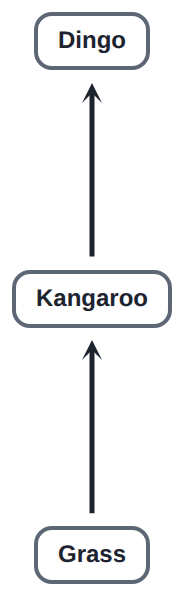
Try firstIn a food web, why does the arrow point from the gum leaves to the koala?
Check your answer
Arrows show the direction energy flows: from the food (gum leaves) into the eater (koala).
A food web joins all the food chains in an ecosystem. Arrows point the way energy flows, from the food to the eater.
Producers make their own food; consumers eat other organisms; decomposers (fungi and bacteria) break down dead matter and wastes.
Revision summary
A food web joins all the food chains in an ecosystem.
Arrows point the way energy flows: from the food to the eater.
Producers make their own food; consumers eat other organisms (primary, secondary…); decomposers (fungi and bacteria, microorganisms) break down dead matter and wastes.
One animal can feed at more than one level.
Arrows point from the food to the eater: the way energy flows.Arrows in a food web · Sound on for the voiceoverVoice: Open the lesson →
Still stuck? Try the lesson again first. Then, if your teacher has said you can, copy a coach prompt into the AI tool your school allows. It asks you questions; it won't give you the answers.
Try firstWhy does a food chain rarely have more than four or five levels?
Check your answer
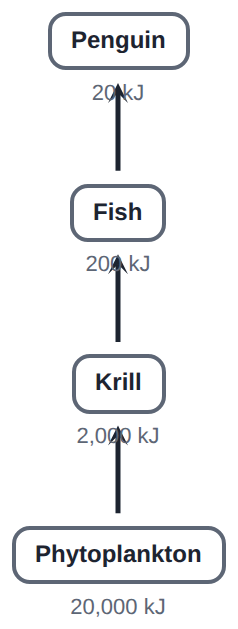
Only about 10% of the energy passes to each level, so after four or five steps there is too little left to support another population.
Energy enters as sunlight and flows one way through a food web. About 10% passes to each level; the rest is used for living or lost as heat. Matter cycles: decomposers return atoms for producers to use again.
Revision summary
Energy enters as sunlight captured by producers and flows one way along the arrows.
At each step only about 10% is passed on; about 90% is used for living, lost as heat or left uneaten (it goes to decomposers).
That's why there are few top predators.
Matter cycles: decomposers return atoms to the soil and air, and producers use them again. Energy does not cycle.
About 10% of the energy passes to each level: 20,000 kJ in the phytoplankton, 20 kJ in the penguin.Energy along a food chain · Sound on for the voiceoverVoice: Open the lesson →
Still stuck? Try the lesson again first. Then, if your teacher has said you can, copy a coach prompt into the AI tool your school allows. It asks you questions; it won't give you the answers.
Try firstFoxes are controlled with baits in a reserve. Predict one effect two links away, and explain.
Check your answer
For example: fewer foxes → more bandicoots → fewer insects (more bandicoots eating them).
A biotic factor is a living part of an ecosystem. When one population changes, the effect passes along the food web, one link at a time: a cascade. Two opposite effects can make the result uncertain.
Revision summary
A biotic factor is a living part of an ecosystem: predators, prey, competitors, disease.
Changing one population affects the species linked to it, and then the species linked to those: a cascade.
Trace it one link at a time: fewer predators → more prey → less of what the prey eats…
When two effects pull opposite ways, the result could go either way; scientists measure to find out.
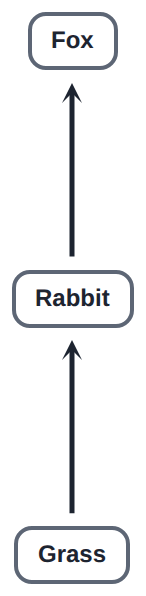
Remove the foxes: more rabbits survive, so they eat more grass. The change passes along the web.A cascade · Sound on for the voiceoverVoice: Open the lesson →
Still stuck? Try the lesson again first. Then, if your teacher has said you can, copy a coach prompt into the AI tool your school allows. It asks you questions; it won't give you the answers.
Try firstA box sits on the floor. Name the two forces on it and describe their arrows.
Check your answer
Weight, pointing down, and support from the floor, pointing up; the same length because they are equal.
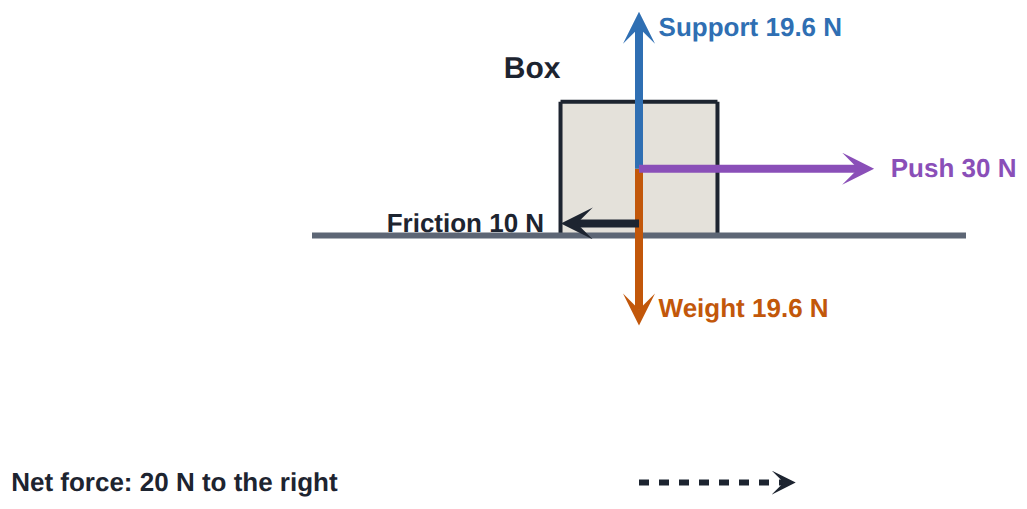
A force has a size (N) and a direction, drawn as an arrow: longer for bigger, pointing the way the force acts.
A force diagram shows every force on one object, each named: weight, support, friction, air resistance, pushes and pulls.
Revision summary
A force has a size (newtons, N) and a direction, so it is drawn as an arrow.
The arrow's length shows the size; it points the way the force acts.
A force diagram shows every force on one object, each one named.
Common forces: weight (down), support (up from a surface), friction (against sliding), air resistance (against motion through air), pushes and pulls.
A force diagram: each force on the box as a named arrow, its length showing the size.Forces as arrows · Sound on for the voiceoverVoice: Open the lesson →
Still stuck? Try the lesson again first. Then, if your teacher has said you can, copy a coach prompt into the AI tool your school allows. It asks you questions; it won't give you the answers.
Try firstA cyclist rides at a steady 20 km/h on a flat road. Are the forces on her balanced? Explain.
Check your answer
Yes: she isn't speeding up or slowing down, so her forward force equals the backward forces (air resistance and friction).
Balanced forces are equal and opposite: the net force is zero. They are still acting; they cancel. The motion doesn't change: still stays still, moving keeps a steady speed.
Unbalanced forces change the motion, in the direction of the net force.
Revision summary
Balanced forces are equal and opposite: the net force is zero. They are still acting; they cancel.
Balanced forces mean no change in motion: still objects stay still; moving objects keep a steady speed in a straight line.
Unbalanced forces change the motion: the object speeds up, slows down or changes direction, the way the net force points.
A car at a steady speed has balanced forces: the engine's push equals air resistance plus friction.
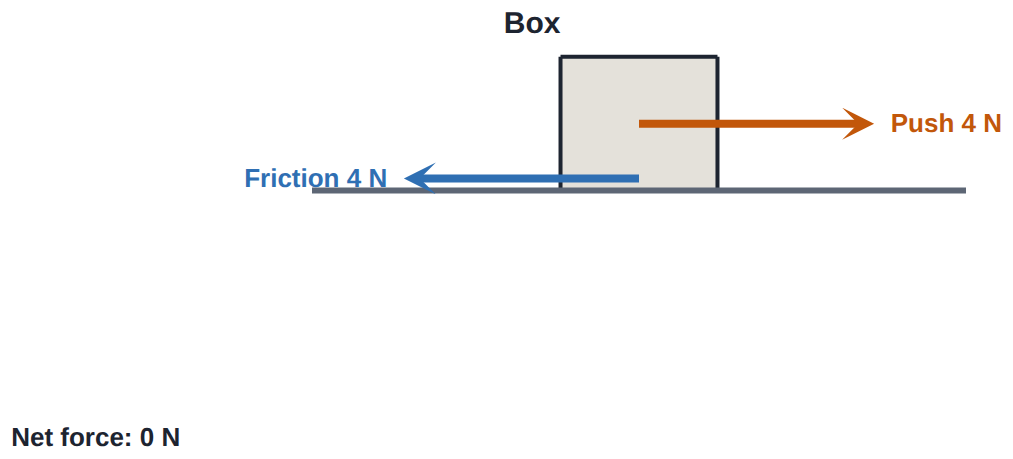
Push 4 N, friction 4 N: balanced, so the net force is 0 N and the motion doesn't change.Balanced forces · Sound on for the voiceoverVoice: Open the lesson →
Still stuck? Try the lesson again first. Then, if your teacher has said you can, copy a coach prompt into the AI tool your school allows. It asks you questions; it won't give you the answers.
Try firstA netball flies towards the ring and bounces back off the backboard. Give the change in motion and the force that caused it.
Check your answer
It reversed direction (and slowed, then sped up the other way). The backboard pushed it back: an unbalanced force away from the board.
An unbalanced force changes an object's motion, in the direction of the net force: it can start, speed up, slow down, stop, reverse or turn an object.
A force against the motion doesn't only stop things: if it keeps acting, the object turns round and speeds up the other way. A steady speed round a bend is a change in direction, so it needs an unbalanced force too.
Revision summary
An unbalanced force (a net force that isn't zero) changes the motion, in the direction of the net force.
A change in motion can be starting, speeding up, slowing down, stopping, reversing or changing direction. Every one needs an unbalanced force.
A force against the motion doesn't just stop an object: if it keeps acting, the object turns round and speeds up the other way.
Steady speed round a bend is still a change in motion (direction), so the forces are unbalanced.
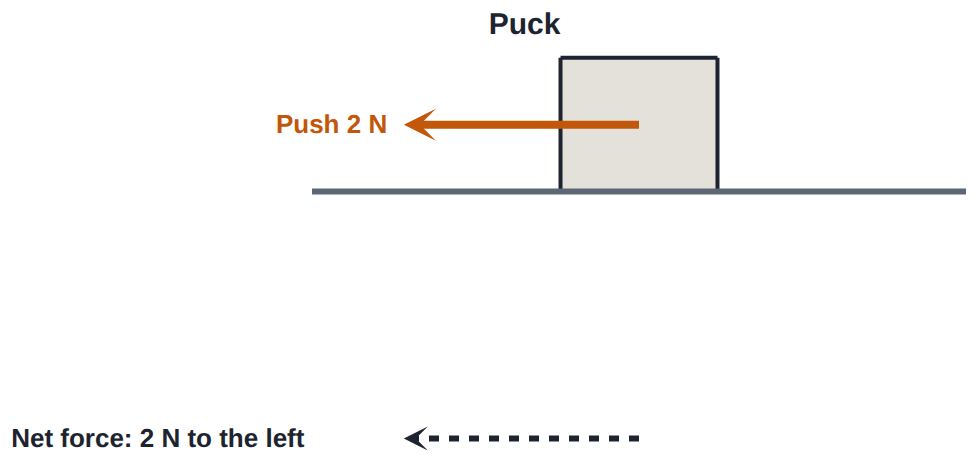
Net force 2 N to the left: the motion changes towards the left, whichever way the puck was moving.What an unbalanced force does · Sound on for the voiceoverVoice: Open the lesson →
Still stuck? Try the lesson again first. Then, if your teacher has said you can, copy a coach prompt into the AI tool your school allows. It asks you questions; it won't give you the answers.
Try firstA 2 kg rock on Earth (g = 9.8 N/kg). What are its mass and its weight on the Moon (g = 1.6 N/kg)?
Check your answer
Mass 2 kg (unchanged); weight 2 × 1.6 = 3.2 N.
Mass (kg) is how much matter an object has; it is the same everywhere. Weight (N) is the force of gravity on it: weight = mass × g.
g is 9.8 N/kg on Earth, 1.6 on the Moon, 3.7 on Mars, 24.8 on Jupiter.
Revision summary
Mass (kg): how much matter. The same everywhere.
Weight (N): the force of gravity on an object. Weight = mass × g.
g is the gravitational field strength: 9.8 N/kg on Earth (about 10), 1.6 on the Moon, 3.7 on Mars, 24.8 on Jupiter.
Gravity depends on mass: the Moon has far less mass than Earth, so it pulls less (smaller g, smaller weight).
Without air, all objects fall together, whatever their mass.
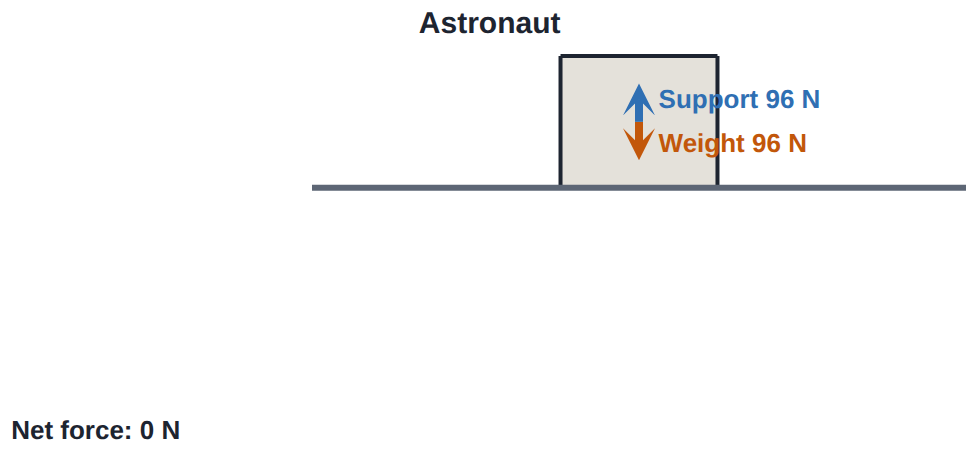
On the Moon: mass 60 kg, weight 96 N (on Earth the same astronaut weighs 588 N).Mass and weight · Sound on for the voiceoverVoice: Open the lesson →
Still stuck? Try the lesson again first. Then, if your teacher has said you can, copy a coach prompt into the AI tool your school allows. It asks you questions; it won't give you the answers.
Still stuck? Try the lesson again first. Then, if your teacher has said you can, copy a coach prompt into the AI tool your school allows. It asks you questions; it won't give you the answers.
Try firstWhat is the difference between rotation and revolution?
Check your answer
Rotation is the Earth spinning on its axis (once a day, causing day and night); revolution is the Earth travelling round the sun (once a year).
Rotation: the Earth spins on its axis once a day, causing day and night. Revolution: it goes round the sun once a year. The axis is tilted 23.4° and always points the same way in space.
Revision summary
Rotation: the Earth spins on its axis once a day: day and night.
Revolution: the Earth goes round the sun once a year (about 365¼ days, so about 365 sunrises).
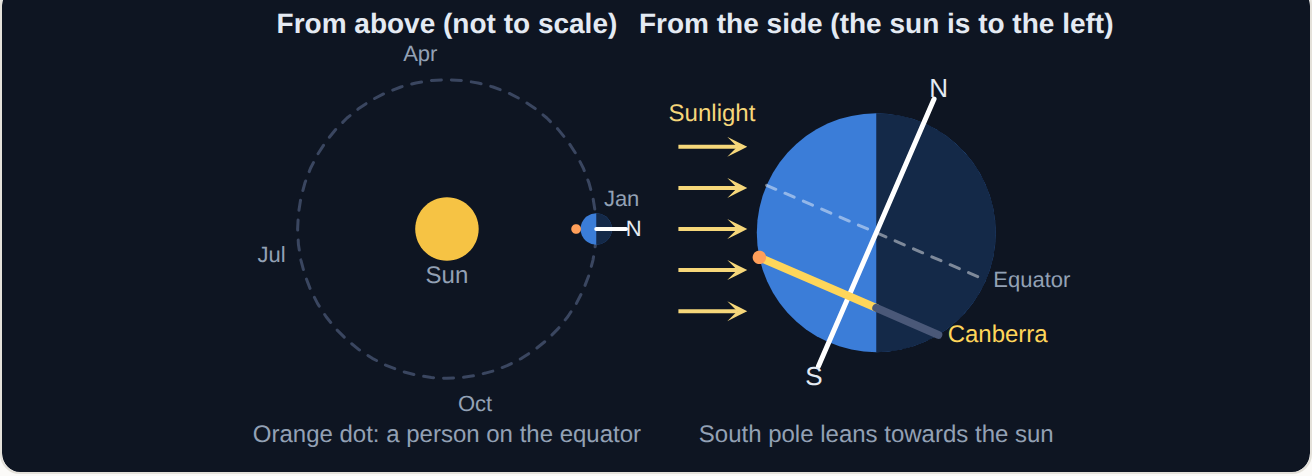
The axis is tilted 23.4° and always points the same way in space, so each hemisphere leans towards the sun for half the year.
Earth's orbit round the sun, with its tilted axis, and the side view showing day and night.Spinning and orbiting · Sound on for the voiceoverVoice: Open the lesson →
Still stuck? Try the lesson again first. Then, if your teacher has said you can, copy a coach prompt into the AI tool your school allows. It asks you questions; it won't give you the answers.
Try firstExplain why Canberra is hotter in December than in June.
Check your answer
In December the Southern Hemisphere leans towards the sun (the tilt), so the noon sun is higher, concentrating the light, and days are longer. It isn't distance: the Earth is actually slightly closer to the sun in January.
Seasons are caused by the Earth's tilt. Leaning towards the sun gives a higher noon sun (concentrated light) and longer days: summer. The hemispheres have opposite seasons. The Earth is closest to the sun in January, so distance isn't the cause.
Revision summary
Seasons are caused by the Earth's tilt, not its distance from the sun (we are closest in January).
Leaning towards the sun: the noon sun is higher (light concentrated on a smaller area) and days are longer: summer.
The two hemispheres have opposite seasons. Near the equator the changes are small.
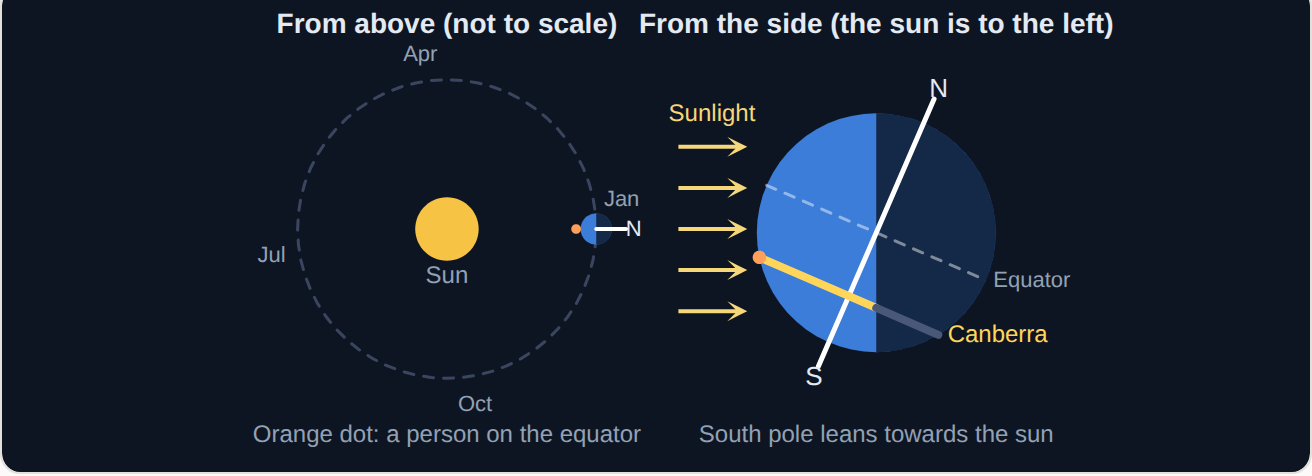
Earth's orbit from above, its axis always leaning the same way; from the side, Canberra tilted towards the sun in December.Why summer is hot · Sound on for the voiceoverVoice: Open the lesson →
Still stuck? Try the lesson again first. Then, if your teacher has said you can, copy a coach prompt into the AI tool your school allows. It asks you questions; it won't give you the answers.
Try firstWhy do we see a half-lit moon at first quarter?
Check your answer
The moon is a quarter of the way round its orbit, at right angles to the sun; we see half of its sunlit half. It isn't Earth's shadow.
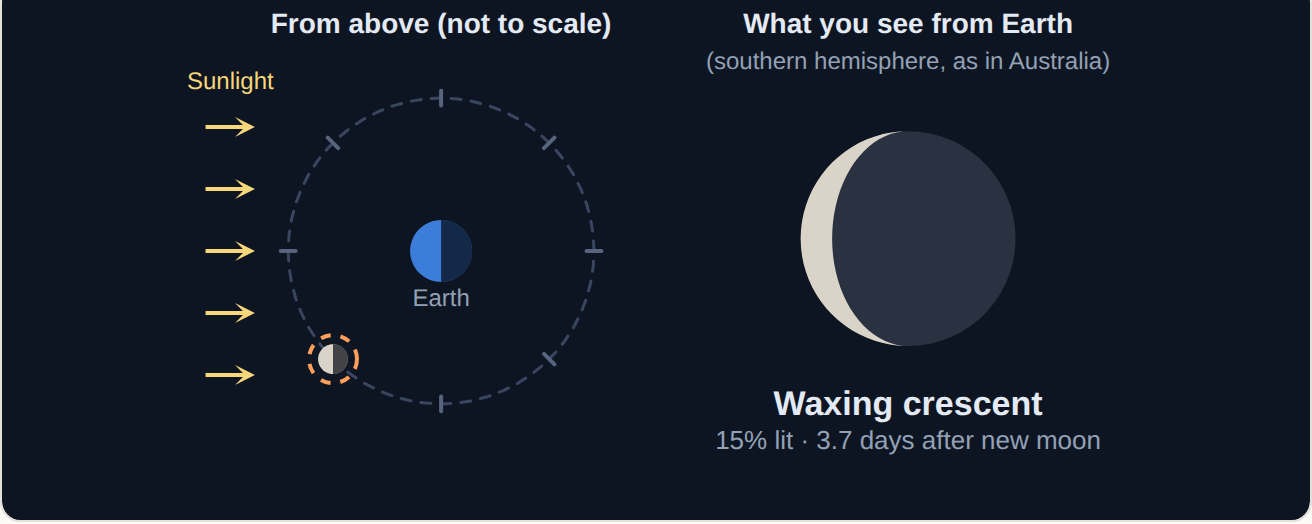
Phases: the sun always lights half the moon; as the moon orbits the Earth (29.5 days), we see more or less of that lit half. New → waxing crescent → first quarter → waxing gibbous → full → waning gibbous → last quarter → waning crescent. Not Earth's shadow.
Revision summary
The sun always lights half the moon. The phase is how much of that lit half we can see, which depends on where the moon is in its orbit.
New moon → waxing crescent → first quarter → waxing gibbous → full moon → waning gibbous → last quarter → waning crescent (about 29.5 days).
Phases are not caused by Earth's shadow. From Australia a waxing moon is lit on the left.
The moon orbiting the Earth, lit on one side by the sun, and how it looks from Earth.The moon's phases · Sound on for the voiceoverVoice: Open the lesson →
Still stuck? Try the lesson again first. Then, if your teacher has said you can, copy a coach prompt into the AI tool your school allows. It asks you questions; it won't give you the answers.
Try firstWhy doesn't every full moon give a lunar eclipse?
Check your answer
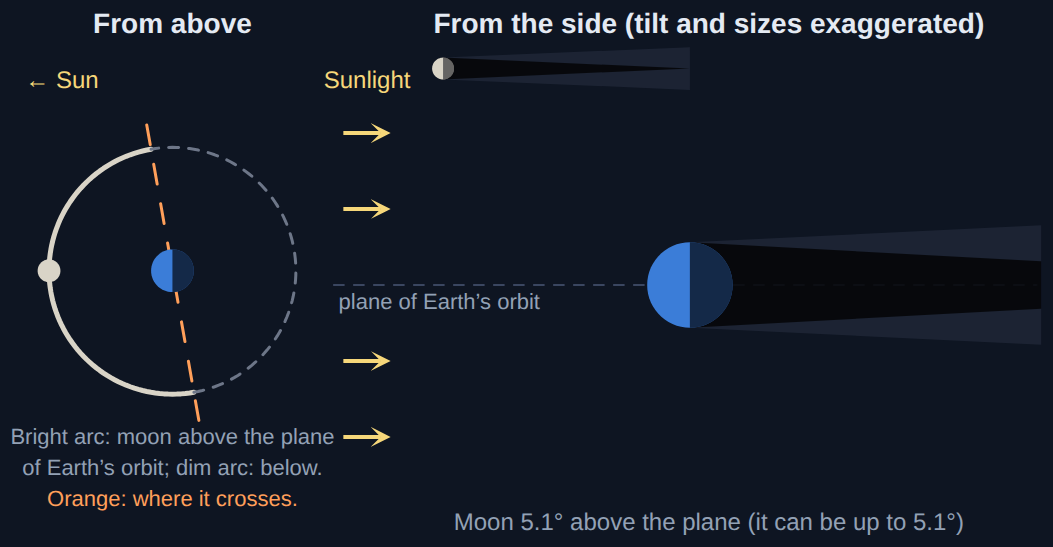
The moon's orbit is tilted about 5° to Earth's, so at most full moons the moon passes above or below Earth's shadow.
Solar eclipse: new moon, the moon's shadow on Earth. Lunar eclipse: full moon, the moon in Earth's shadow. Umbra: full shadow; penumbra: partial. Eclipses are rare because the moon's orbit is tilted about 5°.
Revision summary
Solar eclipse: new moon, moon between sun and Earth, the moon's shadow falls on part of Earth.
Lunar eclipse: full moon, Earth between sun and moon, the moon passes through Earth's shadow (it often looks red).
Umbra: full shadow (total eclipse). Penumbra: partial shadow (partial eclipse).
The moon's orbit is tilted about 5°, so most new and full moons miss: eclipses come in eclipse seasons about every six months.
From above and from the side: the moon's orbit tilted about 5°, so most new and full moons miss the shadow.Eclipses are rare · Sound on for the voiceoverVoice: Open the lesson →
Still stuck? Try the lesson again first. Then, if your teacher has said you can, copy a coach prompt into the AI tool your school allows. It asks you questions; it won't give you the answers.
Try firstWhen do spring tides happen, and why are they bigger?
Check your answer
At new and full moon, when the sun and moon are in line, so their pulls on the oceans add together.
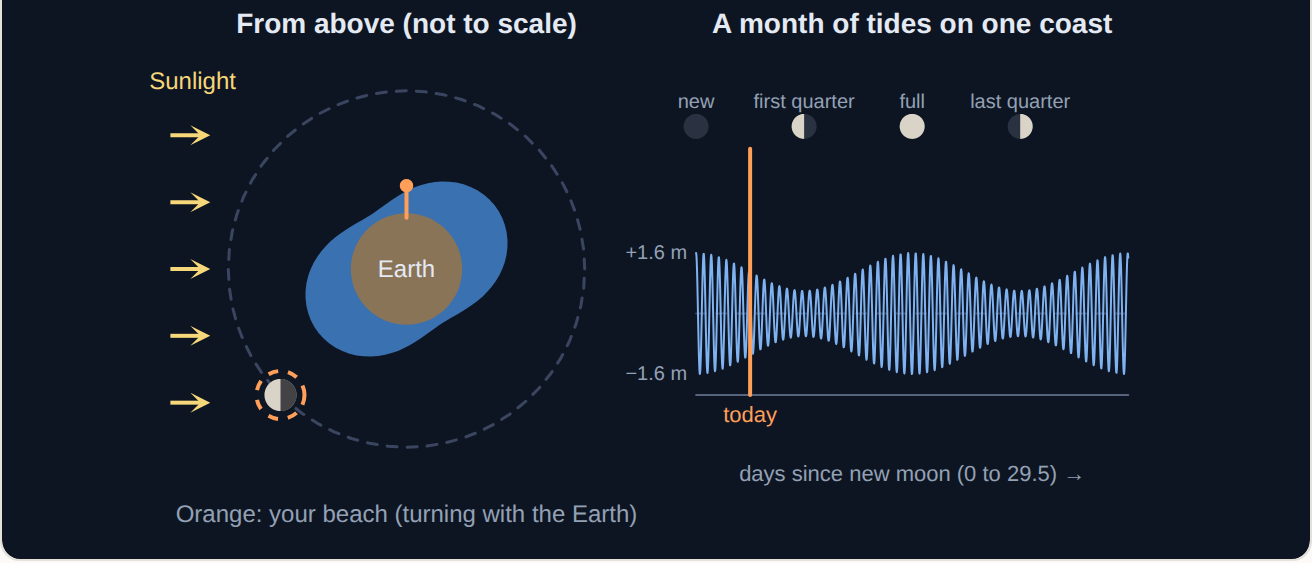
Tides: the moon's gravity pulls the oceans into two bulges; the Earth spins through both, so most coasts get two high tides a day. Spring tides (biggest) at new and full moon (sun and moon in line); neap tides (smallest) at the quarters.
Revision summary
The moon's gravity pulls the oceans into two bulges (towards the moon and on the far side); the Earth spins through both: two high tides a day on most coasts. This is the bulge model, a simplified picture: real coasts vary, and a few get one high tide a day.
Spring tides (biggest range): new and full moon, sun and moon in line. Neap tides (smallest range): quarter moons, sun at right angles.
Spring and neap tides each come about every two weeks, all year.
The oceans pulled into two bulges by the moon (and two smaller ones by the sun).Tides · Sound on for the voiceoverVoice: Open the lesson →
Still stuck? Try the lesson again first. Then, if your teacher has said you can, copy a coach prompt into the AI tool your school allows. It asks you questions; it won't give you the answers.