← Year 8 Earth and space

Year 8 Earth and space: recap

For after the lessons: one card per lesson, to check what you remember. Answer each question in your head or on paper first, then check it. Nothing here is marked.

Looking back over the whole year? See the Year 8 recap.

The rock cycle

1. Why do some rocks have big crystals?

Try firstA rock has crystals too small to see. Did it form underground or at the surface? Why?

Check your answer

At the surface: it cooled quickly, so many crystals started and none had time to grow large.

Igneous rock forms when magma or lava cools. Crystal size records the cooling rate:

  • Slow cooling underground (intrusive): few crystals start and grow large. Granite.
  • Fast cooling at the surface (extrusive): many crystals start and stay small. Basalt.
  • Instant cooling: no pattern at all, glass. Obsidian.
Revision summary
  • Igneous rock forms when magma (underground) or lava (at the surface) cools and sets.
  • Slow cooling (intrusive, underground): few crystals start and grow large. Granite, gabbro.
  • Fast cooling (extrusive, at the surface): many crystals start, all stay small. Basalt.
  • Instant cooling: no time for a pattern, so glass. Obsidian, pumice.
  • Crystal size is a record of cooling rate.
Crystal size and cooling · Sound on for the voiceover
Open the lesson →

Plate tectonics

2. What's inside the Earth?

Try firstName the only liquid layer and explain what the lithosphere is.

Check your answer

The outer core. The lithosphere is the crust plus the rigid top of the mantle: the rigid outer shell broken into plates.

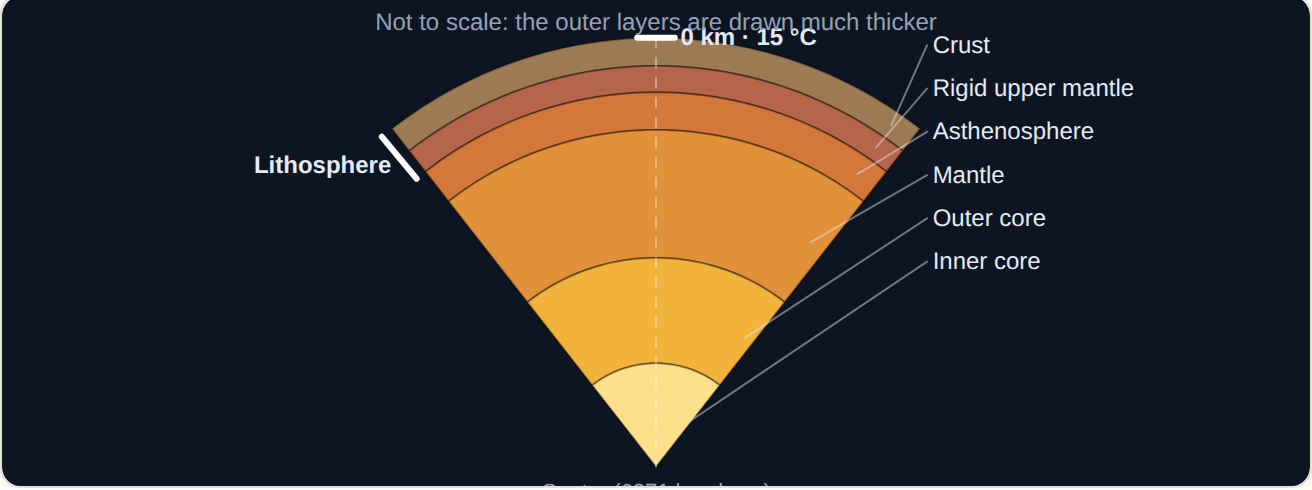
Layers: crust (thin, solid), mantle (solid, flows very slowly), outer core (liquid), inner core (solid). Temperature and pressure rise with depth. The lithosphere (crust + rigid upper mantle) is the rigid outer shell broken into plates; it rests on the soft asthenosphere.

Revision summary
  • Crust (thin, solid) → mantle (thick, solid but flows very slowly) → outer core (liquid iron and nickel) → inner core (solid iron and nickel).
  • Temperature and pressure increase with depth.
  • The lithosphere (crust + rigid top of the mantle) is the rigid outer shell, broken into plates; it rests on the soft, slowly flowing asthenosphere.
A wedge of the Earth: crust, mantle, outer core and inner core (outer layers drawn thicker than to scale).
Earth's layers · Sound on for the voiceover
Open the lesson →

3. What moves the plates?

Try firstWhat drives the movement of tectonic plates?

Check your answer

Convection currents in the mantle: heated rock rises, spreads, cools and sinks, carrying the plates. The heat comes from the core and from radioactive elements in the mantle.

The lithosphere is broken into rigid plates that move a few centimetres a year.

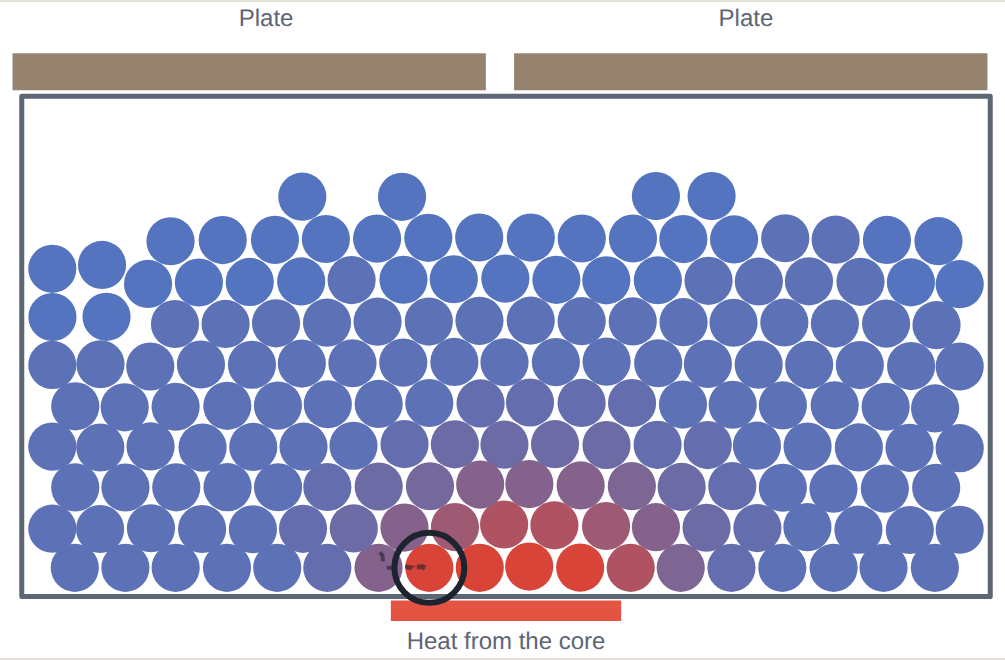
Earth's inner heat, from the core below and from radioactive elements in the mantle rock, drives convection currents in the mantle: hot rock is less dense and rises, spreads under the plates, cools and sinks. The currents carry the plates along.

Revision summary
  • The lithosphere (crust and top of the mantle) is broken into rigid tectonic plates, moving a few centimetres a year.
  • Earth's inner heat (from the core below, and from radioactive elements in the mantle rock) drives convection currents in the mantle: hot rock is less dense and rises, spreads, cools and sinks.
  • The currents carry the plates: apart above rising rock, together above sinking rock. This is a simplified picture: the sinking edges of plates (slab pull) do much of the pulling.
  • The mantle is solid rock that flows extremely slowly, not liquid magma.
A model of the mantle: hot rock (red) rises above the core, spreads under the plates, cools (blue) and sinks.
What moves the plates · Sound on for the voiceover
Open the lesson →