← Year 10 Earth and space

Year 10 Earth and space: recap

For after the lessons: one card per lesson, to check what you remember. Answer each question in your head or on paper first, then check it. Nothing here is marked.

Looking back over the whole year? See the Year 10 recap.

The big bang

1. How did the universe begin?

Try firstOutline three stages of the universe after the big bang.

Check your answer

For example: the first nuclei of hydrogen and helium (3 minutes), atoms forming and light set free (380 000 years), the first stars (about 200 million years), galaxies (about 1 billion years).

The big bang theory: The universe was very hot and dense 13.8 billion years ago, and has been expanding since; whether time itself began then is still an open question. As it expanded it cooled, forming nuclei, atoms, stars and galaxies. Heavier elements were made in stars.

Revision summary
  • The big bang theory: the universe was very hot and dense 13.8 billion years ago, and has been expanding and cooling since; whether time itself began then is still an open question.
  • Stages: inflation (a leading idea) → protons and neutrons → hydrogen and helium nuclei (3 min) → atoms and free light (380 000 years) → first stars (about 200 million years) → galaxies → the sun and Earth (9.2 billion years).
  • Heavier elements were made in stars.
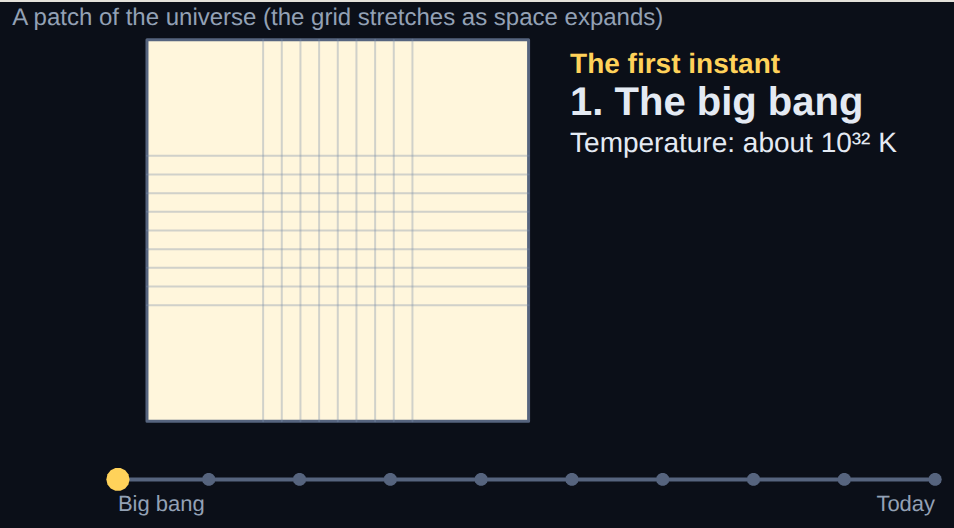
A patch of the universe soon after the big bang: extremely hot and dense.
The big bang · Sound on for the voiceover
Open the lesson →

2. How do we know the universe is expanding?

Try firstWhat does redshift show, and how does it support the big bang?

Check your answer

Galaxies are moving away, farther ones faster: the universe is expanding. Run backwards, everything was once together in a hot, dense state.

Redshift: light from distant galaxies is stretched to longer wavelengths, so they are moving away. Farther galaxies move faster (Hubble's law): an expanding universe with no centre. Run backwards, it began together: the big bang.

Revision summary
  • Redshift: light from distant galaxies is shifted to longer wavelengths: they are moving away. (Strictly, space stretches the light on its way to us; it isn't a Doppler shift from galaxies moving through space.)
  • Hubble's law (built on Vesto Slipher's redshift measurements): farther galaxies move away faster, in proportion to distance.
  • This is what an expanding universe looks like from any galaxy (no centre). Run backwards, everything was once together: evidence for the big bang.
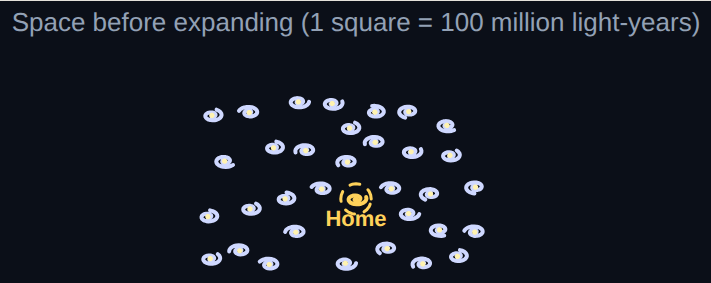
A field of galaxies. When space expands, every galaxy moves away from every other, farther ones faster.
An expanding universe · Sound on for the voiceover
Open the lesson →

Earth's energy balance

3. Where does the sunlight go?

Try firstWhy does replacing sea ice with open ocean warm the area?

Check your answer

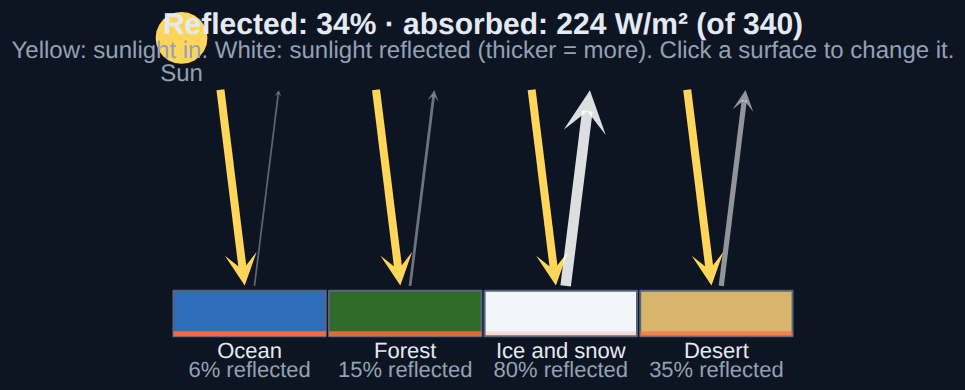
Ice reflects most sunlight (about 80%); dark ocean absorbs most (reflects about 6%), so more energy is absorbed.

Sunlight is Earth's energy input. Some is reflected (the albedo, about 30% overall) and the rest absorbed. Bright surfaces reflect most; dark surfaces absorb most.

Revision summary
  • The sun is Earth's main energy source: about 340 W/m² on average at the top of the atmosphere.
  • Some sunlight is reflected (about 30% on average: the albedo); the rest is absorbed and warms Earth.
  • Bright surfaces (ice, snow, cloud) reflect most; dark ones (ocean, forest) absorb most. Melting ice means more absorbed.
Surfaces under the sun: bright ones (ice) reflect most sunlight; dark ones (ocean, forest) absorb most.
Where sunlight goes · Sound on for the voiceover
Open the lesson →

4. What keeps Earth's temperature steady?

Try firstWhat is energy balance, and what happens if more energy comes in than goes out?

Check your answer

Energy in equals energy out over time. If more comes in, Earth warms until it gives off enough extra infrared to balance again.

Energy balance: absorbed sunlight = infrared given off to space. If in exceeds out, Earth warms until out catches up. Energy moves between spheres by radiation, conduction and convection; the oceans store and carry heat.

Revision summary
  • Energy balance: energy absorbed from the sun = energy given off to space as infrared, over time. Then temperature is steady.
  • Upset it (more in or less out) and Earth warms or cools until out = in again.
  • Energy moves between the spheres by radiation, conduction and convection; the oceans store heat and carry it around the world.
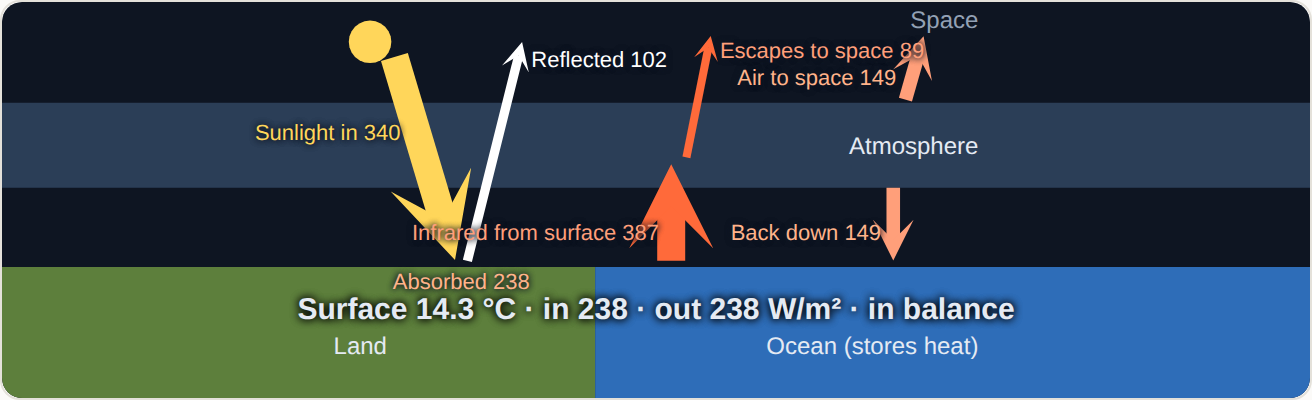
Sunlight in, some reflected, the rest absorbed; infrared given off to space.
Energy balance · Sound on for the voiceover
Open the lesson →

5. How do greenhouse gases warm the Earth?

Try firstExplain how adding CO₂ warms the Earth.

Check your answer

CO₂ absorbs infrared from the surface and sends some back down, so less energy escapes; energy in exceeds energy out, and Earth warms until it gives off enough to balance again.

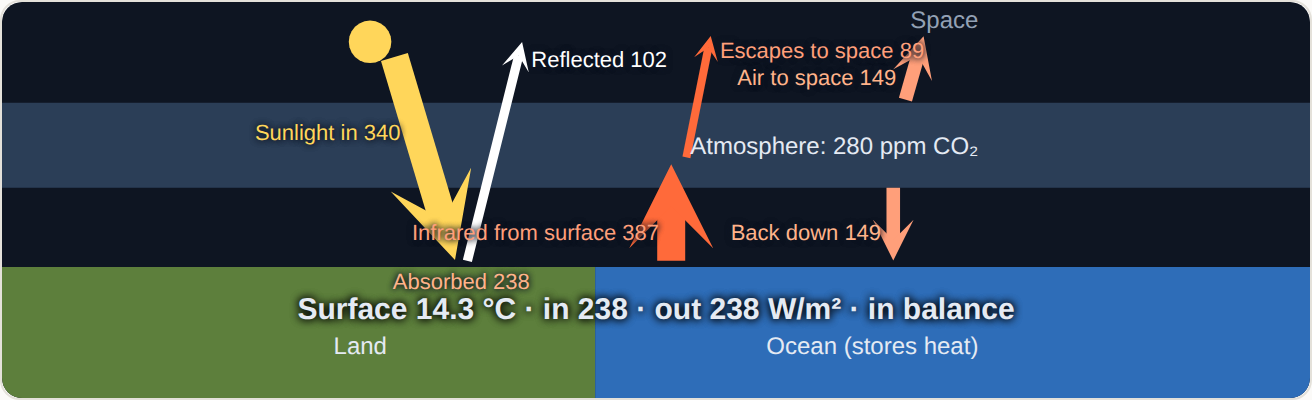
Greenhouse gases absorb outgoing infrared and send some back down, slowing energy loss. The natural effect keeps Earth about 15 °C (not −18 °C); the enhanced effect from extra greenhouse gases upsets the balance, so Earth warms. Not the ozone hole.

Revision summary
  • Earth's surface gives off infrared. Greenhouse gases (water vapour, CO₂, methane, nitrous oxide) absorb some and send part back down: they slow energy going out, not sunlight coming in.
  • Natural greenhouse effect: keeps Earth about 15 °C on average instead of about −18 °C.
  • Enhanced greenhouse effect: extra greenhouse gases from human activity reduce the outgoing infrared, so energy in exceeds energy out and Earth warms until balance is restored.
  • It is not the ozone hole.
Sunlight in; infrared from the surface, part absorbed by greenhouse gases and sent back down.
The greenhouse effect · Sound on for the voiceover
Open the lesson →