← Year 10 Chemistry

Year 10 Chemistry: recap

For after the lessons: one card per lesson, to check what you remember. Answer each question in your head or on paper first, then check it. Nothing here is marked.

Looking back over the whole year? See the Year 10 recap.

Atoms and the periodic table

10. How are the electrons arranged?

Try firstWrite the electron arrangement of aluminium (13 electrons). How many outer electrons does it have?

Check your answer

2, 8, 3: three outer electrons.

Electrons fill shells in order: 2, then 8, then 8. The outermost occupied shell is the outer shell, and its electrons decide how the element reacts.

Revision summary
  • Electrons fill shells in order: 2, then 8, then 8 (then 2 more for potassium and calcium). This is the Bohr model for elements 1 to 20; in heavier atoms the third shell holds more.
  • The outer shell is the outermost occupied one; its electrons decide how the element reacts.
  • A full shell is followed by a new shell, which is why rows of the periodic table end and begin.
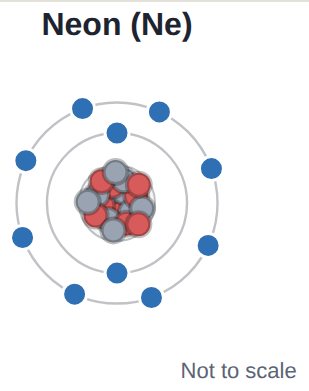
Neon: 10 electrons in shells 2, 8. Both shells are full.
Electron shells · Sound on for the voiceover
Open the lesson →

11. Why do elements in a group behave alike?

Try firstBromine is in group 17. Predict how many outer electrons it has and how it reacts. Explain.

Check your answer

Seven outer electrons; it gains one easily, so it is a reactive non-metal, like chlorine.

Elements in the same group have the same number of outer-shell electrons, so they react in similar ways.

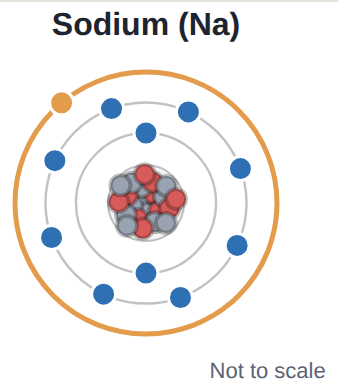
Group 1: one outer electron, easily lost: very reactive metals. Group 17: seven, one short of full: reactive non-metals. Group 18: full outer shell: hardly react.

Revision summary
  • Elements in the same group have the same number of outer-shell electrons, so they react in similar ways.
  • Group 1 (alkali metals): one outer electron, easily lost: very reactive metals.
  • Group 17 (halogens): seven outer electrons, one short of full: very reactive non-metals.
  • Group 18 (noble gases): full outer shells: hardly react. (Full outer shells being stable is a useful rule for the first 20 elements.)
  • The period (row) tells you how many shells an atom has.
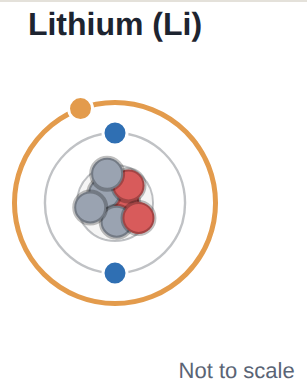
Lithium (2, 1): one outer electron (orange), like every element in group 1.
Groups and outer electrons · Sound on for the voiceover
Open the lesson →

13. Use the table to predict

Try firstPredict the number of outer electrons and the ion formed by calcium, which is in group 2, period 4.

Check your answer

Two outer electrons; it loses them to form a Ca²⁺ ion.

Group gives the outer electrons; period gives the shells. Outer electrons decide reactivity and bonding, so the table is a predictive model, not a list.

Revision summary
  • The group gives the number of outer electrons; the period gives the number of shells.
  • Outer electrons decide reactivity and bonding: group 1 loses one electron, group 17 gains one, group 18 is stable.
  • Reactivity grows down group 1 and falls down group 17.
  • The table is a predictive model: Mendeleev's gaps predicted elements before anyone found them.
Open the lesson →

Reaction rates

14. What kind of reaction is it?

Try firstClassify magnesium + zinc sulfate → magnesium sulfate + zinc, and say why it happens.

Check your answer

Displacement: magnesium is more reactive than zinc, so it takes zinc's place.

Synthesis: substances join into one (A + B → AB). Decomposition: one substance breaks into simpler ones (AB → A + B). Displacement: a more reactive element takes a less reactive one's place (A + BC → AC + B).

Spot the pattern to classify a reaction and predict its products. Displacement only goes from more reactive to less reactive.

Revision summary
  • Synthesis: substances join into one (A + B → AB), such as magnesium burning.
  • Decomposition: one substance breaks into simpler ones (AB → A + B), such as hydrogen peroxide → water + oxygen, often with heat or electricity.
  • Displacement: a more reactive element takes a less reactive one's place (A + BC → AC + B). It doesn't happen the other way round. In a double displacement two compounds swap partners (AB + CD → AD + CB), as in neutralisation: acid + base → salt + water.
  • Spot the pattern to classify a reaction and predict its products.
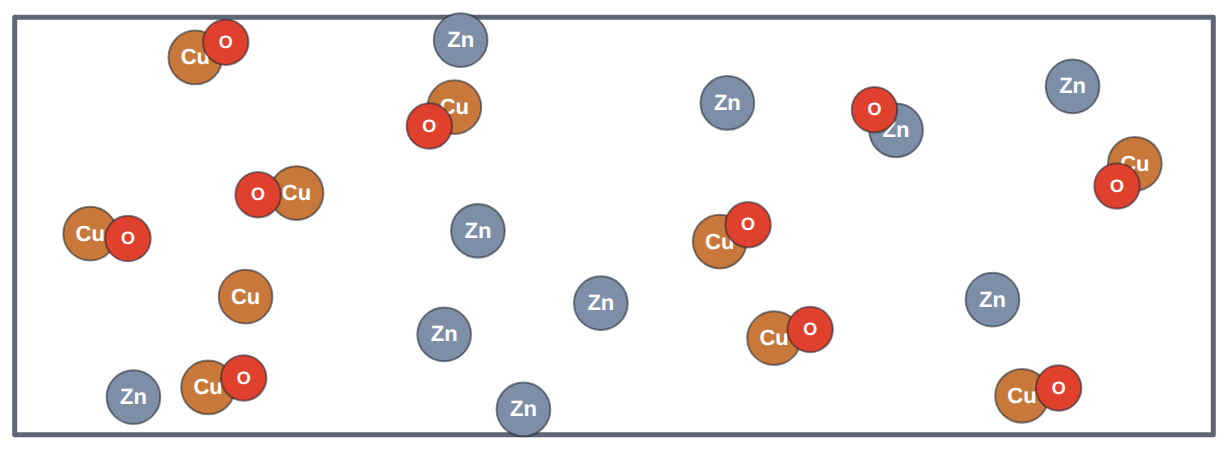
Zinc and copper oxide: zinc, the more reactive metal, takes the oxygen and leaves copper behind. A displacement reaction.
Three kinds of reaction · Sound on for the voiceover
Open the lesson →

15. Why does heat speed up reactions?

Try firstWhy does crushing a tablet make it dissolve and react faster in water?

Check your answer

Crushing increases the surface area, so more particles are exposed and collisions happen more often.

Particles react only when they collide with at least the activation energy.

  • Temperature: particles collide more often and harder (the biggest effect).
  • Concentration and surface area: more collisions each second.
  • Catalyst: lowers the activation energy; not used up.
Revision summary
  • Particles react only when they collide with at least the activation energy (and the right way round). Most collisions just bounce.
  • Temperature: faster particles collide more often and, much more importantly, harder.
  • Concentration and surface area: more collisions each second.
  • Catalyst: a lower activation energy, so more collisions succeed. It is not used up.
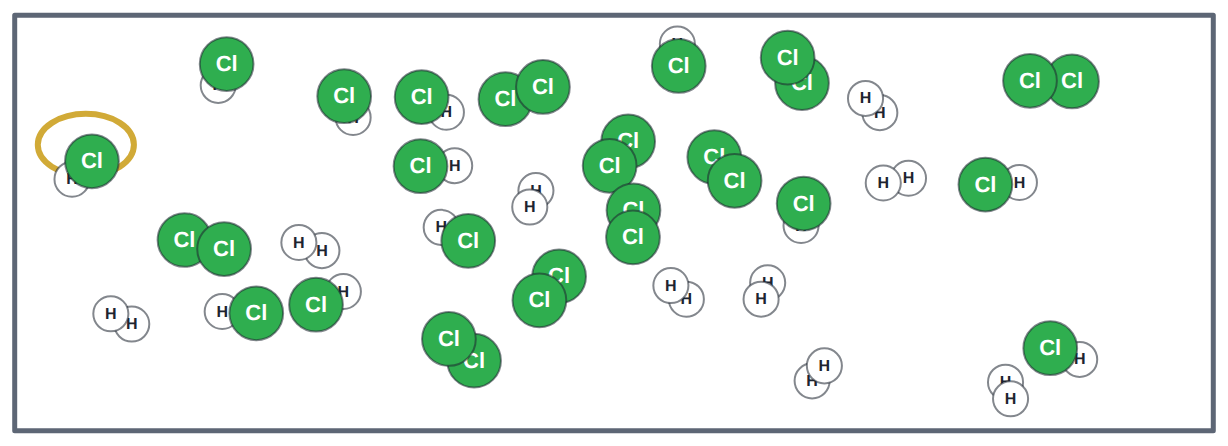
Hydrogen and chlorine molecules colliding: only collisions with enough energy react.
Collision theory · Sound on for the voiceover
Open the lesson →