← Year 9 Biology

Year 9 Biology: recap

For after the lessons: one card per lesson, to check what you remember. Answer each question in your head or on paper first, then check it. Nothing here is marked.

Looking back over the whole year? See the Year 9 recap.

Coordination and control

1. What counts as a stimulus?

Try firstGive one internal stimulus and name its receptor and effector.

Check your answer

For example: body temperature rising; temperature receptors in the brain; sweat glands.

Stimulus: any change the body detects, inside or outside it. Pathway: stimulus → receptor (detects) → command centre (decides) → effector (muscle or gland) → response.

Revision summary
  • A stimulus is any change the body detects, external (light, heat, sound) or internal (blood sugar, temperature, water).
  • Stimulus → receptor → command centre → effector → response.
  • Receptors detect; the brain, spinal cord or a gland decides; muscles and glands are the effectors.
Stimulus to response · Sound on for the voiceover
Open the lesson →

2. Who decides?

Try firstName the command centre in a reflex and say why reflexes are fast.

Check your answer

The spinal cord; the impulse doesn't have to travel to the brain and wait for a decision.

The CNS (brain and spinal cord) is the command centre. Sensory neurons carry impulses in from receptors; motor neurons carry them out to effectors (muscles or glands). A reflex is automatic and fast because no decision is made: most go through the spinal cord, and reflexes in the head (blinking, pupils narrowing) go through the brain stem.

Revision summary
  • The central nervous system (brain and spinal cord) is the command centre.
  • Sensory neurons carry impulses from receptors to the CNS; motor neurons carry them to effectors (muscles or glands).
  • A reflex is automatic and fast: the impulse goes through the spinal cord without waiting for the brain.
Every response follows one pathway: a stimulus is detected by a receptor, a sensory neuron carries the impulse to the central nervous system (brain or spinal cord), a motor neuron carries it to an effector (a muscle or gland), and the effector makes the response.
Every response follows the same pathway
Who decides? · Sound on for the voiceover
Open the lesson →

3. Nerves or hormones?

Try firstGive one difference between how a nerve signal and a hormone travel, and one difference in how long their effects last.

Check your answer

Nerve signals are electrical, along nerves; hormones are chemicals in the blood. Nerve effects are brief; hormone effects last longer.

Both systems run stimulus → receptor → command centre → effector → response. The nervous system sends electrical signals along nerves: very fast, brief, to one place.

The endocrine system uses glands that release hormones into the blood: slower, longer-lasting, reaching target organs anywhere. Many responses use both.

Revision summary
  • Both systems follow stimulus → receptor → command centre → effector → response.
  • Nervous system: electrical signals along nerves, from the brain or spinal cord. Very fast, short-lived, to one place.
  • Endocrine system: hormones released by glands (pancreas, adrenal glands, pituitary) into the blood. Slower, longer-lasting, reaching target organs anywhere.
  • Many responses use both (a fright: a jump from nerves, a pounding heart from adrenaline).
Two ways to send a message · Sound on for the voiceover
Open the lesson →

4. Which system runs it?

Try firstWhich system would you give blinking to, and which growing, and why?

Check your answer

Blinking to nerves, because it has to be fast, short and in one place; growing to hormones, because it has to last for years and reach cells all over the body.

Nerves: fast electrical impulses to one place, short-lived. Hormones: chemicals released by glands into the blood, slower and longer-lasting; every cell gets them but only target cells (with matching receptors) respond.

Revision summary
  • To pick a system for a job, ask how fast it has to be, how long the effect should last and how many places it has to reach.
  • Nerves suit jobs that are fast, short and aimed at one place, like a blink or pulling your hand off a hot pan.
  • Hormones suit jobs that can take minutes or years, need to last, or reach many places at once, like growth. Every cell gets the hormone, but only target cells with matching receptors respond.
  • Many responses need both, like a swerve followed by a pounding heart.
Nerves and hormones · Sound on for the voiceover
Open the lesson →

5. How does your body stay at 37 °C?

Try firstDescribe what happens when your body temperature rises above 37 °C.

Check your answer

Temperature receptors detect it; the hypothalamus sends impulses to the sweat glands and skin blood vessels; sweating and widened vessels cool the body; as it comes back near 37 °C they ease off, and they stop once the heat has gone.

Homeostasis: keeping internal conditions near a set point. Negative feedback: a change is detected and the response reverses it, then eases off as conditions return to the set point (in steady heat a smaller response keeps going to hold it there; it stops once the stimulus has gone). Body temperature: sweating and flushed skin when too hot, shivering and pale skin when too cold.

Revision summary
  • Homeostasis: keeping internal conditions (temperature, blood sugar, water) near a set point.
  • Negative feedback has four parts around a set point: a deviation (a change away from it) is detected; a corrective response reverses it; return detection (receptors sensing it is back near the set point) eases the response off, and it stops once the stimulus has gone. "Negative" means it opposes the change.
  • Too hot: sweating, skin blood vessels widen. Too cold: shivering, skin blood vessels narrow, goosebumps. The hypothalamus is the control centre.
Negative feedback · Sound on for the voiceover
Open the lesson →

Reproduction

6. What makes a sex cell special?

Try firstWhy do sperm and egg cells have 23 chromosomes, not 46?

Check your answer

So that when they fuse at fertilisation, the new cell has 46, the full number, again.

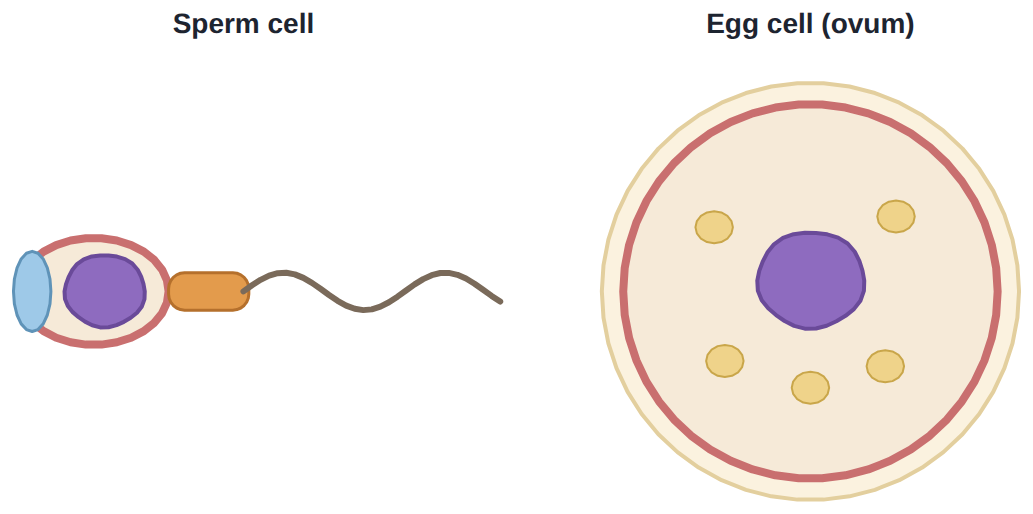
Gametes (sperm and egg) have half the usual number of chromosomes (23 in humans), so fertilisation restores the full number (46). Sperm swim (tail, mitochondria) and digest their way in (acrosome); the egg is large with a food store and lets only one sperm in.

Revision summary
  • Gametes are sex cells: sperm and egg in animals; the male nucleus in pollen and the egg in the ovule in flowering plants.
  • Gametes have half the chromosomes (23 in humans), so fertilisation restores the full number (46).
  • Sperm: tail, midpiece of mitochondria, acrosome. Egg: large, food store, a coat that lets in only one sperm.
A sperm (head, midpiece, tail) and an egg (much larger, with a food store): each carries 23 chromosomes.
Sperm and egg · Sound on for the voiceover
Open the lesson →

7. Why don't brothers and sisters look the same?

Try firstWhy do two offspring of the same parents look different?

Check your answer

Each gets a random one of each parent's two copies of each gene, so each gets a different combination.

Sexual reproduction: two parents; each offspring gets a random half of each parent's genes, so offspring vary. Asexual reproduction: one parent makes clones. Variation helps a population survive change; asexual reproduction is fast and needs no partner.

Revision summary
  • Sexual reproduction: two parents, gametes fuse; each offspring gets a random half of each parent's genes, so offspring vary.
  • Asexual reproduction: one parent, no gametes; offspring are clones.
  • Variation helps a population survive a changing environment; asexual reproduction is fast and needs no partner.
Sexual and asexual reproduction · Sound on for the voiceover
Open the lesson →