← Year 7 Biology

Year 7 Biology: recap

For after the lessons: one card per lesson, to check what you remember. Answer each question in your head or on paper first, then check it. Nothing here is marked.

Looking back over the whole year? See the Year 7 recap.

Classification

1. Why sort living things?

Try firstA new beetle is found in a Queensland rainforest. Give two ways classifying it helps scientists.

Check your answer

Any two of: others can identify it from its features; one scientific name lets scientists everywhere talk about the same beetle; its group shows which beetles it is related to.

Scientists classify living things to identify them, to talk about them clearly (one name everyone understands) and to see how they are related.

Classification groups things by shared features, unlike a plain list. Every system is built for a purpose.

Revision summary
  • Scientists classify living things to identify them, to communicate clearly (one name everyone understands) and to show how they are related.
  • Classification groups by shared features; a list (alphabetical, by date) does not.
  • Every classification is built for a purpose; different purposes can suit different systems.
Why classify? · Sound on for the voiceover
Open the lesson →

2. Plant, animal or something else?

Try firstA white, fuzzy growth spreads over a dead log. It isn't green and it absorbs food from the wood. Which kingdom? Why?

Check your answer

Fungi: it can't make food from sunlight and it absorbs food from dead material.

Living things are grouped into kingdoms by observable features: animals (eat other living things), plants (make food from sunlight), fungi (absorb food from other material), protists (mostly one cell with a nucleus) and bacteria (one tiny cell, no nucleus).

Kingdoms sort by features; they don't always show who is related (fungi are closer to animals than to plants). Scientists now use DNA to group life into three domains, and change the system when evidence demands it.

Revision summary
  • Living things are grouped by observable features into kingdoms: animals, plants, fungi, protists and bacteria.
  • Plants make their own food from sunlight; fungi absorb food from other material; animals eat other living things.
  • Protists are mostly single cells with a nucleus; bacteria are single tiny cells with no nucleus.
  • Some organisms (Euglena, algae) are hard to place: classification is a tool that changes with evidence.
  • Kingdoms sort by features; they don't always show who is related. Fungi are closer relatives of animals than of plants, and protists aren't one family.
  • Scientists now group life by evolutionary relationships, using DNA: three domains (bacteria, archaea and eukaryotes). The five kingdoms are still a useful way to sort what you can see.
Sorting into kingdoms · Sound on for the voiceover
Open the lesson →

3. Who is it? Using a key

Try firstWhy must each question in a dichotomous key be about an observable feature with a clear yes or no?

Check your answer

So that anyone checking the specimen gets the same answer and reaches the same name.

A dichotomous key identifies an organism with two-way choices about observable features. Answer each one about the specimen in front of you; one wrong choice leads to the wrong name.

Revision summary
  • A dichotomous key identifies an organism with a series of two-way choices about observable features.
  • Answer each question about the specimen in front of you; each answer leads to the next step, until you reach a name.
  • One wrong answer leads to the wrong name: check each feature carefully.
  • Good questions have a clear yes or no and use features that don't vary within a kind (legs, covering, backbone), not colour or size.
Using a dichotomous key · Sound on for the voiceover
Open the lesson →

Food webs and ecosystems

4. Who eats whom?

Try firstIn a food web, why does the arrow point from the gum leaves to the koala?

Check your answer

Arrows show the direction energy flows: from the food (gum leaves) into the eater (koala).

A food web joins all the food chains in an ecosystem. Arrows point the way energy flows, from the food to the eater.

Producers make their own food; consumers eat other organisms; decomposers (fungi and bacteria) break down dead matter and wastes.

Revision summary
  • A food web joins all the food chains in an ecosystem.
  • Arrows point the way energy flows: from the food to the eater.
  • Producers make their own food; consumers eat other organisms (primary, secondary…); decomposers (fungi and bacteria, microorganisms) break down dead matter and wastes.
  • One animal can feed at more than one level.
Arrows point from the food to the eater: the way energy flows.
Arrows in a food web · Sound on for the voiceover
Open the lesson →

5. Where does the energy go?

Try firstWhy does a food chain rarely have more than four or five levels?

Check your answer

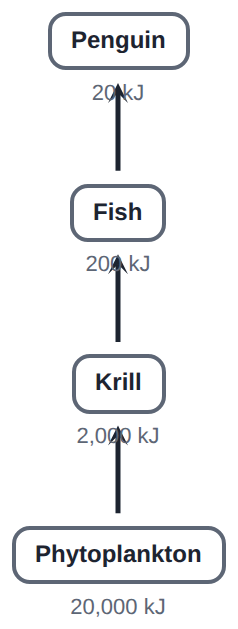
Only about 10% of the energy passes to each level, so after four or five steps there is too little left to support another population.

Energy enters as sunlight and flows one way through a food web. About 10% passes to each level; the rest is used for living or lost as heat. Matter cycles: decomposers return atoms for producers to use again.

Revision summary
  • Energy enters as sunlight captured by producers and flows one way along the arrows.
  • At each step only about 10% is passed on; about 90% is used for living, lost as heat or left uneaten (it goes to decomposers).
  • That's why there are few top predators.
  • Matter cycles: decomposers return atoms to the soil and air, and producers use them again. Energy does not cycle.
About 10% of the energy passes to each level: 20,000 kJ in the phytoplankton, 20 kJ in the penguin.
Energy along a food chain · Sound on for the voiceover
Open the lesson →

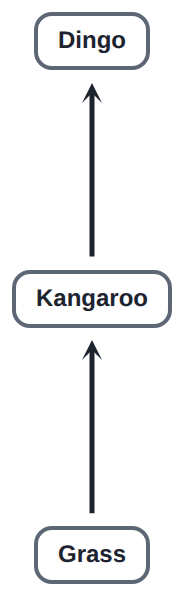
6. What if the dingo disappeared?

Try firstFoxes are controlled with baits in a reserve. Predict one effect two links away, and explain.

Check your answer

For example: fewer foxes → more bandicoots → fewer insects (more bandicoots eating them).

A biotic factor is a living part of an ecosystem. When one population changes, the effect passes along the food web, one link at a time: a cascade. Two opposite effects can make the result uncertain.

Revision summary
  • A biotic factor is a living part of an ecosystem: predators, prey, competitors, disease.
  • Changing one population affects the species linked to it, and then the species linked to those: a cascade.
  • Trace it one link at a time: fewer predators → more prey → less of what the prey eats…
  • When two effects pull opposite ways, the result could go either way; scientists measure to find out.
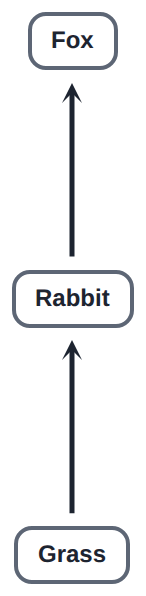
Remove the foxes: more rabbits survive, so they eat more grass. The change passes along the web.
A cascade · Sound on for the voiceover
Open the lesson →