← Year 10 Biology

Year 10 Biology: recap

For after the lessons: one card per lesson, to check what you remember. Answer each question in your head or on paper first, then check it. Nothing here is marked.

Looking back over the whole year? See the Year 10 recap.

Genetics

1. Where are the instructions?

Try firstWhat's the difference between a gene and an allele?

Check your answer

A gene is a section of DNA coding for a protein; an allele is one version of that gene.

DNA carries the instructions; a chromosome is one long coiled DNA molecule; a gene is a section of DNA coding for a protein; alleles are versions of a gene. Chromosomes come in pairs, one from each parent.

Revision summary
  • DNA carries coded instructions as a sequence of bases (A, T, C, G).
  • A chromosome is one long DNA molecule, coiled; humans have 46, in 23 pairs (one of each pair from each parent).
  • A gene is a section of DNA; most genes code for a protein; alleles are different versions of one gene.
  • Genotype: the alleles you have (such as A and O). Phenotype: the characteristic that shows (blood group A).
From body to gene · Sound on for the voiceover
Open the lesson →

2. Why is every sperm and egg different?

Try firstWhy does meiosis make every gamete different?

Check your answer

Each gamete gets one chromosome from each pair, and which one is random, so the combination differs.

Meiosis makes gametes with half the chromosomes: one from each pair, chosen at random, so almost every gamete is a different combination (over 8 million possible in humans). Mitosis makes identical cells for growth and repair.

Revision summary
  • Meiosis makes gametes: chromosome pairs separate; each gamete gets one from each pair, so it has half the number.
  • Which of each pair goes into a gamete is random: 2 × 2 × 2 … for 23 pairs, over 8 million combinations.
  • Random fertilisation (and crossing over) multiply the variety.
Meiosis · Sound on for the voiceover
Open the lesson →

3. Can you predict the offspring?

Try firstComplete Bb × Bb. What fraction of offspring are expected to show the recessive trait?

Check your answer

BB, Bb, Bb, bb: 1 in 4 (25%).

Punnett square: each parent's possible gametes along the edges, every combination in the grid. It gives probabilities: Pp × Pp gives 1 PP : 2 Pp : 1 pp, so 3 dominant : 1 recessive phenotype. Genotype is the alleles; phenotype is the characteristic seen.

Revision summary
  • Genotype: the alleles (PP, Pp, pp). Phenotype: the characteristic seen.
  • A dominant allele shows when present; a recessive one only in homozygous form (pp).
  • A Punnett square gives the probability of each offspring: Pp × Pp gives 1 PP : 2 Pp : 1 pp, so 3 : 1 purple to white; Bb × bb gives 1 : 1.
  • Real numbers vary around the prediction, especially when there are few offspring.
  • Punnett squares here are for one-gene traits such as pea flower colour; most human traits involve many genes.
A Punnett square · Sound on for the voiceover
Open the lesson →

Evolution

4. How different are individuals?

Try firstGive an example of inherited variation and one of environmental variation in humans.

Check your answer

For example: blood group (inherited); a scar or a language spoken (environmental).

Variation: individuals in a population differ. Continuous (any value, such as height) or discontinuous (groups, such as blood group); inherited, environmental, or both. Only inherited variation is passed on, so only it drives evolution.

Revision summary
  • Individuals in a population vary; measuring a characteristic gives a spread.
  • Continuous variation takes any value (height); discontinuous falls into groups (blood group).
  • Variation can be inherited, environmental or both; only inherited variation is passed on, so only it matters for evolution.
  • New inherited variation comes from mutations and from meiosis and fertilisation.
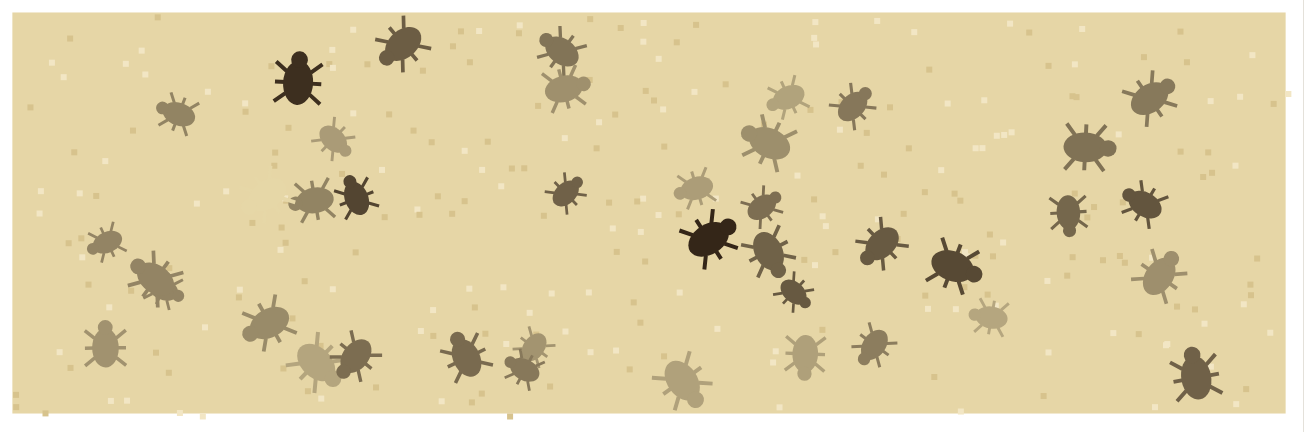
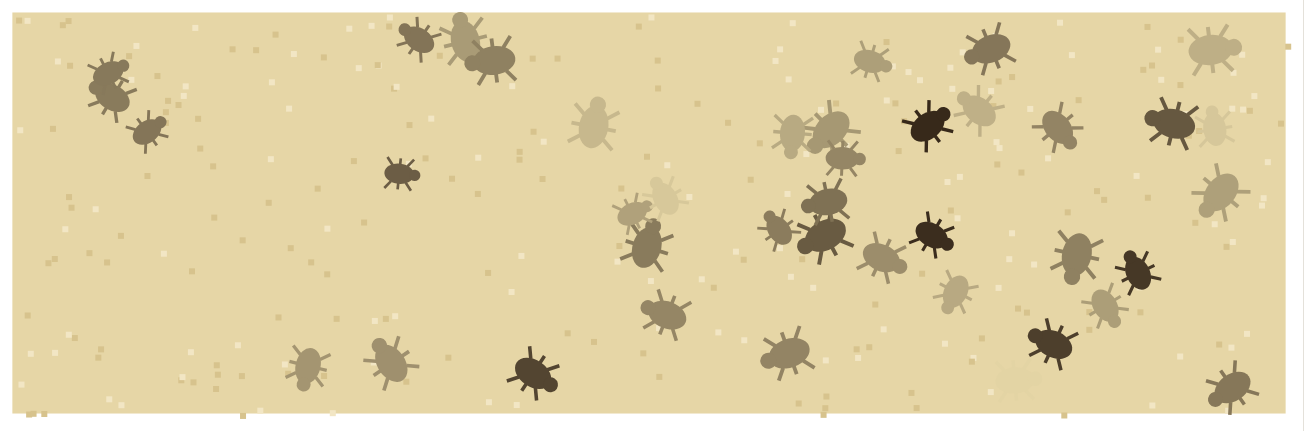
No two beetles quite the same colour: continuous variation in one population.
Variation · Sound on for the voiceover
Open the lesson →

5. Why did the beetles change?

Try firstExplain why the beetle population got paler on pale ground.

Check your answer

Beetles varied in colour; birds ate the darker, more visible ones; paler beetles survived and bred, passing on their colour; over generations, the average colour got paler.

Natural selection: individuals vary; those best suited to the environment are more likely to survive and reproduce, passing on their alleles; over generations the population changes. Individuals don't change: the population does. "Fittest" depends on the environment.

Over millions of years this branches into a tree of life: all living things share ancestors, and DNA shows how closely they are related.

Revision summary
  • Natural selection: individuals vary; more are born than survive; those best suited to the environment are more likely to survive and reproduce; they pass on their alleles; over generations, the population changes.
  • Individuals don't change to suit the environment; the population does.
  • "Fittest" means best suited to the current environment. Selection needs variation.
  • Over millions of years, populations split and diverge: all living things are related in a branching tree of life, not a ladder. The more recent the common ancestor, the more similar the DNA.
  • Features can mislead about relatedness (fungi are closer to animals than to plants), so modern classification uses shared ancestry, and changes as evidence improves.
A population of beetles: each one a slightly different colour, on pale ground.
Natural selection · Sound on for the voiceover
Open the lesson →