← Year 8 Space

Year 8 Space: recap

For after the lessons: one card per lesson, to check what you remember. Answer each question in your head or on paper first, then check it. Nothing here is marked.

Looking back over the whole year? See the Year 8 recap.

Congruence and similarity

1. Congruent triangles

Try firstTwo triangles have AB = PQ = 7 cm, BC = QR = 5 cm and angle B = angle Q = 60°. Are they congruent? Which test?

Check your answer

Yes, by SAS: angle B is between AB and BC.

Congruent triangles are the same shape and size. Each test fixes a triangle: SSS, SAS (the angle between the sides), ASA or AAS, and RHS.

SSA (an angle not between the two sides) is not a test: it can give two different triangles. Equal angles alone give the same shape, not always the same size.
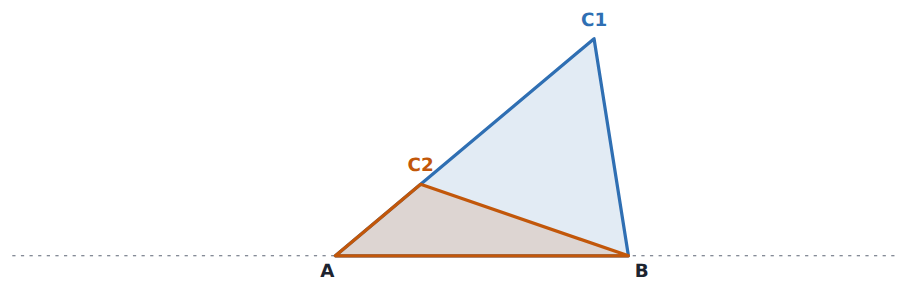
AB = 8, BC = 6 and angle A = 40°: two different triangles fit, so SSA is not a congruence test.
When SSA fails · Sound on for the voiceover
Open the lesson →

2. Similar shapes

Try firstA 2 m by 3 m garden bed is enlarged so the 2 m side becomes 5 m. How long is the 3 m side now?

Check your answer

k = 5 ÷ 2 = 2.5, so 3 × 2.5 = 7.5 m.

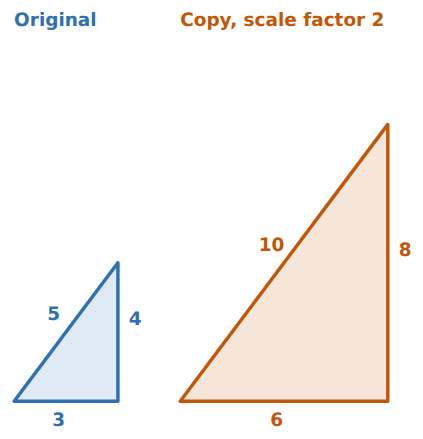
Similar shapes are the same shape, maybe a different size. Every length is multiplied by the same scale factor k = copy ÷ original, and the angles stay the same. Congruent is similar with k = 1.

Triangles are similar by AA, SSS (sides in one ratio) or SAS (two sides in one ratio, the angle between them equal). For other shapes, check both the angles and the ratios of the sides.

A 3, 4, 5 triangle and a copy with scale factor 2: sides 6, 8, 10, the same angles.
A scale factor · Sound on for the voiceover
Open the lesson →

3. Proving quadrilateral properties

Try firstKite ABCD has AB = AD and CB = CD. Prove that angle B = angle D.

Check your answer

Triangles ABC and ADC: AB = AD, CB = CD, AC shared, so they are congruent (SSS). Angle B and angle D match, so they are equal.

A proof gives a reason for every step and works for every shape of the kind; one measured drawing is only an example.

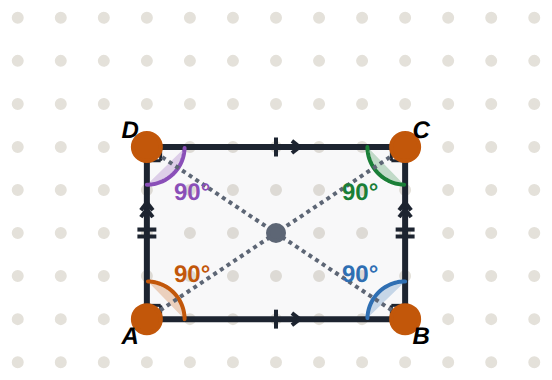
To prove a quadrilateral property: find two triangles (often either side of a diagonal), give the equal parts with reasons, name the congruence test, then use matching parts of congruent triangles. This proves, for example, that a rectangle's diagonals are equal.

A rectangle and its diagonals AC and BD: equal, and they cut each other in half.
Diagonals of a rectangle · Sound on for the voiceover
Open the lesson →

4. Problems with quadrilaterals

Try firstIn parallelogram ABCD, angle B = 3 × angle A. Find all four angles.

Check your answer

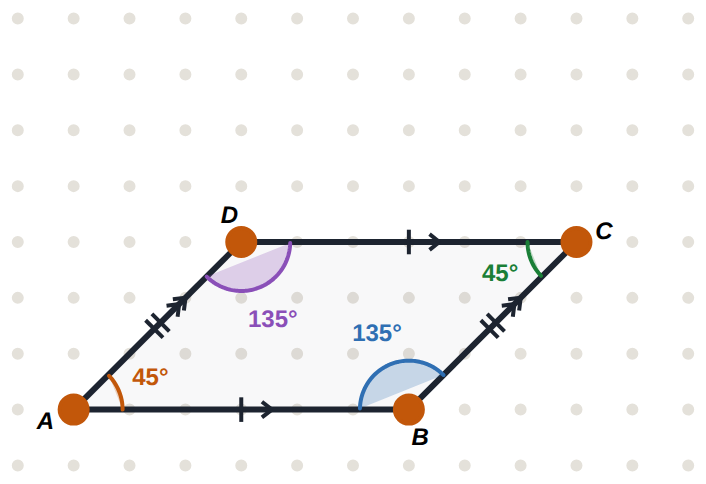
A + 3A = 180, so A = 45°. B = 135°, C = 45°, D = 135°.

Use the properties, with a reason for each step. A parallelogram's opposite angles are equal and its neighbouring (co-interior) angles add to 180°. A kite has one pair of equal opposite angles. A rectangle's diagonals are equal and cut each other in half; a rhombus's cut each other in half at 90°.

Every quadrilateral's angles add to 360°: use it to check.

A parallelogram: opposite angles are equal (45° and 45°, 135° and 135°), and neighbouring angles add to 180°.
Angles in a parallelogram · Sound on for the voiceover
Open the lesson →

Algorithms

5. Algorithms for congruence

Try firstWhy must an algorithm for congruence not answer 'congruent' when two sides and any angle are equal?

Check your answer

If the angle is not between the sides (SSA), two different triangles can fit, so they might not be congruent.

An algorithm for two triangles asks about their equal parts in order: the congruence tests first (SSS, SAS, ASA or AAS, RHS), then similarity (AA, sides in the same ratio), then not enough to tell.

Test it on one pair of every kind, including SSA (which must not be called congruent). When you fix it, test every pair again.

Following the algorithm · Sound on for the voiceover
Open the lesson →

Solids

6. Coordinates in 3D

Try firstA drone is 8 m east, 3 m north and 20 m up from its base, with x east, y north and z up. Write its position. Then it flies 5 m north: where is it now?

Check your answer

(8, 3, 20), then (8, 8, 20).

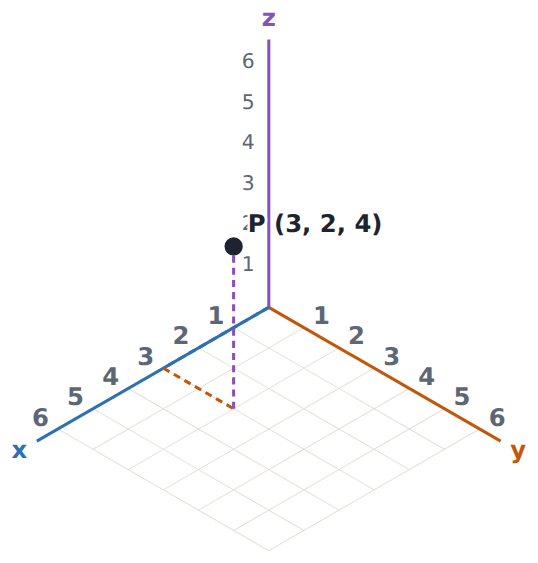
A third axis, z, points up from the x-y plane. A point in space is (x, y, z): along x, along y, then up. The order is always x, y, z; points with z = 0 are on the floor.

Real systems work the same way: east, north and up for a drone; across, back and floor in a building; latitude, longitude and altitude for a plane.

P (3, 2, 4): 3 along x, 2 along y, then 4 up the z-axis.
Three coordinates · Sound on for the voiceover
Open the lesson →