Every idea from Year 9 maths in one place, for after you've done the year (or part of it). Answer each question in your head or on paper first, then check it. Nothing here is marked. If one is shaky, open the lesson and go over it again.
The natural numbers are inside the integers, the integers are inside the rational numbers, and the rational and irrational numbers together are the real numbers.
Each family answers a question the last couldn't: 2−5 needs negatives, 1÷2 needs fractions, and x2=2 needs irrationals.
Still stuck? Try the lesson again first. Then, if your teacher has said you can, copy a coach prompt into the AI tool your school allows. It asks you questions; it won't give you the answers.
50 is exact. 7.07 is rounded: close, but not equal. Keep the exact value or the calculator's full value through the calculation, and round once at the end.
Rounding early adds a small error that later steps can grow.
Still stuck? Try the lesson again first. Then, if your teacher has said you can, copy a coach prompt into the AI tool your school allows. It asks you questions; it won't give you the answers.
Still stuck? Try the lesson again first. Then, if your teacher has said you can, copy a coach prompt into the AI tool your school allows. It asks you questions; it won't give you the answers.
Try firstA circle has diameter 10 cm. What's its exact area?
Check your answer
25π cm².
Keep π or a root exact while you work, and round once at the end. If π is on both sides of a comparison, you can compare the other numbers: 225π against 264.5π.
Still stuck? Try the lesson again first. Then, if your teacher has said you can, copy a coach prompt into the AI tool your school allows. It asks you questions; it won't give you the answers.
A negative power is a reciprocal: a−n=an1. For example, 2−3=231=81.
It's not a negative number. 10−6 is a millionth, a small positive number.
22÷25: two pairs cancel and three 2s are left underneath, so it's 231=2−3.Keep dividing: the power goes below zero · Sound on for the voiceoverVoice: Open the lesson →
Still stuck? Try the lesson again first. Then, if your teacher has said you can, copy a coach prompt into the AI tool your school allows. It asks you questions; it won't give you the answers.
The index laws work with any indices. Multiplying adds the indices, dividing subtracts them, and a power of a power multiplies them.
Subtracting a negative adds: 56÷5−2=56−(−2)=58.
103÷106: three pairs cancel and three 10s are left underneath: 10−3, a thousandth.Same laws, any indices · Sound on for the voiceoverVoice: Open the lesson →
Still stuck? Try the lesson again first. Then, if your teacher has said you can, copy a coach prompt into the AI tool your school allows. It asks you questions; it won't give you the answers.
A letter stands for a number, so the index laws work on it. Multiplying adds the indices, dividing subtracts them, and a power of a power multiplies them.
Numbers in front multiply or divide on their own: 3a2×4a3=12a5.
a2×a3: two as and three as make five, so a5. Here a=3.A letter follows the same laws as a number · Sound on for the voiceoverVoice: Open the lesson →
Still stuck? Try the lesson again first. Then, if your teacher has said you can, copy a coach prompt into the AI tool your school allows. It asks you questions; it won't give you the answers.
Two brackets multiply like the sides of a rectangle. (x+4)(x+3) is x+4 across and x+3 down, so the area has four pieces: x×x=x2, x×3=3x, 4×x=4x and 4×3=12. Add them and collect the two strips: x2+7x+12.
Signs come with the numbers: (x+4)(x−3)=x2−3x+4x−12=x2+x−12.
(x+4)(x+3): one x2, 4x and 3x, and 12 ones make x2+7x+12.Two brackets make four pieces · Sound on for the voiceoverVoice: Open the lesson →
Still stuck? Try the lesson again first. Then, if your teacher has said you can, copy a coach prompt into the AI tool your school allows. It asks you questions; it won't give you the answers.
The two strips join into one term, and the corner is the product. So (x+a)(x+b)=x2+(a+b)x+ab.
For example, (x+5)(x+2)=x2+7x+10, and (x+6)(x−6)=x2−36 because the strips cancel.
(x+5)(x+2): the strips are 5x and 2x, which join to make 7x. The corner is 5×2=10.Add for the middle, multiply for the end · Sound on for the voiceoverVoice: Open the lesson →
Still stuck? Try the lesson again first. Then, if your teacher has said you can, copy a coach prompt into the AI tool your school allows. It asks you questions; it won't give you the answers.
To factorise x2+bx+c, find two numbers that multiply to c and add to b. Then x2+bx+c=(x+p)(x+q).
For example, x2+7x+12: 3 and 4 multiply to 12 and add to 7, so it's (x+3)(x+4). Check by expanding.
x2+5x+6 packs into a rectangle (x+2) by (x+3): the numbers 2 and 3 add to 5 and multiply to 6.Find two numbers: add to b, multiply to c · Sound on for the voiceoverVoice: Open the lesson →
Still stuck? Try the lesson again first. Then, if your teacher has said you can, copy a coach prompt into the AI tool your school allows. It asks you questions; it won't give you the answers.
Try firstWhere does y = (x + 4)(x − 7) meet the x-axis?
Check your answer
At x = −4 and x = 7.
Expanding and factorising are opposites. (x−1)(x−5) and x2−6x+5 are the same curve.
Factorised form shows where it meets the x-axis: each bracket is zero, at x=1 and x=5. Expanded form shows where it starts: put x=0 in to get 5.
y=(x−2)(x−3) meets the x-axis at 2 and 3, because each bracket is zero there.Factorised form shows where the curve meets zero · Sound on for the voiceoverVoice: Open the lesson →
Still stuck? Try the lesson again first. Then, if your teacher has said you can, copy a coach prompt into the AI tool your school allows. It asks you questions; it won't give you the answers.
Still stuck? Try the lesson again first. Then, if your teacher has said you can, copy a coach prompt into the AI tool your school allows. It asks you questions; it won't give you the answers.
Still stuck? Try the lesson again first. Then, if your teacher has said you can, copy a coach prompt into the AI tool your school allows. It asks you questions; it won't give you the answers.
Still stuck? Try the lesson again first. Then, if your teacher has said you can, copy a coach prompt into the AI tool your school allows. It asks you questions; it won't give you the answers.
Still stuck? Try the lesson again first. Then, if your teacher has said you can, copy a coach prompt into the AI tool your school allows. It asks you questions; it won't give you the answers.
Still stuck? Try the lesson again first. Then, if your teacher has said you can, copy a coach prompt into the AI tool your school allows. It asks you questions; it won't give you the answers.
Try firstA table gives y = 2, 6, 12, 20 for x = 1, 2, 3, 4. Linear, quadratic or neither?
Check your answer
Quadratic: first differences 4, 6, 8, second differences 2, 2.
A table is linear when its first differences are equal. It is quadratic when its first differences change by the same amount each time, so its second differences are equal.
Still stuck? Try the lesson again first. Then, if your teacher has said you can, copy a coach prompt into the AI tool your school allows. It asks you questions; it won't give you the answers.
Still stuck? Try the lesson again first. Then, if your teacher has said you can, copy a coach prompt into the AI tool your school allows. It asks you questions; it won't give you the answers.
Still stuck? Try the lesson again first. Then, if your teacher has said you can, copy a coach prompt into the AI tool your school allows. It asks you questions; it won't give you the answers.
Still stuck? Try the lesson again first. Then, if your teacher has said you can, copy a coach prompt into the AI tool your school allows. It asks you questions; it won't give you the answers.
Still stuck? Try the lesson again first. Then, if your teacher has said you can, copy a coach prompt into the AI tool your school allows. It asks you questions; it won't give you the answers.
Still stuck? Try the lesson again first. Then, if your teacher has said you can, copy a coach prompt into the AI tool your school allows. It asks you questions; it won't give you the answers.
Still stuck? Try the lesson again first. Then, if your teacher has said you can, copy a coach prompt into the AI tool your school allows. It asks you questions; it won't give you the answers.
Still stuck? Try the lesson again first. Then, if your teacher has said you can, copy a coach prompt into the AI tool your school allows. It asks you questions; it won't give you the answers.
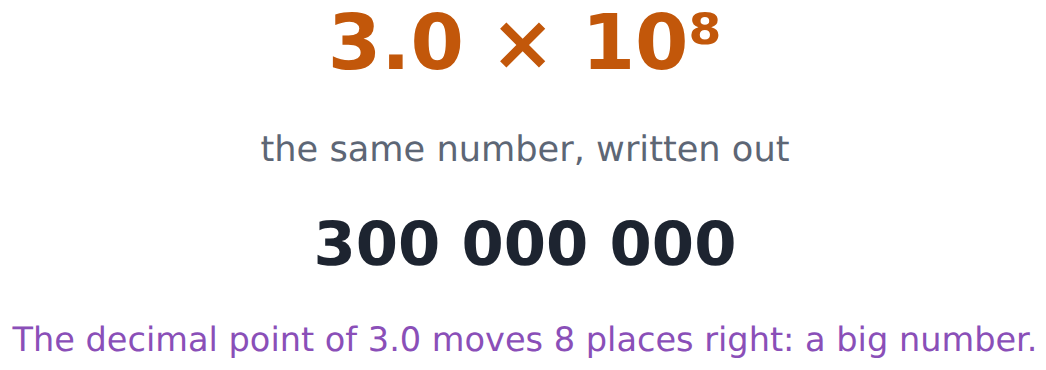
Scientific notation is a number from 1 up to (but not including) 10, times a power of 10.
Big numbers have a positive power: 45000=4.5×10⁴. Small numbers have a negative power: 0.0072=7.2×10⁻³. The power says how many places the decimal point moves.
3×10⁸: the decimal point of 3 moves 8 places right, giving 300 000 000.The power says how far the point moves · Sound on for the voiceoverVoice: Open the lesson →
Still stuck? Try the lesson again first. Then, if your teacher has said you can, copy a coach prompt into the AI tool your school allows. It asks you questions; it won't give you the answers.
Try firstWork out (4 × 10⁶) × (5 × 10⁻²) in scientific notation.
Check your answer
2 × 10⁵.
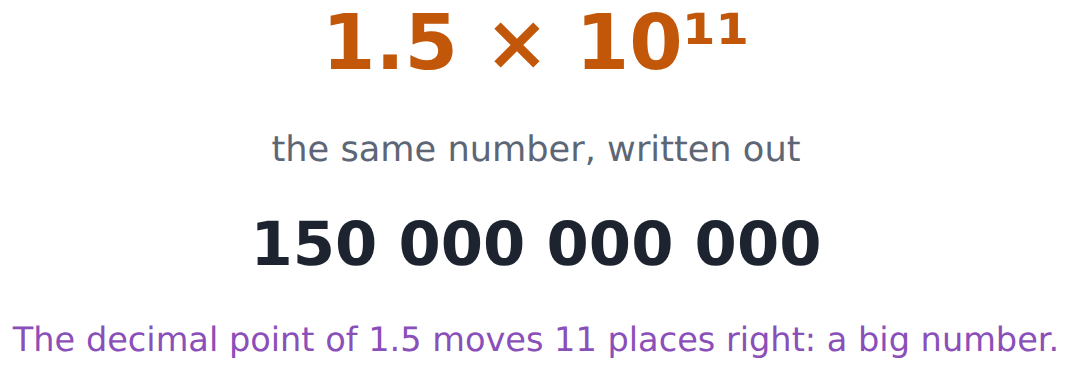
To multiply, multiply the number parts and add the powers. To divide, divide the number parts and subtract the powers. Then check the number part is from 1 to 10: if it's 10 or more, move a factor of 10 into the power.
(3×108)×(5×102)=15×1010=1.5×10¹¹.
15×1010 is 1.5×10¹¹: the number part has to be from 1 to 10, so move a factor of 10 into the power.Fix the number part, then fix the power · Sound on for the voiceoverVoice: Open the lesson →
Still stuck? Try the lesson again first. Then, if your teacher has said you can, copy a coach prompt into the AI tool your school allows. It asks you questions; it won't give you the answers.
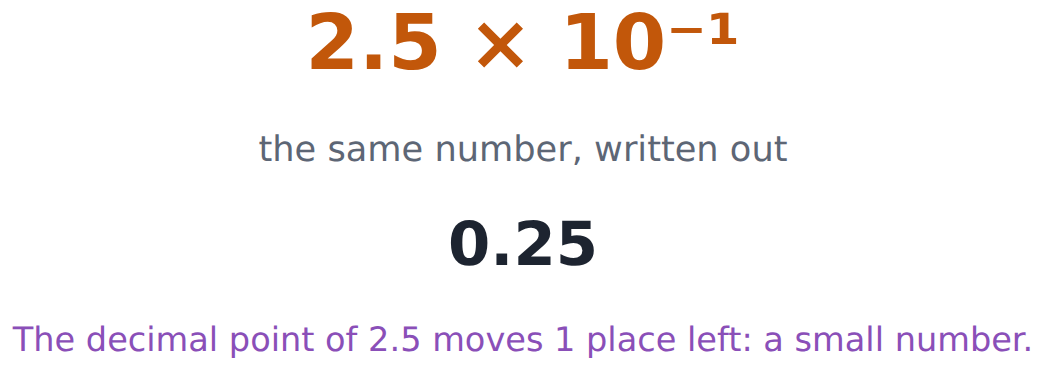
Prefixes are powers of 10: milli is 10−3, micro is 10−6, nano is 10−9. To convert, divide one power by the other.
1 mg =10−3÷10−6 µg =103 µg, so 0.25 mg is 250 µg.
250 micrograms is 2.5×10² µg. A microgram is 10−3 mg, so it's 2.5×10−1=0.25 mg.Micrograms to milligrams: the power drops by 3 · Sound on for the voiceoverVoice: Open the lesson →
Still stuck? Try the lesson again first. Then, if your teacher has said you can, copy a coach prompt into the AI tool your school allows. It asks you questions; it won't give you the answers.
Still stuck? Try the lesson again first. Then, if your teacher has said you can, copy a coach prompt into the AI tool your school allows. It asks you questions; it won't give you the answers.
Still stuck? Try the lesson again first. Then, if your teacher has said you can, copy a coach prompt into the AI tool your school allows. It asks you questions; it won't give you the answers.
Still stuck? Try the lesson again first. Then, if your teacher has said you can, copy a coach prompt into the AI tool your school allows. It asks you questions; it won't give you the answers.
Still stuck? Try the lesson again first. Then, if your teacher has said you can, copy a coach prompt into the AI tool your school allows. It asks you questions; it won't give you the answers.
Still stuck? Try the lesson again first. Then, if your teacher has said you can, copy a coach prompt into the AI tool your school allows. It asks you questions; it won't give you the answers.
Still stuck? Try the lesson again first. Then, if your teacher has said you can, copy a coach prompt into the AI tool your school allows. It asks you questions; it won't give you the answers.
Still stuck? Try the lesson again first. Then, if your teacher has said you can, copy a coach prompt into the AI tool your school allows. It asks you questions; it won't give you the answers.
Still stuck? Try the lesson again first. Then, if your teacher has said you can, copy a coach prompt into the AI tool your school allows. It asks you questions; it won't give you the answers.
Still stuck? Try the lesson again first. Then, if your teacher has said you can, copy a coach prompt into the AI tool your school allows. It asks you questions; it won't give you the answers.
Still stuck? Try the lesson again first. Then, if your teacher has said you can, copy a coach prompt into the AI tool your school allows. It asks you questions; it won't give you the answers.
Still stuck? Try the lesson again first. Then, if your teacher has said you can, copy a coach prompt into the AI tool your school allows. It asks you questions; it won't give you the answers.
Still stuck? Try the lesson again first. Then, if your teacher has said you can, copy a coach prompt into the AI tool your school allows. It asks you questions; it won't give you the answers.
Still stuck? Try the lesson again first. Then, if your teacher has said you can, copy a coach prompt into the AI tool your school allows. It asks you questions; it won't give you the answers.
Still stuck? Try the lesson again first. Then, if your teacher has said you can, copy a coach prompt into the AI tool your school allows. It asks you questions; it won't give you the answers.
Still stuck? Try the lesson again first. Then, if your teacher has said you can, copy a coach prompt into the AI tool your school allows. It asks you questions; it won't give you the answers.
Still stuck? Try the lesson again first. Then, if your teacher has said you can, copy a coach prompt into the AI tool your school allows. It asks you questions; it won't give you the answers.
Still stuck? Try the lesson again first. Then, if your teacher has said you can, copy a coach prompt into the AI tool your school allows. It asks you questions; it won't give you the answers.
Still stuck? Try the lesson again first. Then, if your teacher has said you can, copy a coach prompt into the AI tool your school allows. It asks you questions; it won't give you the answers.
Still stuck? Try the lesson again first. Then, if your teacher has said you can, copy a coach prompt into the AI tool your school allows. It asks you questions; it won't give you the answers.
Still stuck? Try the lesson again first. Then, if your teacher has said you can, copy a coach prompt into the AI tool your school allows. It asks you questions; it won't give you the answers.
Still stuck? Try the lesson again first. Then, if your teacher has said you can, copy a coach prompt into the AI tool your school allows. It asks you questions; it won't give you the answers.
Still stuck? Try the lesson again first. Then, if your teacher has said you can, copy a coach prompt into the AI tool your school allows. It asks you questions; it won't give you the answers.
Still stuck? Try the lesson again first. Then, if your teacher has said you can, copy a coach prompt into the AI tool your school allows. It asks you questions; it won't give you the answers.
Still stuck? Try the lesson again first. Then, if your teacher has said you can, copy a coach prompt into the AI tool your school allows. It asks you questions; it won't give you the answers.
Still stuck? Try the lesson again first. Then, if your teacher has said you can, copy a coach prompt into the AI tool your school allows. It asks you questions; it won't give you the answers.
Still stuck? Try the lesson again first. Then, if your teacher has said you can, copy a coach prompt into the AI tool your school allows. It asks you questions; it won't give you the answers.
Still stuck? Try the lesson again first. Then, if your teacher has said you can, copy a coach prompt into the AI tool your school allows. It asks you questions; it won't give you the answers.
Still stuck? Try the lesson again first. Then, if your teacher has said you can, copy a coach prompt into the AI tool your school allows. It asks you questions; it won't give you the answers.
Match the display to the data type: bars for categories, pies for parts of a whole, lines for time, histograms for measurements and scatter plots for pairs.
Still stuck? Try the lesson again first. Then, if your teacher has said you can, copy a coach prompt into the AI tool your school allows. It asks you questions; it won't give you the answers.
Still stuck? Try the lesson again first. Then, if your teacher has said you can, copy a coach prompt into the AI tool your school allows. It asks you questions; it won't give you the answers.
Still stuck? Try the lesson again first. Then, if your teacher has said you can, copy a coach prompt into the AI tool your school allows. It asks you questions; it won't give you the answers.
Still stuck? Try the lesson again first. Then, if your teacher has said you can, copy a coach prompt into the AI tool your school allows. It asks you questions; it won't give you the answers.
Still stuck? Try the lesson again first. Then, if your teacher has said you can, copy a coach prompt into the AI tool your school allows. It asks you questions; it won't give you the answers.
Still stuck? Try the lesson again first. Then, if your teacher has said you can, copy a coach prompt into the AI tool your school allows. It asks you questions; it won't give you the answers.
Still stuck? Try the lesson again first. Then, if your teacher has said you can, copy a coach prompt into the AI tool your school allows. It asks you questions; it won't give you the answers.
Still stuck? Try the lesson again first. Then, if your teacher has said you can, copy a coach prompt into the AI tool your school allows. It asks you questions; it won't give you the answers.
Relative frequency is the number of times it happened divided by the number of trials. It is an estimate of the probability, and a longer record gives a steadier one.
Still stuck? Try the lesson again first. Then, if your teacher has said you can, copy a coach prompt into the AI tool your school allows. It asks you questions; it won't give you the answers.
Still stuck? Try the lesson again first. Then, if your teacher has said you can, copy a coach prompt into the AI tool your school allows. It asks you questions; it won't give you the answers.
Still stuck? Try the lesson again first. Then, if your teacher has said you can, copy a coach prompt into the AI tool your school allows. It asks you questions; it won't give you the answers.
Still stuck? Try the lesson again first. Then, if your teacher has said you can, copy a coach prompt into the AI tool your school allows. It asks you questions; it won't give you the answers.
Run the simulation many times, find the relative frequency, and compare it with the counted probability. They agree more closely the more trials you run.
Still stuck? Try the lesson again first. Then, if your teacher has said you can, copy a coach prompt into the AI tool your school allows. It asks you questions; it won't give you the answers.
Try firstWhy might 10 real penalties differ from a model's prediction?
Check your answer
Chance in a short run, and things the model leaves out.
Describe the results with numbers, compare them with the theory, and explain differences by chance variation, a short run and what the model leaves out.
Still stuck? Try the lesson again first. Then, if your teacher has said you can, copy a coach prompt into the AI tool your school allows. It asks you questions; it won't give you the answers.