← Year 9 Measurement

Year 9 Measurement: recap

For after the lessons: one card per lesson, to check what you remember. Answer each question in your head or on paper first, then check it. Nothing here is marked.

Looking back over the whole year? See the Year 9 recap.

Scientific notation

1. Scientific notation

Try firstWrite 0.0072 in scientific notation.

Check your answer

7.2 × 10⁻³.

Scientific notation is a number from 1 up to (but not including) 10, times a power of 10.

Big numbers have a positive power: 45 000=4.5×10445\,000 = 4.5 \times 10^4. Small numbers have a negative power: 0.0072=7.2×10−30.0072 = 7.2 \times 10^{-3}. The power says how many places the decimal point moves.
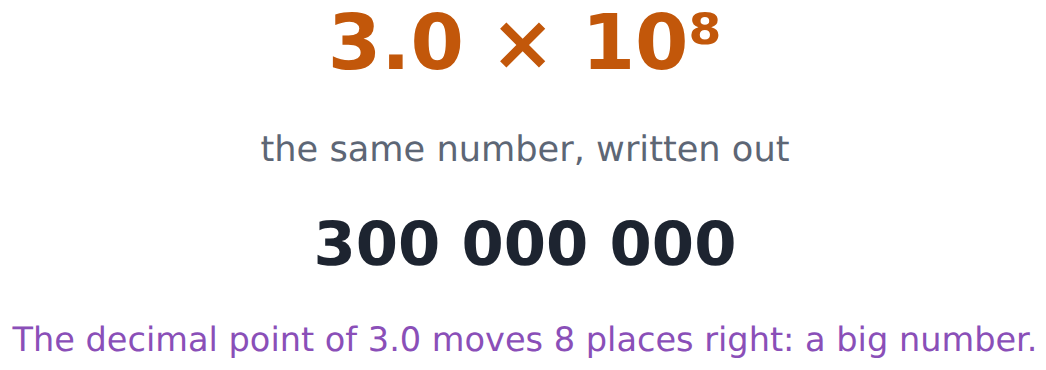
3 \times 10^8: the decimal point of 3 moves 8 places right, giving 300 000 000.
3×1083 \times 10^8: the decimal point of 3 moves 8 places right, giving 300 000 000.
The power says how far the point moves · Sound on for the voiceover
Open the lesson →

2. Calculating in scientific notation

Try firstWork out (4 × 10⁶) × (5 × 10⁻²) in scientific notation.

Check your answer

2 × 10⁵.

To multiply, multiply the number parts and add the powers. To divide, divide the number parts and subtract the powers. Then check the number part is from 1 to 10: if it's 10 or more, move a factor of 10 into the power.

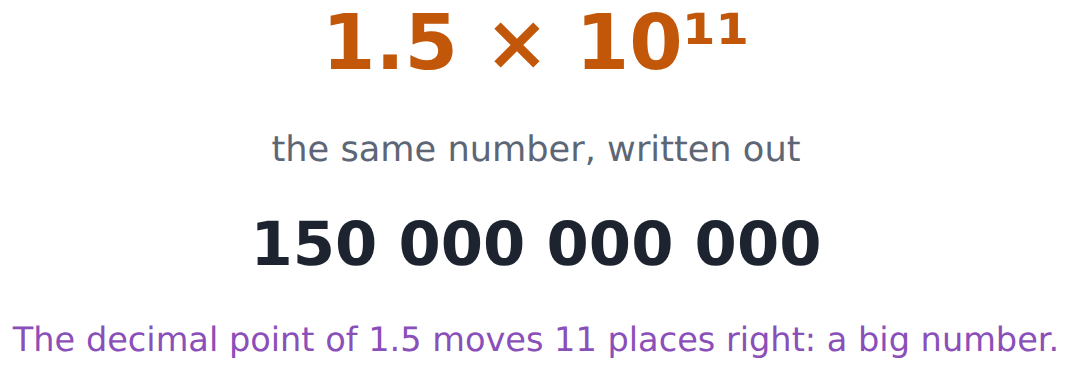
(3×108)×(5×102)=15×1010=1.5×10¹¹(3 \times 10^8) \times (5 \times 10^2) = 15 \times 10^{10} = 1.5 \times 10^{11}.

15 \times 10^{10} is 1.5 \times 10^{11}: the number part has to be from 1 to 10, so move a factor of 10 into the power.
15×101015 \times 10^{10} is 1.5×10111.5 \times 10^{11}: the number part has to be from 1 to 10, so move a factor of 10 into the power.
Fix the number part, then fix the power · Sound on for the voiceover
Open the lesson →

3. Real measurements

Try firstHow many micrograms are in 3 milligrams?

Check your answer

3000, or 3 × 10³.

Prefixes are powers of 10: milli is 10−310^{-3}, micro is 10−610^{-6}, nano is 10−910^{-9}. To convert, divide one power by the other.

1 mg =10−3÷10−6= 10^{-3} \div 10^{-6} µg =103= 10^{3} µg, so 0.25 mg is 250 µg.

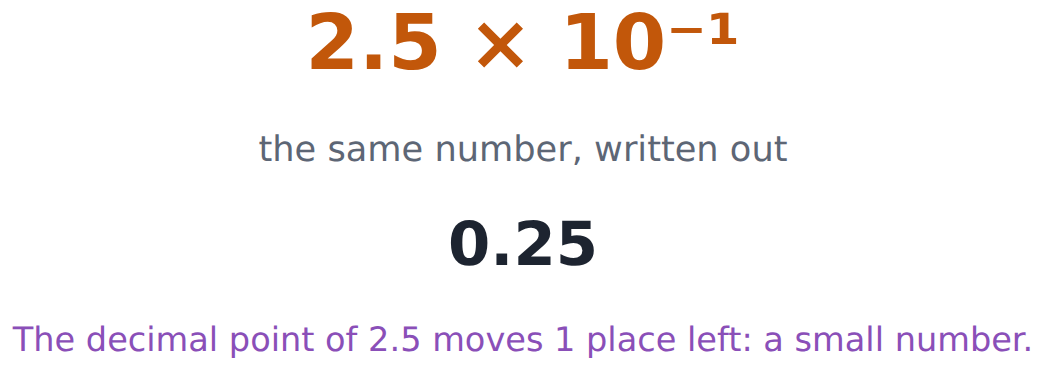
250 micrograms is 2.5 \times 10^{2} µg. A microgram is 10^{-3} mg, so it's 2.5 \times 10^{-1} = 0.25 mg.
250250 micrograms is 2.5×1022.5 \times 10^{2} µg. A microgram is 10−310^{-3} mg, so it's 2.5×10−1=0.252.5 \times 10^{-1} = 0.25 mg.
Micrograms to milligrams: the power drops by 3 · Sound on for the voiceover
Open the lesson →

Surface area and volume

4. Surface area from nets

Try firstHow wide is a can's label when flattened, if the radius is r?

Check your answer

2πr, the circumference.

Unfold the solid into its net, find the area of each piece and add them.

A cylinder's curved side becomes a rectangle with width 2πr.

Open the lesson →

5. Volume of prisms and cylinders

Try firstA cylinder has radius 2 and height 5. What is the base area times the height?

Check your answer

π × 4 × 5 ≈ 62.8.

A prism or cylinder is a base layer stacked up to the height: V = Ah.

For a cylinder A = πr², so V = πr²h.

Open the lesson →

6. Area and volume problems

Try firstPaint covering a wall: area or volume?

Check your answer

Area.

Covering needs surface area (square units). Filling needs volume (cubic units).

A table of designs for the same volume shows which uses least material.

Open the lesson →

Measurement error

7. Every measurement is an estimate

Try firstA reading is 7 cm to the nearest cm. What are the bounds?

Check your answer

6.5 cm and 7.5 cm.

A reading to the nearest mark could be half a mark out either way.

The true value is between the lower and the upper bound.

Open the lesson →

8. Absolute and relative error

Try firstA length should be 100 cm and is 98 cm. What is the relative error?

Check your answer

0.02.

Absolute error is how far out. Relative error is the absolute error divided by the true value.

Relative error lets you compare things of different sizes.

Open the lesson →

9. Percentage error

Try firstA length of 200 cm is out by 1 cm. What is the percentage error?

Check your answer

0.5%.

Percentage error is the absolute error divided by the true value, times 100.

A difference is real only if it is bigger than the combined errors.

Open the lesson →

Proportion and rate models

10. Set up a rate model

Try firstA track climbs 300 m. How long does the climb add by Naismith's rule?

Check your answer

0.5 hours.

Naismith's rule has two rates added together: time on the flat is distance ÷ 5 and time climbing is climb ÷ 600.

Match each part with its unit.

Open the lesson →

11. Solve the rate model

Try first0.5 hours is how many minutes?

Check your answer

30.

Use the model forwards to find a time, or backwards to find a distance or a start.

Say what the answer means for the plan, and leave a margin.

Open the lesson →

12. Judge the model

Try firstWhy report a range, not one number, from a model?

Check your answer

The model is an estimate; the range shows how much depends on its assumptions.

A model is only as good as what it assumes.

Test it on a different case and report the answer, the range and the reason.

Open the lesson →

Trigonometry

13. Find a side with trigonometry

Try firstOpposite = adjacent × ?

Check your answer

tan of the angle.

Name the sides from the angle, choose the ratio that has the side you know and the side you want, and solve.

If the unknown is on top, multiply. If it is underneath, divide.

Open the lesson →

14. Find an angle

Try firsttan of an angle is 1. What is the angle?

Check your answer

45°.

tan⁻¹, sin⁻¹ and cos⁻¹ turn a ratio back into an angle.

Name the sides, pick the ratio, then use its inverse.

Open the lesson →

15. Similar triangles and scale

Try firstTriangle sides are multiplied by 5. By how much is the area multiplied?

Check your answer

25.

Similar triangles have the same angles. Multiply every side by the same scale factor.

The area is multiplied by the factor squared.

Open the lesson →

16. Ramp to a door

Try firstRise 1, run 14: which tool gives the angle?

Check your answer

tan⁻¹(1 ÷ 14).

Draw the triangle and mark what you know. The gradient gives a side, Pythagoras gives the third side, and an inverse ratio gives the angle.

Then check the answer makes sense.

Open the lesson →