← Year 7 Algebra

Year 7 Algebra: recap

For after the lessons: one card per lesson, to check what you remember. Answer each question in your head or on paper first, then check it. Nothing here is marked.

Looking back over the whole year? See the Year 7 recap.

Expressions

1. Letters that vary

Try firstA taxi charges T = 2d + 4 dollars for d km. Name the variables and the constants, and say what the 4 means.

Check your answer

Variables: T and d. Constants: 2 and 4. The 4 is the fee to get in, paid even for 0 km.

In a formula, letters stand for quantities. A letter whose value can change is a variable; a number that stays the same is a constant.

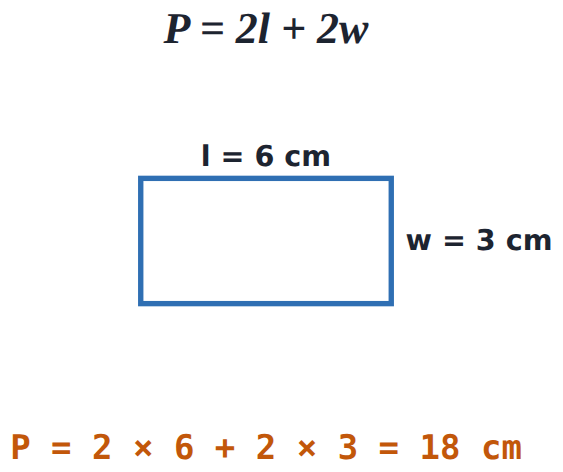
In P=2l+2wP = 2l + 2w, PP, ll and ww are variables and the 2s are constants.

In an equation such as 3x+2=143x + 2 = 14, the letter is an unknown: one particular number (x=4x = 4) makes it true.

P = 2l + 2w: P, l and w are variables (each rectangle has its own); the 2s are constants (the same for every rectangle).
P=2l+2wP = 2l + 2w: PP, ll and ww are variables (each rectangle has its own); the 2s are constants (the same for every rectangle).
Variables change; constants stay the same · Sound on for the voiceover
Open the lesson →

2. Substituting into formulas

Try firstFind C = 8h + 15 when h = 3, and V = lwh when l = 2, w = 5, h = 3.

Check your answer

C = 8 × 3 + 15 = 39. V = 2 × 5 × 3 = 30.

To substitute, replace each letter with its value.

A number next to a letter means multiply: 2l2l means 2×l2 \times l. Two letters next to each other also multiply: lwlw means l×wl \times w. Write the × signs in before working anything out.

Then work it out in order: brackets first, then × and ÷, then + and −. Give the units.

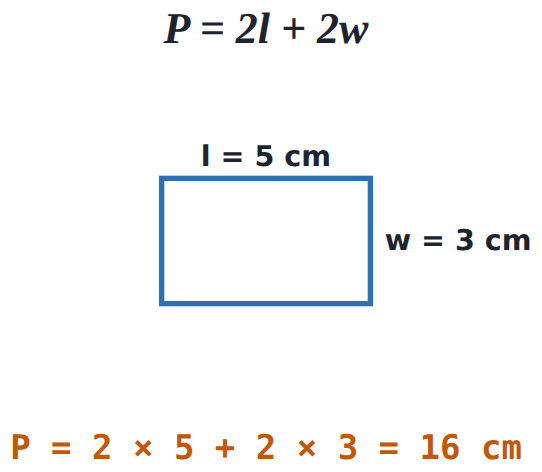
l = 5 and w = 3: write in the × signs, P = 2 \times 5 + 2 \times 3 = 10 + 6 = 16 cm.
l=5l = 5 and w=3w = 3: write in the × signs, P=2×5+2×3=10+6=16P = 2 \times 5 + 2 \times 3 = 10 + 6 = 16 cm.
Replace each letter with its value · Sound on for the voiceover
Open the lesson →

3. Finding an unknown

Try firstA gym costs T = 15w + 30 dollars for w weeks. Someone paid 120 dollars. How many weeks? Check your answer.

Check your answer

120 = 15w + 30, so 15w = 90 and w = 6. Check: 15 × 6 + 30 = 120.

When you know a formula's answer but not one of its letters, substitute the values you know. What is left is an equation with one unknown.

Solve it by undoing: undo the last operation first (+ and − before × and ÷).

Then check: put your answer back into the formula. It should give the value you started with.

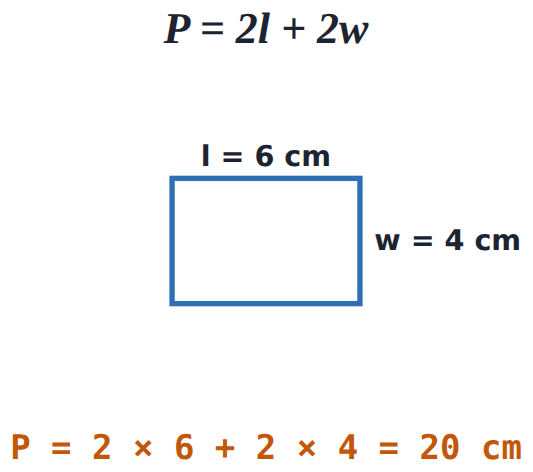
P = 20 and l = 6: 20 = 2 \times 6 + 2w, so 2w = 8 and w = 4. Check: 2 \times 6 + 2 \times 4 = 20.
P=20P = 20 and l=6l = 6: 20=2×6+2w20 = 2 \times 6 + 2w, so 2w=82w = 8 and w=4w = 4. Check: 2×6+2×4=202 \times 6 + 2 \times 4 = 20.
Substitute what you know, then solve for the rest · Sound on for the voiceover
Open the lesson →

4. Words into expressions

Try firstWrite an expression for: (a) 4 less than n; (b) 2 more than 5 times n; (c) n shared between 3.

Check your answer

(a) n − 4. (b) 5n + 2. (c) n/3.

Words about a number tell you what to do to it. More than means add; less than means subtract; times, twice and lots of mean multiply; divided by and shared between mean divide.

Write the operations in the order the words say them. "3 more than twice n" is twice n (2n) and then 3 more: 2n+32n + 3.

"Less than" starts from the number: 7 less than n is n−7n - 7, not 7−n7 - n.

Check an expression by trying a number you can work out in words.

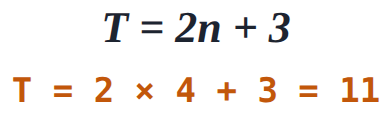
"3 more than twice n": twice n is 2n, then 3 more gives 2n + 3. With n = 4: 2 \times 4 + 3 = 11.
"3 more than twice nn": twice nn is 2n2n, then 3 more gives 2n+32n + 3. With n=4n = 4: 2×4+3=112 \times 4 + 3 = 11.
Say it in steps, then write each step · Sound on for the voiceover
Open the lesson →

5. When brackets are needed

Try firstWrite an expression for: (a) add 6 to n, then multiply by 3; (b) multiply n by 3, then add 6. Which one gives 15 when n = 3?

Check your answer

(a) 3(n + 6); (b) 3n + 6. (b): 3 × 3 + 6 = 15; (a) gives 27.

Brackets group a part so it is worked out first.

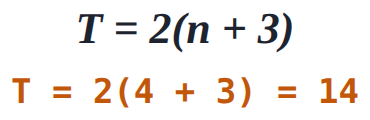
If a sentence says to do something to the whole result of an earlier step, put that earlier step in brackets. "Add 3 to n, then double the result" is 2(n+3)2(n + 3).

If the later step is adding or subtracting, brackets are not needed: "double n, then add 3" is 2n+32n + 3.

The two are different. With n=4n = 4: 2(n+3)=142(n + 3) = 14 and 2n+3=112n + 3 = 11.

"Add 3 to n, then double the result": the brackets keep n + 3 together, so 2(n + 3). With n = 4: 2(4 + 3) = 14. Without brackets, 2n + 3 = 11.
"Add 3 to nn, then double the result": the brackets keep n+3n + 3 together, so 2(n+3)2(n + 3). With n=4n = 4: 2(4+3)=142(4 + 3) = 14. Without brackets, 2n+3=112n + 3 = 11.
Brackets keep a part together · Sound on for the voiceover
Open the lesson →

6. An expression for any case

Try firstA gym costs 30 dollars to join plus 15 dollars a week. Write what your letter stands for, an expression for the total, and the cost after 8 weeks.

Check your answer

Let w be the number of weeks. Total = 15w + 30. After 8 weeks: 15 × 8 + 30 = 150 dollars.

To write an expression for a situation: (1) say what the letter stands for: the number that changes, such as the number of guests; (2) multiply it by the amount for each one; (3) add anything paid only once.

A hall costing 60 dollars plus 5 dollars per guest, with gg guests, is 5g+605g + 60.

Test the expression with one case you can check in words, then use it for any number.

The letter stands for a number, not for the objects: in 3a3a, aa is how many apples.

Let g be the number of guests. A hall costs 60 dollars plus 5 dollars per guest: C = 5g + 60. With 10 guests: 5 \times 10 + 60 = 110 dollars.
Let gg be the number of guests. A hall costs 60 dollars plus 5 dollars per guest: C=5g+60C = 5g + 60. With 10 guests: 5×10+60=1105 \times 10 + 60 = 110 dollars.
Say what the letter stands for, then write the expression · Sound on for the voiceover
Open the lesson →

Rules, tables and graphs

7. Growing patterns

Try firstA pattern has 6, 11, 16 tiles in Figures 1 to 3. Write the rule and find Figure 20.

Check your answer

s = 5n + 1; Figure 20 has 101 tiles.

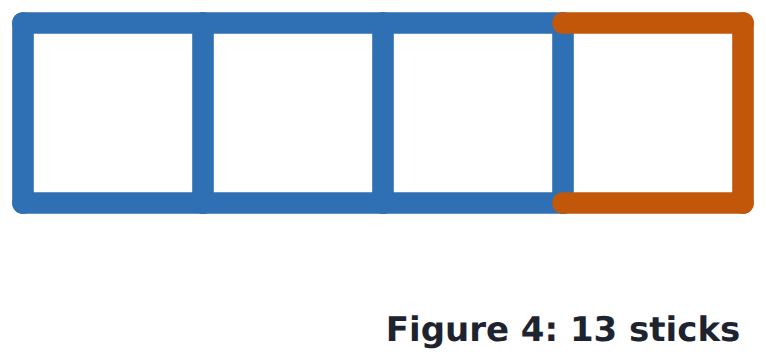
A growing pattern adds the same amount each time. Look at what each new figure adds: for a row of squares made of sticks, each new square adds 3 sticks (it shares a side).

So figure nn has nn lots of 3, plus what every figure has before that: 1 stick on the left. The rule is s=3n+1s = 3n + 1.

The rule gives any figure without drawing it: Figure 10 has 3×10+1=313 \times 10 + 1 = 31 sticks. To go backwards, solve: 3n+1=463n + 1 = 46 gives n=15n = 15.

Figure 4 has 13 sticks. Each new square adds 3 (orange), and there is 1 extra stick at the start: s = 3n + 1.
Figure 4 has 13 sticks. Each new square adds 3 (orange), and there is 1 extra stick at the start: s=3n+1s = 3n + 1.
Each figure adds the same amount: that gives the rule · Sound on for the voiceover
Open the lesson →

8. Tables from rules

Try firstMake a table for y = 4x − 3 with the inputs 0, 1, 2, 3. Write the pairs.

Check your answer

Outputs −3, 1, 5, 9. Pairs (0, −3), (1, 1), (2, 5), (3, 9).

A rule like y=2x+3y = 2x + 3 turns an input xx into an output yy. To make a table of values, choose some inputs, put each one in place of xx, and work out its output.

Each input and its output make an ordered pair (x,y)(x, y): input first, output second. For x=4x = 4: y=2(4)+3=11y = 2(4) + 3 = 11, so the pair is (4,11)(4, 11), not (11,4)(11, 4) and not (4,4)(4, 4).

To go backwards (which input gives an output of 15?), set the rule equal to it and solve: 2x+3=152x + 3 = 15, so x=6x = 6.

Input x, work out y, write the pair (x, y) · Sound on for the voiceover
Open the lesson →

9. Plotting a rule

Try firstPlot the pairs of y = 3x − 1 for x = 0 to 3. Describe the graph.

Check your answer

(0, −1), (1, 2), (2, 5), (3, 8): a straight line going up 3 for each step right, crossing the y-axis at −1.

To plot the point (x,y)(x, y), start at (0,0)(0, 0), go across xx and then up yy. A negative number goes left or down.

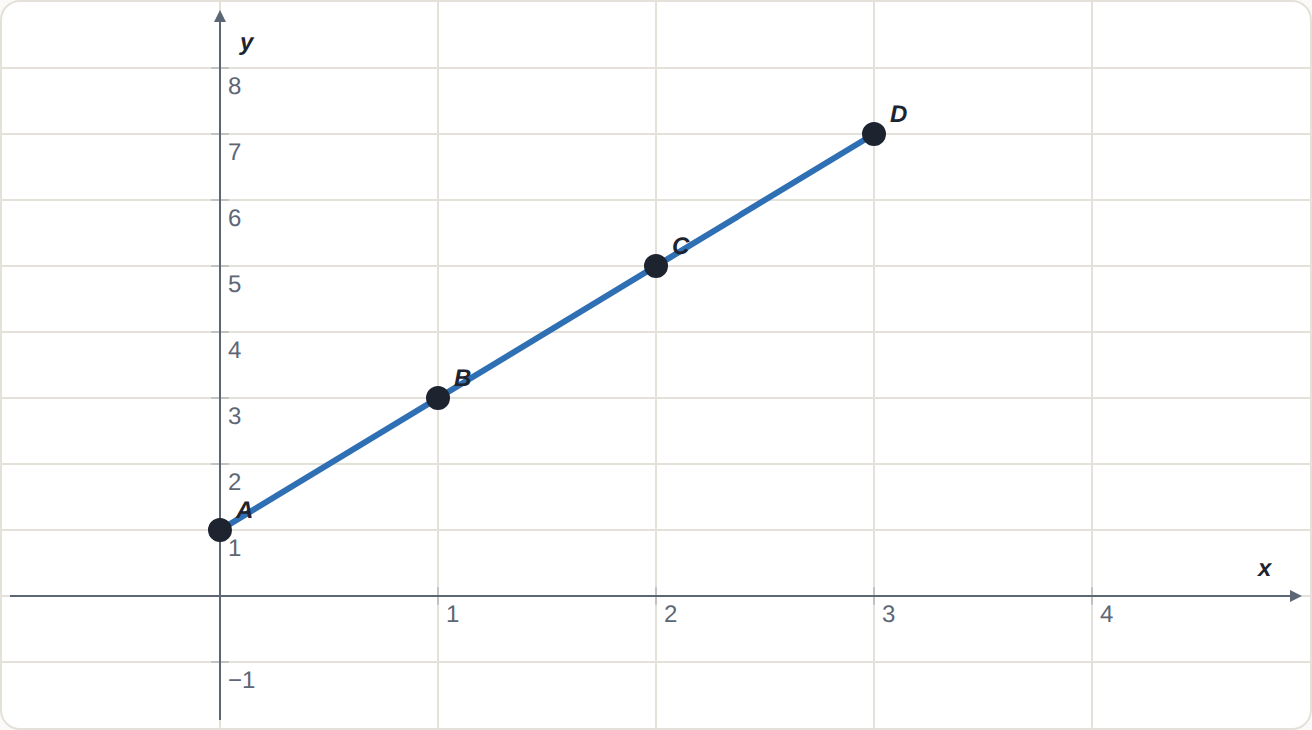
Plot each ordered pair from a rule's table. For y=2x+1y = 2x + 1 the pairs (0,1)(0, 1), (1,3)(1, 3), (2,5)(2, 5), (3,7)(3, 7) lie on a straight line, because each step of 1 across adds the same amount (2) to yy.

Describe the line by which way it goes and how much for each step: "up 2 for each step right, crossing the yy-axis at 1". If the steps in the table change, the points curve instead.

The pairs of y = 2x + 1: (0, 1), (1, 3), (2, 5), (3, 7). They lie on a straight line, going up 2 for each step right.
The pairs of y=2x+1y = 2x + 1: (0,1)(0, 1), (1,3)(1, 3), (2,5)(2, 5), (3,7)(3, 7). They lie on a straight line, going up 2 for each step right.
Open the lesson →

10. Reading a graph

Try firstA graph of height (cm) against age (years) has the point (12, 150). What does it say?

Check your answer

At 12 years the height is 150 cm.

A graph of real data pairs two measurements. Check the axis labels first: one measurement is across (the bottom axis) and the other is up the side.

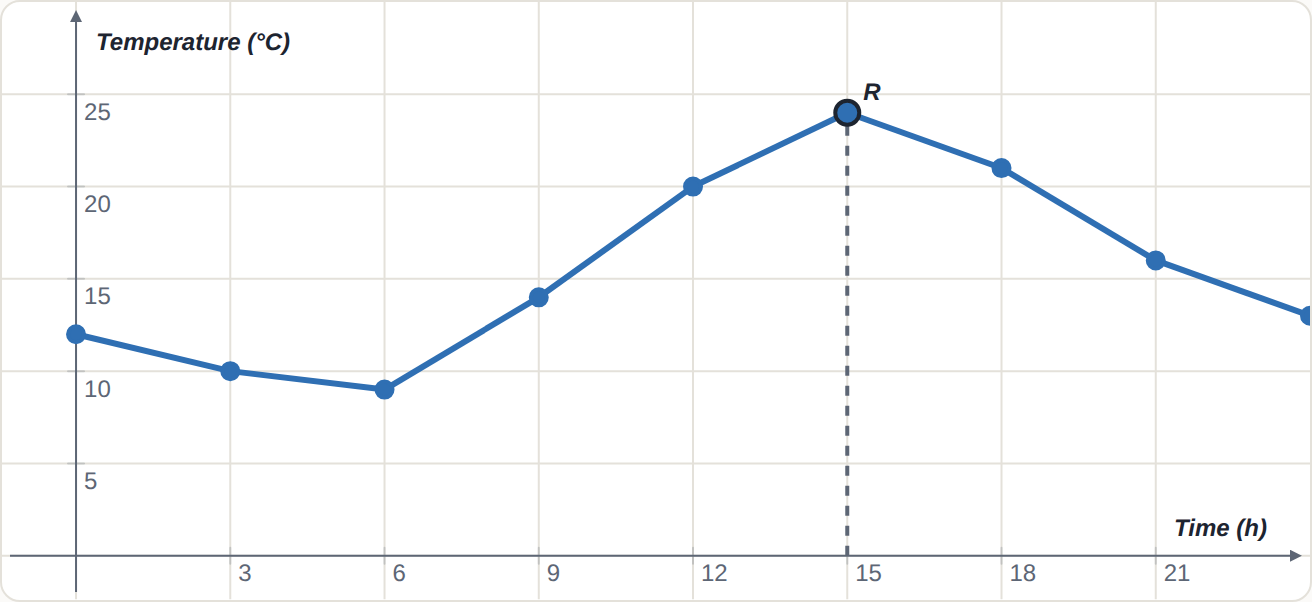
To read a graph, find the value you know on its own axis, go to the line, then read across to the other axis. The point (15,24)(15, 24) on a graph of temperature against time says: at 15 hours the temperature is 24 °C. Give the units in your answer.

The two numbers of a point belong to different axes. Swapping them gives a different (and wrong) statement.

At 15 hours the temperature is 24 °C: find 15 on the Time axis, go up to the line, read across to the Temperature axis. The point is (15, 24).
At 15 hours the temperature is 24 °C: find 15 on the Time axis, go up to the line, read across to the Temperature axis. The point is (15,24)(15, 24).
Find one value, go to the line, read the other · Sound on for the voiceover
Open the lesson →

11. Describing a relationship

Try firstA graph of a tap's water in a bucket (L) against time (min) goes up, then is flat. Describe it.

Check your answer

As time increases, the amount of water increases, then stays constant (the tap was turned off).

A graph shows how one measurement changes as another changes. Describe it one section at a time: as time increases, the other measurement increases, decreases or stays constant.

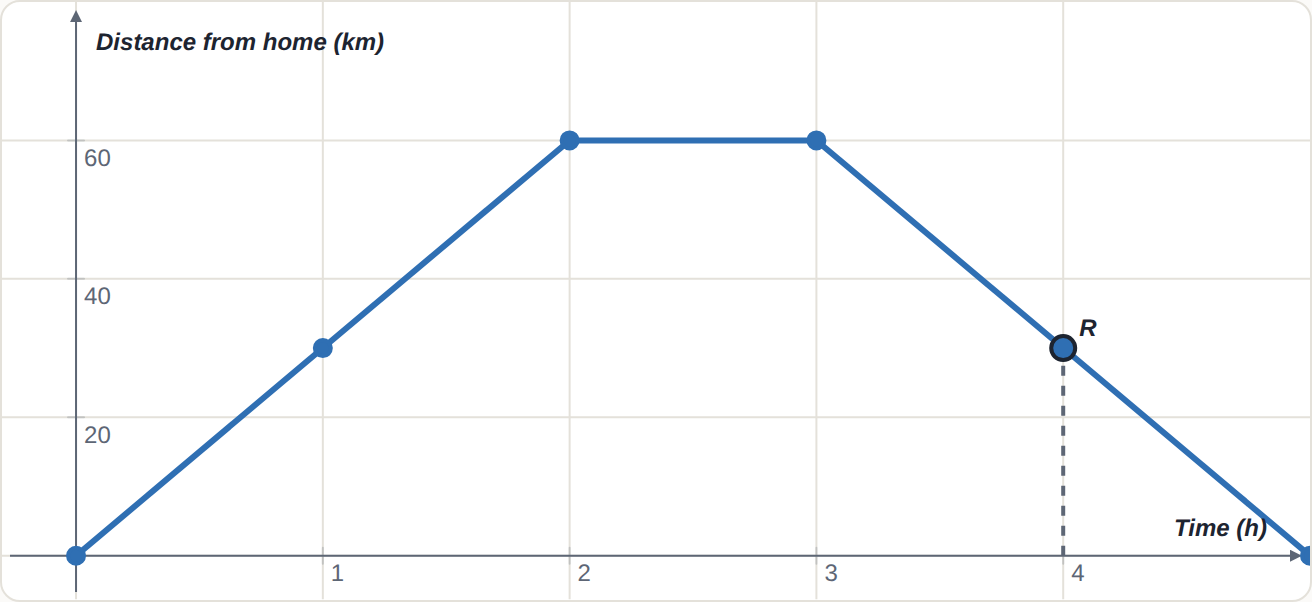
For the bike ride: from 0 to 2 hours the distance from home increases, from 2 to 3 hours it stays constant (the cyclist has stopped), and from 3 to 5 hours it decreases (riding home).

A graph is not a picture of the journey. A line going down does not mean going downhill: it means the measurement on the up-axis is getting smaller.

A bike ride. 0 to 2 hours: the distance from home increases. 2 to 3 hours: it stays constant (stopped). 3 to 5 hours: it decreases (riding home).
Describe one section at a time · Sound on for the voiceover
Open the lesson →

12. Changing one thing at a time

Try firstIn V = lwh with l = 2, w = 3, h = 4, h goes to 8 and nothing else changes. What is V?

Check your answer

48: 2 × 3 × 8, double the 24 it was.

To see what one variable does in a formula, change that variable only and keep the others the same, then record the results in a table.

In V=lwhV = lwh, doubling any one variable doubles VV. In A=s×sA = s \times s, doubling ss makes AA four times as big.

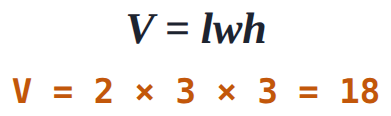
With l = 2 and w = 3 held still, a taller box (h = 3) has volume 2 \times 3 \times 3 = 18.
With l=2l = 2 and w=3w = 3 held still, a taller box (h = 3) has volume 2×3×3=182 \times 3 \times 3 = 18.
Only h changes · Sound on for the voiceover
Open the lesson →

Equations

13. Equations as a balance

Try firstIs x = 7 a solution of 3x − 5 = 16? Show how you know.

Check your answer

Yes. 3 × 7 − 5 = 21 − 5 = 16, which equals the right side.

An equation says two things are equal: 2x+3=112x + 3 = 11 says "two lots of something, plus 3, is 11".

The solution is the value that makes it true. To check a value, put it in place of the letter (this is called substitution) and work out each side. If both sides are the same, it is a solution.

Remember: 2x2x means 2×x2 \times x. If x=4x = 4, then 2x2x is 8, not 24.

Open the lesson →

14. Solving by backtracking

Try firstSolve 5x + 6 = 41 by backtracking. Show each step and check your answer.

Check your answer

41 − 6 = 35, then 35 ÷ 5 = 7. Check: 5 × 7 + 6 = 41.

Backtracking means running an equation backwards. In 2x+3=112x + 3 = 11, xx is multiplied by 2, then 3 is added, and the answer is 11.

To find xx, undo each step with its opposite, starting with the last one: take away 3 (11−3=811 - 3 = 8), then divide by 2 (8÷2=48 \div 2 = 4).

Then check by running forwards: 2×4+3=112 \times 4 + 3 = 11. If it matches, you have the solution.

Open the lesson →

15. The balance method

Try firstSolve 4x + 3 = 2x + 11. Show each step and check your answer in the first equation.

Check your answer

Take 2x from both sides: 2x + 3 = 11. Take 3: 2x = 8. Divide by 2: x = 4. Check: 4 × 4 + 3 = 19 and 2 × 4 + 11 = 19.

An equation is like a balanced scale. If you do the same thing to both sides, it stays balanced, so the equation stays true.

To solve 2x+3=112x + 3 = 11: take 3 from both sides (2x=82x = 8), then divide both sides by 2 (x=4x = 4).

When xx is on both sides, take the same number of xx from both sides first.

Always check in the first equation: 2×4+3=112 \times 4 + 3 = 11 ✓.

Open the lesson →