← Teacher guide Markdown for Prepare

Chance: cheat sheet

Year 8 Probability · The words and methods from the lessons, with an example of each.

complementary events

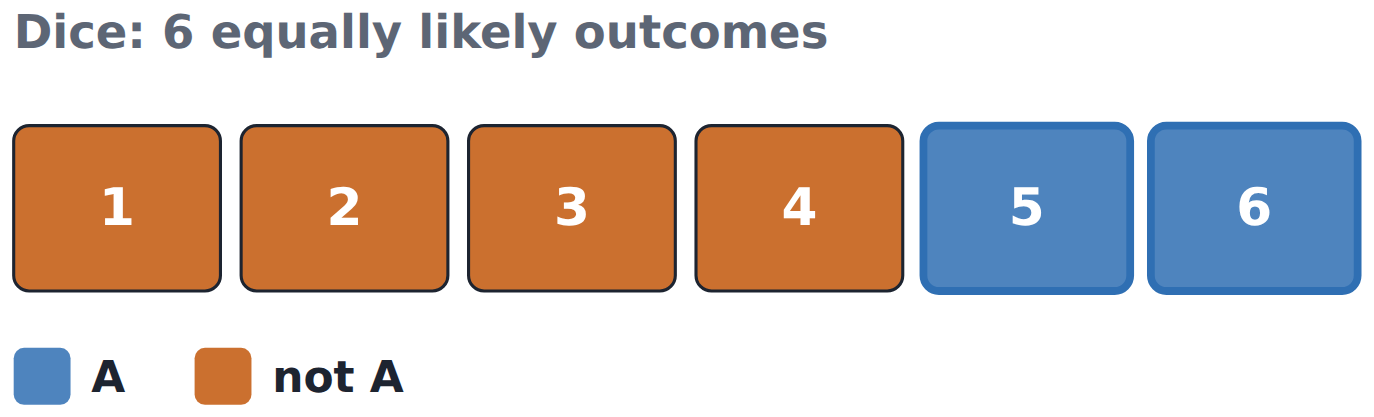
An event and its complement cover every outcome once. For 'at least one', count the outcomes with none and subtract from 1.
P(not A)=1−P(A)P(\text{not } A) = 1 - P(A)
Roll 5 or 6 (A) and the other four outcomes (not A)

grid and tree diagram

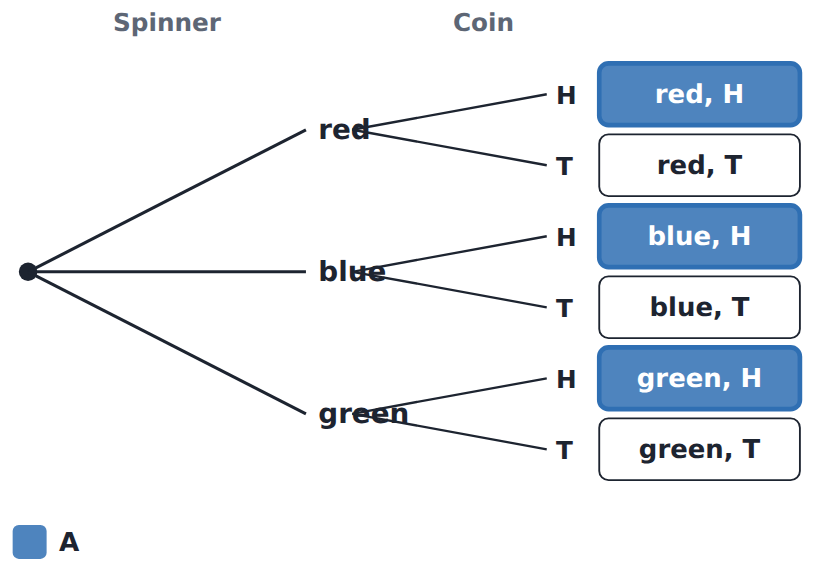
Two events make pairs: a grid or a tree lists every pair once, and the number of outcomes is the two counts multiplied. HT and TH are different outcomes.
outcomes=3×2=6\text{outcomes} = 3 \times 2 = 6
A spinner with three equal parts, then a coin: 6 outcomes, 3 of them heads

Venn diagram and two-way table

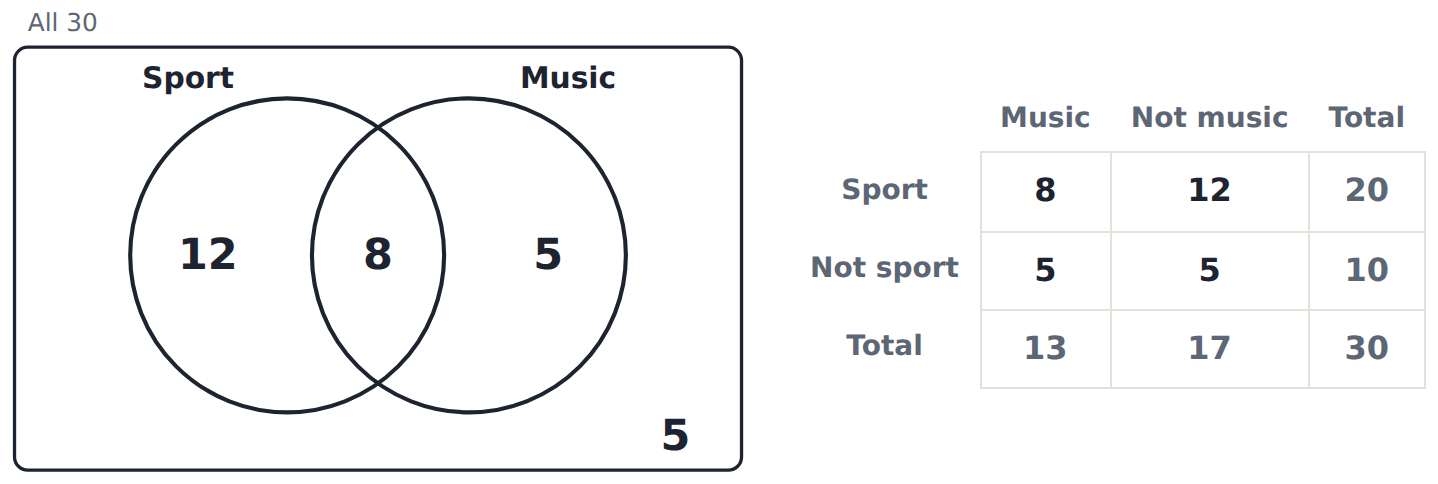
Two yes/no properties make four groups: one only, both, the other only, neither. Each is a region of the Venn diagram and a cell of the table.
both first: only=total−both\text{both first: only} = \text{total} - \text{both}
The same 30 students as a Venn diagram and a two-way table

and, or, not

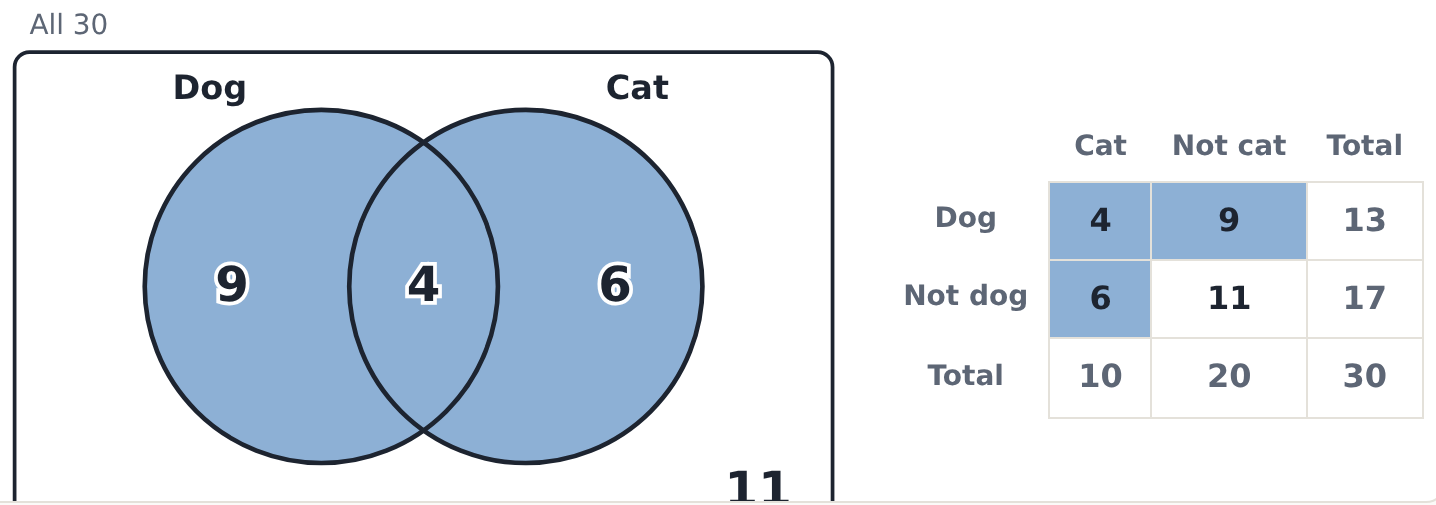
And is the overlap; or is one, the other or both; not A is everything outside A. Count each outcome once.
P(A or B)=P(A)+P(B)−P(A and B)P(A \text{ or } B) = P(A) + P(B) - P(A \text{ and } B)
Dog or cat: everything inside the circles, 19 of 30

simulation

Run many trials with random numbers (=RANDBETWEEN(1,6) is a dice) and compare the relative frequency with the probability. Short runs can be well off.
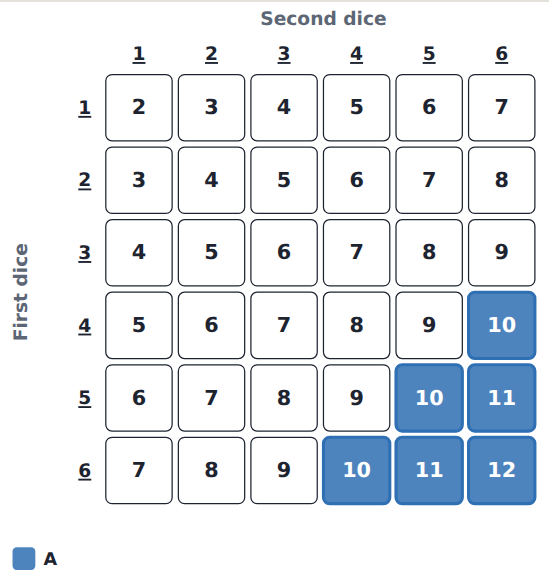
relative frequency=counttrials\text{relative frequency} = \dfrac{\text{count}}{\text{trials}}
Two dice with a total of 10 or more chosen (6 of 36), ready to simulate