← Year 10 Space

Year 10 Space: recap

For after the lessons: one card per lesson, to check what you remember. Answer each question in your head or on paper first, then check it. Nothing here is marked.

Looking back over the whole year? See the Year 10 recap.

Proof

1. Some cases or every case?

Try firstMia measured the diagonals of 6 rectangles and they were equal each time. Is that a proof that every rectangle's diagonals are equal? Say why.

Check your answer

No. Six rectangles are six cases. A proof gives a reason that works for every rectangle, such as two congruent triangles.

A demonstration checks some cases and shows the claim works for those. A proof gives a reason that covers every case at once.

A letter that stands for any whole number, or a rule that holds for every triangle, turns a demonstration into a proof. A single counterexample, a checked case that breaks the claim, is enough to show a claim is false.
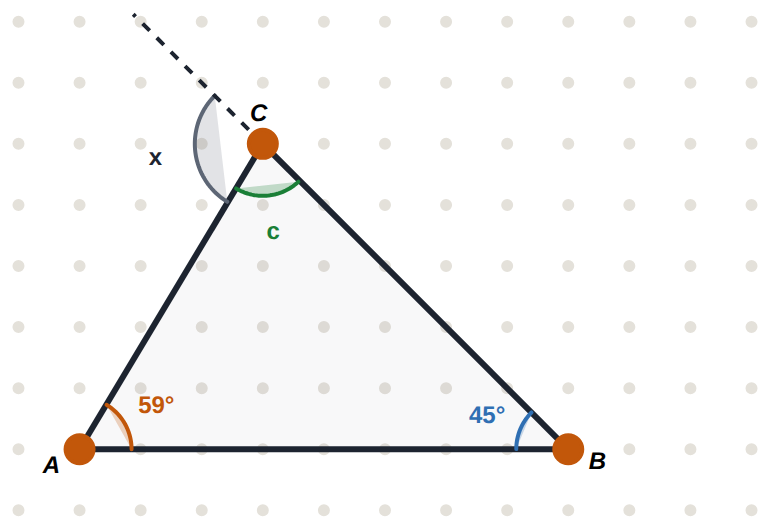
a = 59^\circ, b = 45^\circ, and x = 104^\circ here. Dragging shows x = a + b for the triangles you try. A proof shows it for every triangle.
a=59∘a = 59^\circ, b=45∘b = 45^\circ, and x=104∘x = 104^\circ here. Dragging shows x=a+bx = a + b for the triangles you try. A proof shows it for every triangle.
Cases or a proof · Sound on for the voiceover
Open the lesson →

2. Writing a proof

Try firstTriangle ABC has a = 50° and b = 60°. Side AC is extended past C, making an exterior angle x. Write a proof, with a reason for each line, that x = a + b.

Check your answer

c = 180° − 50° − 60° = 70° (angles in a triangle). x = 180° − 70° = 110° (angles on a straight line). So x = 110° = a + b.

A proof is a list of statements, each with a reason. A reason is a given fact, a rule you already know (such as co-interior angles add to 180°), or a line you have already proved.

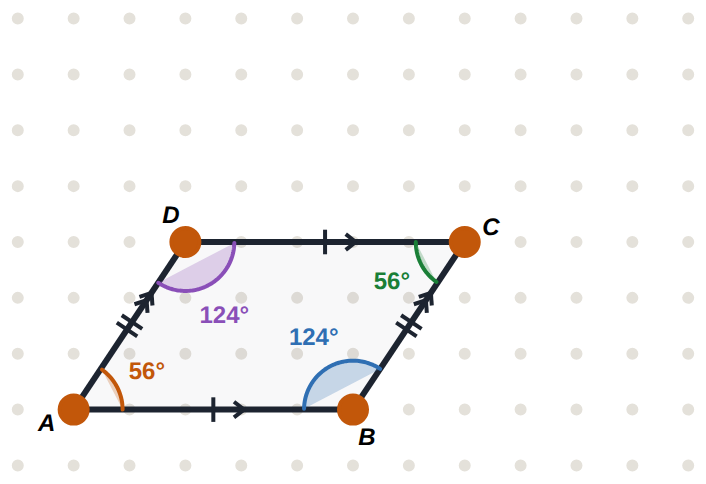
To prove opposite angles of a parallelogram are equal: A + B = 180° and B + C = 180° (co-interior angles), so A = C. A reason cannot be the conclusion itself.

A parallelogram ABCD. A + B = 180° and B + C = 180°, both co-interior angles, so A = C.
Each statement has a reason · Sound on for the voiceover
Open the lesson →

3. Using theorems

Try firstA corner has sides 9 m and 12 m, and the diagonal is 15 m. Is the corner square? Name the theorem.

Check your answer

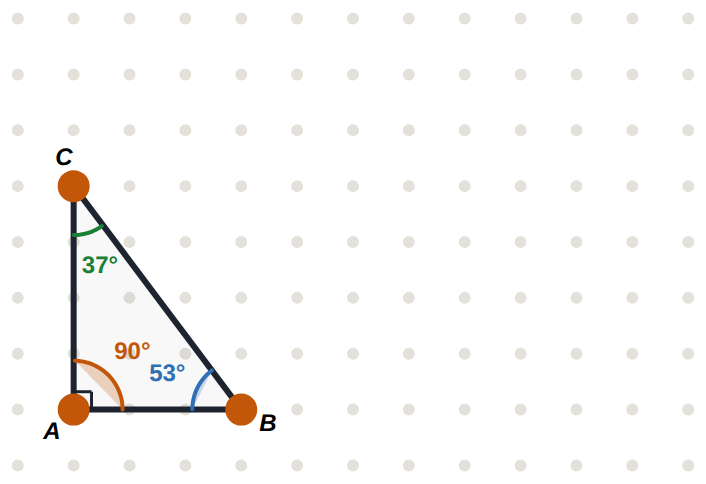
Yes. 9² + 12² = 225 = 15², so by Pythagoras' converse the angle is a right angle.

A theorem is a result already proved. To use one, match the facts you have to the facts it needs, and check its direction.

Pythagoras' converse: if a² + b² = c², the angle opposite c is 90°. The rectangle test: a parallelogram with equal diagonals is a rectangle (equal diagonals alone are not enough). The parallelogram test: both pairs of opposite sides equal makes a parallelogram.

Sides 3 and 4 at the corner, and the string across is 5: 3² + 4² = 5², so the corner is a right angle.
Using Pythagoras' converse · Sound on for the voiceover
Open the lesson →

Networks

4. Nodes and edges

Try firstA network has 9 edges. What do the degrees of all its nodes add up to?

Check your answer

18.

A network is nodes joined by edges. A map of train lines is a network: the stations are nodes and the lines are edges. The degree of a node is how many edges meet there.

A network keeps only who is joined to whom, so the length of a line on the page isn't a distance.

Open the lesson →

5. Every street once

Try firstA connected suburb has four junctions with an odd number of streets. Can the sweeper do every street once?

Check your answer

No. A route can only start and finish at odd junctions, so two is the most it can handle.

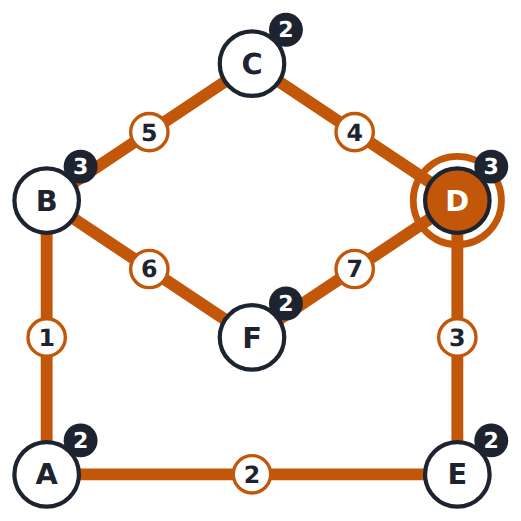
A route that uses every street exactly once exists in a connected network when it has no odd junctions or exactly two. With two, it starts at one odd junction and finishes at the other. With none, it can start anywhere and comes back to where it started.

A made-up suburb: B and D have three streets each. Starting at B and finishing at D uses every street once.
Start at A, then start at B · Sound on for the voiceover
Open the lesson →

6. Euler's rule

Try firstA solid has 6 faces and 10 vertices. How many edges?

Check your answer

14.

For a solid with flat faces, faces + vertices = edges + 2. Count two of the three and the rule gives the third. When you count edges from the sides of the faces, halve the total, because every edge is on two faces.

Open the lesson →

Algorithms

7. Pin the problem down

Try firstA spray reaches 7 m. Write one thing that must be true of a layout, and find the side of the biggest square one sprinkler covers, to 1 decimal place.

Check your answer

Every point of the oval is within 7 m of a sprinkler. The side is 7 × √2 ≈ 9.9 m.

A problem is pinned down when you can say its inputs, its output, what counts as done, what must hold and what you're assuming.

For the sprinklers: the oval's length and width and the spray's reach go in, a count and positions come out, and a layout counts only if every point is within reach of a sprinkler. The job splits into two smaller problems: how big a square one sprinkler covers (its corner is the furthest point, so the side is r × √2) and how many of those squares the oval takes.

Open the lesson →

8. Write the algorithm

Try firstA sprinkler reaches 8 m (s = 11.2). Run the algorithm on an oval 25 m long and 14 m wide. How many sprinklers does it place?

Check your answer

25 ÷ 11.2 ≈ 2.23 rounds up to 3 columns. 14 ÷ 11.2 = 1.25 rounds up to 2 rows. 3 × 2 = 6 sprinklers.

An algorithm is exact steps that work for any input. Some steps compute a number, one decides whether to go on, and a loop repeats the placing for every cell.

For the sprinklers: find s = 1.4 × r, count the columns and rows with each rounded up, work out the cell size, then put a sprinkler in the middle of every cell. It always covers the oval; it doesn't always use the fewest.

Open the lesson →