← Year 10 Measurement

Year 10 Measurement: recap

For after the lessons: one card per lesson, to check what you remember. Answer each question in your head or on paper first, then check it. Nothing here is marked.

Looking back over the whole year? See the Year 10 recap.

Log scales

1. How big is a step?

Try firstA magnitude 8 against a magnitude 6: about how many times as much energy?

Check your answer

About 1000 (32 × 32 = 1024).

On a logarithmic scale each step is a multiplication, not an addition.

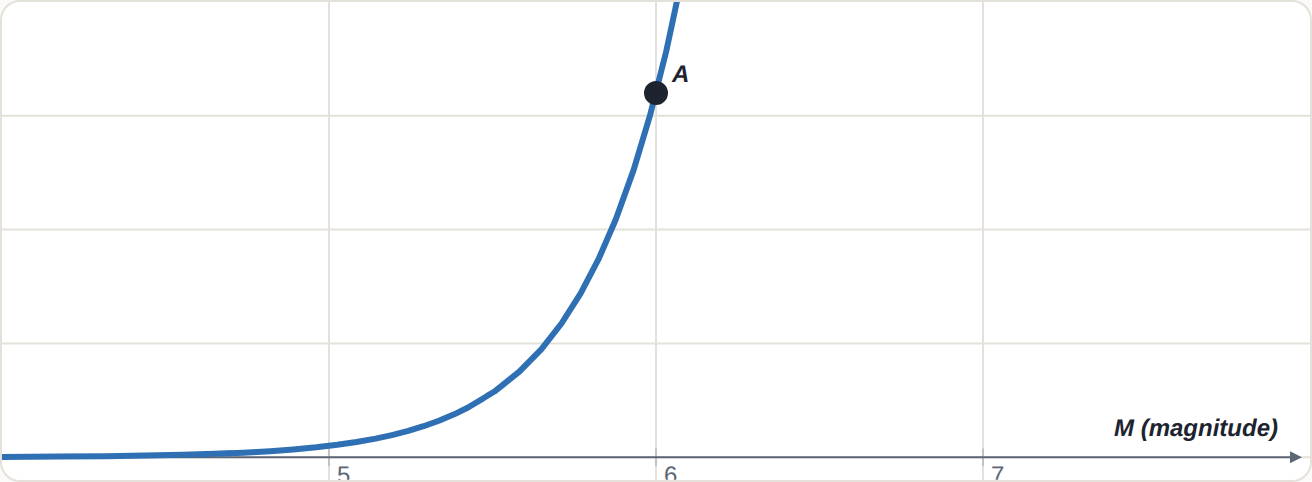
Each step up the earthquake scale is about 32 times the energy. Two steps is 32×32=102432 \times 32 = 1024, three steps is 323=32 76832^3 = 32\,768. Going down a step divides by 32.

One step from magnitude 5 to 6: the energy is about 32 times as much, so the point is at 32.
One step up the scale is a multiplication · Sound on for the voiceover
Open the lesson →

2. Reading log scales

Try firstHow many hours is it safe to stay at 94 dB, if 85 dB allows 8 hours and every 3 dB halves it?

Check your answer

1 hour (3 steps, 8 ÷ 8).

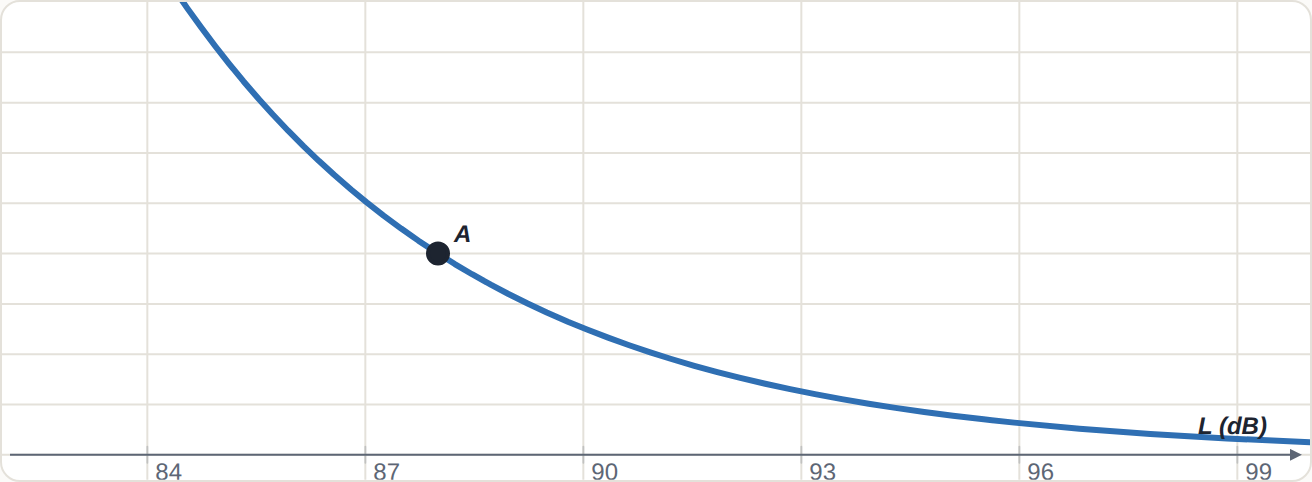
Equal steps on a log scale are equal multipliers. On the decibel scale each 3 dB step halves the safe time: 8 hours, 4, 2, 1, and so on.

A log ruler puts every power of 10 the same distance apart, so two things 10k10^{k} times apart are kk steps apart, and the middle between 10 and 1000 is 100.

Three decibels up, from 85 to 88: the safe time halves, from 8 hours to 4.
Every 3 dB halves the time · Sound on for the voiceover
Open the lesson →

Composite solids

3. Break it into solids

Try firstA water pipe is a big cylinder with a smaller cylinder through the middle. Do you add or take away the small cylinder's volume to find the pipe's material?

Check your answer

Take it away: the hole has no material in it.

An object made of solids is found in parts. Name the solids, then add the volumes of the parts that make up the space, and take away the volumes of the parts that are holes.

A cone holds a third of the cylinder that fits round it. Where two solids join, the faces that touch are hidden inside.

Open the lesson →

4. Surface area of composite objects

Try firstA box stands on top of a bigger box. Why is the surface area of the stack less than the two boxes' surface areas added together?

Check your answer

The face where they touch is hidden on both, so it counts for neither.

The surface area of a composite object is just the outside faces. Where two solids join, the faces that touch are hidden, so they are left out.

A hole through a solid takes away two faces but adds an inside wall, so the surface area can go up.

Open the lesson →

5. Volume of composite objects

Try firstA pool has a shallow end and a deep end. Name two ways to find its volume.

Check your answer

Add the shallow box and the deep box, or take the missing water away from a box as deep as the deep end.

A composite volume is found by adding the parts or by taking a part away from a bigger solid. Both ways give the same answer, so one checks the other.

A model of a real tank or silo makes assumptions, such as perfect shapes, and its answer is only as good as they are.

Open the lesson →

Trigonometry in practice

6. Looking up, looking down

Try firstFrom a 20 m cliff the angle of depression to a boat is 30°. What is the angle of elevation from the boat to the cliff top?

Check your answer

30°. They're alternate angles.

A line of sight makes the same size angle at both ends: the angle of depression from the top and the angle of elevation from the bottom.

Draw the triangle with the angle at the bottom, where the height is opposite it and the distance along the ground is next to it. Then use tangent: tan⁡t=height÷distance\tan t = \text{height} \div \text{distance}.

Open the lesson →

7. Bearings

Try firstA leg is 100 m on a bearing of 060°. Which is bigger, north or east?

Check your answer

East (87 m against 50 m). 060° is closer to east than to north.

A bearing is an angle measured clockwise from north, in three figures.

Draw the triangle with the angle at the start, between the north line and the path. North is next to the angle (cos⁡\cos) and east is opposite it (sin⁡\sin). Past 090°, measure the angle from the south line.

Open the lesson →

8. The triangle inside

Try firstA box is 6 cm by 6 cm by 7 cm. What is the longest straight line inside it?

Check your answer

11 cm (36 + 36 + 49 = 121).

To find a length inside a box, find a right-angled triangle. The floor gives one: its hypotenuse is the floor diagonal.

Then the floor diagonal and the height are the shorter sides of a second triangle, standing up. Its hypotenuse is the longest line in the box: l2+w2+h2\sqrt{l^2 + w^2 + h^2}.

Open the lesson →

Measurement error

9. Where errors come from

Try firstA scale shows 3 g when nothing is on it. Is that an instrument, a method or a person error, and is it systematic or random?

Check your answer

Instrument; systematic, because it adds 3 g to every reading.

An error can come from the instrument, the method or the person.

A systematic error pushes every reading the same way, so repeating and averaging does not remove it. A random error goes both ways, so the average is closer. Readings that agree with each other can all be wrong in the same way, so check against a trusted value.

Open the lesson →

10. One error, one result

Try firstA square is measured as 5.0 m by 5.0 m, each to the nearest 0.1 m. What is the highest its area could be?

Check your answer

5.05 × 5.05 = 25.5025 m².

A result calculated from measurements has an error too, and it is usually bigger than any one measurement's error.

Use the lowest and highest of each measurement: the lowest result comes from every measurement at its lowest, and the highest from every measurement at its highest. For a 4.0 m by 3.0 m room, to the nearest 0.1 m, the area could be from 11.65 m² to 12.35 m².

l = 4.0 and w = 3.0 to the nearest 0.1 m: the area could be anywhere from 11.6525 m² to 12.3525 m².
l=4.0l = 4.0 and w=3.0w = 3.0 to the nearest 0.1 m: the area could be anywhere from 11.6525 m² to 12.3525 m².
A reading can be out, so the area can be out · Sound on for the voiceover
Open the lesson →

11. Errors that build up

Try firstTwelve pieces are each measured to the nearest 0.1 m. How far out could the total be, at most?

Check your answer

12 × 0.05 = 0.6 m.

When a job is done in many steps, the errors add: in the worst case the total is out by the number of steps times one step's error.

When measurements are multiplied, their percentage errors add up, about. A bound is the most a result could be out by; real errors usually partly cancel.

Five lengths of 4.0 m, each to the nearest 0.1 m: the total is 20.0 m, and it could be out by up to 0.25 m.
Small errors add up · Sound on for the voiceover
Open the lesson →

Scale

12. Scale factors

Try firstAt 1 : 200 a building is 6.5 cm on the plan. How long is the building in metres?

Check your answer

6.5 × 200 = 1300 cm = 13 m.

A scale such as 1 : 100 is a scale factor of 100. Plan to real: multiply by it. Real to plan: divide by it. Change units last, because the answer comes out in the plan's unit.

Areas use the scale factor squared, so a plan area of 12 cm² at 1 : 100 is 12 m².

Open the lesson →

13. Using a plan

Try firstAt 1 : 100 a corridor is 0.8 cm wide on the plan. How wide is it in real life?

Check your answer

0.8 × 100 = 80 cm = 0.8 m.

To use a plan, read a length with a ruler, multiply by the scale, change to metres, and compare with what you want to fit.

A reading error on the plan is multiplied by the scale too, so check whether the margin is bigger than the error.

Open the lesson →