← Year 10 Algebra

Year 10 Algebra: recap

For after the lessons: one card per lesson, to check what you remember. Answer each question in your head or on paper first, then check it. Nothing here is marked.

Looking back over the whole year? See the Year 10 recap.

Powers of terms

1. Powers of terms

Try firstSimplify (3x²)³.

Check your answer

27x⁶.

A power outside a bracket applies to every part inside: (2k)3=23×k3=8k3(2k)^3 = 2^3 \times k^3 = 8k^3.

Divide terms by dividing the numbers and subtracting the indices. If the index comes out negative, write the letter underneath: 4k2÷8k3=12k4k^2 \div 8k^3 = \dfrac{1}{2k}.

Open the lesson →

Special products and factorising

2. Special products

Try firstExpand (x − 6)².

Check your answer

x² − 12x + 36.

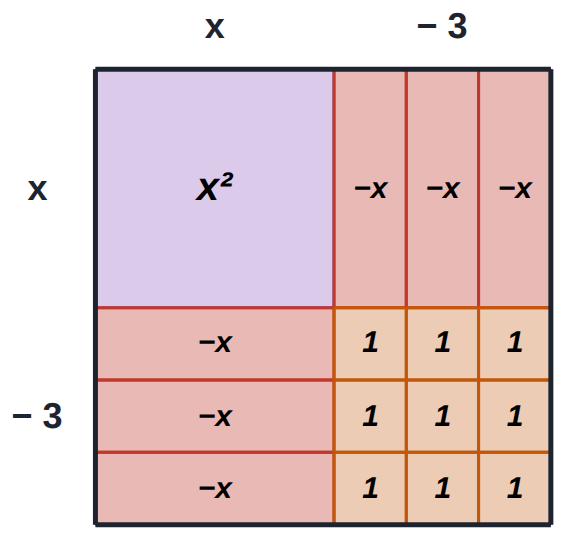
A bracket squared is the bracket times itself: (x+3)2=(x+3)(x+3)=x2+3x+3x+9=x2+6x+9(x + 3)^2 = (x + 3)(x + 3) = x^2 + 3x + 3x + 9 = x^2 + 6x + 9. There are four pieces: a square, two strips and a corner. It isn't x2+9x^2 + 9.

With a minus sign, the strips are red and the corner is still positive: (x−3)2=x2−6x+9(x - 3)^2 = x^2 - 6x + 9.

When the brackets differ only in their sign, the strips cancel: (x+3)(x−3)=x2−3x+3x−9=x2−9(x + 3)(x - 3) = x^2 - 3x + 3x - 9 = x^2 - 9.

(x - 3)^2: the square x^2, two red strips of 3x taken off, and a corner of +9.
(x−3)2(x - 3)^2: the square x2x^2, two red strips of 3x3x taken off, and a corner of +9+9.
A square bracket: two strips and a corner · Sound on for the voiceover
Open the lesson →

3. Factorising when x² has a number

Try firstFactorise 2x² + 11x + 5.

Check your answer

(2x + 1)(x + 5).

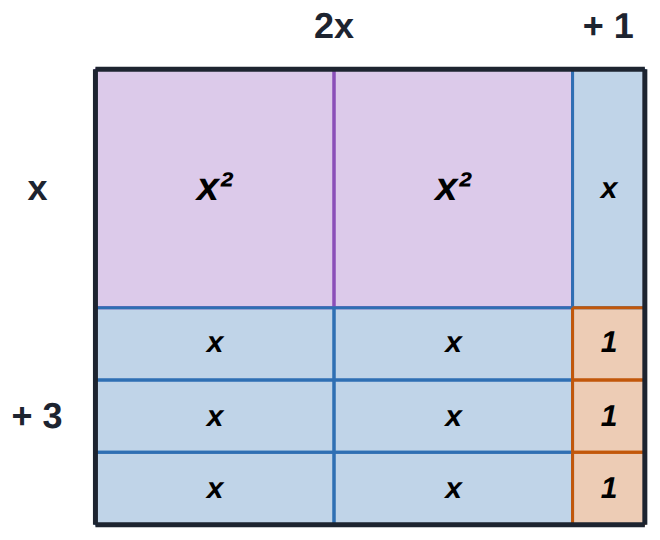
When there's a number in front of x2x^2, the two numbers for the strips multiply to a×ca \times c, not cc. For 2x2+7x+32x^2 + 7x + 3: 2×3=62 \times 3 = 6, and 11 and 66 add to 77.

Split the middle term and group: 2x2+6x+x+3=2x(x+3)+1(x+3)=(2x+1)(x+3)2x^2 + 6x + x + 3 = 2x(x + 3) + 1(x + 3) = (2x + 1)(x + 3). Check by expanding.

2x^2 + 7x + 3 packs into a rectangle 2x + 1 wide and x + 3 tall: 2 big squares, 7 strips and 3 ones.
2x2+7x+32x^2 + 7x + 3 packs into a rectangle 2x+12x + 1 wide and x+3x + 3 tall: 2 big squares, 7 strips and 3 ones.
Pack the tiles: the x² number changes the sides · Sound on for the voiceover
Open the lesson →

Solving

4. Completing the square

Try firstWrite x² + 6x + 1 as (x + 3)² + k. What is k?

Check your answer

−8: the corner needs 9 and there is 1, so k = 1 − 9 = −8.

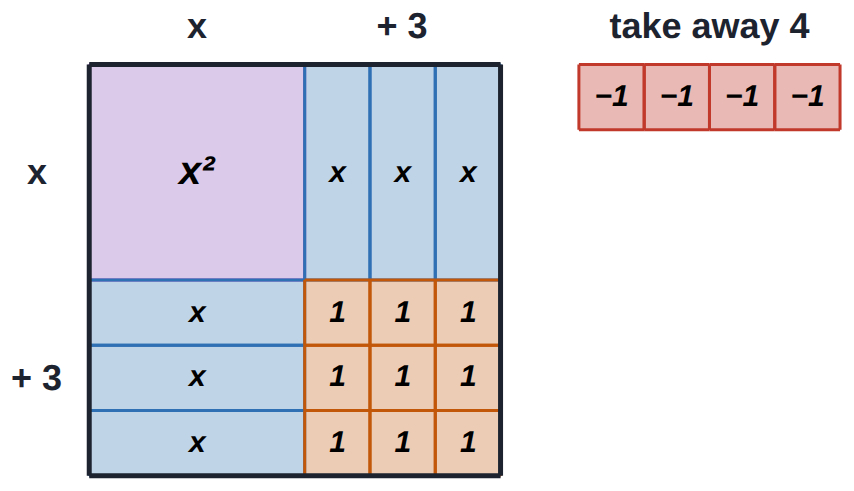
A square with sides x+3x + 3 is an xx by xx square, two strips of 3x3x, and a corner of 9. That is (x+3)2=x2+6x+9(x + 3)^2 = x^2 + 6x + 9.

If you have x2+6x+5x^2 + 6x + 5, you have the square and the strips but only 5 ones for a corner that needs 9. So it is the square, with 4 ones taken away: x2+6x+5=(x+3)2−4x^2 + 6x + 5 = (x + 3)^2 - 4.

A square is never below zero, so the lowest value of (x+3)2−4(x + 3)^2 - 4 is −4-4, when x=−3x = -3.

x^2 + 6x + 5: three x-tiles down each side, a corner that needs 9 ones, and only 5 to put in it, so 4 are taken away: (x + 3)^2 - 4.
x2+6x+5x^2 + 6x + 5: three xx-tiles down each side, a corner that needs 9 ones, and only 5 to put in it, so 4 are taken away: (x+3)2−4(x + 3)^2 - 4.
Fill the corner, then take away what you didn't have · Sound on for the voiceover
Open the lesson →

5. Solving by reshaping

Try firstA rectangle's length is 2 m more than its width, and its area is 15 m². Find the width.

Check your answer

3 m: w(w + 2) = 15, so (w + 5)(w − 3) = 0 and w = 3 (w = −5 is thrown out).

A photo 30 cm by 20 cm with a border xx all the way round has sides 30+2x30 + 2x and 20+2x20 + 2x, because the border is at both ends.

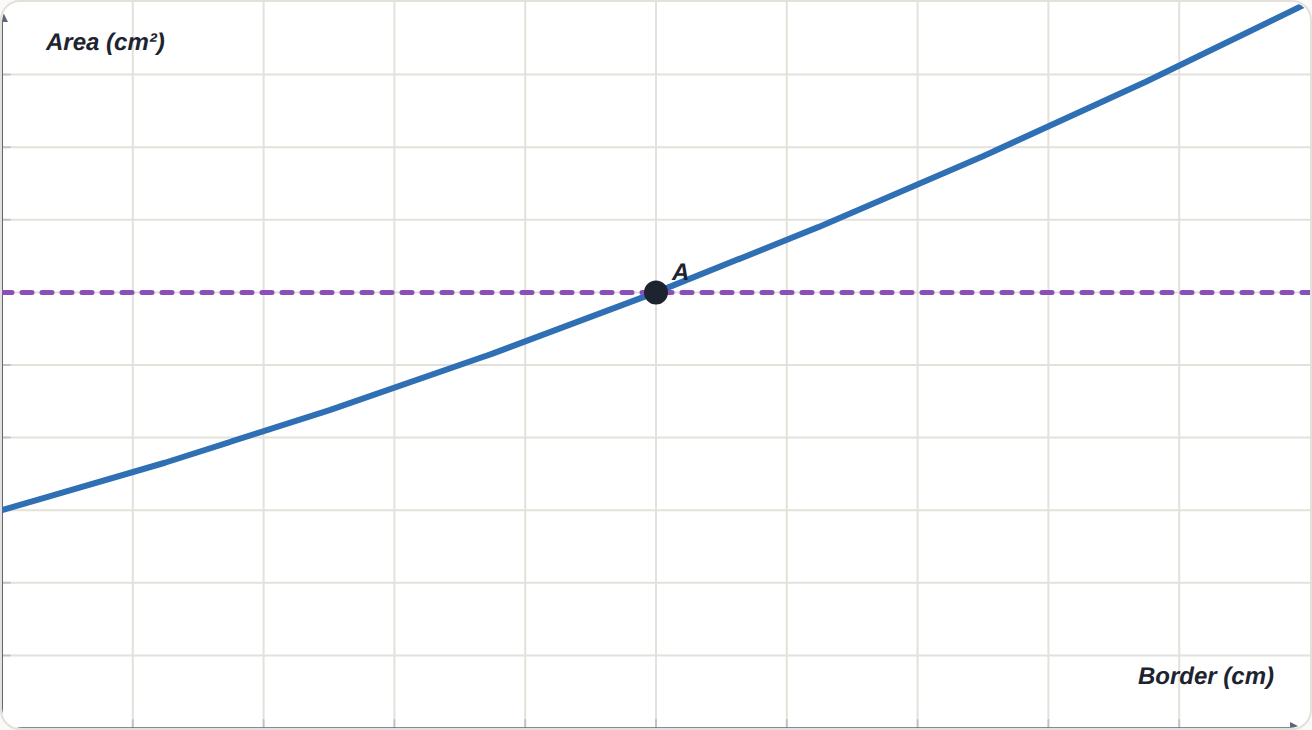
The framed area is (30+2x)(20+2x)=4x2+100x+600(30 + 2x)(20 + 2x) = 4x^2 + 100x + 600. Setting it to 1200 and moving everything across gives 4x2+100x−600=04x^2 + 100x - 600 = 0, which is x2+25x−150=0x^2 + 25x - 150 = 0 after dividing by 4. That factorises as (x+30)(x−5)=0(x + 30)(x - 5) = 0.

Both x=−30x = -30 and x=5x = 5 solve the equation, but a border can't be negative, so the answer is 5 cm.

The framed area 4w^2 + 100w + 600 meets 1200 at a border of w = 5 cm.
The framed area 4w2+100w+6004w^2 + 100w + 600 meets 12001200 at a border of w=5w = 5 cm.
Make the framed area reach 1200 · Sound on for the voiceover
Open the lesson →

6. Solving inequalities

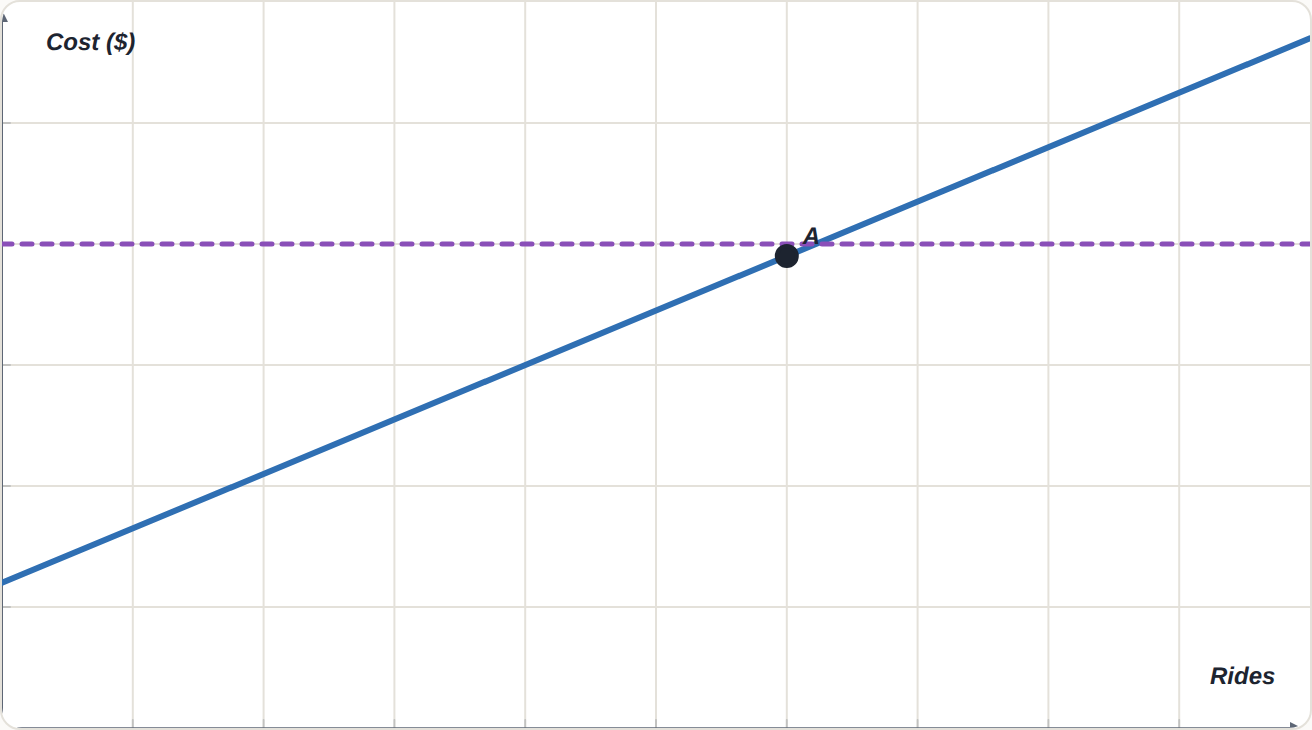
Try firstYou have $50 and a day costs $14 entry plus $3.50 a ride. What is the most whole rides?

Check your answer

10: 14 + 3.5r ≤ 50, so r ≤ 10.28, and 10 whole rides.

An entry of $12 and $4.50 a ride costs 12+4.5r12 + 4.5r for rr rides. With $40 to spend, 12+4.5r≤4012 + 4.5r \le 40.

Solve it like an equation: 4.5r≤284.5r \le 28, so r≤6.2r \le 6.2. If you divide by a negative, reverse the sign.

The solution is a range, but rides come whole, so the context picks the values: the most is 6 rides, which costs $39. Seven would cost $43.50.

12 + 4.5r against the 40 limit: 6 rides cost 39, and 7 would cost 43.50.
12+4.5r12 + 4.5r against the $40 limit: 6 rides cost $39, and 7 would cost $43.50.
Rides until the cost passes $40 · Sound on for the voiceover
Open the lesson →

Two variables

7. Regions from a budget

Try firstTickets cost 10 dollars and snacks 5 dollars. The budget is 60 dollars. Where does the boundary of 10t + 5s ≤ 60 meet each axis?

Check your answer

t-axis (s = 0): 10t = 60, t = 6. s-axis (t = 0): 5s = 60, s = 12. The line joins (6, 0) and (0, 12).

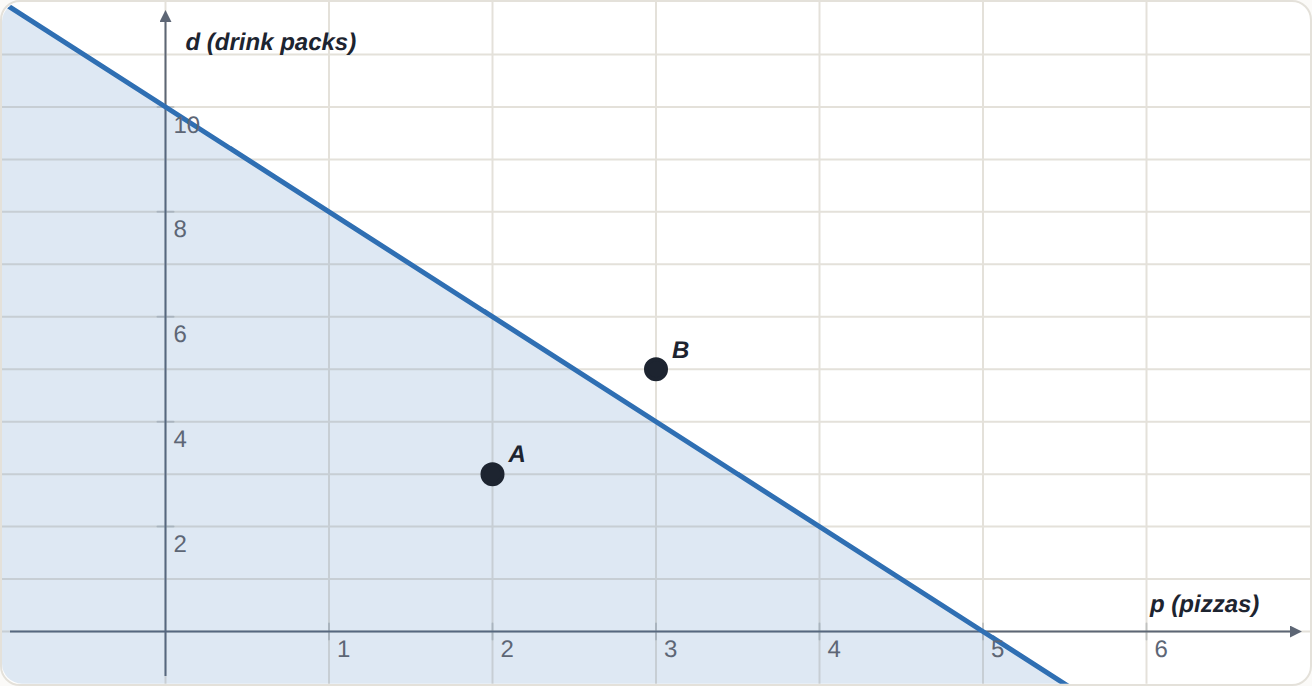
A budget with two kinds of item is an inequality in two letters: 24p+12d≤12024p + 12d \le 120.

To graph it, put each letter equal to 0 in turn. With p=0p = 0: 12d=12012d = 120 so d=10d = 10. With d=0d = 0: 24p=12024p = 120 so p=5p = 5. Draw a solid line through (5,0)(5, 0) and (0,10)(0, 10), then test (0,0)(0, 0) to shade the side that fits.

Every point in the region is a plan within the budget. Only the whole-number points are plans the shop can sell.

24p + 12d \le 120. Plan A (2 pizzas, 3 packs) costs 84 dollars and fits. Plan B (3 pizzas, 5 packs) costs 132 dollars and does not.
24p+12d≤12024p + 12d \le 120. Plan A (2 pizzas, 3 packs) costs 84 dollars and fits. Plan B (3 pizzas, 5 packs) costs 132 dollars and does not.
A budget is a region · Sound on for the voiceover
Open the lesson →

8. Solving by substitution

Try firstSolve y = 3x and x + y = 20.

Check your answer

x + 3x = 20, so 4x = 20, x = 5 and y = 15. Check: 5 + 15 = 20.

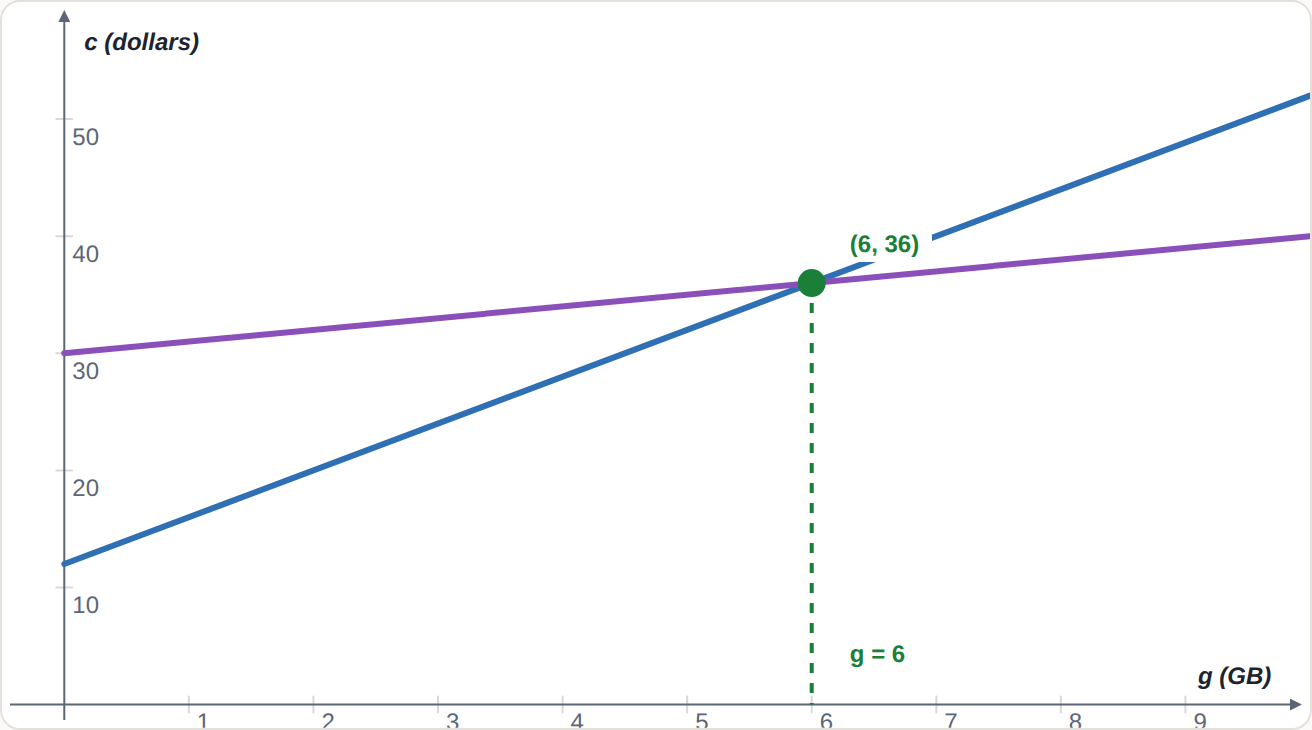
When one equation says what a letter equals, substitute it into the other equation. With c=12+4gc = 12 + 4g and c=30+gc = 30 + g, both rules equal cc, so 12+4g=30+g12 + 4g = 30 + g. Solve to get g=6g = 6, then put it back in a rule to find c=36c = 36.

Put the replacement in brackets: for 5c−2g=215c - 2g = 21 with c=g+3c = g + 3, write 5(g+3)−2g=215(g + 3) - 2g = 21, not 5g+3−2g5g + 3 - 2g.

A false result such as 10=1410 = 14 means the lines are parallel and there is no solution. A true result such as 0=00 = 0 means the lines are the same and every point is a solution.

c = 12 + 4g and c = 30 + g meet at (6, 36): both plans cost 36 dollars at 6 GB.
c=12+4gc = 12 + 4g and c=30+gc = 30 + g meet at (6,36)(6, 36): both plans cost 36 dollars at 6 GB.
Both rules give c, so set them equal · Sound on for the voiceover
Open the lesson →

9. Solving by elimination

Try firstSolve 2x + y = 11 and 2x + 3y = 19.

Check your answer

Subtract: 2y = 8, so y = 4. Then 2x + 4 = 11, so x = 3.5. Check: 7 + 12 = 19.

Elimination adds or subtracts whole equations so a letter cancels. For 4v+2k=444v + 2k = 44 and 4v+5k=624v + 5k = 62, subtract the first from the second: 3k=183k = 18, so k=6k = 6. Put kk back to find v=8v = 8. Check in the other equation.

If no coefficients match, multiply an equation (both sides) first. If the letter's terms have opposite signs, add.

A false result such as 0=40 = 4 means no solution (parallel lines). A true result such as 0=00 = 0 means infinitely many (the same line).

Open the lesson →

10. Setting up equations

Try firstA plan is 90 cents a day plus 30 cents per kWh. Write the cost c for a day with k kWh, and find c when k = 10.

Check your answer

c = 90 + 30k. For k = 10: 90 + 300 = 390 cents, which is 3.90 dollars.

To set up a problem from a situation:

  1. Name the letters, with units: kk is the kWh used in a day, cc is the cost for the day in cents.
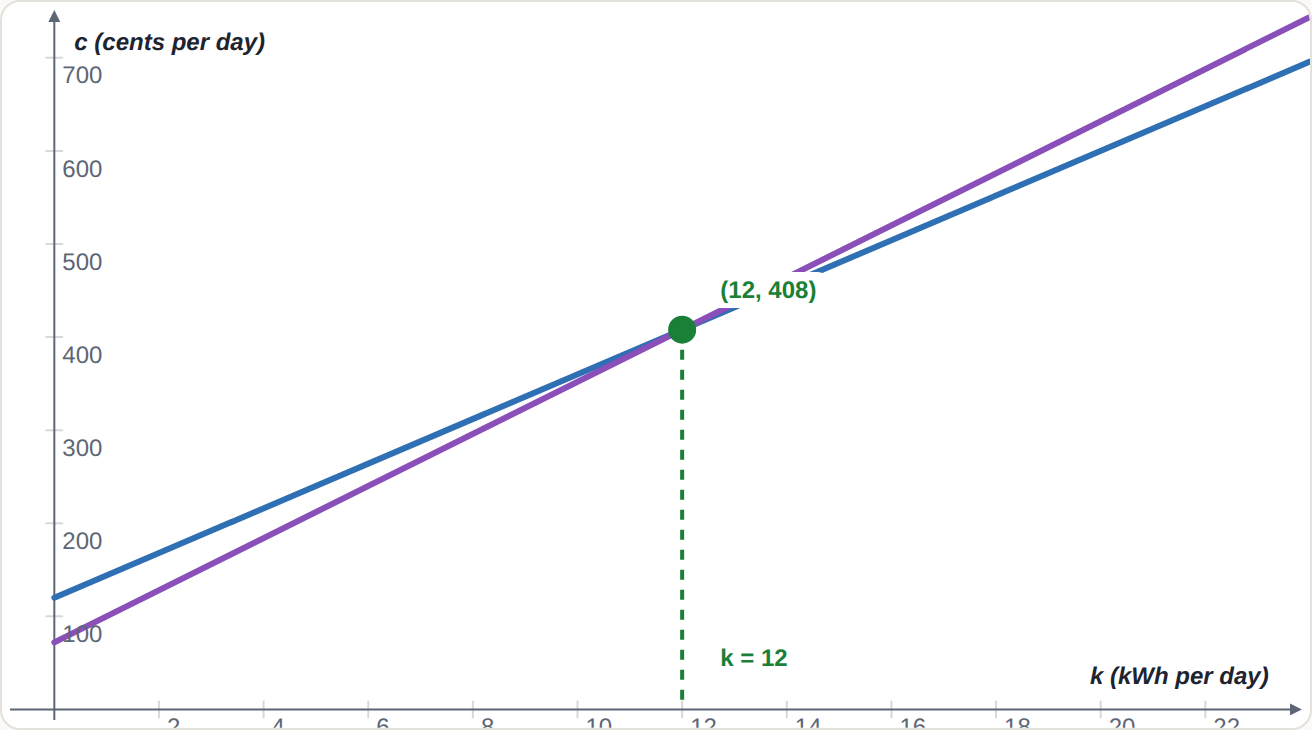
  2. Write each rule in one unit: Plan A is c=120+24kc = 120 + 24k, Plan B is c=72+28kc = 72 + 28k.
  3. Solve: set the rules equal, 120+24k=72+28k120 + 24k = 72 + 28k, so k=12k = 12 and c=408c = 408.
  4. Say it in the situation's words: at 12 kWh a day the plans cost the same, 408 cents a day. Above that Plan A is cheaper.
  5. Check it makes sense: no negative kWh and no half tickets.
Plan A (c = 120 + 24k) and Plan B (c = 72 + 28k) meet at (12, 408): at 12 kWh a day both cost 408 cents.
Plan A (c=120+24kc = 120 + 24k) and Plan B (c=72+28kc = 72 + 28k) meet at (12,408)(12, 408): at 12 kWh a day both cost 408 cents.
From a rate card to a crossing · Sound on for the voiceover
Open the lesson →

Exponentials

11. Same ratio each time

Try firstA table goes 3, 12, 48, 192. Is it linear or exponential? What is the next value?

Check your answer

Exponential: each value is 4 times the one before. The next value is 768.

A table is exponential when each value is the same number of times the one before. That number is the ratio: divide a value by the one before it.

A linear table has a constant difference instead: the same amount added each step. 5,10,15,205, 10, 15, 20 is linear. 5,10,20,405, 10, 20, 40 is exponential, with ratio 2.

A ratio below 1 is still exponential: 80,40,20,1080, 40, 20, 10 has ratio 0.5.

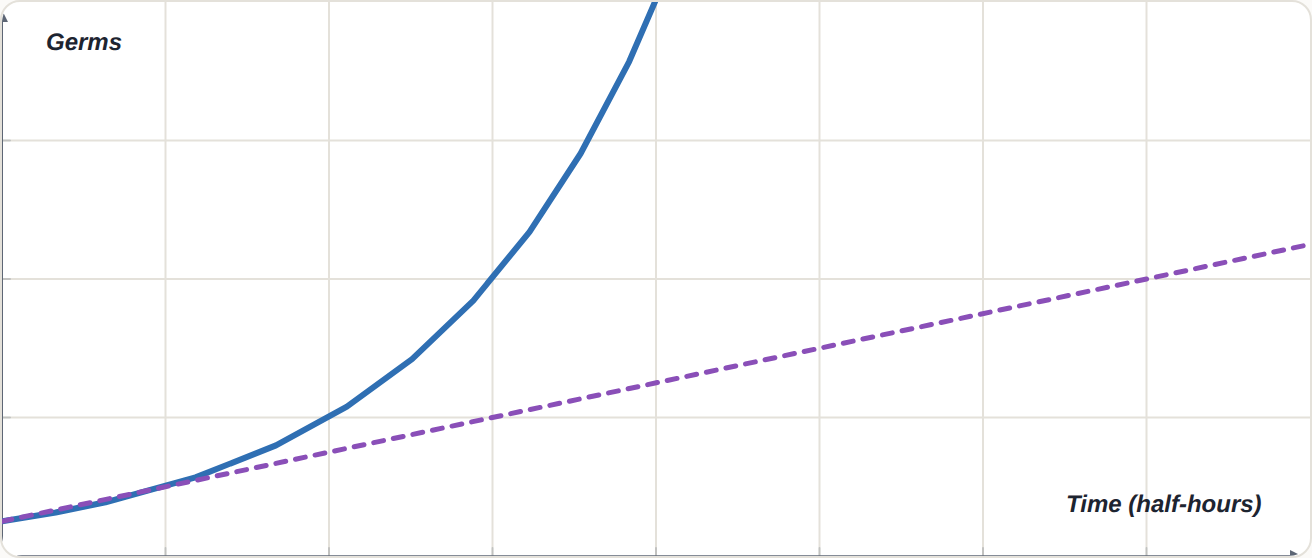
Both lines start at 100 and reach 200 after one half hour. The solid line doubles each time; the dashed line adds 100.
Adding and multiplying start together, then split apart · Sound on for the voiceover
Open the lesson →

12. Exponential graphs

Try firstFor y = 10(0.5ˣ): where does it cross the y-axis, does it grow or decay, and what line does it get close to but never reach?

Check your answer

At 10; decay; y = 0.

In y=a(bx)y = a(b^x), aa is where the graph crosses the yy-axis, because b0=1b^0 = 1. bb is what you multiply by each step.

If b>1b > 1 the graph grows. If 0<b<10 < b < 1 it decays: the values get smaller but never reach 0. The line y=0y = 0 is the asymptote: the graph gets as close as you like but never touches it.

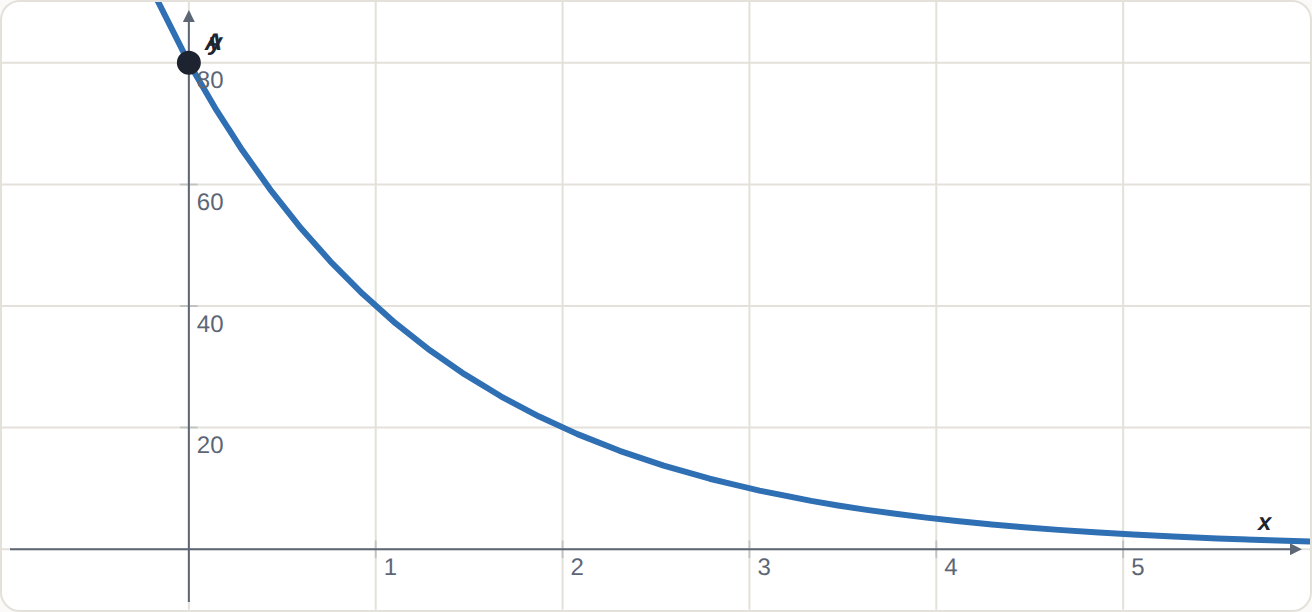
y = 80(0.5^x) starts at 80 and halves each step. It gets closer to y = 0 but never reaches it.
y=80(0.5x)y = 80(0.5^x) starts at 80 and halves each step. It gets closer to y=0y = 0 but never reaches it.
b above 1 grows, b below 1 decays · Sound on for the voiceover
Open the lesson →

13. From graph to equation

Try firstA graph goes through (0, 6) and (1, 18). Write its rule. Does it grow or decay?

Check your answer

y = 6(3^x). It grows, because b = 3 is more than 1.

For an exponential graph y=a(bx)y = a(b^x), a is where it crosses the yy-axis: the value at x=0x = 0.

b is what you multiply by each step, so divide any value by the one before it: b=40÷50=0.8b = 40 \div 50 = 0.8.

Check with the next point. If the ratio is the same, the rule fits.

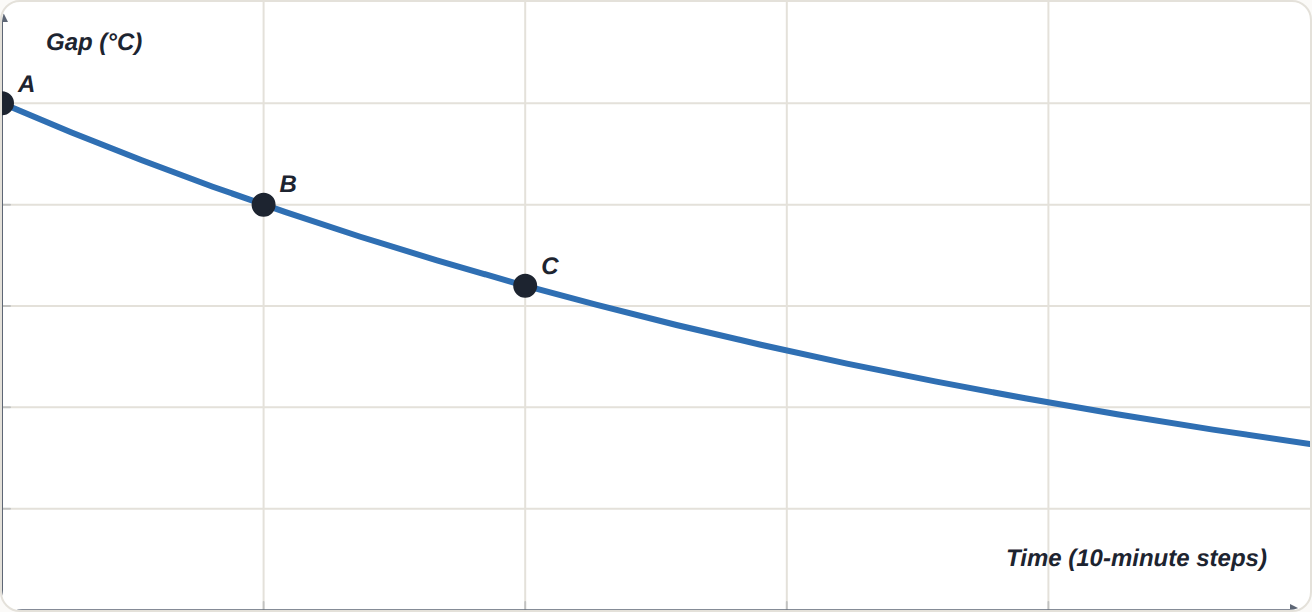
Cup B's gap: 50, 40, 32. The start is a = 50, and b = 40 \div 50 = 0.8, so y = 50(0.8^x).
Cup B's gap: 50, 40, 32. The start is a=50a = 50, and b=40÷50=0.8b = 40 \div 50 = 0.8, so y=50(0.8x)y = 50(0.8^x).
Match the curve: a is the start, b is the ratio · Sound on for the voiceover
Open the lesson →

14. Same base both sides

Try firstSolve 9ˣ = 81, then solve 4ˣ = 8.

Check your answer

9ˣ = 81: x = 2. 4ˣ = 8: 2²ˣ = 2³, so x = 1.5.

To solve an equation with xx in the power, write both sides as powers of the same base. If 2x=262^x = 2^6 then x=6x = 6.

The base isn't multiplying xx, so you can't divide by it. 3x=813^x = 81 means 3 multiplied xx times, which is 343^4.

If the bases differ, find a base that makes both. 8x=328^x = 32: 8=238 = 2^3, 32=2532 = 2^5, so 23x=252^{3x} = 2^5 and x=53x = \dfrac{5}{3}.

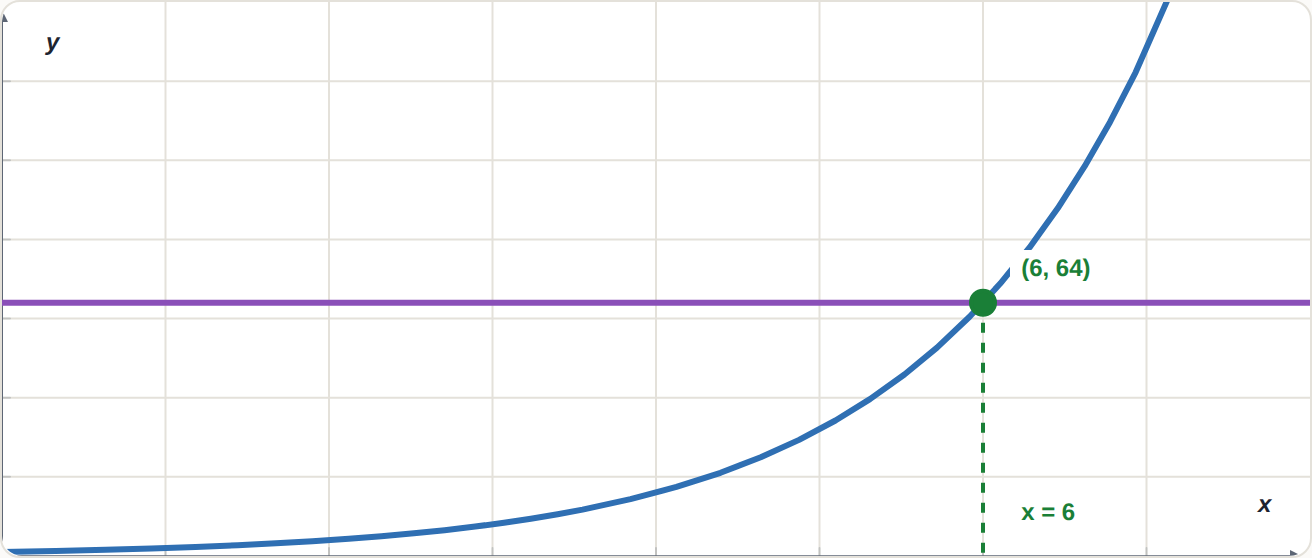
2^x = 64: the curve y = 2^x meets the line y = 64 at x = 6.
2x=642^x = 64: the curve y=2xy = 2^x meets the line y=64y = 64 at x=6x = 6.
Where the curve meets the line is the answer · Sound on for the voiceover
Open the lesson →

Models and relations

15. Which model?

Try firstA table goes 80, 100, 125, 156.25. Linear, quadratic or exponential? Show the test.

Check your answer

Exponential: 100 ÷ 80 = 1.25, 125 ÷ 100 = 1.25 and 156.25 ÷ 125 = 1.25. The differences 20, 25, 31.25 are not equal.

To choose a model from a table, test it three ways, in order:

  1. First differences. If they are equal, it's a line.
  2. Second differences (differences of the differences). If they are equal, it's a quadratic.
  3. Ratios. Divide each value by the one before. If they are equal, it's an exponential.

Say which test worked, and show the numbers.

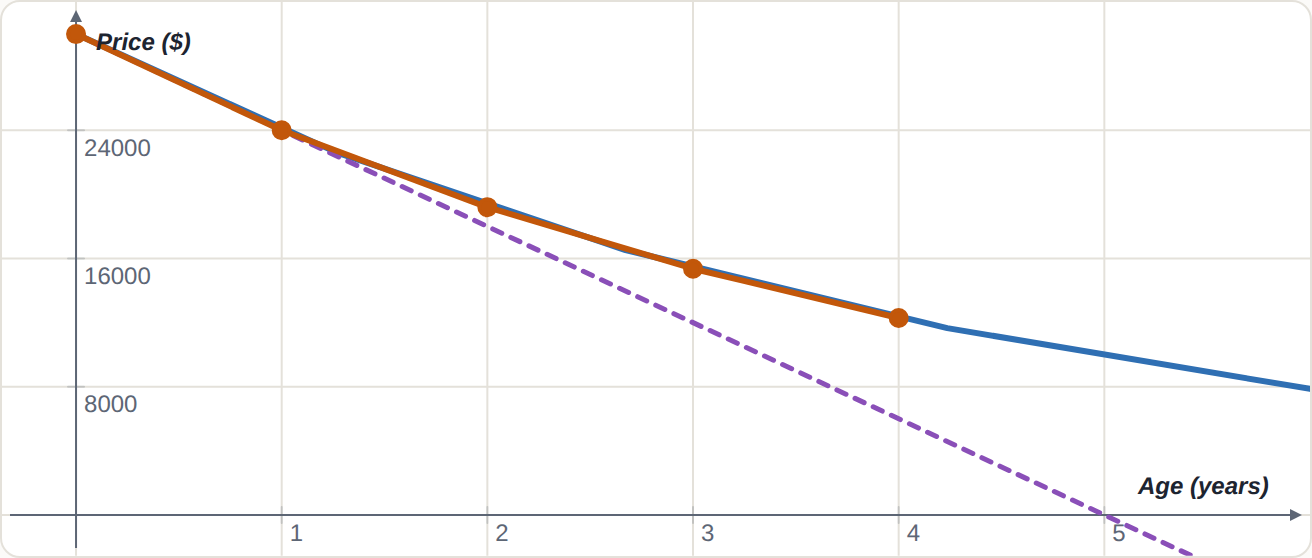
The dots are the prices. The dashed line drops the same dollars each year and misses them. The solid curve takes 20% off each year and passes through all five.
Two models, one set of prices · Sound on for the voiceover
Open the lesson →

16. Writing the model

Try firstA phone loses 20% of its value each year and costs 900 new. Write the model and find its value after 3 years.

Check your answer

A = 900(0.8ⁿ). After 3 years: 900 × 0.8³ = 460.80 dollars.

A rate a year changes the balance by the same share each year, so the model multiplies.

  • Growth of r%: factor b=1+r/100b = 1 + r/100, for example 5% is 1.05.
  • Decay of r%: factor b=1−r/100b = 1 - r/100, for example 8% is 0.92.

The model is A=a(bn)A = a(b^n): aa is the starting amount and nn is the number of years. Always give the answer in dollars (or the unit in the question).

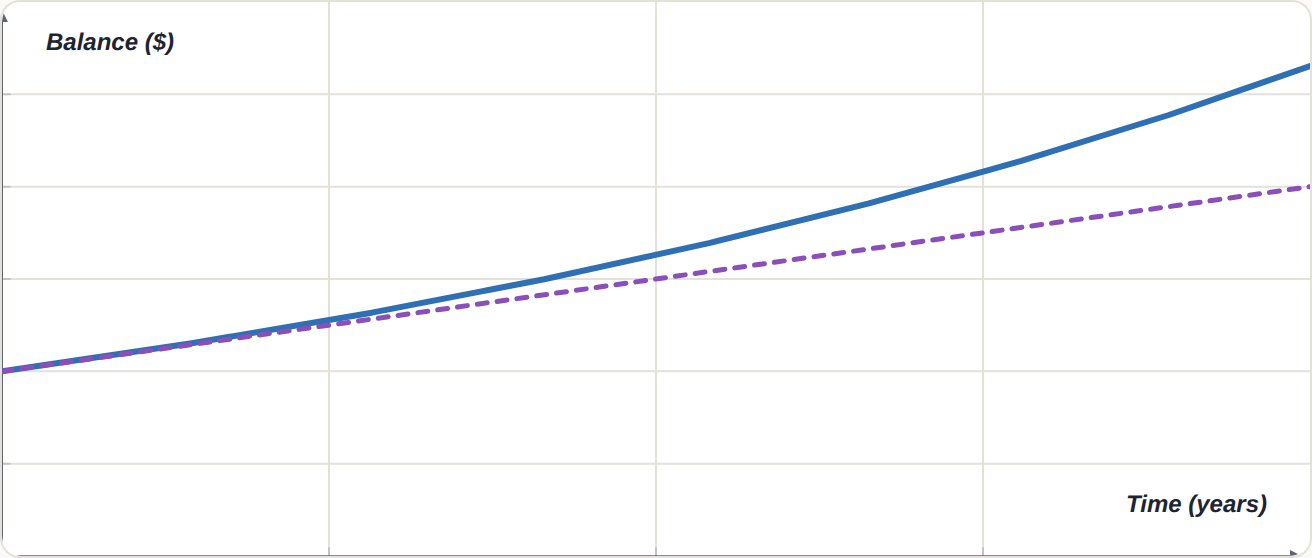
Both start at 1,000 and gain 50 in the first year. The solid curve earns 5% on the new balance each year; the dashed line adds the same 50 every year.
Both start at $1,000 and gain $50 in the first year. The solid curve earns 5% on the new balance each year; the dashed line adds the same $50 every year.
A rate each year multiplies, not adds · Sound on for the voiceover
Open the lesson →

17. Where they meet

Try firstPlan A is worth 1,000 + 200x and Plan B is worth 500 × 1.5ˣ. At x = 3 A is 1,600 and B is 1,687.5. At x = 2 A is 1,400 and B is 1,125. Between which two values of x do they meet?

Check your answer

Between 2 and 3: A is ahead at 2 and B is ahead at 3.

Where two graphs meet, the two values are equal. The coordinates of that point tell you both the time and the common value.

To find a crossing exactly enough:

  1. Read a window from the graph.
  2. Zoom in on that window, or make a table of the two values in it.
  3. Find where the one in front changes, and halve the gap again if you need more figures.
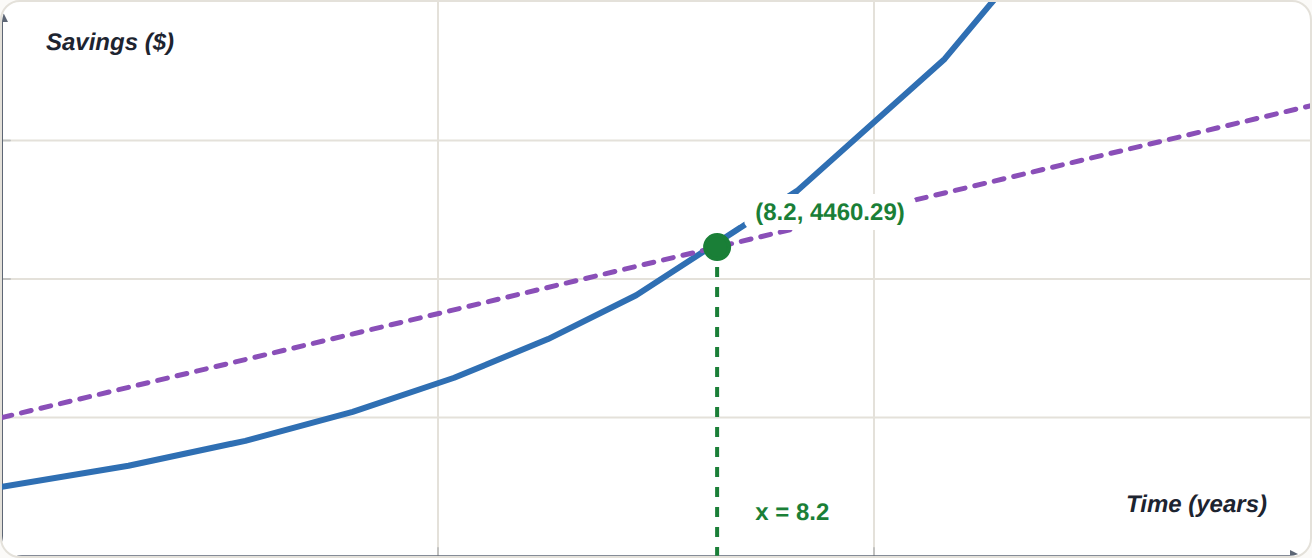
Plan A (dashed) starts ahead and adds 300 a year. Plan B (solid) starts lower and grows 20% a year. They meet at about 8.2 years, when both are worth about 4,460.
Plan A (dashed) starts ahead and adds $300 a year. Plan B (solid) starts lower and grows 20% a year. They meet at about 8.2 years, when both are worth about $4,460.
The crossing is where the plans are equal · Sound on for the voiceover
Open the lesson →

18. Circles as relations

Try firstA circle has equation (x − 2)² + (y + 5)² = 36. What are its centre and radius? Is it a function?

Check your answer

Centre (2, −5), radius 6. It isn't a function: a vertical line through the centre meets it twice.

A circle is every point a fixed distance, the radius rr, from a centre (h,k)(h, k). Its equation is

(x−h)2+(y−k)2=r2(x - h)^2 + (y - k)^2 = r^2

  • The centre is where each bracket is zero: (x−3)(x - 3) gives h=3h = 3, and (y+1)(y + 1) gives k=−1k = -1.
  • The right side is the radius squared.
  • A circle is a relation, but not a function: most xx values have two yy values.
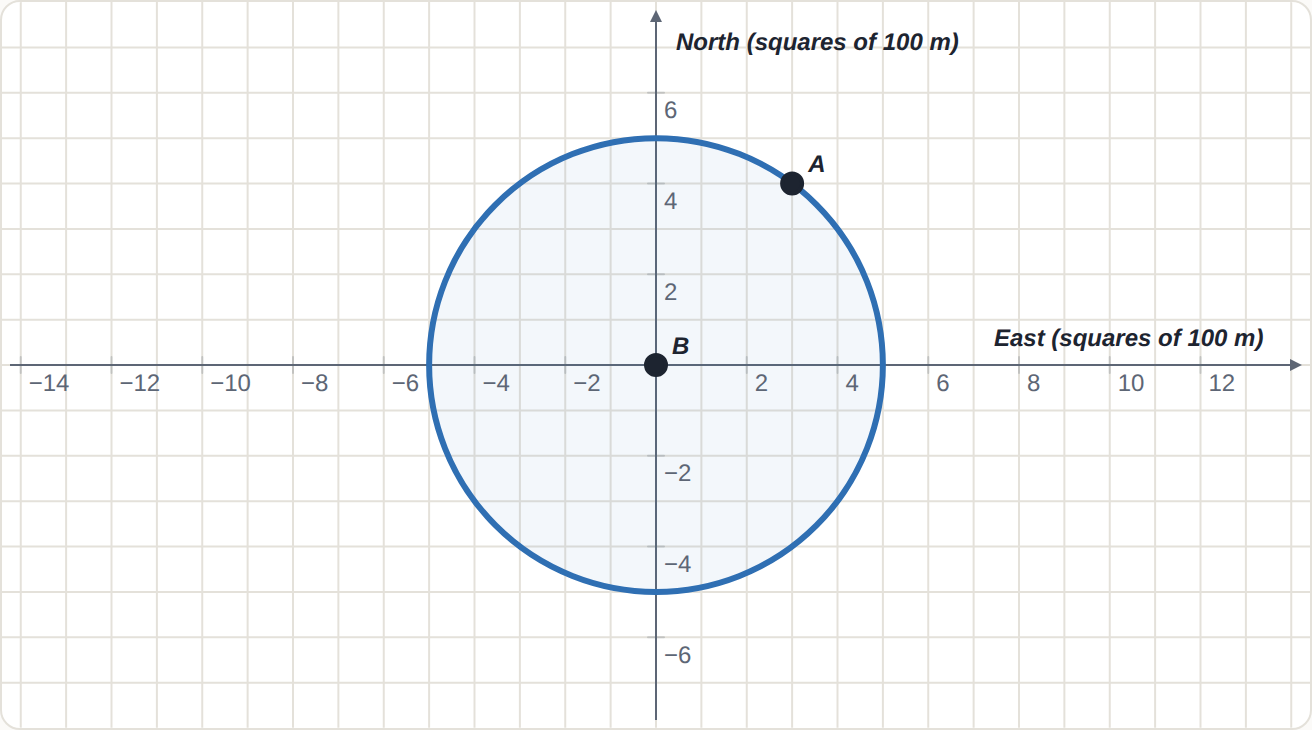
A circle with centre (0, 0) and radius 5. The point (3, 4) is on it: 3² + 4² = 9 + 16 = 25.
Move the centre, change the radius, and the equation follows · Sound on for the voiceover
Open the lesson →

19. Judging the model

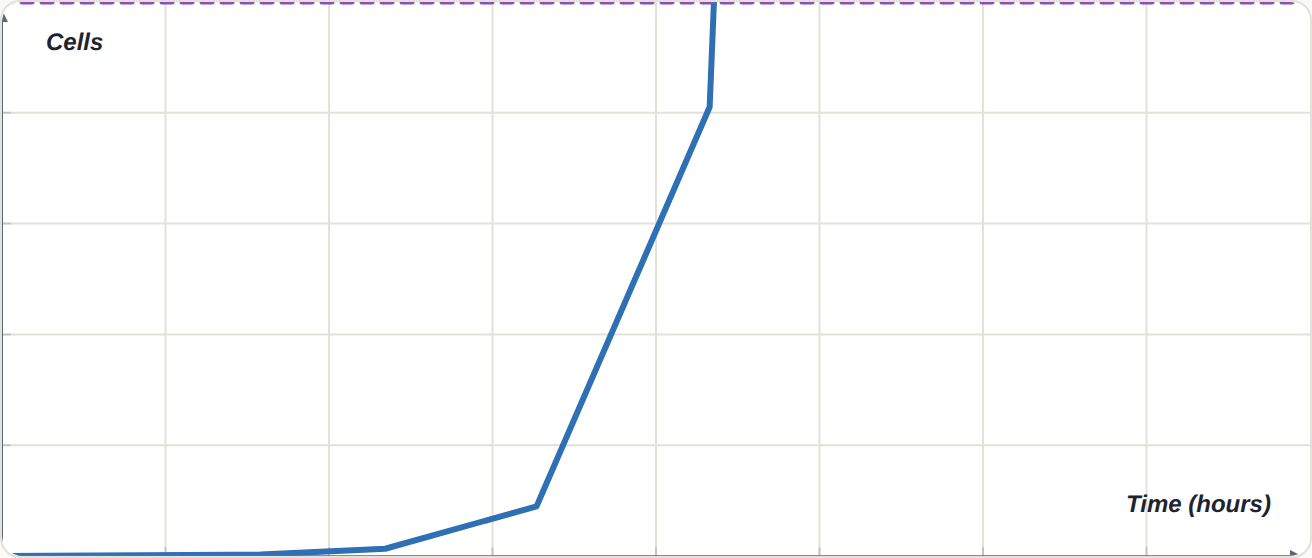
Try firstA model for a colony says 200 × 1.5ʰ cells after h hours. A dish holds 10,000 cells. In which whole hour does the model first pass the dish, and what should you say about hours after it?

Check your answer

200 × 1.5¹⁰ = 11,533 and 200 × 1.5⁹ = 7,689, so hour 10. After it the model is not reliable, because the dish is full.

A model is judged by what it says, whether it matches data, what it assumes and how far out it can be trusted.

  • Interpret: say what the result means in the situation, with units.
  • Test: compare the model with a real measurement; change an input such as the doubling time if it is off.
  • Assumptions: the doubling time stays the same however many cells there are.
  • Range: past the point where the food or room runs out, the model's numbers describe something that does not exist.
The model doubles every 20 minutes. The dashed line is the most a small dish could hold: past it, the curve is no longer telling the truth.
Open the lesson →

20. Make a conjecture

Try firstIn y = ax², Mia says 'if a is bigger, the curve is narrower'. Write one test that could show her wrong, and say what you'd expect to see.

Check your answer

Any negative pair: a = −1 and a = −3. −1 is bigger, but y = −x² is wider than y = −3x². One case that disagrees rejects the claim; she could change it to 'if a is further from 0'.

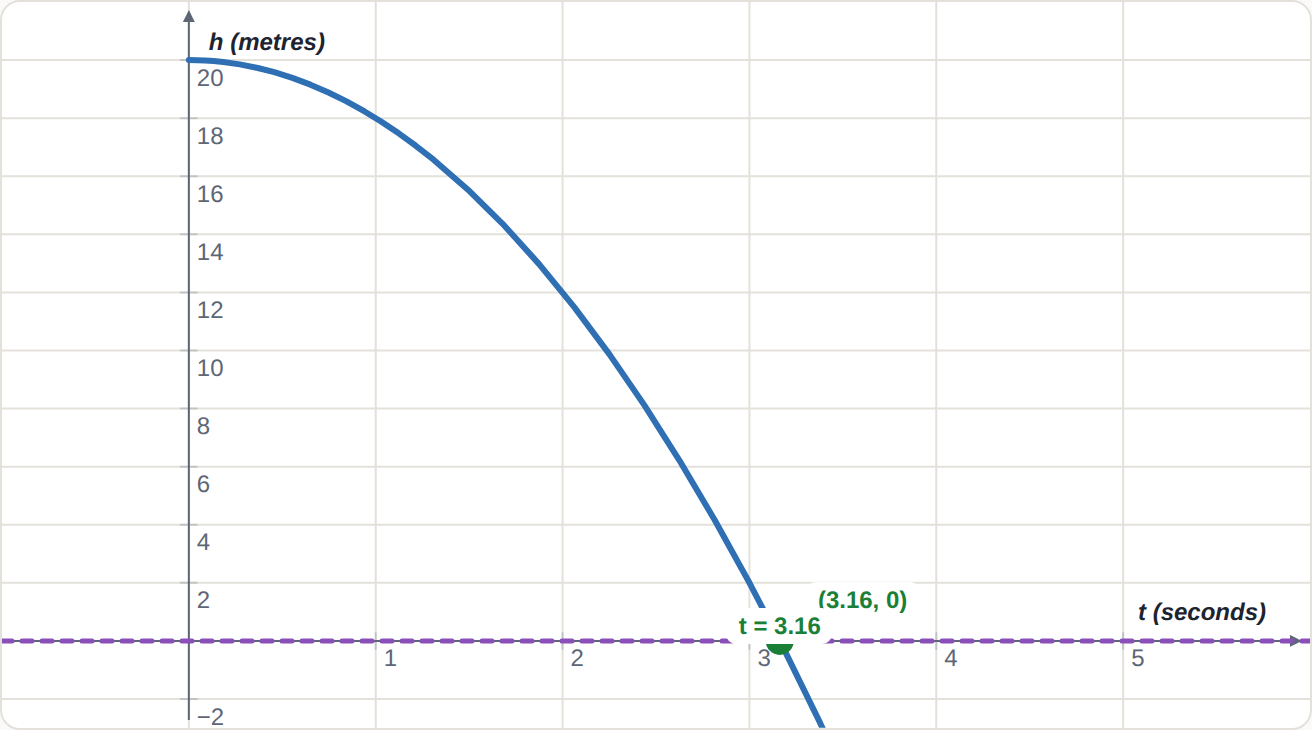
A conjecture is a claim about a whole family of cases that you can test: "If aa is bigger, then the ball lands sooner."

  • State it as if-then, so a new case could show it wrong.
  • Test it by changing one number at a time, and include a case that might break it (zero, a negative, a very small number).
  • Cases that agree support it; they don't prove it. One case that disagrees rejects it, and you can then refine the claim.
With a = 2, the ball's height is h = 20 − 2t². The ball reaches the ground when the curve meets the dashed line.
Open the lesson →