← Water as a resource

Water as a resource: recap

For after the lessons: one card per lesson, to check what you remember. Answer each question in your head or on paper first, then check it. Nothing here is marked.

Water as a resource

1. Renewable, non-renewable or continuous?

Try firstWhy is a forest renewable but sunlight continuous? Which one can be used up?

Check your answer

A forest comes back by regrowing and can be used up if trees are cut faster than they grow. Sunlight is always there and nothing we do can use it up.

A renewable resource comes back by itself, but it can be used up if we take it faster than it returns. Timber, fish and river water are examples.

A continuous resource is always there, whatever we do. We cannot use it up. Sunlight and wind are examples.

A non-renewable resource takes so long to form that it does not come back in our time. Coal and oil are examples.
Open the lesson →

2. Water on the move: how it joins places

Try firstWhy might a town care about loose soil on an upstream farm?

Check your answer

Rain can wash soil into the river. Surface water can carry it to the town, affecting water quality.

Water connects places when movement transfers materials or consequences. Name the start, pathway, something carried and receiving place. Surface water, soil moisture and groundwater describe different stores.

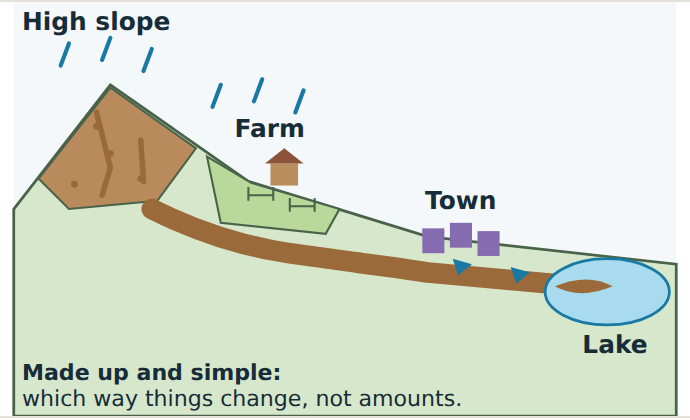
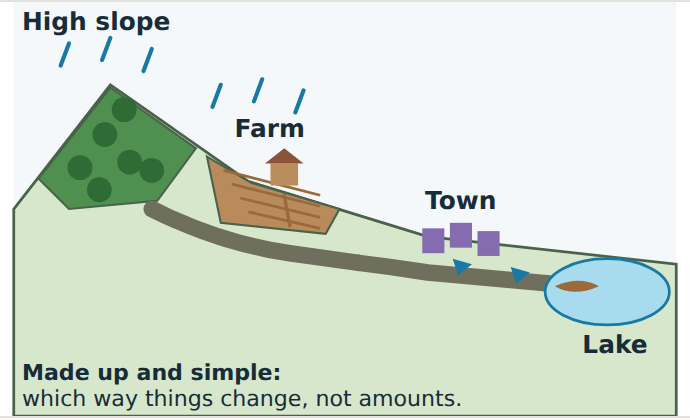
Kerrin is made up. A storm on the bare farm sends soil down the river, past the town and into the lake.
Open the lesson →

3. Good for some, bad for others

Try firstExplain one effect of the Snowy Scheme and a contrasting consequence.

Check your answer

Diversion supplies water for irrigation, an economic benefit for farms. Much lower Snowy River flows changed the channel greatly; environmental releases now flush sediment to reclaim a deeper channel.

An effect says what changes because water moves. Environmental focuses on nature, economic on production and income, social on daily life. One movement can help one place and harm another.

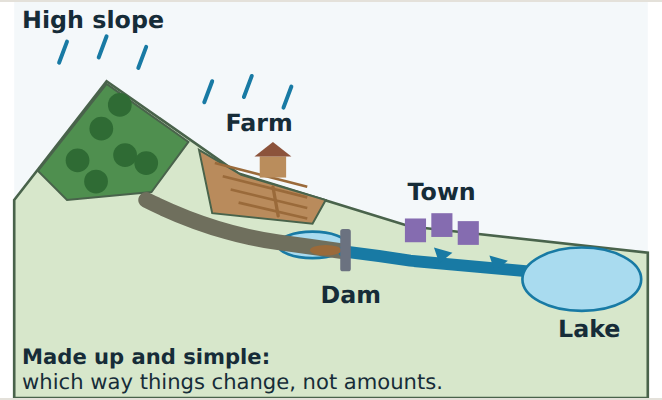
Kerrin is made up. The dam holds back soil and evens out the town's water, and less water and soil reach the lake.
Open the lesson →

4. How moving water changes the land

Try firstWhy is the river is in a low place not enough to explain a deepening valley?

Check your answer

It gives location, not a process. Flow erodes soil or rock and transports it away; repeated removal can deepen the channel.

Erosion removes material, transport carries it, and deposition adds sediment where it settles. Explain water acting on material and the resulting change to a place.

Kerrin is made up. Soil is eroded from the bare slope, carried down the river and deposited where it slows at the lake.
Open the lesson →

5. Putting it together: classify, connect, change

Try firstWater carries soil from Pebblewash Creek’s slope to a pond, where it settles. Explain two tools together.

Check your answer

Surface water connects the places by carrying soil. When flow slows in the pond, deposition adds sediment to its bed, changing the place.

Classify with a refilling reason, connect with a pathway and what it transfers, and explain physical change through a process. Join at least two tools in the same case.

Open the lesson →