← Language for people and situations

Language for people and situations: recap

For after the lessons: one card per lesson, to check what you remember. Answer each question in your head or on paper first, then check it. Nothing here is marked.

Warm-up: same message, different words

1. Same message, different words

Try firstSay which reader each message fits: 'Yo, you coming?' and 'Would you like to join us?'

Check your answer

'Yo, you coming?' fits a friend. 'Would you like to join us?' is careful and fits a reader you do not know well or who has authority.

The same message can be worded in many ways. The words that fit depend on who is reading and what the message is for.

Informal is not wrong and formal is not more correct. Inclusive wording makes sure no reader is left out.
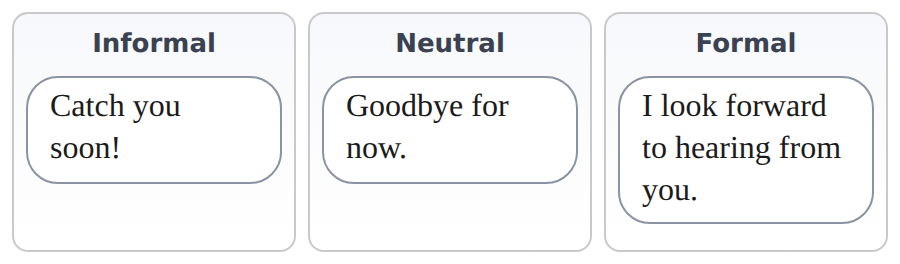
The three goodbyes mean the same thing. The words sit at different places on the scale, so each suits a different reader.
Open the lesson →

2. Shades of meaning

Try firstWhich is stronger, 'upset' or 'devastated'? Say how you know.

Check your answer

Devastated is stronger. Upset is a mild or medium feeling; devastated is the strongest of the two.

Synonyms are words with similar meanings but not the same strength or feeling. Antonyms are opposites.

An exact or specialist word tells the reader more than a general one.

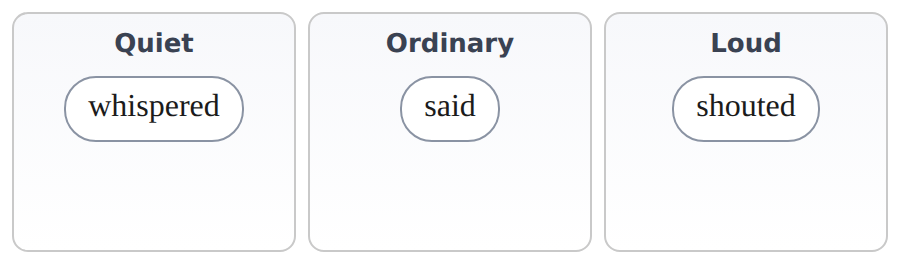
Whispered, said and shouted are all ways of speaking. They sit at different places on the scale from quiet to loud.
Open the lesson →

3. Words and roles

Try firstWhich role does 'Please sit down.' signal, and which does 'May I sit down?' signal?

Check your answer

'Please sit down.' signals the person in charge, giving an instruction. 'May I sit down?' signals the person asking for permission.

Orders, requests and titles show who is in charge. Formality is a scale, not a switch.

To choose words, think about who is reading, what the message is for, and where it will be read.

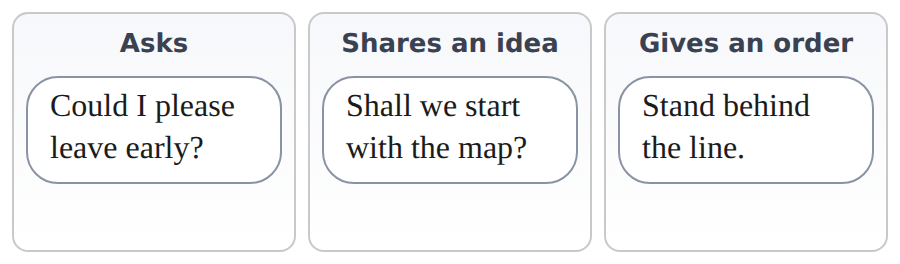
Asking, sharing an idea and giving an order sit in different places. Each signals a different role in the conversation.
Open the lesson →

Formality, identity and roles

4. From slang to formal

Try firstName one feature of formal language and one of slang.

Check your answer

Formal: full forms, exact words, no slang. Slang: very casual words used by a close group.

Language sits on a scale from slang to formal. Polite is not the same as formal.

Formal writing uses full forms and exact words, and no slang.

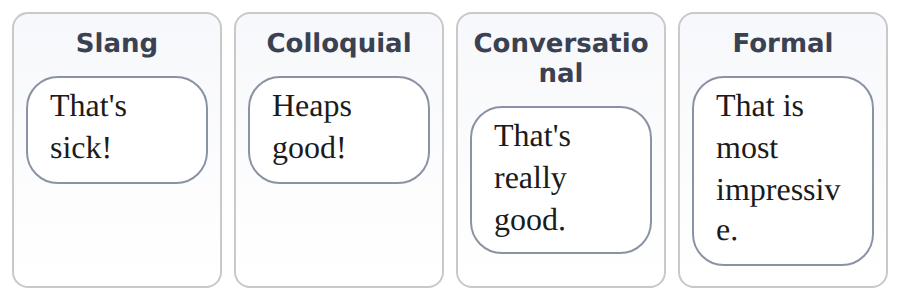
The same idea can be said in four ways. The words move along a scale from slang to formal.
Open the lesson →

5. Who is it for?

Try firstName the two cues that shape how formal to be.

Check your answer

How well you know the person (familiarity), and who has more authority (power).

Two things shape how formal to be: how well you know the person, and who has authority.

They can pull in different directions, so a message can be warm and respectful.

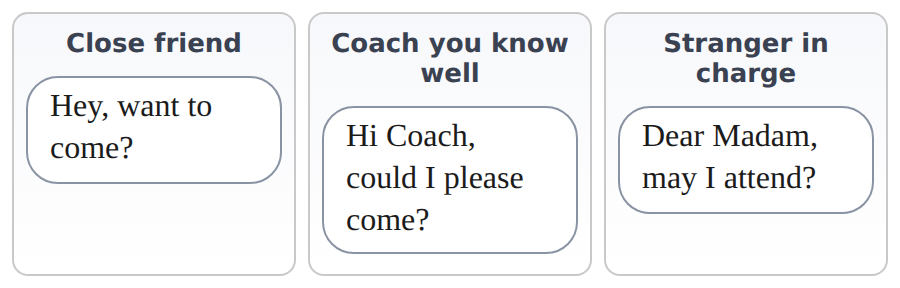
Three people, three sets of words. How well you know them and how much authority they have both change what you say.
Open the lesson →

6. Words that show who you are

Try firstGive one way words show a group, and one way they help make belonging.

Check your answer

Show: a club's jargon tells others which group you belong to. Make: using the group's words helps you become part of it.

The words we use show which groups we belong to, and using a group's words helps make that belonging.

All the ways people speak are valid for the groups that use them. None shows a person's character.

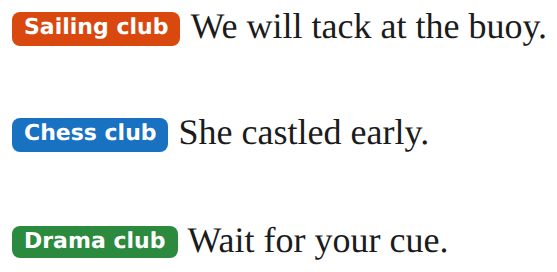
Words from a sailing club, a chess club and a drama club. Each group has words that signal that you belong.
Open the lesson →

7. Words that build roles

Try firstGive one way words can leave a newcomer out, and one way to fix it.

Check your answer

Unexplained acronyms or specialist terms leave a newcomer out. Fix by explaining them once or using plain words.

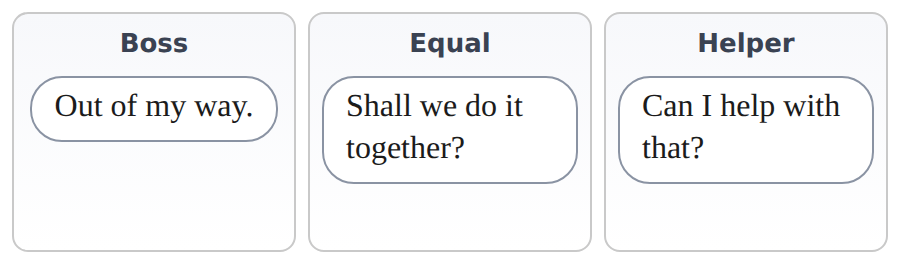
Words build roles in a group: who leads, who is equal, who helps.

Special words can welcome a newcomer when explained, and leave them out when not.

A boss, an equal and a helper each sound different. The words build the role.
Open the lesson →

Challenge: rewrite the notice

8. Challenge: rewrite the notice

Try firstName one thing you changed in the notice and why.

Check your answer

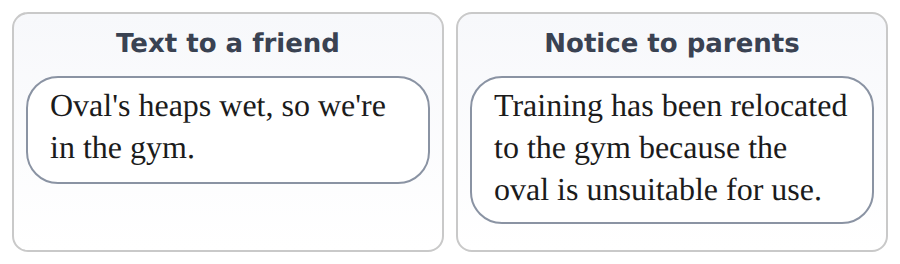
Any change that moves a word or short form up the scale to fit parents, such as 'heaps' to 'unsuitable for use'.

Move a message up the scale to fit its readers: swap slang and short forms for exact words and full forms.

The same news said two ways. The second fits the reader better.
Open the lesson →