← How texts are built

How texts are built: recap

For after the lessons: one card per lesson, to check what you remember. Answer each question in your head or on paper first, then check it. Nothing here is marked.

Stages and phases

3. Stages and phases

Try firstIn an explanation of how a volcano erupts, which phase must come before 'melted rock bursts out of the top'?

Check your answer

Gas and melted rock building up pressure underground. Each phase depends on the one before.

A text's big parts are stages. Smaller moves inside a stage are phases.

An explanation has an opening statement (what is being explained) and an explanation sequence. Each step in the sequence is a phase, in the order it happens.

Signal words show where you are: when, then and as a result mark the phases; best and disappointing mark a review's judgement.
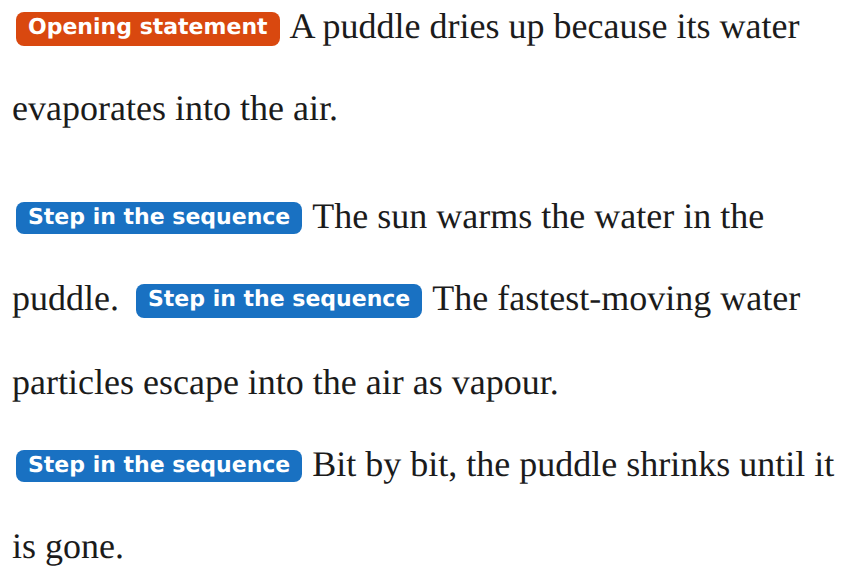
The opening statement says what is being explained. The explanation sequence has three phases, one step each, in the order they happen.
Open the lesson →

4. Purpose shapes the text

Try firstA text about bushfires is in the present tense, starts 'Bushfires are fires that burn through bush and grassland', and uses technical words such as ember. What is its purpose and type?

Check your answer

To describe: it is a report. The general statement and the present tense and technical words fit that purpose.

A text's purpose decides its stages and its language.

  • Retell: a recount (orientation, events, ending; past tense, time words).
  • Describe: a report (general statement, descriptions; present tense, technical words).
  • Persuade: an argument (position, reasons, position restated; should, would, because).

The same facts can go in any of them. The purpose decides how they are arranged.

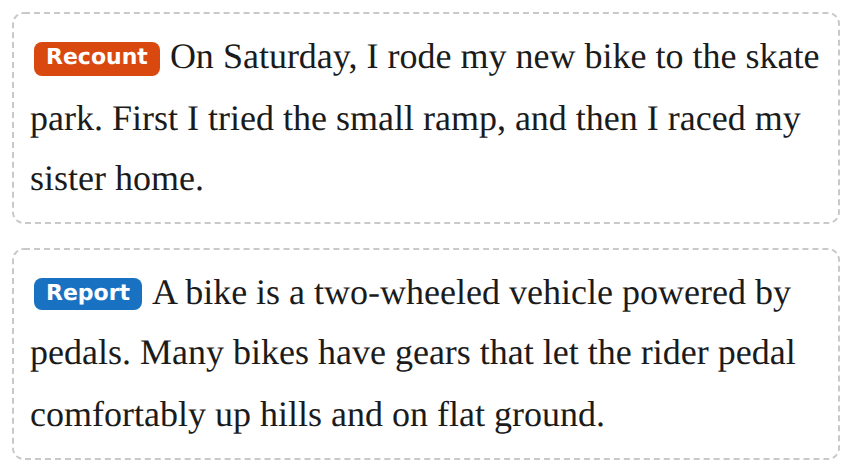
Same topic, two purposes: the recount retells one ride in time order, in the past tense; the report describes what bikes are like, in the present tense.
Open the lesson →

Organising ideas

5. Patterns for ideas

Try first'Many students forget their hats. One way to fix this is to sell cheap hats at the office.' Which pattern, and which words show it?

Check your answer

Problem and solution: forgotten hats are the problem, and One way to fix this introduces the solution.

Ideas inside a text follow patterns:

  • Cause and effect: because, so, as a result.
  • Compare and contrast: both, also, unlike, whereas.
  • Problem and solution: the problem is, one way to fix this.
  • Claim and support: for example, this shows.

Signal words show the pattern. A writer picks the pattern that fits what the text is for, and carries it through.

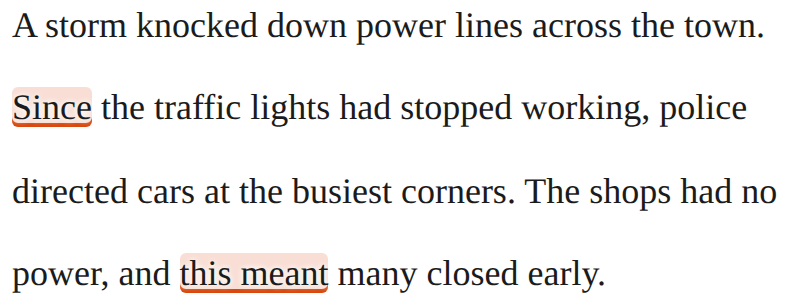
Since and this meant are signal words. Each one links an effect to its cause, so the paragraph uses a cause and effect pattern.
Open the lesson →

6. What comes first

Try firstA school newsletter starts with three sentences about the new pool and ends with 'The pool will be closed for all of Term 1.' What does this order do?

Check your answer

It puts the good news in the spotlight and the closure where quick readers might miss it.

Where an idea sits changes how much it matters. What comes first gets the spotlight.

A news report puts the main point first, then details, then background, so a reader in a hurry still gets the news.

The order can also hide things. Ask what a text puts first, what it saves for last, and what it leaves out.

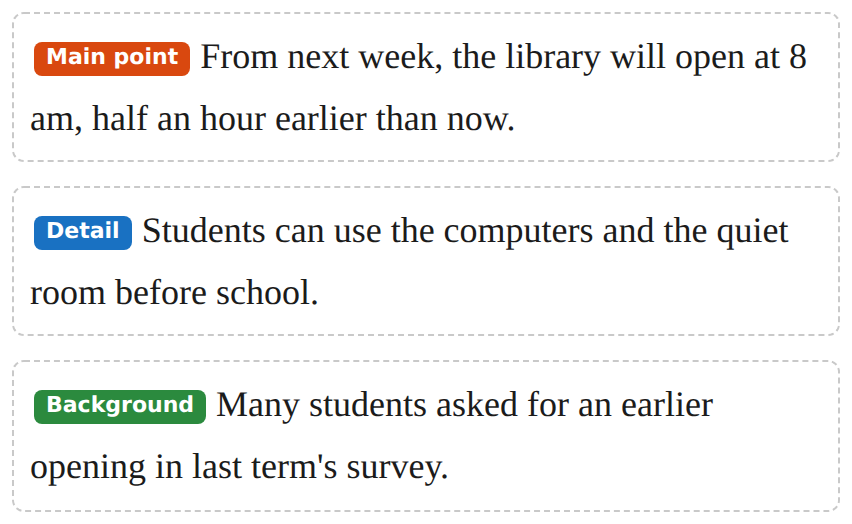
The main point comes first, a detail follows, and the background comes last, so a reader who stops early still gets the news.
Open the lesson →

Built for a reader

7. Built for a reader

Try firstA text for parents says 'Wear a hat!' and nothing else. Does it work for its reader? Why or why not?

Check your answer

Probably not well: adults can use reasons and detail (why hats matter, which kind), so a single command undersells them. It would suit a young child better.

Writers choose structure and language together, for a particular reader.

For young readers: a hook, short commands (Swim, Stay, Ask) and you. For adults: reasons, technical words and more detail.

To judge a text, ask: would this reader understand it and act on it?

Walk, Return and ask are short commands that tell a young reader exactly what to do, and your and you speak straight to them.
Open the lesson →

8. Mixing text types

Try firstA science web page explains the water cycle as the journey of one raindrop called Drop. What types does it mix, and why?

Check your answer

An explanation told as a story (with a character). The character makes the steps easy to follow and remember.

Writers mix text types on purpose. The result is a hybrid.

A charity letter opens with a true story so you care. A novel told as diary entries lets you live each day. A recipe starts with a memory.

A hybrid works when each borrowed part does a job for the main purpose and links back to the point.

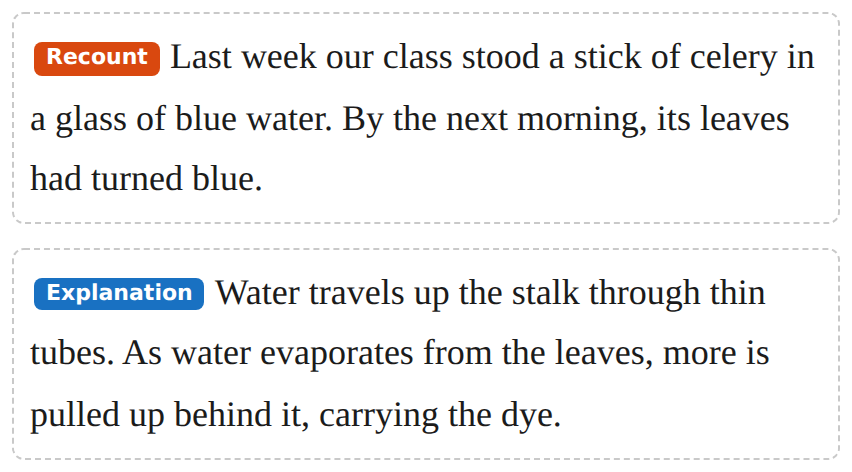
A science blog post that mixes types: the recount says what the class saw, then the explanation says how it works.
Open the lesson →

Challenge: build an argument

9. Challenge: build an argument

Try firstAn argument ends: 'Also, trees give homes to possums.' What's wrong with this as an ending?

Check your answer

It adds a new reason instead of restating the position. The ending should sum up the reasons and press the point again.

An argument has three stages:

  • Position: what you want, in one clear sentence.
  • Reasons: each in its own paragraph, with evidence.
  • Restated position: the point again, summing up the reasons.

Joining words such as Firstly, In addition and Therefore carry the reader from one stage to the next.

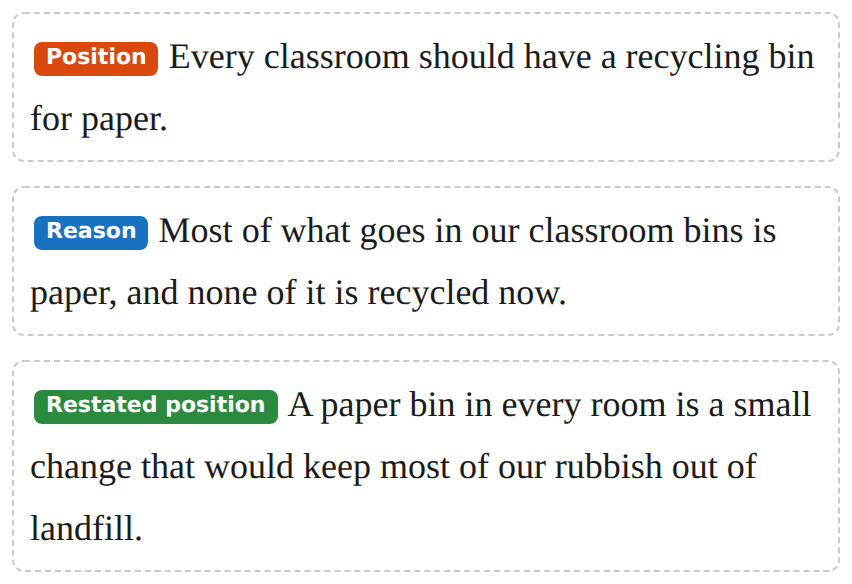
The position says what the writer wants, a reason backs it up with evidence, and the restated position presses the point again at the end.
Open the lesson →