← Holding writing together

Holding writing together: recap

For after the lessons: one card per lesson, to check what you remember. Answer each question in your head or on paper first, then check it. Nothing here is marked.

Words that hold it together

4. Say it again, on purpose

Try first'Mia and Ava went to the shops. She bought a hat.' What is unclear, and how would you fix it?

Check your answer

She could be Mia or Ava. Repeat the name: Ava bought a hat.

Writers repeat key words on purpose. Each repeat tells the reader the text is still about the same thing.

A word that means the same (dry spell for drought) carries the chain. A word that means the opposite (rain against drought) starts a second chain that answers the first.

Repeat the key word when it or they could point to two things.
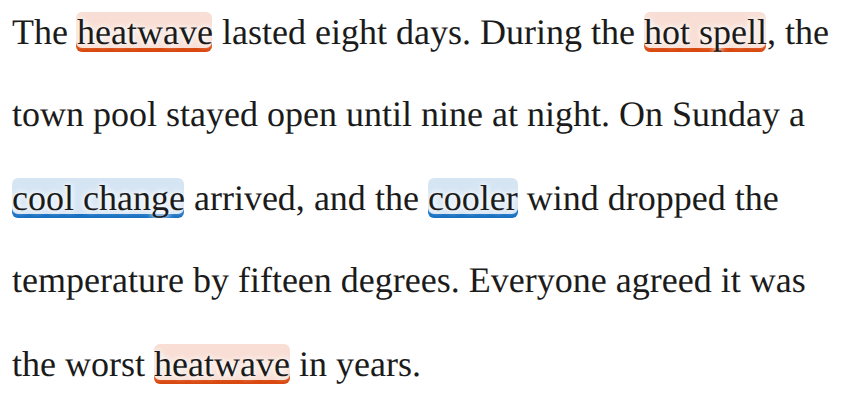
Heatwave is repeated, and hot spell means the same, so the text stays on the heat. Cool change and cooler start an opposite chain that answers the heat chain.
Open the lesson →

5. Word chains

Try first'We caught a flathead off the jetty. The fish was 40 centimetres long.' What does the fish link to, and why does it work?

Check your answer

The flathead. Fish is a general word for a flathead, and the flathead came first.

A general word can stand in for a specific one the reader has already met: a kelpie becomes the dog, then the animal.

These words make a word chain that keeps the reader on the same thing without repeating the same word.

It only works if the specific word comes first, and only one thing fits.

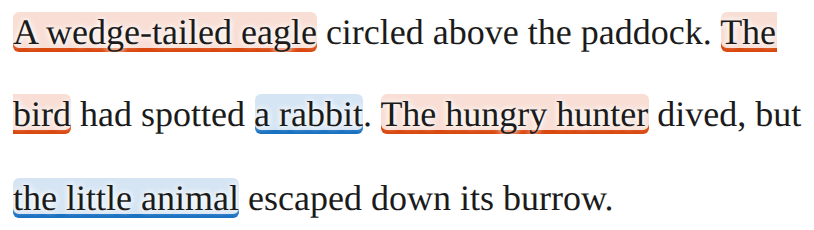
The eagle comes first, then the bird and the hungry hunter. The rabbit comes first, then the little animal.
Open the lesson →

Guiding the reader

6. Tell the reader what's coming

Try firstWhich is the topic sentence? 'Koalas sleep up to 20 hours a day. Eucalyptus leaves give them little energy. Koalas spend most of their lives resting to save energy.'

Check your answer

Koalas spend most of their lives resting to save energy. The other two sentences are details that explain it, even though it comes last.

A topic sentence tells the reader what a paragraph is about. The other sentences are details: examples, facts and reasons that belong to it.

It is often first, but not always. To find it, read the whole paragraph, ask what the sentences share, and find the sentence that says it.

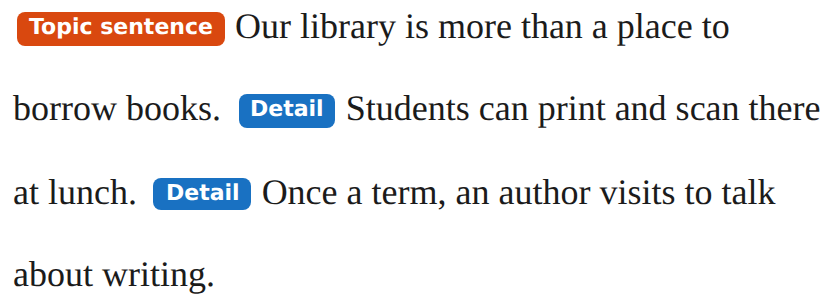
The topic sentence says what the paragraph is about. Each detail gives one more thing the library offers.
Open the lesson →

7. Open and close

Try firstA conclusion says 'Sharks have been around for 400 million years.' No paragraph mentioned this. What is wrong?

Check your answer

It adds a new fact. A conclusion pulls together what the text already said; the new fact belongs in a body paragraph.

An overview at the start says what the text is about and what it will cover, often in order.

Each body paragraph takes one part, in the order the overview gave.

A conclusion pulls it all together, often echoing the overview, and adds nothing new.

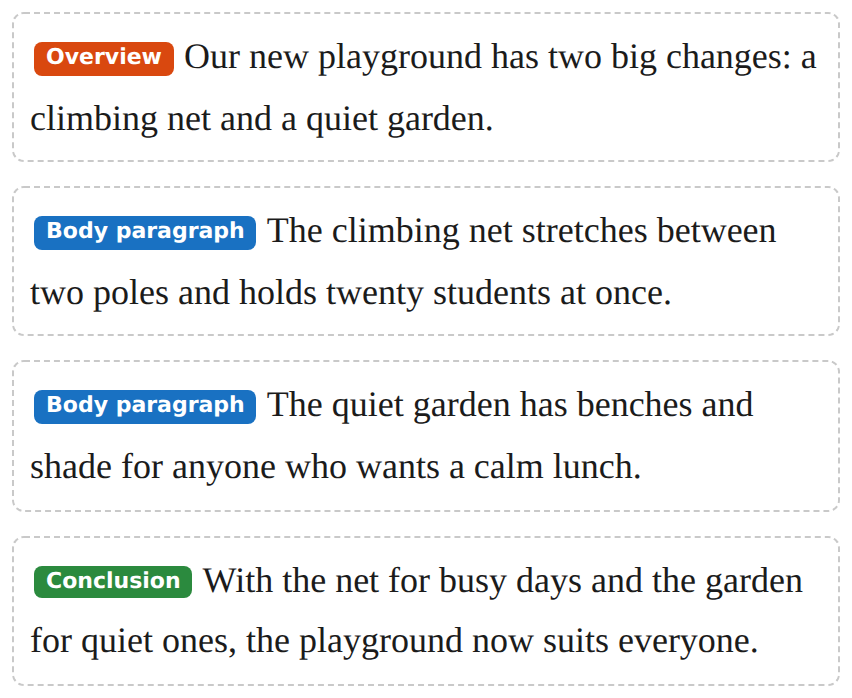
The overview names the net and the garden, the body paragraphs take them in that order, and the conclusion echoes both without adding anything new.
Open the lesson →

Inside a paragraph

8. Inside a paragraph

Try first'Dogs make better pets than cats. My dog fetches the newspaper every morning.' What is missing, and write it.

Check your answer

The explanation: for example, 'This shows that dogs can be trained to help, which makes them more useful pets.'

A strong paragraph has three parts:

  • a claim: what you argue
  • evidence: an example in your own words, or a short quotation in the writer's exact words
  • an explanation: how the evidence shows the claim

The explanation is the step most often missing. Start it with "This shows that...".

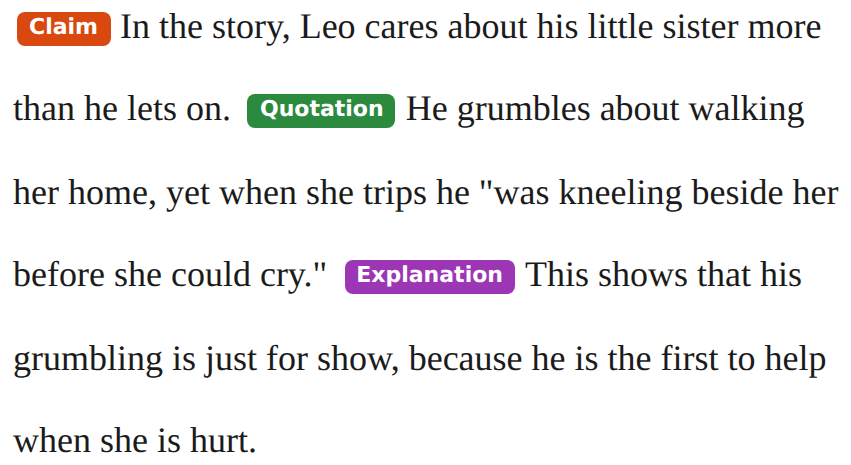
The claim says what the writer argues, the quotation is the evidence, and the explanation says how the evidence shows the claim.
Open the lesson →

Challenge: repair the report

9. Challenge: repair the report

Try firstName the four checks you used to repair the report.

Check your answer

Pointing words are clear; joining words do the right job; paragraphs follow the overview's order; evidence is explained.

A text can have all the right facts and still be hard to follow. Four checks fix most of it:

  • Is every pointing word clear? If two things fit, name the thing.
  • Does each joining word do the right job?
  • Do the paragraphs follow the overview's order?
  • Is every piece of evidence explained?
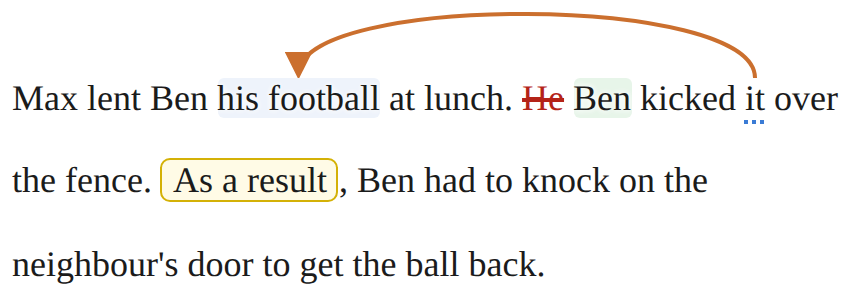
He could mean Max or Ben, so He is replaced with Ben. As a result says the trip next door happened because of the kick.
Open the lesson →