← Structures

Structures: recap

For after the lessons: one card per lesson, to check what you remember. Answer each question in your head or on paper first, then check it. Nothing here is marked.

Frames and trusses

1. Pull or push

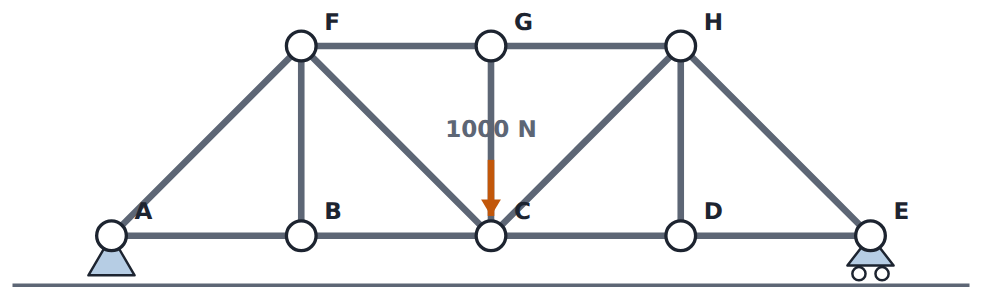
Try firstA roof truss 6 m wide and 1.5 m tall carries 900 N at the top. How hard does the bottom member pull, and is it in tension or compression?

Check your answer

900 × 6 ÷ (4 × 1.5) = 900 N, in tension.

In a frame joined by pins, each member only pulls (tension: being stretched) or pushes (compression: being squashed). In a roof truss under a load, the sloping members push and the bottom member pulls, holding the feet together.

Slanted members must carry more than their share, because only part of a slanted force holds the load up. So a flatter roof has bigger forces, and a taller one smaller forces but longer, dearer members.
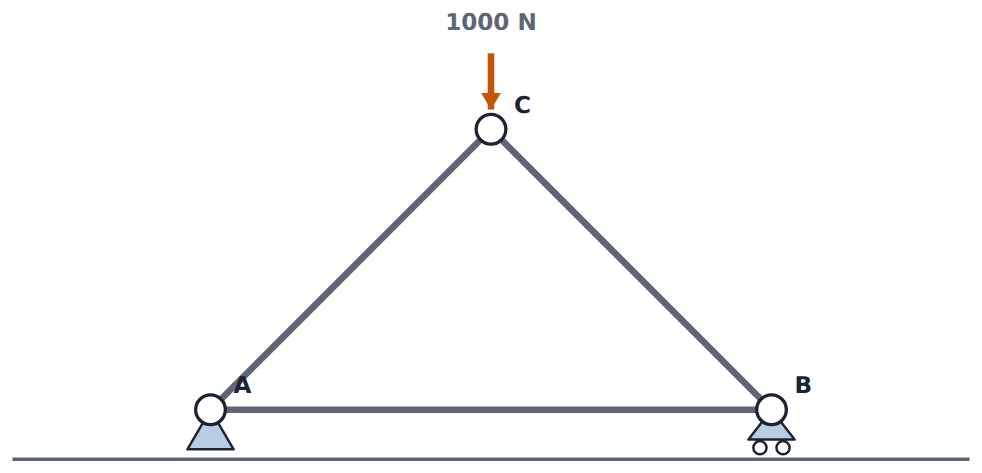
A roof truss under 1000 N: the sloping members push (red), the bottom member pulls (blue).
Tension and compression · Sound on for the voiceover
Open the lesson →

2. Triangles hold their shape

Try firstA frame has 9 joints on a pin and a roller. How many members does it need to be rigid with none spare?

Check your answer

2 × 9 − 3 = 15.

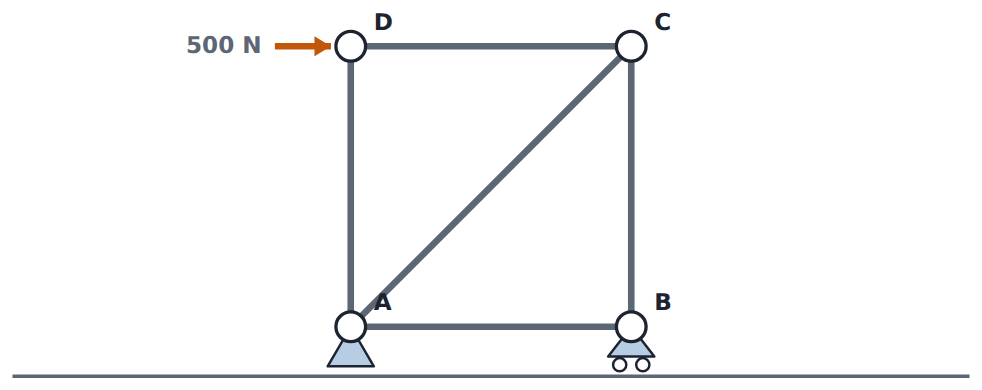
A triangle can't change shape unless a side changes length; a square on pins can lean without any member stretching, so it folds over however strong its members are. A diagonal brace turns a square into two triangles.

For a flat frame on a pin and a roller, members + 3 = 2 × joints gives the number it needs with none spare: one diagonal per square panel.

One diagonal turns a square into two triangles, and the frame holds its shape.
One brace · Sound on for the voiceover
Open the lesson →

3. Design a bridge

Try firstA 3 m member on this board is pushed with 1000 N. Will it buckle? Show the sum.

Check your answer

8000 ÷ 3² = 8000 ÷ 9 ≈ 889 N, less than 1000 N, so it buckles.

Under a pull, a member only fails when it snaps. Under a push, a long thin member buckles (bows sideways) at a much smaller force, and the longer it is the worse: twice as long buckles at a quarter of the push.

Good trusses are rows of short triangles: pushed members kept short, long members arranged to pull. Testing to failure shows how much margin a design has: its failure load ÷ its working load is its safety factor.

A Pratt truss: short panels, diagonals that pull, and a top chord that pushes.
Short pushes, long pulls · Sound on for the voiceover
Open the lesson →

Beams

4. Beams and shapes

Try firstA plank 20 mm deep is replaced by one 40 mm deep, the same width. How does its sag change?

Check your answer

Twice as deep is 2³ = 8 times stiffer, so it sags an eighth as much.

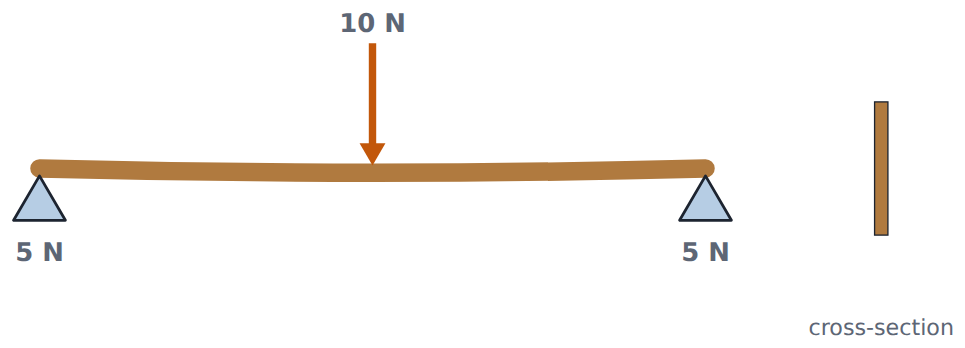
A beam's supports share its load like a lever: the nearer support holds more. Each share is the load × the far distance ÷ the span.

How much a beam sags depends on its shape more than on how much material it has: stiffness grows with depth cubed. A strip on its edge is 100 times stiffer than flat; an I-beam puts its material at the top and bottom, far from the middle, where it does most good.

The same strip on its edge: a hundred times stiffer than flat.
Depth counts · Sound on for the voiceover
Open the lesson →