← Mechanisms

Mechanisms: recap

For after the lessons: one card per lesson, to check what you remember. Answer each question in your head or on paper first, then check it. Nothing here is marked.

Gears

1. Gear up the winch

Try firstAn 8-tooth gear drives a 40-tooth gear. The motor turns 100 times a minute and lifts 50 g on its own. How fast does the output turn, and what can it lift?

Check your answer

Ratio 40 ÷ 8 = 5, so 100 ÷ 5 = 20 turns a minute, and 50 × 5 = 250 g.

A gear ratio is driven teeth ÷ driver teeth. When a small gear drives a big one, the big one turns slower but stronger, by the same factor: an 8-tooth gear driving a 24-tooth gear gives a ratio of 3, so the winch turns 3 times slower and can lift 3 times as much.

To check a design, work out the speed (divide by the ratio), the strength (multiply by the ratio) and the time, then check every criterion in the brief. Sometimes no design meets them all, and someone has to decide which one to relax.
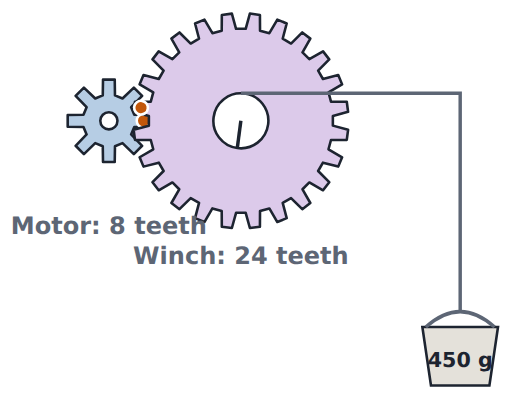
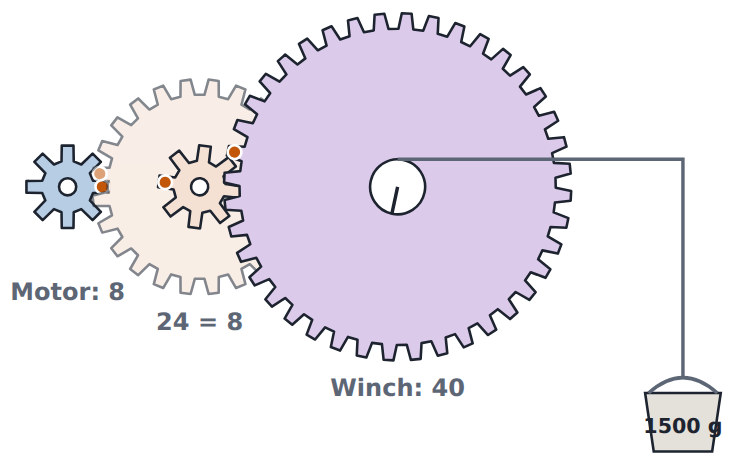
An 8-tooth gear on the motor drives a 24-tooth gear on the winch: 3 times slower, 3 times stronger.
Trading speed for strength · Sound on for the voiceover
Open the lesson →

2. Gear trains

Try firstA motor turning 240 times a minute drives 10 → 30, then 10 → 40 on the same axle. How fast does the output turn, and how many times stronger is it?

Check your answer

Ratio 3 × 4 = 12, so 240 ÷ 12 = 20 turns a minute, 12 times stronger.

A gear between two others is an idler. Its teeth cancel out, so the ratio is still last ÷ first: it only changes the direction of the turn (each mesh reverses it).

Two gears on one axle turn together. That lets the next stage start from a small gear again: a compound train. The overall ratio is the stage ratios multiplied: 8 → 24 then 8 → 40 is 3 × 5 = 15, so the winch is 15 times slower and 15 times stronger. Big ratios come in stages so the gears stay a sensible size.

8 → 24, then 8 → 40 on the same axle: 3 × 5 = 15 times slower and stronger.
Two stages multiply · Sound on for the voiceover
Open the lesson →

Levers and pulleys

3. Levers

Try firstA 400 N load is 0.25 m from a pivot. You push 1 m from the pivot on the other side. What push balances it, and how far does your hand move to lift the load 0.1 m?

Check your answer

400 × 0.25 = 100, so 100 ÷ 1 = 100 N; the hand is 4 times as far from the pivot, so it moves 0.4 m.

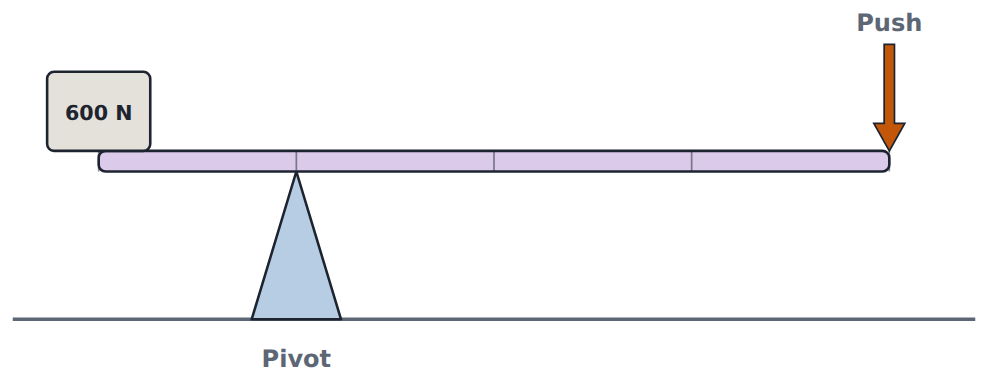
A lever is a bar that turns on a pivot. A force's turning effect is the force × its distance from the pivot. It balances when the turning effects on both sides are equal: 600 N × 0.5 m = 200 N × 1.5 m.

Pushing far from the pivot makes your push stronger, by the same factor that your hand moves farther: 3 times the force, 3 times the distance. Where the pivot, the load and the push sit gives three kinds of lever; the one in your arm gives up force to gain speed.

Pivot 0.5 m from a 600 N rock: a 200 N push 1.5 m away lifts it, and your hand moves 3 times as far.
Trading force for distance · Sound on for the voiceover
Open the lesson →

4. Pulleys

Try first5 ropes hold up a 1000 N load. What pull lifts it, and how much rope do you pull to lift it 2 m?

Check your answer

1000 ÷ 5 = 200 N, and 5 × 2 = 10 m.

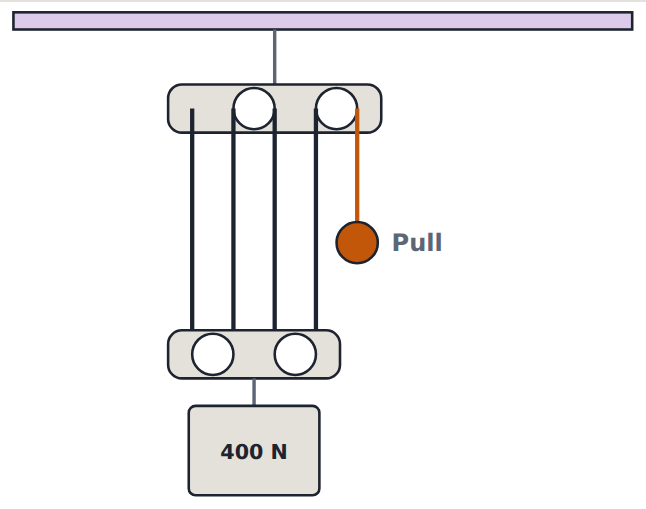
One fixed pulley changes the direction of a pull, not its size: 400 N still needs 400 N, but you can pull down.

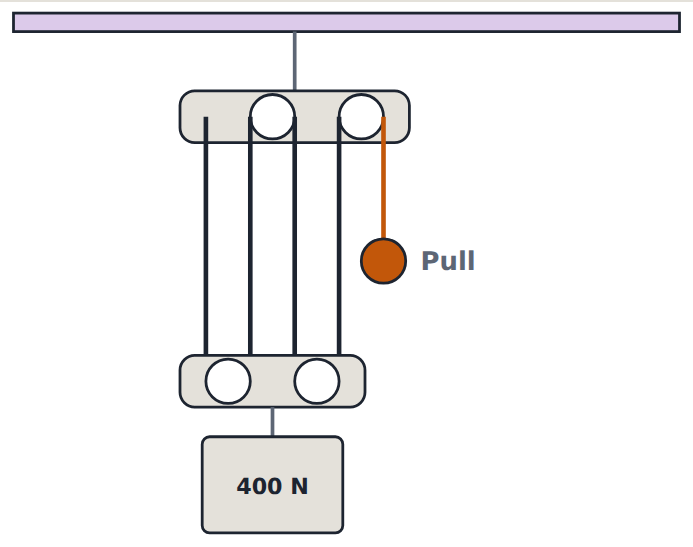
Ropes that hold up a moving block share the load. Count only those ropes: with 4 of them, each holds a quarter, so you pull 100 N. But each of the 4 ropes must get shorter, so you pull 4 m of rope to lift the load 1 m. Work in (100 N × 4 m) equals work out (400 N × 1 m), just like gears and levers.

Four ropes hold the bottom block: each takes 100 N of the 400 N sack, and you pull 4 m of rope to lift it 1 m.
Ropes share the load · Sound on for the voiceover
Open the lesson →

Real machines

5. Real machines lose energy

Try firstA two-stage gear train has stages of 95% and 90%. What is its overall efficiency, and where does the rest of the energy go?

Check your answer

0.95 × 0.9 = 0.855, about 86%; the other 14% becomes heat and sound in the meshes.

Real machines rub, so each stage passes on only part of the work it receives: a gear mesh about 95%, a pulley wheel about 90%. Efficiency = useful work out ÷ work in, and stages multiply: two 95% meshes give 90%.

The 'lost' work isn't destroyed: it becomes heat and sound (energy is conserved). So a real machine needs more work in than an ideal one, and adding more pulleys or gears eventually stops helping, because each new stage wastes more.

Four ropes with friction: each wheel passes on 90%, so the system is 66% efficient and the pull is 153 N, not 100 N.
Where the work goes · Sound on for the voiceover
Open the lesson →