← Linkages and cams

Linkages and cams: recap

For after the lessons: one card per lesson, to check what you remember. Answer each question in your head or on paper first, then check it. Nothing here is marked.

Changing motion

1. Cranks and sliders

Try firstA crank of radius 15 mm drives a piston 4 cm² in area at 50 turns a minute. What is the stroke, and how much water a minute?

Check your answer

Stroke 30 mm = 3 cm; 4 × 3 = 12 cm³ a stroke; 12 × 50 = 600 cm³ a minute.

A crank is an arm or pin on a turning wheel. A connecting rod joins it to a slider on a straight track, so one turn of the crank pushes the slider out and back once.

The stroke (how far the slider moves) is twice the crank's radius: the pin goes from one side of the centre to the other. The rod's length changes where the slider runs, not how far. A pump moves stroke × piston area each stroke, and makes one stroke for every turn.
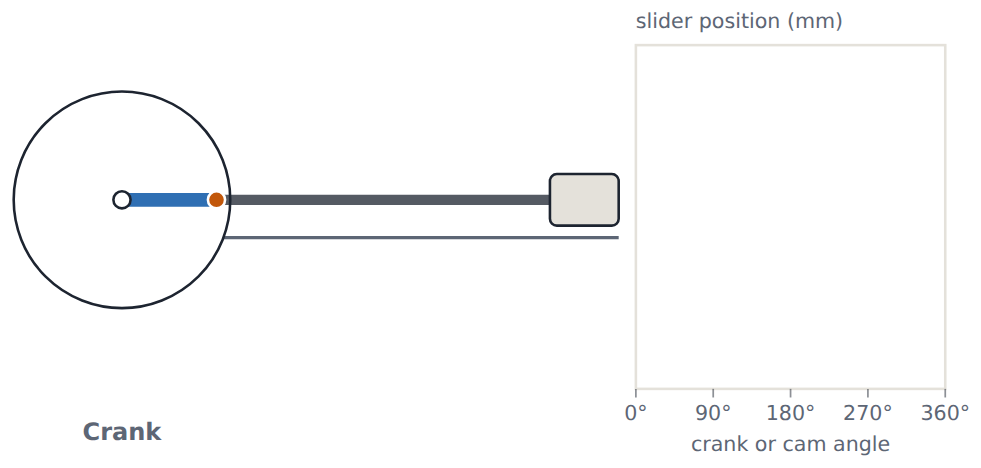
A 25 mm crank pushes the slider 50 mm out and back each turn: the stroke is twice the radius.
Round and round becomes back and forth · Sound on for the voiceover
Open the lesson →

2. Cams and followers

Try firstA snail cam has a 36 mm lift. How high is the follower at 90°, and what happens at 360°?

Check your answer

90 ÷ 360 × 36 = 9 mm; at 360° it drops suddenly back to 0.

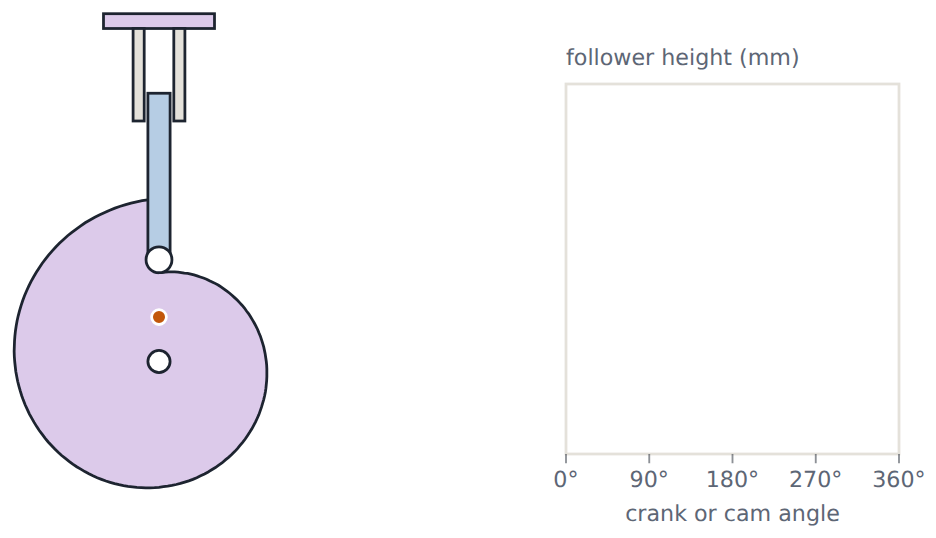
A cam is a shaped wheel; a follower rests on its edge and rises and falls as it turns. Where the edge gets farther from the axle, the follower rises; where it stays the same distance, the follower rests (a dwell).

A displacement graph shows the follower's height against how far the cam has turned. An eccentric (round, off centre) cam gives a smooth wave and lifts by twice its offset; a pear cam rests for half a turn; a snail cam rises slowly and drops suddenly; a heart cam rises and falls steadily.

A snail cam lifts the follower slowly for a whole turn, then drops it suddenly.
A shape becomes a path · Sound on for the voiceover
Open the lesson →

3. Four-bar linkages

Try firstBars 25, 75, 55 and 60 mm, with the 25 mm bar as the crank. Can the crank turn all the way? Show the sums.

Check your answer

25 + 75 = 100, 55 + 60 = 115; 100 ≤ 115 and the crank is shortest, so yes.

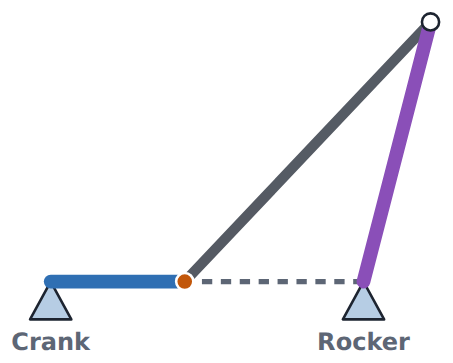
A four-bar linkage has a fixed frame, a crank that turns on one pivot, a rocker that swings on the other, and a coupler joining them. It turns rotation into rocking.

It only works if the lengths allow it. Sort the four bars; if the shortest + the longest is no more than the other two, one bar can turn all the way round, and if that is the crank, the crank turns and the rocker swings. A longer crank swings the rocker farther, until the rule fails and it jams.

Crank 30, coupler 80, rocker 60 and ground 70 mm: the crank turns all the way and the rocker swings back and forth.
Turning becomes rocking · Sound on for the voiceover
Open the lesson →