← Scarcity and opportunity cost

Scarcity and opportunity cost: recap

For after the lessons: one card per lesson, to check what you remember. Answer each question in your head or on paper first, then check it. Nothing here is marked.

Needs and wants

1. Needs, wants and why wanting keeps going

Try firstMia gets her new bike. What usually happens to her wants, and why does that matter?

Check your answer

A new want turns up, such as a helmet. Wants keep growing (economists treat them as unlimited), so more stuff alone does not end wanting.

A need is something you must have to stay safe and well. A want is something you would like but could live without.

Meeting one want tends to bring another, so wants keep growing. Economists start from the idea that wants have no limit, and the next lesson builds on it.
Open the lesson →

Scarcity

2. Scarcity - not enough for everything

Try firstThe tuckshop runs out of pies, then orders more. Is scarcity gone? Why?

Check your answer

No. The shortage is fixed, but the oven and helpers are still limited, and wants are not, so scarcity remains.

Scarcity is the gap between unlimited wants and limited resources (land, labour and capital). A shortage is a short-term run-out that more stock can fix.

Scarcity makes every community decide what to make, how to make it and for whom.

Open the lesson →

Choice and opportunity cost

3. Opportunity cost - what you give up

Try firstYou choose a film over practice and cleaning. You ranked practice second. What is your opportunity cost?

Check your answer

Practice, the next best option. Not the ticket, and not cleaning.

The opportunity cost of a choice is the next best alternative you gave up. It is one thing, not the price and not everything else.

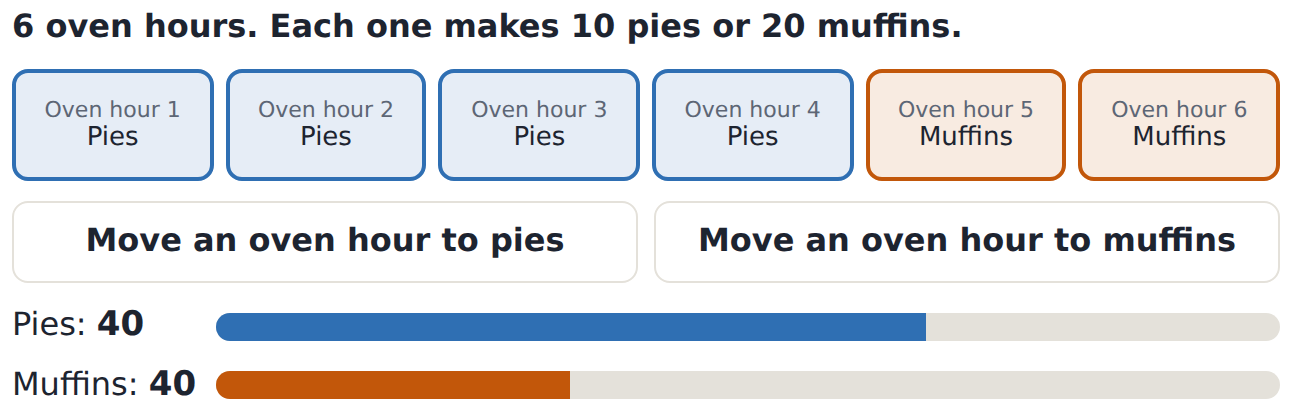
On the oven board, moving one hour to pies bakes 10 more pies and 20 fewer muffins. The 20 muffins are the opportunity cost of those pies.

Time, money and land all have opportunity costs, because each can be used only once.

Four oven hours on pies and two on muffins: 40 pies and 40 muffins. Compared with three hours each, that is 10 more pies and 20 fewer muffins.
One oven, two choices · Sound on for the voiceover
Open the lesson →

4. Putting it together - scarcity, choice and the future

Try firstA council picks a skate park over a library. In one or two sentences, use scarcity and opportunity cost to explain it.

Check your answer

There was not enough money for both (scarcity), so it chose. The opportunity cost is the library, the next best use of the money.

The chain: wants are unlimited, resources are limited, so there is scarcity; scarcity forces choices about what, how and for whom; each choice has an opportunity cost.

A good choice also asks whether it is sustainable: is enough left for the future?

Open the lesson →