← Whose view is it?

Whose view is it?: recap

For after the lessons: one card per lesson, to check what you remember. Answer each question in your head or on paper first, then check it. Nothing here is marked.

Whose view is it?

1. Whose view is it?

Try firstChoose one source and answer: who made it, what do they want, and what does it leave out?

Check your answer

For example, the Gazette editorial: the newspaper's editors, who want the market made permanent; it leaves out people who need to drive in or park nearby.

Every source about a civic issue comes from someone with a perspective. Ask: Who made it? What do they want? What did they put in, and what did they leave out?

Official and factual-looking sources have a perspective too. A source can be accurate and still lean, through the facts it chooses.
Open the lesson →

2. Why views differ

Try firstCompare two sources: one point they agree on, one they disagree on, and why.

Check your answer

For example, Ines and the Gazette both like a market; they disagree on running it as planned, because Ines needs nearby parking and the Gazette values a lively street.

To compare two sources: find where they agree, where they disagree, and explain why.

Views usually differ because of values (what people care about), interests (what they stand to gain or lose), information (what they know) or role (the job they have to do). Disagreeing doesn't mean someone is lying.

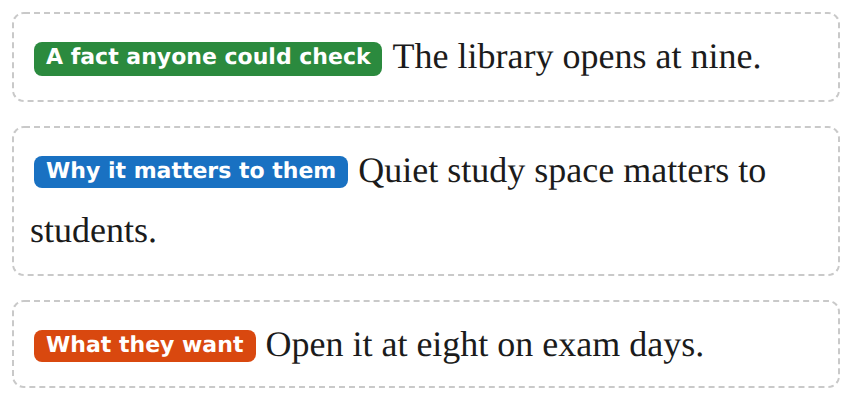
Three sentences from a made-up note about the library, labelled: a fact anyone could check, why it matters to them, and what they want.
Open the lesson →

3. Why it's hard to decide

Try firstName one challenge in the Wattle Creek decision and explain what makes it hard.

Check your answer

For example, access: a car-free street and nearby accessible parking are both good values that pull in different directions, so majority support doesn't settle it.

A civic decision is hard when values compete, interests compete or evidence is missing.

Majority support matters, but it doesn't remove the problems of people who lose out. A council can trial an idea, change it to meet a need, or find a middle way, and some people may still be unhappy.

Open the lesson →